
IGCSE · Physics · Past papers · Paper 1 (Multiple Choice)
Answer Key
Need more than one subject? All-notes pass: unlimited downloads of every note for a year: unlimited downloads of every note on the site, PKR 999 a year. All packs and courses.
Opens inside this page. Prefer your own PDF app? Open the PDF.
Check yourself
5 quick questions on IGCSE Physics
Tap an answer to see if you are right, and why. Free, no sign-up.
Start the free testNew · free
O Level Physics written answers, marked like a real examiner
Answer a Paper 2 style question by typing or speaking. You get your mark point by point, what the examiner was looking for that you missed, and a model answer. 5 free answers a day with a free account.
Try a written question👍 33 students found these notes useful
Was this note useful?
Full text of Answer Key
www.megalecture.com · www.youtube.com/@megalecture
Fahad H. Ahmad
M.Eng NUS Singapore · B.Eng NUST · 15+ years of teaching experience in Singapore, UAE & Pakistan · 60,000+ subscribers and 20 million+ video lecture views.
IGCSEPHYSICS0625·TOPICALPASTPAPERS
Sound — Paper 1
Worked Answer Key (Multiple Choice)
Free notes, practice tests and live classes Back to megalecture.com
Sound — Paper 1 · Worked Answer Key
These are Megalecture worked answers for the topical multiple-choice compilation on Sound (IGCSE
Physics 0625, Paper 1). Every answer below was solved from first principles by the Megalecture team.
Calculations use the standard sound relations — speed = distance / time, the echo rule (the sound travels to the reflector and back, so distance = ½ × speed × time), and the wave equation v = fλ. Useful reference values: the audible range for a healthy human ear is about 20 Hz to 20 000 Hz; ultrasound is any frequency above 20 000 Hz; and sound travels fastest in solids, slower in liquids, slowest in gases (and not at all in a vacuum). Use this key to mark your work and to see the one-line reasoning behind each correct letter. The questions are numbered as in the compilation; the exam reference for each is given in the second column.
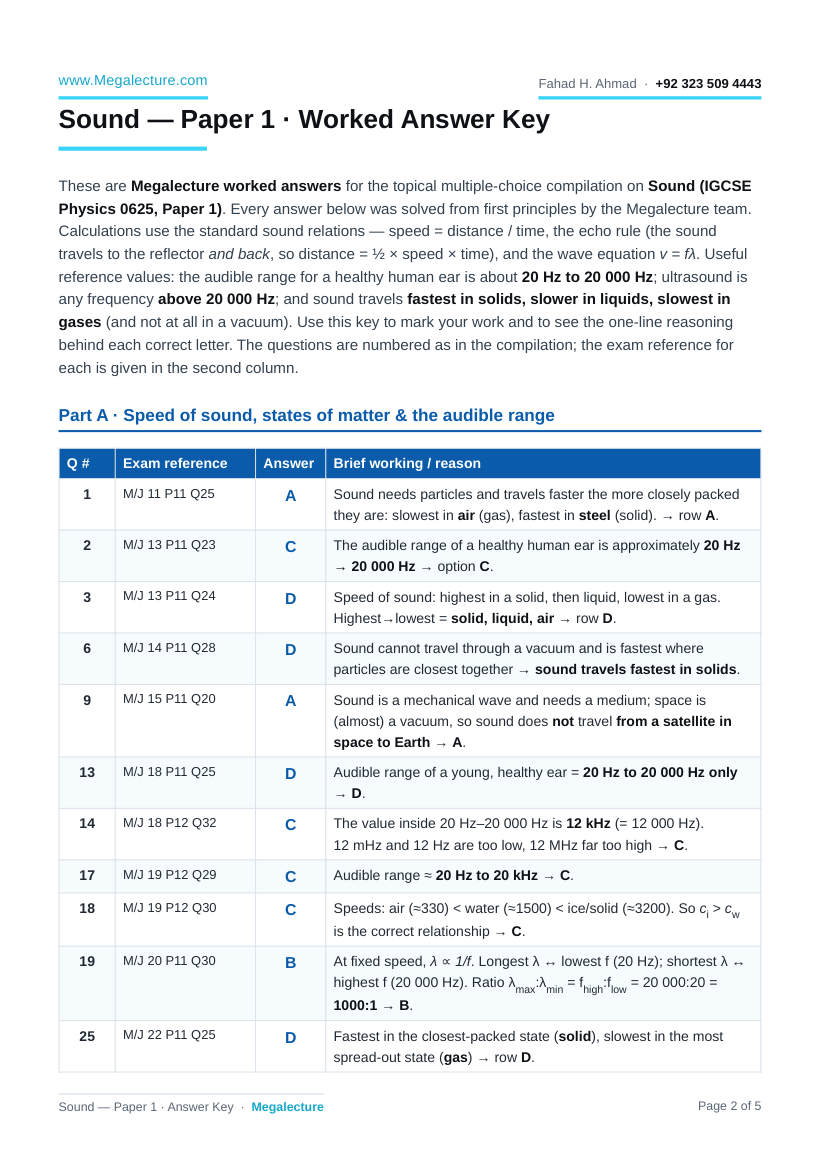
Part A · Speed of sound, states of matter & the audible range Q # Exam reference Answer Brief working / reason
M/J 11 P11 Q25
A
Sound needs particles and travels faster the more closely packed they are: slowest in air (gas), fastest in steel (solid). → row A.
M/J 13 P11 Q23
C
The audible range of a healthy human ear is approximately 20 Hz
→ 20 000 Hz → option C.
M/J 13 P11 Q24
D
Speed of sound: highest in a solid, then liquid, lowest in a gas.
Highest→lowest = solid, liquid, air → row D.
M/J 14 P11 Q28
D
Sound cannot travel through a vacuum and is fastest where particles are closest together → sound travels fastest in solids.
M/J 15 P11 Q20
A
Sound is a mechanical wave and needs a medium; space is
(almost) a vacuum, so sound does not travel from a satellite in space to Earth → A.
M/J 18 P11 Q25
D
Audible range of a young, healthy ear = 20 Hz to 20 000 Hz only
→ D.
M/J 18 P12 Q32
C
The value inside 20 Hz–20 000 Hz is 12 kHz (= 12 000 Hz).
12 mHz and 12 Hz are too low, 12 MHz far too high → C.
M/J 19 P12 Q29
C
Audible range ≈ 20 Hz to 20 kHz → C.
M/J 19 P12 Q30
C
Speeds: air (≈330) < water (≈1500) < ice/solid (≈3200). So ci > cw is the correct relationship → C.
M/J 20 P11 Q30
B
At fixed speed, λ ∝ 1/f. Longest λ ↔ lowest f (20 Hz); shortest λ ↔ highest f (20 000 Hz). Ratio λmax:λmin = fhigh:flow = 20 000:20 =
1000:1 → B.
M/J 22 P11 Q25
D
Fastest in the closest-packed state (solid), slowest in the most spread-out state (gas) → row D.
Sound — Paper 1 · Answer Key · Megalecture
Q # Exam reference Answer Brief working / reason
O/N 16 P12 Q29
A
Increasing speed (slowest→fastest) = gas (slowest), then liquid, then solid (fastest) = gas → liquid → solid → option A.
O/N 17 P11 Q24
A
Typical speeds: air ≈ 330 m/s, water ≈ 1500 m/s, steel ≈ 6000 m/s
→ row A (330, 1500, 6000).
O/N 18 P11 Q22
C
Audible range = lowest 20 Hz, highest 20 kHz (= 20 000 Hz) → row
C.
O/N 19 P11 Q29
A
Speed of sound in air ≈ 330 m/s. Convert each option: A =
3.3 × 104 cm/s = 33 000 cm/s = 330 m/s ✓. B = 33 000 m/s, C =
330 000 m/s, D = 3.3 × 10⁸ m/s — all far too fast. → A.
O/N 19 P12 Q27
D
Slowest→fastest = air (ca), liquid (cL), solid (cs) → row D (ca, cL, cs).
O/N 20 P11 Q31
C
Sound is fastest where particles are most closely bonded → in solids → C.
Part B · Pitch, loudness, waveforms & the wave equation Q # Exam reference Answer Brief working / reason
M/J 13 P11 Q25
D
Pitch depends on frequency. A higher pitch means a higher frequency → an increase in the frequency of vibration.
M/J 15 P12 Q30
B
Y has greater amplitude → louder; Y has smaller frequency than X
→ lower pitch. So Y is louder and lower pitch → B.
M/J 16 P11 Q26
B
Quieter = smaller amplitude (lower); unchanged pitch = same frequency. So amplitude lower, frequency same → row B.
M/J 19 P11 Q27
D
Louder = increasing amplitude; lower pitch = decreasing frequency
(waves spreading out, growing taller). The trace with growing height and lengthening wavelength is D.
O/N 11 P11 Q26
C
Same note (same frequency) and same loudness setting, but different waveform shapes → the difference is the quality (timbre)
→ C.
O/N 13 P11 Q23
B
A compression is a region of maximum air pressure, i.e. the peak of the pressure–time graph → point B.
O/N 15 P11 Q22
D
Same pitch (same frequency) and similar size, but different waveform shape → the sounds differ in the quality → D.
O/N 15 P12 Q25
B
Increasing amplitude only makes the sound louder; frequency
(50 Hz) is unchanged so pitch is unchanged → a louder sound of the same pitch → B.
O/N 16 P11 Q29
A
Loudness is determined by amplitude; greater amplitude → louder
→ A.
Sound — Paper 1 · Answer Key · Megalecture
Q # Exam reference Answer Brief working / reason
O/N 17 P11 Q25
D
Crossing into a new medium, the frequency is fixed by the source
(stays constant); since λ increases and v = fλ, the speed must increase → row D.
M/J 22 P11 Q20
B
On refraction the frequency is unchanged (set by the source). Only the speed and wavelength change → B.
Part C · Echoes & speed-of-sound calculations Q # Exam reference Answer Brief working / reason
M/J 14 P12 Q29
C
Echo travels 2 × 200 = 400 m. Mean time =
(1.44+1.70+1.58+1.76)/4 = 1.62 s. v = 400 / 1.62 ≈ 247 m/s → C.
M/J 17 P11 Q31
A
Depth of sea bed = ½ × 1500 × 1.0 = 750 m. Depth of whale = ½ ×
1500 × 0.60 = 450 m. Height above sea bed = 750 − 450 = 300 m
→ A.
M/J 21 P11 Q25
B
Echo path = 2d. d = ½ × v × t = ½ × 320 × 4.0 = 640 m → B.
M/J 22 P11 Q24
B
Echo from P travels 2×50 = 100 m; from Q travels 2×200 = 400 m.
Extra path = 300 m in 1.0 s → v = 300 / 1.0 = 300 m/s → B.
O/N 15 P12 Q21
A
v = fλ → λ = v / f = 1500 / 24 000 = 0.063 m → A.
O/N 15 P12 Q27
C
d = ½ × v × t = ½ × 320 × 4.0 = 640 m → C.
O/N 16 P12 Q30
B
Echo from P = 2×50 = 100 m; from Q = 2×200 = 400 m. Difference
= 300 m heard 1.0 s apart → v = 300 / 1.0 = 300 m/s → B.
O/N 18 P11 Q21
C
(speed of light)/(speed of sound) ≈ (3 × 10⁸)/(330) ≈ 9 × 10⁵ ≈ 106
→ C.
O/N 18 P12 Q27
D
Each pulse makes a round trip of 2×1200 = 2400 m. 5 pulses in
8.0 s → one round trip every 8.0/5 = 1.6 s. v = 2400 / 1.6 =
1500 m/s → D.
O/N 19 P12 Q28
D
Echo is heard halfway between bangs (bangs 1.0 s apart) → echo time = 0.50 s for a round trip of 2×80 = 160 m. v = 160 / 0.50 =
320 m/s → D.
O/N 20 P12 Q27
D
Round-trip distance = 2×6000 = 12 000 m → travel time =
12 000/1500 = 8.0 s. The next pulse is sent 2.0 s after the echo returns, so the gap between pulses = 8.0 + 2.0 = 10 s → D.
O/N 21 P11 Q25
D
Each clap echo travels 2x. Claps coincide with echoes, so the clap interval = 2x/v. N claps in time t → interval = t/N. Hence 2x/v = t/N
→ v = 2Nx/t → D.
O/N 21 P12 Q28
B
An echo is sound bouncing back off a surface → it is caused by reflection → B.
Sound — Paper 1 · Answer Key · Megalecture
Q # Exam reference Answer Brief working / reason
O/N 19 P11 Q28
C
The echo is the sound wave bouncing back from the cliff face → reflection → C.
Part D · Ultrasound Q # Exam reference Answer Brief working / reason
M/J 13 P12 Q27
D
Ultrasound is above 20 kHz. Of the options only 30 kHz exceeds
20 kHz → D.
M/J 14 P12 Q28
D
Ultrasound > 20 000 Hz. Only 35 000 Hz qualifies → D.
M/J 18 P12 Q33
A
A genuine ultrasound use is cleaning jewellery (ultrasonic cleaning). The others use light/electromagnetic waves → A.
M/J 20 P11 Q31
B
Another ultrasound use is pre-natal scanning (imaging an unborn baby) → B.
M/J 21 P12 Q29
B
P (cleaning jewellery) and R (imaging an unborn baby) are real ultrasound uses; Q (tanning) uses UV light. So P and R only → B.
M/J 22 P11 Q26
A
The valid ultrasound use listed is cleaning jewellery → A.
O/N 14 P13 Q24
C
Two traces of the same frequency and amplitude but different shape differ in timbre (quality) → C.
O/N 14 P13 Q25
C
Light reaches the campers almost instantly; the thunder arrives
5.0 s later. Distance = v × t = 340 × 5.0 = 1700 m → C.
O/N 14 P13 Q27
A
Echo path = 2d. Mean time = (0.72+0.80+0.71+0.81+0.71)/5 =
0.75 s. d = ½ × v × t = ½ × 320 × 0.75 = 120 m → A.
O/N 14 P12 Q19
B
A medical ultrasound use is pre-natal scanning → B.
O/N 15 P12 Q26
C
An ultrasound scanner builds an image from echoes — ultrasound reflected by the baby → C.
O/N 18 P11 Q23
D
Ultrasound is used for cleaning, pre-natal scanning and quality control, but not for sterilising medical equipment → D.
O/N 20 P12 Q28
B
Sound (and so ultrasound) is a longitudinal wave; ultrasound has a frequency greater than 20 kHz → row B.
O/N 21 P12 Q26
C
The scanner forms the image from ultrasound reflected by the baby (echoes from boundaries inside the body) → C.
Note from Megalecture. Several questions in this compilation repeat across exam sessions — for example the two- buildings echo (Q24 / Q40), the cliff echo (Q21 / Q37), the ultrasound prenatal-scan items and the audible-range items.
They are answered consistently above. Remember the two ideas that unlock almost every numerical part: for an echo the sound covers twice the distance to the reflector (use d = ½ × v × t), and for any wave v = fλ. These are original
Megalecture worked solutions prepared for revision use.
Sound — Paper 1 · Answer Key · Megalecture
