
IGCSE · Physics · Past papers · Paper 1 (Multiple Choice)
Answer Key
Need more than one subject? All-notes pass: unlimited downloads of every note for a year: unlimited downloads of every note on the site, PKR 999 a year. All packs and courses.
Opens inside this page. Prefer your own PDF app? Open the PDF.
Check yourself
5 quick questions on IGCSE Physics
Tap an answer to see if you are right, and why. Free, no sign-up.
Start the free testNew · free
O Level Physics written answers, marked like a real examiner
Answer a Paper 2 style question by typing or speaking. You get your mark point by point, what the examiner was looking for that you missed, and a model answer. 5 free answers a day with a free account.
Try a written question👍 33 students found these notes useful
Was this note useful?
Full text of Answer Key
www.megalecture.com · www.youtube.com/@megalecture
Fahad H. Ahmad
M.Eng NUS Singapore · B.Eng NUST · 15+ years of teaching experience in Singapore, UAE & Pakistan · 60,000+ subscribers and 20 million+ video lecture views.
IGCSEPHYSICS0625·TOPICALPASTPAPERS
Simple Magnetism & Magnetic Fields — Paper 1
Worked Answer Key (Multiple Choice)
Free notes, practice tests and live classes Back to megalecture.com
Simple Magnetism & Magnetic Fields — Paper 1 · Worked Answer Key
These are Megalecture worked answers for the topical multiple-choice compilation on Simple
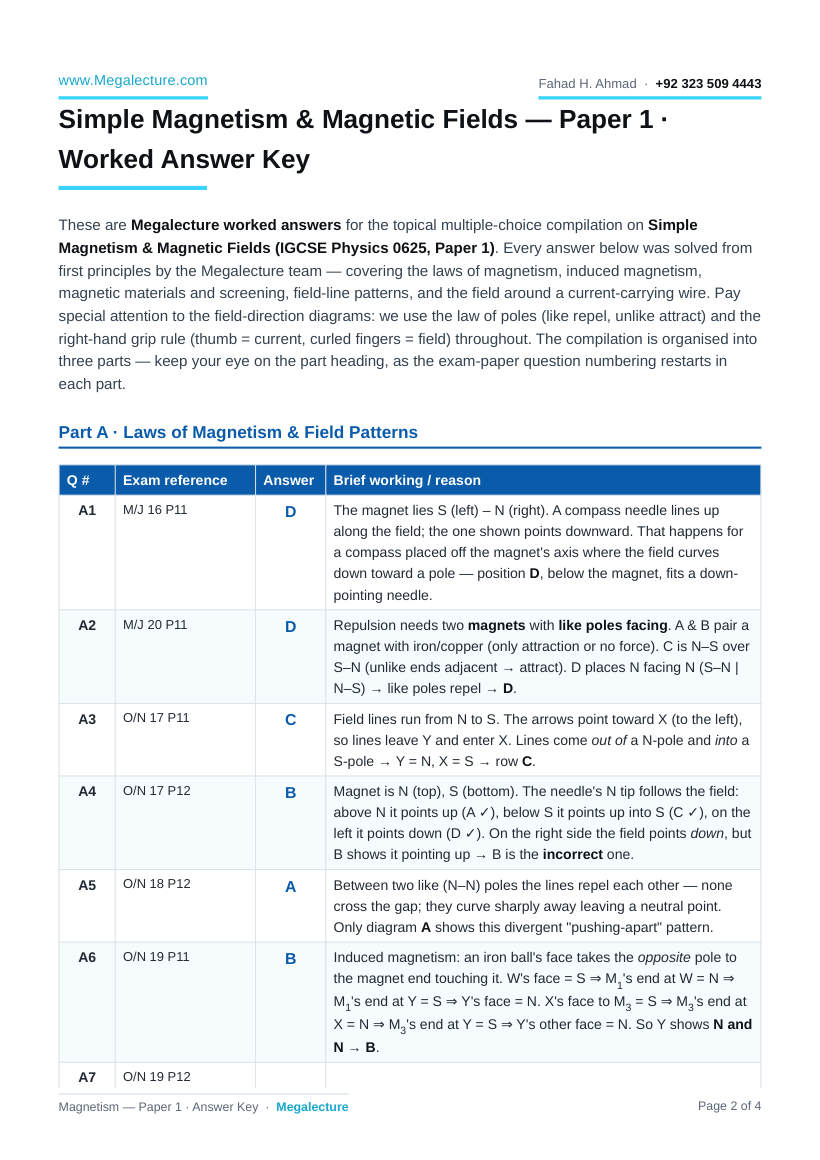
Magnetism & Magnetic Fields (IGCSE Physics 0625, Paper 1). Every answer below was solved from first principles by the Megalecture team — covering the laws of magnetism, induced magnetism, magnetic materials and screening, field-line patterns, and the field around a current-carrying wire. Pay special attention to the field-direction diagrams: we use the law of poles (like repel, unlike attract) and the right-hand grip rule (thumb = current, curled fingers = field) throughout. The compilation is organised into three parts — keep your eye on the part heading, as the exam-paper question numbering restarts in each part.
Part A · Laws of Magnetism & Field Patterns Q # Exam reference Answer Brief working / reason A1
M/J 16 P11
D
The magnet lies S (left) – N (right). A compass needle lines up along the field; the one shown points downward. That happens for a compass placed off the magnet's axis where the field curves down toward a pole — position D, below the magnet, fits a down- pointing needle.
A2
M/J 20 P11
D
Repulsion needs two magnets with like poles facing. A & B pair a magnet with iron/copper (only attraction or no force). C is N–S over
S–N (unlike ends adjacent → attract). D places N facing N (S–N |
N–S) → like poles repel → D.
A3
O/N 17 P11
C
Field lines run from N to S. The arrows point toward X (to the left), so lines leave Y and enter X. Lines come out of a N-pole and into a
S-pole → Y = N, X = S → row C.
A4
O/N 17 P12
B
Magnet is N (top), S (bottom). The needle's N tip follows the field:
above N it points up (A ✓), below S it points up into S (C ✓), on the left it points down (D ✓). On the right side the field points down, but
B shows it pointing up → B is the incorrect one.
A5
O/N 18 P12
A
Between two like (N–N) poles the lines repel each other — none cross the gap; they curve sharply away leaving a neutral point.
Only diagram A shows this divergent "pushing-apart" pattern.
A6
O/N 19 P11
B
Induced magnetism: an iron ball's face takes the opposite pole to the magnet end touching it. W's face = S ⇒ M1's end at W = N ⇒
M1's end at Y = S ⇒ Y's face = N. X's face to M3 = S ⇒ M3's end at
X = N ⇒ M3's end at Y = S ⇒ Y's other face = N. So Y shows N and
N → B.
A7
Magnetism — Paper 1 · Answer Key · Megalecture
Q # Exam reference Answer Brief working / reason B
The single field line leaves P (loops up and back), so lines come out of P → P = N. The line then runs from P toward Q and enters Q
→ lines go into Q → Q = S. Hence P = N, Q = S → row B.
Part B · Magnetic Properties of Matter Q # Exam reference Answer Brief working / reason B1
M/J 17 P11
D
A magnet attracts any magnetic material, so attraction alone is not proof. Only a magnet can repel another magnet's pole → "It repels one end of another magnet." → D.
B2
M/J 17 P11
B
Magnetic shielding needs a soft magnetic material that draws the field lines into itself and around the cavity. Of the options that is iron → B.
B3
M/J 17 P12
B
A magnet is demagnetised by placing it inside a coil carrying alternating current (the reversing field randomises the domains).
The a.c. method is option B.
B4
M/J 19 P11
B
The clips hang by induced magnetism. Soft iron loses its magnetism almost completely once the inducing magnet is removed, so the chain collapses → "soft-iron clips become demagnetised when the magnet is removed." → B.
B5
M/J 19 P12
B
Bar 1 (X) is attracted to both poles → it is unmagnetised magnetic material = iron. Bar 2 (Y) is attracted to N but repelled by S → it is itself a permanent magnet = steel. So bar 1 = iron, bar 2 = steel →
B.
B6
O/N 16 P11
D
Screening works only with a magnetic material that channels stray field lines around the instrument: soft iron, because it is a magnetic material → D.
B7
O/N 17 P11
A
A soft-iron shield does not block or absorb the field — it provides an easy path that channels the field lines around the device, so they re-emerge on the far side → A.
B8
O/N 20 P11
D
The iron wall becomes magnetised by the bar magnet sitting inside it; this is magnetic induction (induced magnetism), not any electrical effect → D.
Part C · Electromagnetism (Field of a Current) Q # Exam reference Answer Brief working / reason C1
M/J 18 P11
A
While P is connected the electromagnet holds the armature up.
Magnetism — Paper 1 · Answer Key · Megalecture
Q # Exam reference Answer Brief working / reason
falls; falling closes the separate bell circuit, so the bell rings → row
A (fail-safe alarm).
C2
M/J 18 P11
A
Field lines around a straight wire are concentric circles. Right-hand grip rule: current into the page → field is clockwise. The top arrow of diagram A points right (clockwise), so A shows the correct shape and direction.
C3
M/J 19 P11
C
The compass sits just below the "into-card" wire and just above the
"out-of-card" wire. Grip rule: below the into-card wire the field points left; above the out-of-card wire the field also points left. The two add, so the needle points left → C.
C4
M/J 20 P11
D
The magnet is clamped (fixed). The varying current in the coil makes the coil experience a varying force, so the coil moves; the cone is fixed to the coil and moves with it, pushing the air. So coil and cone vibrate → D.
C5
O/N 17 P12
A
Current is into the paper, so by the grip rule the field is clockwise.
Increasing the current strengthens the field, so the lines move closer together → "clockwise, lines move closer together" → A.
Note from Megalecture. Watch the field-direction items (C2, C3, C5 and A3/A4): always fix the current direction first, apply the right-hand grip rule, then read off the arrow. For the law-of-poles questions, remember that attraction is not proof of magnetism — only repulsion is. These are original Megalecture worked solutions prepared for revision use.
Magnetism — Paper 1 · Answer Key · Megalecture
