
IGCSE · Physics · Past papers · Paper 1 (Multiple Choice)
IGCSE Physics Light: Paper 1 MCQ Answer Key
Opens inside this page. Prefer your own PDF app? Open the PDF.
Check yourself
5 quick questions on IGCSE Physics
Tap an answer to see if you are right, and why. Free, no sign-up.
Start the free test14 of 15 students found these notes useful · 3.7 out of 5 from 3 ratings
Was this note useful?
Full text of IGCSE Physics Light: Paper 1 MCQ Answer Key
www.megalecture.com · www.youtube.com/@megalecture
Online tutoring for Cambridge IGCSE, O Level & A Level Physics
Fahad H. Ahmad
Contact: +92 323 509 4443
M.Eng NUS Singapore · B.Eng NUST · 15+ years of teaching experience in Singapore, UAE & Pakistan · 60,000+ subscribers and 20 million+ video lecture views.
www.Megalecture.com · +92 323 509 4443
IGCSEPHYSICS0625·TOPICALPASTPAPERS
Light — Paper 1
Worked Answer Key (Multiple Choice)
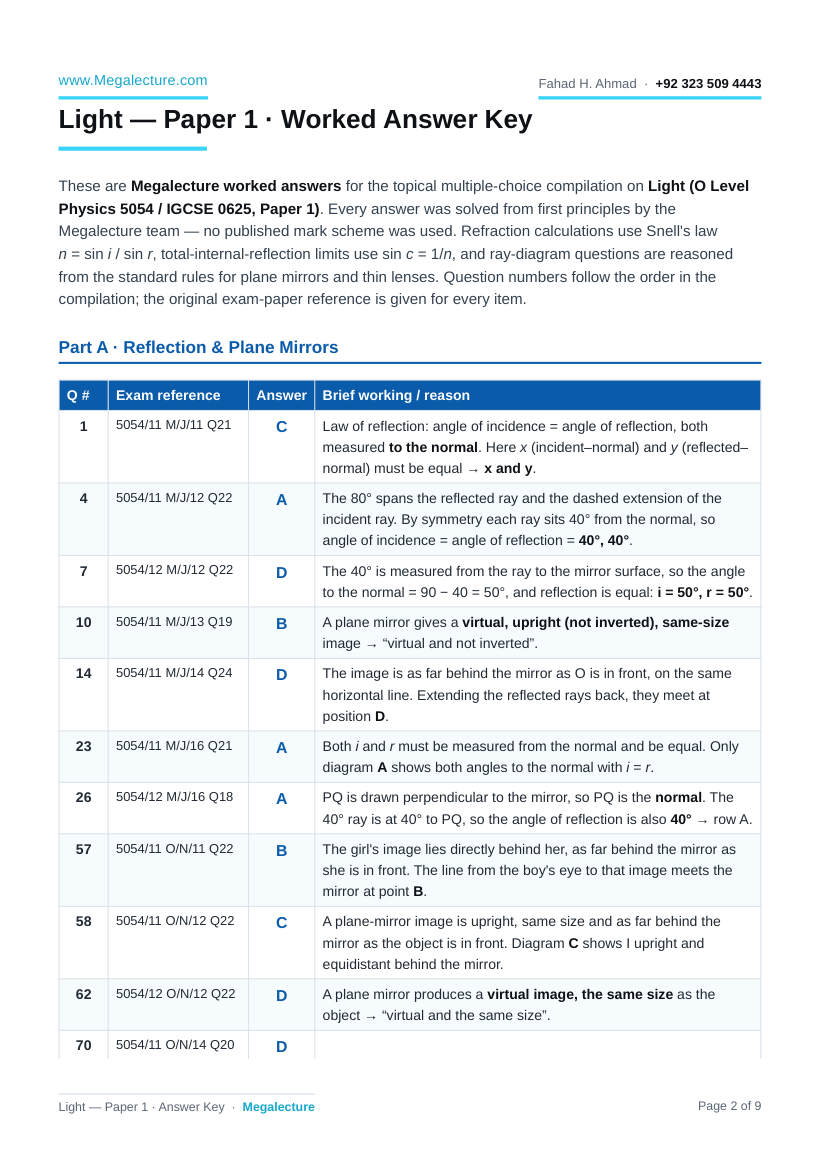
Light — Paper 1 · Worked Answer Key
These are Megalecture worked answers for the topical multiple-choice compilation on Light (O Level
Physics 5054 / IGCSE 0625, Paper 1). Every answer was solved from first principles by the
Megalecture team — no published mark scheme was used. Refraction calculations use Snell's law n = sin i / sin r, total-internal-reflection limits use sin c = 1/n, and ray-diagram questions are reasoned from the standard rules for plane mirrors and thin lenses. Question numbers follow the order in the compilation; the original exam-paper reference is given for every item.
Part A · Reflection & Plane Mirrors Q # Exam reference Answer Brief working / reason
5054/11 M/J/11 Q21
C
Law of reflection: angle of incidence = angle of reflection, both measured to the normal. Here x (incident–normal) and y (reflected– normal) must be equal → x and y.
5054/11 M/J/12 Q22
A
The 80° spans the reflected ray and the dashed extension of the incident ray. By symmetry each ray sits 40° from the normal, so angle of incidence = angle of reflection = 40°, 40°.
5054/12 M/J/12 Q22
D
The 40° is measured from the ray to the mirror surface, so the angle to the normal = 90 − 40 = 50°, and reflection is equal: i = 50°, r = 50°.
5054/11 M/J/13 Q19
B
A plane mirror gives a virtual, upright (not inverted), same-size image → “virtual and not inverted”.
5054/11 M/J/14 Q24
D
The image is as far behind the mirror as O is in front, on the same horizontal line. Extending the reflected rays back, they meet at position D.
5054/11 M/J/16 Q21
A
Both i and r must be measured from the normal and be equal. Only diagram A shows both angles to the normal with i = r.
5054/12 M/J/16 Q18
A
PQ is drawn perpendicular to the mirror, so PQ is the normal. The
40° ray is at 40° to PQ, so the angle of reflection is also 40° → row A.
5054/11 O/N/11 Q22
B
The girl's image lies directly behind her, as far behind the mirror as she is in front. The line from the boy's eye to that image meets the mirror at point B.
5054/11 O/N/12 Q22
C
A plane-mirror image is upright, same size and as far behind the mirror as the object is in front. Diagram C shows I upright and equidistant behind the mirror.
5054/12 O/N/12 Q22
D
A plane mirror produces a virtual image, the same size as the object → “virtual and the same size”.
5054/11 O/N/14 Q20
D
www.Megalecture.com Fahad H. Ahmad · +92 323 509 4443
Q # Exam reference Answer Brief working / reason
To see the shoes (height 0) the eye (150 cm) needs a ray reflecting at the mid-height of eye and shoes. The bottom of the mirror must be at half the eye height = 150/2 = 75 cm.
5054/11 O/N/16 Q23
C
Rotating the mirror by 10° turns the normal by 10° toward the fixed ray. New angle of incidence = 40 + 10 = 50°.
5054/12 O/N/17 Q20
C
Only the diagram where each ray reflects with the angle of reflection equal to the angle of incidence (both to the normal) is correct → C.
5054/12 O/N/19 Q24
D
A reflected ray from a plane mirror travels as if it came from the image behind the mirror. The ray from the object's top reflects so it appears to come from the top of I.
5054/11 O/N/20 Q27
A
The mirror is wide enough that a reflected ray from each of P, Q and
R can reach the eye, so the student sees all three images (✓✓✓).
5054/12 O/N/20 Q23
D
A plane-mirror image is virtual, upright and the same size as the object → row D.
5054/12 O/N/21 Q23
A
X is the angle between the incident ray and the normal, the angle of incidence i; by the law of reflection X = Y always → symbol i, X = Y =
A.
Part B · Refraction, Snell's Law & Total Internal Reflection Q # Exam reference Answer Brief working / reason
5054/11 M/J/11 Q22
B
In B the ray entering the glass at the flat face is drawn unbent.
Passing from air into denser glass it must bend toward the normal, so B is the path that is not correct.
5054/11 M/J/12 Q23
A
sin r = sin 40° / 1.46 = 0.643 / 1.46 = 0.440, so r = 26°.
5054/11 M/J/12 Q23
A
Identical to Q5: sin r = sin 40° / 1.46 → r = 26°.
5054/12 M/J/12 Q23
B
The critical angle is the angle inside the glass to the normal at which the ray just grazes the surface (refraction = 90°). That is angle
B.
5054/11 M/J/13 Q20
A
Taking the marked 30° as the angle of incidence: sin r = sin 30° / 1.5
= 0.500/1.5 = 0.333, so r = 19°.
5054/11 M/J/14 Q25
C
The 20° and 40° rays refract out (still below the critical angle); the
50° ray is totally internally reflected, so it exceeds it. The critical angle lies between 40° and 50° — the only listed value in that range is 45°.
5054/11 M/J/15 Q22
D
sin r = sin 45° / 1.5 = 0.707/1.5 = 0.471, r = 28°. The ray turns through x = 45 − 28 ≈ 15° (between the refracted ray and the straight-through path).
www.Megalecture.com Fahad H. Ahmad · +92 323 509 4443
Q # Exam reference Answer Brief working / reason
5054/11 M/J/15 Q24
D
At Y the angle of incidence exceeds the critical angle, so the light is totally internally reflected and stays inside the fibre → direction D.
5054/12 M/J/15 Q25
D
At exactly the critical angle the refracted ray travels along the surface (90° to the normal), with partial reflection back into the glass → diagram D.
5054/12 M/J/15 Q26
D
Same as Q17: sin r = sin 45°/1.5 → r = 28°, the ray turns through x ≈
15°.
5054/11 M/J/16 Q23
A
sin r = sin 57°/1.5 = 0.839/1.5 = 0.559, r = 34°. Critical angle: sin c =
1/1.5 = 0.667, c = 42° → row A.
5054/12 M/J/16 Q21
A
n = sin(angle in air) / sin(angle in glass), both to the normal. In air the angle is w, in glass it is y → sin w / sin y.
5054/11 M/J/17 Q27
A
Incidence exceeds the critical angle, so the ray is totally internally reflected, staying in the glass with angle of reflection = angle of incidence → arrow A.
5054/11 M/J/17 Q28
A
sin r = sin 15° / 1.5 = 0.259/1.5 = 0.173, r = 10°.
5054/11 M/J/18 Q23
C
TIR happens at a glass→air boundary and the reflected ray obeys the law of reflection: “When TIR occurs, the angle of incidence is equal to the angle of reflection” → C.
5054/11 M/J/20 Q26
A
Air→glass: sin i = n sin r with n = 1.5, so sin i against sin r is a straight line through the origin, gradient 1.5 → graph A.
5054/11 M/J/20 Q27
A
Light from the underwater lamp meets the surface from below and refracts away from the normal into the air (with partial reflection).
The valid emerging path is ray A.
5054/12 M/J/20 Q31
A
Light running along the surface means refraction at 90°, so the larger angle y (in the denser medium W) equals the critical angle. W has the greater n and y = c → A.
5054/11 M/J/21 Q21
A
Liquid→air: n sin iliq = sin rair. sin i = sin 32°/1.4 = 0.530/1.4 = 0.378, i
= 22°.
5054/11 M/J/21 Q22
B
Entering along a radius (no bend at the curved face), the ray partly reflects and partly refracts away from the normal on leaving the flat face. Diagram B shows both the weak reflection and the bent refracted ray.
5054/11 O/N/11 Q21
A
Air→glass with fixed n>1: sin i = n sin r is a straight line through the origin sloping upward (gradient>1) → graph A.
5054/11 O/N/12 Q23
D
At the critical angle the refracted ray skims along the surface (90° to the normal) with partial internal reflection → diagram D.
5054/12 O/N/12 Q23
A
www.Megalecture.com Fahad H. Ahmad · +92 323 509 4443
Q # Exam reference Answer Brief working / reason
Entering normal to the curved face the ray reaches the centre undeviated, then at the flat face partly reflects (inside) and partly refracts away from the normal into air → diagram A.
5054/11 O/N/13 Q20
D
In a fibre, light zig-zags by total internal reflection with each angle of reflection equal to the angle of incidence at the walls → diagram
D.
5054/12 O/N/13 Q23
D
At M the ray bends as it passes from glass into air at the flat face — this is refraction.
5054/12 O/N/13 Q24
A
sin r = sin 45° / 1.8 = 0.707/1.8 = 0.393, r = 23°.
5054/11 O/N/14 Q21
D
Light emerges along the surface, so the angle in the vacuum is 90° and the angle in the medium is 60°. n = sin(vacuum)/sin(medium) = sin 90° / sin 60°.
5054/12 O/N/14 Q16
C
TIR occurs at 70°, so the critical angle is less than 70°. To be denser than the surrounding liquid (1.4) the plastic's index must be greater than 1.4 → row C.
5054/11 O/N/15 Q21
D
Medium→air, i = 30°: sin r = 1.8 × sin 30° = 1.8 × 0.5 = 0.90, r = 64°.
5054/11 O/N/16 Q24
C
sin r = sin 36° / 1.5 = 0.588/1.5 = 0.392, r = 23°. Deviation d = 36 −
23 = 13° → row C.
5054/12 O/N/17 Q21
A
sin r = sin 50° / 1.5 = 0.766/1.5 = 0.511, r = 31°.
5054/12 O/N/17 Q22
C
Same as Q74: TIR at 70° means critical angle less than 70°; to be denser than the 1.4 liquid the plastic's index is greater than 1.4 → row C.
5054/12 O/N/18 Q25
D
“Incident angle greater than the critical angle” is the defining condition for total internal reflection.
5054/11 O/N/19 Q26
D
The refracted ray runs along the boundary, i.e. at 90° to the normal, so the angle of refraction is 90° (incidence equals the critical angle).
5054/11 O/N/19 Q27
A
In both prisms the light hits the sloping face at 45°, exceeding the
42° critical angle, so TIR occurs in P and in Q.
5054/12 O/N/19 Q25
C
Light passes from glass into air; angle P is between the normal and the ray in the air, where the ray has bent away from the normal — that is the angle of refraction.
5054/11 O/N/20 Q28
C
θ is below the critical angle, so the ray refracts into air, bending away from the normal: the angle of refraction is greater than θ → C.
5054/11 O/N/21 Q20
C
At surface XY the light leaves the glass into air, bending away from the normal. The angle of refraction is between the emerging ray and the normal on the air side = angle C.
www.Megalecture.com Fahad H. Ahmad · +92 323 509 4443
Part C · Lenses, Images & Optical Instruments Q # Exam reference Answer Brief working / reason
5054/11 M/J/11 Q23
D
A diverging (concave) lens always forms a virtual, upright, diminished image → “virtual and smaller than the object”.
5054/12 M/J/12 Q24
C
A short-sighted eye focuses distant light in front of the retina; the diagram showing the parallel rays meeting before the retina = C.
5054/11 M/J/13 Q21
A
The image is real and beyond 2f on the far side, so the object must be just outside the focal point on the near side (between f and 2f) → point A.
5054/12 M/J/13 Q26
B
The focal length is the lens-to-focus distance, where the ray that arrived parallel to the axis crosses it → length B.
5054/11 M/J/14 Q27
D
A short-sighted eye forms the image of a distant object in front of the retina and is corrected with a diverging lens → row D.
5054/11 M/J/15 Q23
C
A magnifying glass is a converging lens with the object inside f, giving a virtual, erect, magnified image → “virtual and erect”.
5054/12 M/J/15 Q27
C
Same as Q18 — a magnifying glass forms a virtual and erect image.
5054/11 M/J/16 Q22
B
The focal length runs from the lens to where the parallel-arriving ray crosses the principal axis = length B.
5054/12 M/J/16 Q20
B
Positions 1 and 2 narrow the spreading beam (converging); position
3 widens it (diverging) → converging, converging, diverging = B.
5054/12 M/J/17 Q28
A
A prism deviates green (higher frequency) more than yellow, both toward the base. The diagram with green below yellow on the emerging side = A.
5054/11 M/J/18 Q22
D
The plane-mirror image lies behind the mirror level with O. Extending the two reflected rays backwards, they meet at position D.
5054/11 M/J/18 Q24
B
The lens shown is diverging; a diverging lens always gives a smaller, upright image → “smaller and the same way up”.
5054/11 M/J/19 Q25
C
A diverging lens spreads the parallel beam so the rays appear to come from the focus F on the incoming side. Diagram C shows this virtual focus at F.
5054/12 M/J/19 Q27
B
Object at 2f from a converging lens gives a real, inverted, same- size image at 2f. The only correct statement: “It is inverted” → B.
5054/12 M/J/19 Q28
B
The diagram shows a virtual image (rays back-projected, object inside F). A photographic enlarger needs a real image on the paper, so this is not it because “the image is virtual” → B.
5054/11 M/J/20 Q28
D
www.Megalecture.com Fahad H. Ahmad · +92 323 509 4443
Q # Exam reference Answer Brief working / reason
A converging lens brings a parallel beam to a real focus on the far side. Only diagram D shows the rays converging to a point beyond the lens.
5054/12 M/J/20 Q33
B
A virtual, magnified image needs a converging lens with the object inside F, the rays diverging after the lens. Diagram B shows the convex lens producing this.
5054/11 M/J/21 Q23
D
The retina image is real and inverted (A wrong); long-sight images form behind the retina (B wrong); short sight does not give only virtual images (C wrong). Correct: short sight is corrected by a diverging lens → D.
5054/12 M/J/21 Q25
A
From the scale ray diagram, object = 1.5 cm and image = 3.0 cm.
Magnification = 3.0/1.5 = 2.0.
5054/12 M/J/21 Q26
B
Only the magnifying glass has the object closer to the lens than the focal length (object inside F) → B.
5054/11 M/J/22 Q21
B
The rays emerge diverging and the eye sees a virtual image by back- projection — object inside F gives a larger, upright image → “larger and upright”.
5054/11 M/J/22 Q22
C
A prism both disperses and refracts. Red has the lower frequency, so the frequency of red compared with blue is smaller → “dispersion and refraction” + “smaller” = row C.
5054/11 O/N/12 Q24
A
From the scale diagram, object = 1.5 cm and image = 3.0 cm, so magnification = 3.0/1.5 = 2.0.
5054/12 O/N/12 Q24
C
From the scale diagram, image height ÷ object height = 4 squares / 1 square = 4.0.
5054/11 O/N/14 Q22
D
O lies inside the focal point F, so the image is virtual, upright and enlarged. On the axis it appears beyond Q → to the right of Q.
5054/11 O/N/14 Q23
A
A camera uses a converging lens to form a real, inverted image on the sensor → row A.
5054/11 O/N/16 Q25
B
Object distance u = 45 cm, image distance v = 20 + 16 = 36 cm. 1/f =
1/45 + 1/36 = 0.0222 + 0.0278 = 0.0500, so f = 20 cm.
5054/11 O/N/16 Q26
D
From the scale ray diagram, image height ÷ object height = 6.0.
5054/11 O/N/17 Q21
C
Short sight is corrected with a diverging lens, thin in the middle and thick at the edges (concave) → row C.
5054/11 O/N/17 Q22
A
A real image on a screen needs the object beyond the focal length;
the image is real and inverted → “distance between object and lens is greater than the focal length” = A.
5054/12 O/N/17 Q23
B
www.Megalecture.com Fahad H. Ahmad · +92 323 509 4443
Q # Exam reference Answer Brief working / reason
X shows a virtual magnified image (object inside F) — a magnifying glass; Y shows a real enlarged image on the far side — a projector.
Row: X = magnifying glass, Y = projector = B.
5054/11 O/N/18 Q20
B
Red light is slowed less in glass than blue and is refracted less →
“slowed down less and refracted less”.
5054/12 O/N/18 Q23
A
The real image lies just beyond F on the right, so the object must be just outside F on the left (between f and 2f) → point A.
5054/12 O/N/19 Q26
C
Image = 6.0 cm and object = 3.0 cm (read from the scale diagram, f
= 4.0 cm). Magnification = 6.0/3.0 = 2.0.
5054/11 O/N/20 Q29
D
A converging lens brings the parallel beam to the focal point F on the far side; both rays cross exactly at F → diagram D.
5054/11 O/N/21 Q21
B
The two rays leave region X diverging but appear to come from a magnified image behind the object — a converging lens forming a virtual image (object inside F) → row B.
5054/11 O/N/21 Q22
A
A long-sighted girl cannot focus near objects, so she sees close objects less clearly than a person with normal vision. Long sight is corrected with a converging lens, and the near image forms behind
(not in front of) the retina → A.
5054/12 O/N/21 Q24
D
“Object beyond the focal point” with an “upside-down (inverted) image” describes a real image formed by a converging lens → D.
Part D · Colour, Dispersion & Wave Nature of Light Q # Exam reference Answer Brief working / reason
5054/12 M/J/18 Q28
D
Blue light has a higher frequency, shorter wavelength, travels slower in glass and is refracted more: “Blue light is refracted more by a glass prism than red light” → D.
5054/11 M/J/19 Q26
D
Increasing frequency = decreasing wavelength: red, orange, yellow, green, blue, violet → D.
5054/11 M/J/21 Q24
A
A prism disperses white light so violet bends most, red least, both toward the base. The diagram with red on top and violet at the bottom of the emerging spectrum = A.
5054/12 M/J/22 Q26
A
After indigo, increasing-wavelength order is blue → green → yellow
→ orange. The three immediately following indigo are blue → green
→ orange → A.
5054/11 O/N/12 Q25
C
Violet has the higher frequency; red has the longer wavelength → row C.
5054/12 O/N/12 Q25
B
www.Megalecture.com Fahad H. Ahmad · +92 323 509 4443
Q # Exam reference Answer Brief working / reason
Red light has a lower frequency and therefore a longer wavelength than blue → “Red light has a longer wavelength than blue light”.
5054/11 O/N/15 Q20
B
Same as Q65: red light has a longer wavelength than blue → B.
5054/11 O/N/16 Q27
D
Of blue and yellow, yellow has the lower frequency, and a lower frequency means a longer wavelength, so yellow has the longer wavelength too → row D (yellow, yellow).
5054/11 O/N/21 Q23
D
Higher-frequency (blue) light is deviated more by a prism, so deviation d increases with frequency. The graph rising from red to blue = D.
Note from Megalecture. A few items recur across this compilation (the magnifying-glass image question, the red/blue colour question and the 45° refraction question appear in more than one paper); they are answered consistently above.
Refraction angles are quoted to the nearest degree using n = sin i / sin r and sin c = 1/n. These are original Megalecture worked solutions prepared for revision use and were solved independently of any official mark scheme.
www.Megalecture.com Fahad H. Ahmad · +92 323 509 4443
