
IGCSE · Physics · Past papers · Paper 2 (Theory)
IGCSE Physics Sound: Paper 2 Worked Solutions

Opens inside this page. Prefer your own PDF app? Open the PDF.
Check yourself
5 quick questions on IGCSE Physics
Tap an answer to see if you are right, and why. Free, no sign-up.
Start the free test14 of 15 students found these notes useful · 3.7 out of 5 from 3 ratings
Was this note useful?
Full text of IGCSE Physics Sound: Paper 2 Worked Solutions
www.megalecture.com · www.youtube.com/@megalecture
Online tutoring for Cambridge IGCSE, O Level & A Level Physics
Fahad H. Ahmad
Contact: +92 323 509 4443
M.Eng NUS Singapore · B.Eng NUST · 15+ years of teaching experience in Singapore, UAE & Pakistan · 60,000+ subscribers and 20 million+ video lecture views.
www.Megalecture.com · +92 323 509 4443
IGCSEPHYSICS0625·TOPICALPASTPAPERS
Sound — Paper 2
Worked Solutions (Theory / Structured)
Sound — Paper 2 · Worked Solutions
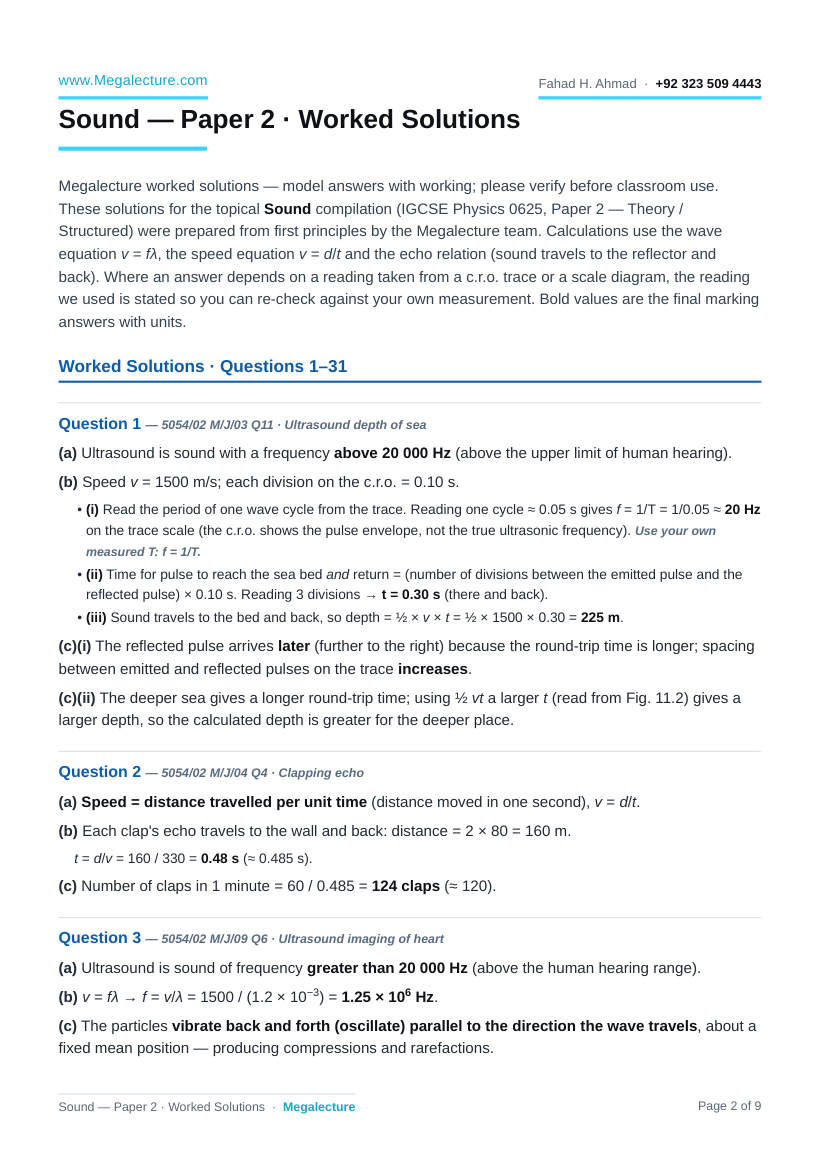
Megalecture worked solutions — model answers with working; please verify before classroom use.
These solutions for the topical Sound compilation (IGCSE Physics 0625, Paper 2 — Theory /
Structured) were prepared from first principles by the Megalecture team. Calculations use the wave equation v = fλ, the speed equation v = d/t and the echo relation (sound travels to the reflector and back). Where an answer depends on a reading taken from a c.r.o. trace or a scale diagram, the reading we used is stated so you can re-check against your own measurement. Bold values are the final marking answers with units.
Worked Solutions · Questions 1–31 Question 1 — 5054/02 M/J/03 Q11 · Ultrasound depth of sea
- Ultrasound is sound with a frequency above 20 000 Hz (above the upper limit of human hearing).
- Speed v = 1500 m/s; each division on the c.r.o. = 0.10 s.
- Read the period of one wave cycle from the trace. Reading one cycle ≈ 0.05 s gives f = 1/T = 1/0.05 ≈ 20 Hz on the trace scale (the c.r.o. shows the pulse envelope, not the true ultrasonic frequency). Use your own measured T: f = 1/T.
- Time for pulse to reach the sea bed and return = (number of divisions between the emitted pulse and the reflected pulse) × 0.10 s. Reading 3 divisions → t = 0.30 s (there and back).
(iii) Sound travels to the bed and back, so depth = ½ × v × t = ½ × 1500 × 0.30 = 225 m.
(c)(i) The reflected pulse arrives later (further to the right) because the round-trip time is longer; spacing between emitted and reflected pulses on the trace increases.
(c)(ii) The deeper sea gives a longer round-trip time; using ½ vt a larger t (read from Fig. 11.2) gives a larger depth, so the calculated depth is greater for the deeper place.
Question 2 — 5054/02 M/J/04 Q4 · Clapping echo
- Speed = distance travelled per unit time (distance moved in one second), v = d/t.
- Each clap's echo travels to the wall and back: distance = 2 × 80 = 160 m.
t = d/v = 160 / 330 = 0.48 s (≈ 0.485 s).
- Number of claps in 1 minute = 60 / 0.485 = 124 claps (≈ 120).
Question 3 — 5054/02 M/J/09 Q6 · Ultrasound imaging of heart
- Ultrasound is sound of frequency greater than 20 000 Hz (above the human hearing range).
- v = fλ → f = v/λ = 1500 / (1.2 × 10⁻³) = 1.25 × 10⁶ Hz.
- The particles vibrate back and forth (oscillate) parallel to the direction the wave travels, about a fixed mean position — producing compressions and rarefactions.
•
•
- www.Megalecture.com Fahad H. Ahmad · +92 323 509 4443
- The passing wave makes the pressure rise and fall (compression then rarefaction); higher pressure compresses the gas bubble and lower pressure lets it expand, so the bubble contracts and expands in step with the pressure changes.
Question 4 — 5054/22 M/J/10 Q10 · Speed of sound & flaw detection
- Method for the speed of sound in air (model answer):
Make the sound: bang two blocks together / fire a starting pistol / clap, a sharp loud sound.
Measure: the distance d from the source to an observer (or wall) with a tape/metre rule, and the time t with a stopwatch.
Calculate: v = d/t (for a wall echo over there-and-back distance 2d, v = 2d/t).
Precaution: use a large distance and repeat several times and average to reduce timing (reaction-time) error.
(b)(i) Ultrasound is sound with frequency above 20 000 Hz.
- The S pulses are equally spaced; spacing between successive S pulses ≈ 4 divisions = 4 × 1.0 × 10−6 s =
4.0 × 10⁻⁶ s. Number per second = 1 / (4.0 × 10⁻⁶) = 2.5 × 10⁵ pulses. Use your own reading of the S–S spacing.
(iii) 1. Energy is absorbed / not all is reflected at the back surface. 2. The wave spreads out (diverges) / energy lost on the longer path, so less reaches the detector.
- A reflection from the crack appears half-way (in time) between each S and its R, with a smaller amplitude
— drawn and labelled C.
- λ = v/f = 4000 / (8.0 × 10⁶) = 5.0 × 10⁻⁴ m = 0.50 mm.
Question 5 — 5054/21 M/J/11 Q6 · Bat ultrasound
- An echo is sound that is reflected from a surface and heard again after the original sound.
- Draw a second, smaller-amplitude burst of the same frequency (same spacing of cycles) further along the time axis (the reflected, weaker burst).
(c)(i) Audible range ≈ 20 Hz to 20 000 Hz.
(c)(ii) Ultrasound has a frequency higher than 20 000 Hz, i.e. above the top of the audible range.
Question 6 — 5054/21 M/J/12 Q6 · Organ note on c.r.o.
(a)(i) The amplitude (height) of the trace gets smaller with time, so the sound gets quieter.
(a)(ii) The spacing (period) of the cycles stays constant, so the frequency — and hence the pitch — is unchanged.
(b)(i) Frequency = the number of complete waves (oscillations) produced per second.
(b)(ii) f = 1/T = 1/0.020 = 50 Hz.
(b)(iii) Read from the trace the time for the amplitude to fall to half its start value (one cycle = 0.020 s, so count cycles). Reading ≈ 4 cycles → t ≈ 0.080 s. Use your own count from Fig. 6.1.
Question 7 — 5054/21 M/J/14 Q10 · Sound wave in air
•
•
•
•
•
•
•
•
•
•
•
•
•
•
- www.Megalecture.com Fahad H. Ahmad · +92 323 509 4443
- Wavelength = the distance between two adjacent points in phase (e.g. from one compression to the next compression).
(b)(i) Each molecule vibrates back and forth about a fixed position, parallel to the direction of travel of the wave.
(b)(ii) A is in a compression (molecules close together) while B is in a rarefaction (molecules spread out) — so at this instant they are displaced in opposite directions / are in different parts of the cycle.
- Place an electric bell (ringing) inside a glass bell-jar connected to a vacuum pump. As the air is pumped out the sound gets quieter and almost disappears, showing a medium is needed to carry sound.
(Labelled diagram: bell-jar, electric bell, leads through seal, vacuum pump.)
(d)(i) An echo is sound reflected from a surface and heard after the original sound.
(d)(ii) Wave travels to wall and back: v = 2d/t = (2 × 20)/0.12 = 333 m/s (≈ 330 m/s).
(d)(iii) f = v/λ = 333 / 0.030 = 1.1 × 10⁴ Hz (≈ 11 000 Hz).
(d)(iv) Compression to nearest rarefaction = ½λ = 30/2 = 15 mm.
Question 8 — 5054/21 M/J/17 Q10(c) · Loudspeaker sound
(c)(i) v = fλ = 2000 × 0.16 = 320 m/s.
(c)(ii) 1. Audible range ≈ 20 Hz to 20 000 Hz.
(c)(ii) 2. Smallest wavelength is at the highest frequency: λ = v/f = 320 / 20 000 = 0.016 m (1.6 cm).
(c)(iii) Aim a loudspeaker at a hard flat surface at an angle; use a microphone (or your ear) to find where the reflected sound is loudest. Show the angle of incidence = angle of reflection, both measured from the normal
— confirming the law of reflection. (Diagram: source, normal to surface, equal angles each side.)
Question 9 — 5054/22 M/J/17 Q6(b) · Sound wave properties
(b)(i) λ = v/f = 330 / 3800 = 0.087 m (8.7 cm).
(b)(ii) No — 3.8 Hz is below 20 Hz, the lowest audible frequency, so a person with normal hearing cannot hear it.
Question 10 — 5054/21 M/J/19 Q10(b) · Measuring speed of sound (pistol)
(b)(i) Needed: a stopwatch (timer) and a long measuring tape / metre rule (to measure the distance).
(b)(ii) Measure the distance between the two students with the tape. The observer starts the stopwatch when the puff of smoke is seen and stops it when the sound (bang) is heard; record this time t. Speed of sound v = distance / t. Repeat and average.
(b)(iii) 1. Speed in a liquid ≈ 1500 m/s. 2. Speed in a solid ≈ 5000 m/s (a few thousand m/s).
Question 11 — 5054/21 M/J/20 Q9 · Ultrasound prenatal scan
(a)(i) Ultrasound is sound of frequency above 20 000 Hz.
(a)(ii) At a boundary between two materials, part of the wave is reflected and part is transmitted (refracted) into the second material.
(a)(iii) Time from A (emitted) to B (return) = (0.05 − 0.02) ms = 0.03 ms = 3.0 × 10⁻⁵ s (there and back).
Distance = ½ × v × t = ½ × 1500 × 3.0 × 10−5 = 0.0225 m (2.25 cm). Read the A–B time from Fig. 9.1.
(a)(iv) Speed in gases ≈ 340 m/s; speed in solids ≈ 5000 m/s.
•
•
•
•
•
•
•
•
•
•
•
•
•
•
•
•
•
•
- www.Megalecture.com Fahad H. Ahmad · +92 323 509 4443
Question 12 — 5054/22 M/J/21 Q4 · Reflection of sound (tubes)
(a)(i) Draw tube B so that the angle it makes with the surface (with the normal) equals the angle of tube A — i.e. positioned so the angle of reflection = angle of incidence, the reflected ray reaching the ear.
(a)(ii) Sound reflects off the smooth surface obeying the law of reflection (angle of incidence = angle of reflection). The reflected sound is loudest along this direction, so B must lie along the reflected path.
- Typical speed of sound in a solid ≈ 5000 m/s (a few thousand m/s — far greater than 330 m/s in air).
Question 13 — 5054/2 O/N/02 Q11 · Two-microphone speed of sound
(a)(i) Sound spreads out from the source and reaches microphone 1 first, then microphone 2, because mic 2 is further away; the extra distance d gives the time delay t.
(a)(ii) Microphone 2 detects a quieter sound because the wave has travelled further and spread out, so its intensity (energy per unit area) is lower.
- From the table, v = gradient of the d–t graph ≈ (4.00 − 1.00)/(0.0121 − 0.0032) ≈ 340 m/s (individual points give ≈ 310–335 m/s; line of best fit ≈ 340 m/s).
(c)(i) The two traces are separated by 1 cm; with 1.0 ms/cm, t = 1.0 ms (1.0 × 10⁻³ s).
(c)(ii) d = v × t = 340 × 1.0 × 10−3 = 0.34 m (≈ 34 cm).
- (1) The distance/path inside a building is short, so the time is very small and hard to measure with a stopwatch; (2) reaction time of the person is comparable to the time interval, giving a large percentage error (also echoes off walls confuse the timing).
- The time interval t would be smaller because the speed of sound in water is much greater than in air, so the same distance d is covered more quickly.
Question 14 — 5054/02 O/N/03 Q4 · Compressions A–D
- As one complete wave passes a point, the air there goes through one compression and one rarefaction: the molecules vibrate to and fro (parallel to the wave) and the local pressure rises above then falls below normal, returning to the start after one period.
(b)(i) Frequency = the number of complete waves passing a point each second (waves per second).
(b)(ii) λ = v/f = 320 / 2000 = 0.16 m. A to D spans 3 wavelengths, so distance = 3λ = 3 × 0.16 = 0.48 m.
Question 15 — 5054/02 O/N/05 Q5(a) · Phone notes on c.r.o.
(a)(i) Continue the trace with waves of larger amplitude (louder) and shorter period / closer together
(higher pitch = higher frequency).
(a)(ii) The second trace has a greater amplitude (so the second note is louder) and the cycles are closer together / period is shorter (higher frequency, so higher pitch).
Question 16 — 5054/02 O/N/07 Q6 · Loudspeaker cone
- The cone vibrates back and forth; as it moves out it pushes the air together (compression) and as it moves back it lets the air spread out (rarefaction), so a series of compressions and rarefactions travels out through the air as a longitudinal sound wave.
(b)(i) Highest audible frequency ≈ 20 000 Hz.
•
•
•
•
•
•
•
•
•
•
•
•
- www.Megalecture.com Fahad H. Ahmad · +92 323 509 4443
(b)(ii) Longest wavelength is at the lowest frequency (20 Hz): λ = v/f = 340 / 20 = 17 m.
Question 17 — 5054/02 O/N/08 Q9 · Swimmer & loudspeaker
(a)(i) The loudspeaker cone vibrates, pushing and pulling the air to make compressions and rarefactions;
these pressure variations travel out through the air as a longitudinal wave (sound).
(a)(ii) Loud = large amplitude of the sound wave; low-pitched = low frequency (few cycles per second).
(a)(iii) t = d/v = 0.57 / 330 = 1.7 × 10⁻³ s (≈ 0.0017 s).
(a)(iv) Sound travels much faster in water than in air, so through water it takes less time to cover the same distance.
(b)(i) λ = v/f = 330 / 20 000 = 0.0165 m (1.65 cm).
(b)(ii) Diagram of a longitudinal wave: a line of dots showing regions where molecules are close together
(compressions) and spread apart (rarefactions), with the vibration direction along the direction of travel.
Question 18 — 5054/02 O/N/09 Q5 · Full-scale sound wave
(a)(i) Mark C where the lines are closest together (a compression) and R where the lines are furthest apart (a rarefaction).
(a)(ii) Measure the distance from one compression to the next on the full-scale diagram. Typical reading λ ≈
0.066 m (≈ 6.6 cm). Use your own measurement from Fig. 5.1.
(a)(iii) v = fλ = 5100 × 0.066 ≈ 340 m/s (depends on your measured λ; v should be close to 330–340 m/s).
- In a longitudinal wave the particles vibrate parallel to the direction of energy travel (compressions/ rarefactions); in a transverse wave they vibrate at right angles to the direction of travel (crests/troughs).
Question 19 — 5054/02 (c.r.o. note) · Frequency from trace
- Read the period: the trace shows 2 complete waves; reading one wave as ≈ 4 divisions, T = 4 ×
0.20 ms = 0.80 ms = 8.0 × 10⁻⁴ s. f = 1/T = 1 / (8.0 × 10⁻⁴) = 1250 Hz. Use your own count of divisions per cycle.
Question 20 — 5054/21 O/N/11 Q7 · Volume-control circuit
- Moving S towards C gives the loudspeaker a smaller share of the input voltage, so a smaller current/ voltage drives it; the cone vibrates with smaller amplitude and the sound becomes quieter (softer).
- The amplitude of the sound wave increases (it gets louder); the frequency stays the same (pitch is constant).
Question 21 — 5054/21 O/N/12 Q9(c) · Submarine ultrasound
(c)(i) Ultrasound is sound of frequency above 20 000 Hz.
(c)(ii) The vibrating source pushes the water particles to and fro; each particle passes the vibration to the next, sending compressions and rarefactions through the water (a longitudinal wave) — the particles oscillate but do not travel with the wave.
(c)(iii) 1. The speed of the ultrasound in water must also be known. 2. Distance = ½ × speed × t (half, because the pulse travels to the obstacle and back).
(c)(iv) Other use of ultrasound: medical scanning (e.g. prenatal/pre-natal imaging) — also flaw detection in metals, or cleaning.
•
•
•
•
•
•
•
•
•
•
•
•
•
•
- www.Megalecture.com Fahad H. Ahmad · +92 323 509 4443
Question 22 — 5054/21 O/N/13 Q10 · Lightning & thunder
(a)(i) Light travels far faster than sound, so the light from the lightning reaches her almost instantly while the thunder (sound) takes several seconds to travel the same distance.
(a)(ii) She measures the time t between seeing the flash and hearing the thunder with a stopwatch; knowing the distance d to the hillside, speed of sound = d/t (light's travel time is negligible).
Question 23 — 5054/22 O/N/13 Q5 · Longitudinal pressure wave
- A longitudinal wave is one in which the particles vibrate back and forth parallel to the direction in which the wave travels, producing compressions and rarefactions.
(b)(i) Highest frequency ≈ 20 000 Hz; lowest frequency ≈ 20 Hz.
(b)(ii) Shortest wavelength is at the highest frequency: λ = v/f = 330 / 20 000 = 0.0165 m (1.65 cm).
Question 24 — 5054/21 O/N/14 Q5 · Ultrasound distance meter
- Ultrasound is sound with a frequency greater than 20 000 Hz (above human hearing).
- The wave travels to the opposite wall and back, so the one-way distance = ½ × v × t = ½ × 340 ×
0.030 = 5.1 m.
Question 25 — 5054/21 O/N/15 Q7 · Compressions and rarefactions
- In a compression the particles are pushed close together (higher pressure); in a rarefaction they are spread further apart (lower pressure).
(b)(i) v = fλ, so λ = v/f.
(b)(ii) In the same medium v is fixed, and λ = v/f. Ultrasound has the higher frequency, so it has the shorter wavelength; audible sound (lower f) has the longer wavelength.
- One use: medical scanning / prenatal imaging (pulses reflect from boundaries inside the body to build an image). Also: flaw detection, depth sounding (sonar), cleaning.
Question 26 — 5054/21 O/N/16 Q5 · Loudspeaker in a bell-jar
- Frequency = the number of complete vibrations (waves) per second.
(b)(i) λ = v/f = 330 / 2200 = 0.15 m.
(b)(ii) 1. The frequency stays the same (set by the source). 2. The speed increases (sound travels faster in glass than in air).
(c)(i) 1. The loudspeaker cone vibrates back and forth, pushing the air to make compressions and rarefactions.
- Each air particle passes its vibration to the next, so the compressions/rarefactions (pressure variations) travel out through the air as a longitudinal wave.
(c)(ii) Removing the air leaves fewer (then no) particles to carry the vibrations, so less sound energy is transmitted to the jar and outside — sound cannot travel through a vacuum, so the volume heard falls.
Question 27 — 5054/21 O/N/17 Q5 · Medical ultrasound
- Ultrasound is sound of frequency above 20 000 Hz (above the upper limit of human hearing).
•
•
•
•
•
•
•
•
•
- www.Megalecture.com Fahad H. Ahmad · +92 323 509 4443
- Prenatal scanning: a transmitter sends pulses of ultrasound into the body; at each boundary between tissues part of the pulse is reflected. A detector measures the time for each reflected pulse to return;
from the times (and the speed of ultrasound in tissue) the depths of the boundaries are found and a computer builds an image of the baby.
Question 28 — 5054/22 O/N/17 Q6 · Echo from a building
- An echo is sound reflected from a surface and heard a short time after the original sound.
(b)(i) The amplitude has decreased (the echo is quieter, less energy).
(b)(ii) The frequency is unchanged (same pitch).
- λ = v/f = 330 / 3700 = 0.089 m (≈ 8.9 cm).
Question 29 — 5054/22 O/N/18 Q9 · Sound vs ultrasound
- Ultrasound has a frequency higher than 20 000 Hz, above the audible range; ordinary sound lies within 20 Hz–20 000 Hz.
(b)(ii) 1. Mark R at the centres of two regions where the lines are most spread out. 2. Draw a double-headed arrow spanning one full wavelength (compression to next compression). 3. Measure the arrow; a typical reading λ ≈ 0.060 m gives v = fλ = 25 000 × 0.060 = 1500 m/s. Use your own measured length; v should be ≈
1500 m/s for oil.
(c)(i) The speed of the sound decreases as it passes from the liquid into air (sound is slower in air than in liquid).
(c)(ii) The wave refracts at the boundary: as it slows, the compressions bend (change direction) on crossing into the air — drawn continuing into the air at a different angle (bent away from the original direction).
- Ultrasound cleaning: the object is placed in a liquid through which high-frequency ultrasound is passed; the rapid pressure variations make tiny bubbles form and collapse (and shake the dirt), dislodging dirt from the surface, including places that are hard to reach.
Question 30 — 5054/22 O/N/19 Q5 · Ultrasound jewellery cleaner
- In a longitudinal wave the particles vibrate back and forth parallel to the direction the wave travels (giving compressions and rarefactions).
(b)(i) λ = v/f = 1500 / 42 000 = 0.036 m (3.6 cm).
(b)(ii) The ultrasound makes the fluid vibrate rapidly, forming and collapsing tiny bubbles (and shaking the surface); this knocks the dirt off the jewellery, even from grooves and awkward places.
Question 31 — 5054/21 O/N/21 Q8 · Loudspeaker driven by a.c.
(b)(ii) The vibrating cone pushes the nearby air molecules together (compression), then as it moves back the molecules spread out (rarefaction). Each molecule passes the vibration to the next, so these pressure variations travel out through the air as a longitudinal sound wave.
(b)(iii) In a longitudinal wave the particles vibrate parallel to the direction of travel; in a transverse wave they vibrate at right angles to the direction of travel.
(b)(iv) From Fig. 8.2 the period is T = 0.005 s, so f = 1/T = 200 Hz. The cone reverses direction twice per cycle, so reversals per second = 2 × 200 = 400.
•
•
•
•
•
•
•
•
•
- www.Megalecture.com Fahad H. Ahmad · +92 323 509 4443
(b)(v) λ = v/f = 340 / 200 = 1.7 m.
(c)(i) A larger maximum voltage drives a larger current, so the cone vibrates with greater amplitude — the sound becomes louder.
(c)(ii) The frequency is unchanged, so there is no change in pitch.
Note from Megalecture. Several parts (Q1, Q4(b)(ii), Q6(b)(iii), Q11(a)(iii), Q18, Q19 and Q29(b)) require a value to be read from a c.r.o. trace or a full-scale diagram; the readings stated above are sensible values, but you should re-measure from your own copy and recompute — the method and the final speed/wavelength should still land within the expected range (≈ 330–340 m/s in air, ≈ 1500 m/s in water/tissue). These are original Megalecture worked solutions for revision use.
•
•
- www.Megalecture.com Fahad H. Ahmad · +92 323 509 4443
