
IGCSE · Physics · Past papers · Paper 1 (Multiple Choice)
Answer Key
Need more than one subject? All-notes pass: unlimited downloads of every note for a year: unlimited downloads of every note on the site, PKR 999 a year. All packs and courses.
Opens inside this page. Prefer your own PDF app? Open the PDF.
Check yourself
5 quick questions on IGCSE Physics
Tap an answer to see if you are right, and why. Free, no sign-up.
Start the free testNew · free
O Level Physics written answers, marked like a real examiner
Answer a Paper 2 style question by typing or speaking. You get your mark point by point, what the examiner was looking for that you missed, and a model answer. 5 free answers a day with a free account.
Try a written question👍 33 students found these notes useful
Was this note useful?
Full text of Answer Key
www.megalecture.com · www.youtube.com/@megalecture
Fahad H. Ahmad
M.Eng NUS Singapore · B.Eng NUST · 15+ years of teaching experience in Singapore, UAE & Pakistan · 60,000+ subscribers and 20 million+ video lecture views.
IGCSEPHYSICS0625·TOPICALPASTPAPERS
Electric Charge — Paper 1
Worked Answer Key (Multiple Choice)
Free notes, practice tests and live classes Back to megalecture.com
Electric Charge — Paper 1 · Worked Answer Key
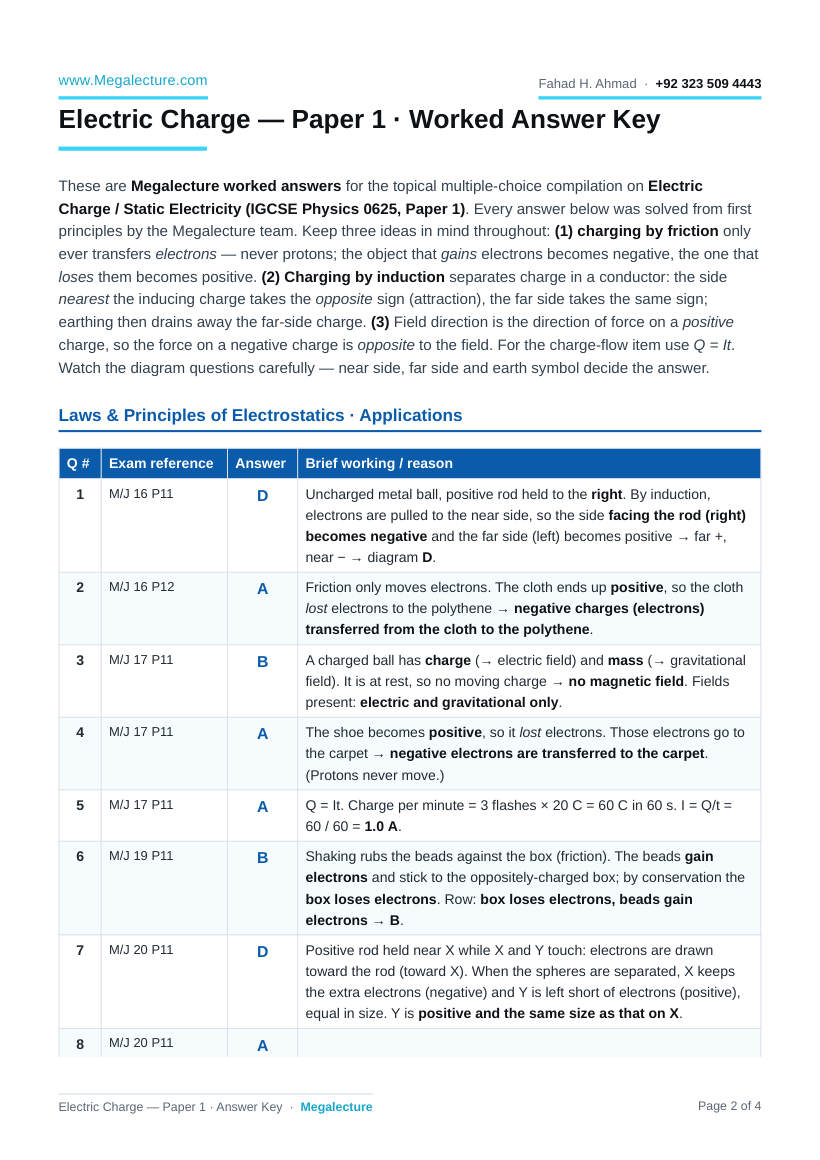
These are Megalecture worked answers for the topical multiple-choice compilation on Electric
Charge / Static Electricity (IGCSE Physics 0625, Paper 1). Every answer below was solved from first principles by the Megalecture team. Keep three ideas in mind throughout: (1) charging by friction only ever transfers electrons — never protons; the object that gains electrons becomes negative, the one that loses them becomes positive. (2) Charging by induction separates charge in a conductor: the side nearest the inducing charge takes the opposite sign (attraction), the far side takes the same sign;
earthing then drains away the far-side charge. (3) Field direction is the direction of force on a positive charge, so the force on a negative charge is opposite to the field. For the charge-flow item use Q = It.
Watch the diagram questions carefully — near side, far side and earth symbol decide the answer.
Laws & Principles of Electrostatics · Applications Q # Exam reference Answer Brief working / reason
M/J 16 P11
D
Uncharged metal ball, positive rod held to the right. By induction, electrons are pulled to the near side, so the side facing the rod (right) becomes negative and the far side (left) becomes positive → far +, near − → diagram D.
M/J 16 P12
A
Friction only moves electrons. The cloth ends up positive, so the cloth lost electrons to the polythene → negative charges (electrons) transferred from the cloth to the polythene.
M/J 17 P11
B
A charged ball has charge (→ electric field) and mass (→ gravitational field). It is at rest, so no moving charge → no magnetic field. Fields present: electric and gravitational only.
M/J 17 P11
A
The shoe becomes positive, so it lost electrons. Those electrons go to the carpet → negative electrons are transferred to the carpet.
(Protons never move.)
M/J 17 P11
A
Q = It. Charge per minute = 3 flashes × 20 C = 60 C in 60 s. I = Q/t =
60 / 60 = 1.0 A.
M/J 19 P11
B
Shaking rubs the beads against the box (friction). The beads gain electrons and stick to the oppositely-charged box; by conservation the box loses electrons. Row: box loses electrons, beads gain electrons → B.
M/J 20 P11
D
Positive rod held near X while X and Y touch: electrons are drawn toward the rod (toward X). When the spheres are separated, X keeps the extra electrons (negative) and Y is left short of electrons (positive), equal in size. Y is positive and the same size as that on X.
M/J 20 P11
A
Electric Charge — Paper 1 · Answer Key · Megalecture
Q # Exam reference Answer Brief working / reason
Field direction = direction of force on a positive charge. The force on this negative charge points right, so the field points the opposite way
→ to the left.
M/J 20 P12
B
Only electrons are free to move in a metal. The positively-charged cloud
(its base is +) pulls electrons off the earthed conductor, so the top is left positive. Only electrons move in the conductor.
O/N 16 P11
B
Positive sphere midway between an isolated rod (left) and an earthed rod (right). Isolated rod: induction gives far end +, near end − ("+ … −").
Earthed rod: the near side is induced − while the far-side + drains to earth, so it shows − on the near side only. Both features match diagram B.
O/N 17 P11
A
Rubbing makes the polythene rod negative, so it gained electrons.
Therefore electrons move from the cloth to the rod.
O/N 17 P12
B
The block becomes negative, so it gained electrons from the silk handkerchief → negative electrons flow from the handkerchief to the block. (Positive charges / protons do not flow.)
O/N 17 P12
A
A negative rod near an uncharged sphere induces charge: the side facing the rod becomes positive (attraction) and the far side becomes negative. Diagram A shows + on the near side, − on the far side.
O/N 18 P11
A
Field lines of an isolated positive point charge are straight and point radially outwards (away from the charge) → diagram A.
O/N 18 P11
D
P(+) and Q(−). At Y (on the line, midpoint) both charges drive the field the same way — from + toward − — giving a strong field pointing toward Q. At X (off-axis, farther out) the vertical components cancel and only a smaller component remains, still toward Q. So the field is weaker at X than at Y and in the same direction.
O/N 18 P11
C
Positive rod near the sphere, then sphere earthed → electrons flow up from earth and the sphere gains a net negative charge. Remove the earth, then remove the rod: the trapped electrons spread out, leaving the sphere negative all over → diagram C.
O/N 19 P11
C
The cloud base is negative; it repels electrons in the earthed mast downwards, so the top of the mast is left positive. Charge "at the top" is positive, produced by electrons moving to the bottom of the mast.
O/N 19 P11
B
Rubbing of the moving aircraft against the air transfers electrons → it charges up by friction of the aircraft with the air.
O/N 19 P12
B
Plate X is positive. As earthed plate Y is brought closer, X attracts electrons onto Y's facing surface, so electrons flow to Y from earth only. (Protons never flow.)
O/N 19 P12
C
Electric Charge — Paper 1 · Answer Key · Megalecture
Q # Exam reference Answer Brief working / reason
Copper is chosen because it is a good conductor: it has a low electrical resistance, so charge from the cloud/strike flows safely to earth.
O/N 20 P11
B
The rubbed polythene rod is charged; it induces opposite charge on the near surface of the earthed water stream, which is attracted. The water, being earthed, stays neutral overall → rod charged, water uncharged.
O/N 20 P11
B
The field points vertically up; force on a negative charge is opposite to the field → vertically downwards.
Note from Megalecture. Every diagram item was decided by tracking electrons only (protons are fixed in the nuclei) and by remembering that the near side of an induced conductor takes the opposite sign, while earthing drains the far- side charge. These are original Megalecture worked solutions prepared for revision use.
Electric Charge — Paper 1 · Answer Key · Megalecture
