
IGCSE · Physics · Past papers · Paper 1 (Multiple Choice)
Answer Key
Need more than one subject? All-notes pass: unlimited downloads of every note for a year: unlimited downloads of every note on the site, PKR 999 a year. All packs and courses.
Opens inside this page. Prefer your own PDF app? Open the PDF.
Check yourself
5 quick questions on IGCSE Physics
Tap an answer to see if you are right, and why. Free, no sign-up.
Start the free testNew · free
O Level Physics written answers, marked like a real examiner
Answer a Paper 2 style question by typing or speaking. You get your mark point by point, what the examiner was looking for that you missed, and a model answer. 5 free answers a day with a free account.
Try a written question👍 33 students found these notes useful
Was this note useful?
Full text of Answer Key
www.megalecture.com · www.youtube.com/@megalecture
Fahad H. Ahmad
M.Eng NUS Singapore · B.Eng NUST · 15+ years of teaching experience in Singapore, UAE & Pakistan · 60,000+ subscribers and 20 million+ video lecture views.
IGCSEPHYSICS0625·TOPICALPASTPAPERS
Electromagnetic Spectrum — Paper 1
Worked Answer Key (Multiple Choice)
Free notes, practice tests and live classes Back to megalecture.com
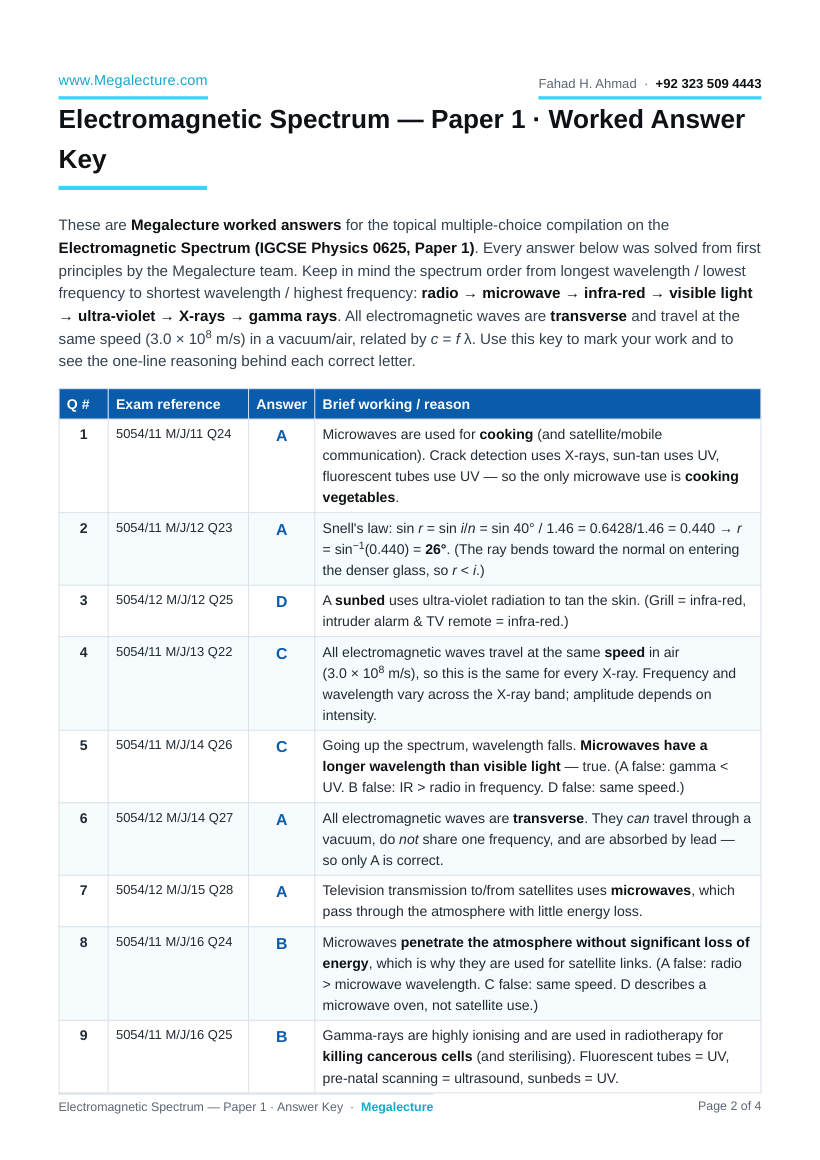
Electromagnetic Spectrum — Paper 1 · Worked Answer Key
These are Megalecture worked answers for the topical multiple-choice compilation on the
Electromagnetic Spectrum (IGCSE Physics 0625, Paper 1). Every answer below was solved from first principles by the Megalecture team. Keep in mind the spectrum order from longest wavelength / lowest frequency to shortest wavelength / highest frequency: radio → microwave → infra-red → visible light
→ ultra-violet → X-rays → gamma rays. All electromagnetic waves are transverse and travel at the same speed (3.0 × 10⁸ m/s) in a vacuum/air, related by c = f λ. Use this key to mark your work and to see the one-line reasoning behind each correct letter.
Q # Exam reference Answer Brief working / reason
5054/11 M/J/11 Q24
A
Microwaves are used for cooking (and satellite/mobile communication). Crack detection uses X-rays, sun-tan uses UV, fluorescent tubes use UV — so the only microwave use is cooking vegetables.
5054/11 M/J/12 Q23
A
Snell's law: sin r = sin i/n = sin 40° / 1.46 = 0.6428/1.46 = 0.440 → r
= sin−1(0.440) = 26°. (The ray bends toward the normal on entering the denser glass, so r < i.)
5054/12 M/J/12 Q25
D
A sunbed uses ultra-violet radiation to tan the skin. (Grill = infra-red, intruder alarm & TV remote = infra-red.)
5054/11 M/J/13 Q22
C
All electromagnetic waves travel at the same speed in air
(3.0 × 10⁸ m/s), so this is the same for every X-ray. Frequency and wavelength vary across the X-ray band; amplitude depends on intensity.
5054/11 M/J/14 Q26
C
Going up the spectrum, wavelength falls. Microwaves have a longer wavelength than visible light — true. (A false: gamma <
UV. B false: IR > radio in frequency. D false: same speed.)
5054/12 M/J/14 Q27
A
All electromagnetic waves are transverse. They can travel through a vacuum, do not share one frequency, and are absorbed by lead — so only A is correct.
5054/12 M/J/15 Q28
A
Television transmission to/from satellites uses microwaves, which pass through the atmosphere with little energy loss.
5054/11 M/J/16 Q24
B
Microwaves penetrate the atmosphere without significant loss of energy, which is why they are used for satellite links. (A false: radio
> microwave wavelength. C false: same speed. D describes a microwave oven, not satellite use.)
5054/11 M/J/16 Q25
B
Gamma-rays are highly ionising and are used in radiotherapy for killing cancerous cells (and sterilising). Fluorescent tubes = UV, pre-natal scanning = ultrasound, sunbeds = UV.
Electromagnetic Spectrum — Paper 1 · Answer Key · Megalecture
Q # Exam reference Answer Brief working / reason
5054/11 M/J/17 Q29
C
Between ultra-violet and radio, in order of increasing wavelength, the spectrum runs visible light → infra-red → microwave. The missing piece is therefore "visible light, infra-red, microwave".
5054/11 M/J/17 Q30
C
Television signals are sent to a satellite by microwaves (sound waves cannot travel through space; IR/light are not used for satellite uplinks).
5054/12 M/J/18 Q29
B
An optical fibre guides light by repeated total internal reflection along its core. (Magnifying glass, enlarger and projector use refraction.)
5054/12 M/J/18 Q30
D
Infra-red is an electromagnetic wave, so it travels at the speed of light. It is transverse (not longitudinal), non-ionising, and has a lower frequency than UV — so only D is correct.
5054/11 M/J/20 Q29
B
Red light is at the long-wavelength end of the visible band, so red light has a lower frequency than violet (c = fλ with same c). A prism deviates red less; red has the longer wavelength; speed in vacuum is the same.
5054/12 M/J/21 Q27
D
X-rays and microwaves are both electromagnetic. Sound, water waves and ultrasound are mechanical, so they are ruled out — only
D contains two genuine EM members.
5054/11 M/J/22 Q23
C
Ultrasound is a mechanical (sound) wave, not electromagnetic.
Radio waves, television signals and ultraviolet are all parts of the EM spectrum.
5054/11 O/N/11 Q20
C
In air all colours travel at the same speed, and red light has the greater (longer) wavelength than violet. Row C: same speed, greater wavelength.
5054/11 O/N/11 Q24
D
Section R has a frequency just below visible light, so R is infra-red.
An infra-red application is the television remote controller. (Killing cells/sterilisation = gamma/UV; satellite TV = microwave.)
5054/11 O/N/13 Q22
D
Detecting cracks inside metal uses X-rays, whose frequency band in the table is 1018 Hz to 1021 Hz. The matching range is 1018 Hz to
1022 Hz.
5054/11 O/N/14 Q24
D
Microwaves are used for satellite television. Crack detection = X- rays, sun-tan = UV, fluorescent tube = UV — so D is the only microwave application.
5054/11 O/N/14 Q25
D
Sound is a mechanical wave that needs a medium, so it cannot cross the vacuum of space. Infra-red, light and radio are electromagnetic and do reach the Earth.
5054/12 O/N/15 Q20
D
Electromagnetic Spectrum — Paper 1 · Answer Key · Megalecture
Q # Exam reference Answer Brief working / reason
Infra-red is electromagnetic, so it can travel in a vacuum and in gases (and in transparent solids/liquids). The statements claiming it cannot travel in a vacuum are false.
5054/11 O/N/16 Q28
B
Both gamma-rays and X-rays are ionising: they are used to kill cancerous cells and to detect cracks in metal (radiography).
Microwaves and UV cannot do both.
5054/12 O/N/16 Q25
A
All electromagnetic waves are transverse — true. Not all transverse waves travel at 3×10⁸ m/s (water waves do not);
longitudinal waves can be refracted; water waves are transverse — so only A holds.
5054/11 O/N/17 Q23
A
Ionising + frequency higher than microwaves + invisible → high- frequency EM radiation. Of the options, only gamma rays are ionising (IR, light and radio are not). Answer: gamma rays.
5054/12 O/N/17 Q24
C
A sunbed uses ultra-violet, which lies just beyond visible light on the short-wavelength side. With order radio | A | B | visible light | C | D | gamma rays, UV sits at position C (between visible light and gamma rays).
5054/12 O/N/18 Q26
C
Radio waves are used in television communications. They are electromagnetic (not sound), are not used to kill cancer cells, and have frequencies lower than visible light — so only C is correct.
5054/11 O/N/19 Q25
B
All EM waves share the same speed in air, so the speed must stay
3.0 × 10⁸ m/s. Radio waves have a lower frequency than the
3.0 × 10⁹ Hz microwaves, so 3.0 × 10⁵ Hz fits → row B.
5054/12 O/N/20 Q25
B
Correct uses: X-rays → killing cancerous cells; ultraviolet → sterilising surgical instruments; microwaves → satellite television. Only row B matches all three.
5054/11 O/N/21 Q24
B
A television remote control emits infrared rays. (Gamma, radio and
UV are not used for short-range TV remotes.)
5054/12 O/N/21 Q27
C
Time = distance / speed = 300 000 m / (3.0 × 10⁸ m/s) =
1.0 × 10⁻³ m... = 1.0 × 10⁻³ s. (Radio signals travel at the speed of light.)
Note from Megalecture. These are original Megalecture worked solutions prepared for revision use. Watch for the recurring traps in this topic: every EM wave is transverse and travels at the same speed in a vacuum/air, only the frequency and wavelength change along the spectrum, and sound/ultrasound are mechanical waves that are not part of the electromagnetic spectrum.
Electromagnetic Spectrum — Paper 1 · Answer Key · Megalecture
