
IGCSE · Physics · Past papers · Paper 1 (Multiple Choice)
Answer Key
Need more than one subject? All-notes pass: unlimited downloads of every note for a year: unlimited downloads of every note on the site, PKR 999 a year. All packs and courses.
Opens inside this page. Prefer your own PDF app? Open the PDF.
Check yourself
5 quick questions on IGCSE Physics
Tap an answer to see if you are right, and why. Free, no sign-up.
Start the free testNew · free
O Level Physics written answers, marked like a real examiner
Answer a Paper 2 style question by typing or speaking. You get your mark point by point, what the examiner was looking for that you missed, and a model answer. 5 free answers a day with a free account.
Try a written question👍 33 students found these notes useful
Was this note useful?
Full text of Answer Key
www.megalecture.com · www.youtube.com/@megalecture
Fahad H. Ahmad
M.Eng NUS Singapore · B.Eng NUST · 15+ years of teaching experience in Singapore, UAE & Pakistan · 60,000+ subscribers and 20 million+ video lecture views.
IGCSEPHYSICS0625·TOPICALPASTPAPERS
Electric Current — Paper 1
Worked Answer Key (Multiple Choice)
Free notes, practice tests and live classes Back to megalecture.com
Electric Current — Paper 1 · Worked Answer Key
These are Megalecture worked answers for the topical multiple-choice compilation on Electric
Current (IGCSE Physics 0625, Paper 1). Every answer below was solved from first principles by the
Megalecture team using the standard relations Q = It, V = IR (Ohm's law), P = VI, energy = VIt, and the resistance rule R ∝ length / area. Calculations use the data given in each question. Use this key to mark your work and to see the one-line reasoning behind each correct letter. The compilation is split into two parts — note that the exam-paper question numbering restarts in each part.
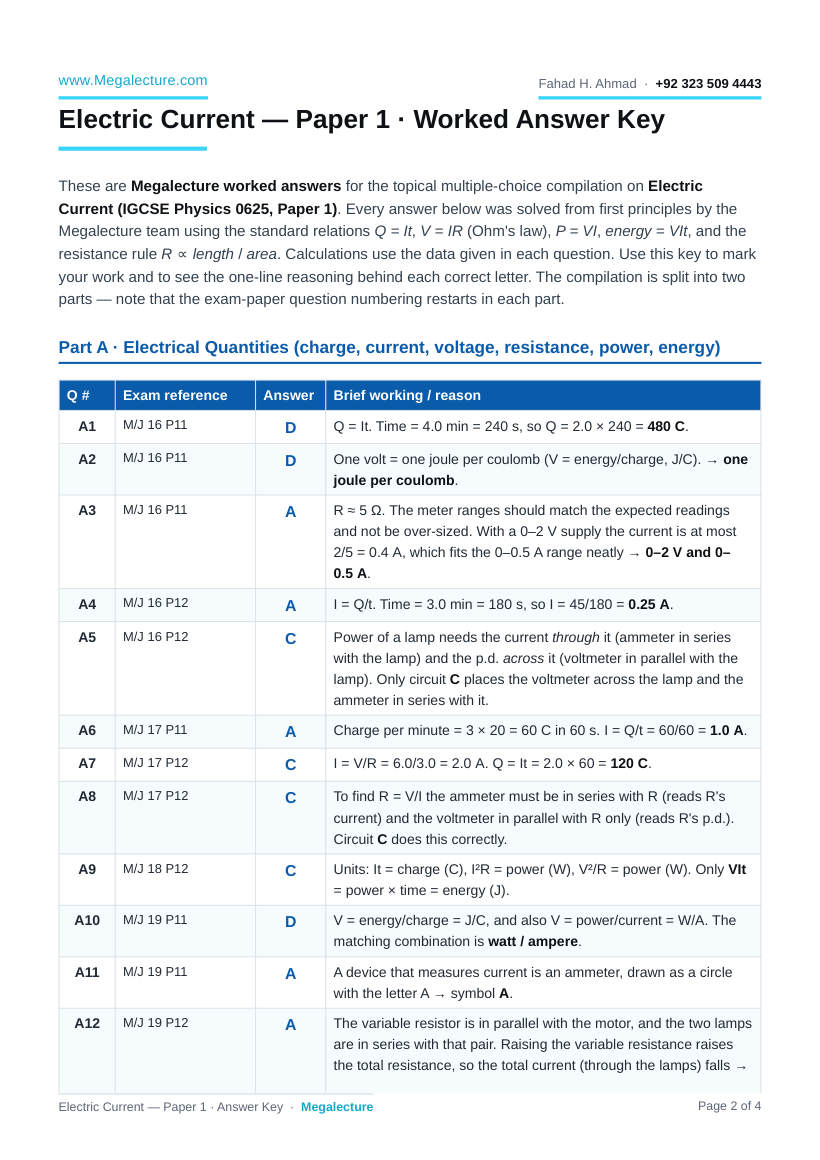
Part A · Electrical Quantities (charge, current, voltage, resistance, power, energy) Q # Exam reference Answer
Brief working / reason A1
M/J 16 P11
D
Q = It. Time = 4.0 min = 240 s, so Q = 2.0 × 240 = 480 C.
A2
M/J 16 P11
D
One volt = one joule per coulomb (V = energy/charge, J/C). → one joule per coulomb.
A3
M/J 16 P11
A
R ≈ 5 Ω. The meter ranges should match the expected readings and not be over-sized. With a 0–2 V supply the current is at most
2/5 = 0.4 A, which fits the 0–0.5 A range neatly → 0–2 V and 0–
0.5 A.
A4
M/J 16 P12
A
I = Q/t. Time = 3.0 min = 180 s, so I = 45/180 = 0.25 A.
A5
M/J 16 P12
C
Power of a lamp needs the current through it (ammeter in series with the lamp) and the p.d. across it (voltmeter in parallel with the lamp). Only circuit C places the voltmeter across the lamp and the ammeter in series with it.
A6
M/J 17 P11
A
Charge per minute = 3 × 20 = 60 C in 60 s. I = Q/t = 60/60 = 1.0 A.
A7
M/J 17 P12
C
I = V/R = 6.0/3.0 = 2.0 A. Q = It = 2.0 × 60 = 120 C.
A8
M/J 17 P12
C
To find R = V/I the ammeter must be in series with R (reads R's current) and the voltmeter in parallel with R only (reads R's p.d.).
Circuit C does this correctly.
A9
M/J 18 P12
C
Units: It = charge (C), I²R = power (W), V²/R = power (W). Only VIt
= power × time = energy (J).
A10
M/J 19 P11
D
V = energy/charge = J/C, and also V = power/current = W/A. The matching combination is watt / ampere.
A11
M/J 19 P11
A
A device that measures current is an ammeter, drawn as a circle with the letter A → symbol A.
A12
M/J 19 P12
A
The variable resistor is in parallel with the motor, and the two lamps are in series with that pair. Raising the variable resistance raises the total resistance, so the total current (through the lamps) falls → www.Megalecture.com Fahad H. Ahmad · +92 323 509 4443
Electric Current — Paper 1 · Answer Key · Megalecture
Q # Exam reference Answer Brief working / reason
lamps dimmer. More of the branch current is now forced through the motor → motor turns faster. → lamps dimmer, motor faster.
A13
M/J 19 P12
B
Take I = 2 A, V = 10 V, R = V/I = 5 Ω — these are self-consistent
(A, C and D can all be correct). But e.m.f. is measured in volts, not joules, so "the e.m.f. E is 12 J" cannot be correct → B.
A14
M/J 20 P11
A
The unit of e.m.f. is the volt = J/C. For identical cells in parallel the battery e.m.f. equals that of just one cell (only their current capacity adds, not their e.m.f.). The row giving J/C together with "the e.m.f.
of one of the cells" is A.
A15
O/N 16 P12
C
To find power of a heater: ammeter in series (to read the current) and voltmeter in parallel (to read the p.d.) → row C.
A16
O/N 17 P11
B
The voltmeter must be in parallel across the lamp and the ammeter in series with it. Circuit B has the voltmeter connected across the lamp and the ammeter in series in the loop.
A17
O/N 18 P11
D
Work done = QV = charge × e.m.f. = 2.0 × 10 = 20 J.
A18
O/N 18 P12
D
To measure resistance, connect the voltmeter in parallel and the ammeter in series with the conductor, then R = V/I → option D.
A19
O/N 18 P12
C
P = energy/time = 240/0.010 = 24 000 W. I = P/V = 24000/2000 =
12 A.
A20
O/N 19 P12
B
A = single cell, C = a.c. supply, D = battery (cells) — all are sources. B is a voltmeter, a measuring instrument, so it does not represent a power source.
A21
O/N 20 P12
C
A battery stores chemical energy, whose unit is the joule (J) → energy, J.
A22
O/N 20 P12
B
Two lamps in parallel ⇒ total current = 2 × 4.0 = 8.0 A. t = Q/I =
150 000/8.0 = 18 750 s = 18750/3600 = 5.2 hours.
Part B · Resistance and Resistivity Q # Exam reference Answer Brief working / reason B1
M/J 16 P11
B
On a V–I graph, gradient = V/I = resistance. P is the steeper line, so P has the greater resistance. Same material and length ⇒ R ∝
1/A, so the higher-resistance wire has the smaller area; the larger area belongs to Q. → greater R = P, larger area = Q → row B.
B2
M/J 18 P11
D
R ∝ length / area. Wire Y has 2× length and ½ area, so RY = R ×
(2)/(½) = 4R.
B3
M/J 19 P11
D
For a metal wire (ohmic) the V–I graph is a straight line through the origin; its gradient V/I is the resistance of the wire.
Electric Current — Paper 1 · Answer Key · Megalecture
Q # Exam reference Answer Brief working / reason B4
M/J 20 P12
C
R ∝ length / area. Second wire: 2× length, 4× area ⇒ R2 = R × (2)/
- = R/2.
B5
O/N 18 P11
A
For a fixed resistor (ohmic, constant R), I ∝ V, so the I–V graph is a straight line through the origin → graph A.
B6
O/N 18 P11
D
R = ρl/A, so R ∝ l/A. Going from (l = 0.50 m, A = 1.0×10⁻⁶ m²) to (l
= 2.0 m, A = 0.50×10⁻⁶ m²) multiplies R by (2.0/0.50) × (1.0/0.50) =
4 × 2 = 8. R = 0.75 × 8 = 6.0 Ω.
B7
O/N 19 P12
A
As the thermistor warms its resistance falls, so V = IR rises less and less steeply: the V–I curve bends over (concave down, gradient decreasing) → graph A.
Note from Megalecture. These are original Megalecture worked solutions prepared for revision use. Watch the part headings: the exam question numbers reset between "Electrical quantities" and "Resistance and resistivity". For all numerical items the working uses the figures printed in each question (with charge in coulombs, time in seconds and so on).
Electric Current — Paper 1 · Answer Key · Megalecture
