
IGCSE · Physics · Past papers · Paper 2 (Theory)
IGCSE Physics Electromagnetic Spectrum: Paper 2 Worked Solutions
Opens inside this page. Prefer your own PDF app? Open the PDF.
Full text of IGCSE Physics Electromagnetic Spectrum: Paper 2 Worked Solutions
www.megalecture.com · www.youtube.com/@megalecture
Online tutoring for Cambridge IGCSE, O Level & A Level Physics
Fahad H. Ahmad
Contact: +92 323 509 4443
M.Eng NUS Singapore · B.Eng NUST · 15+ years of teaching experience in Singapore, UAE & Pakistan · 60,000+ subscribers and 20 million+ video lecture views.
www.Megalecture.com · +92 323 509 4443
IGCSEPHYSICS0625·TOPICALPASTPAPERS
Electromagnetic Spectrum — Paper 2
Worked Solutions (Theory / Structured)
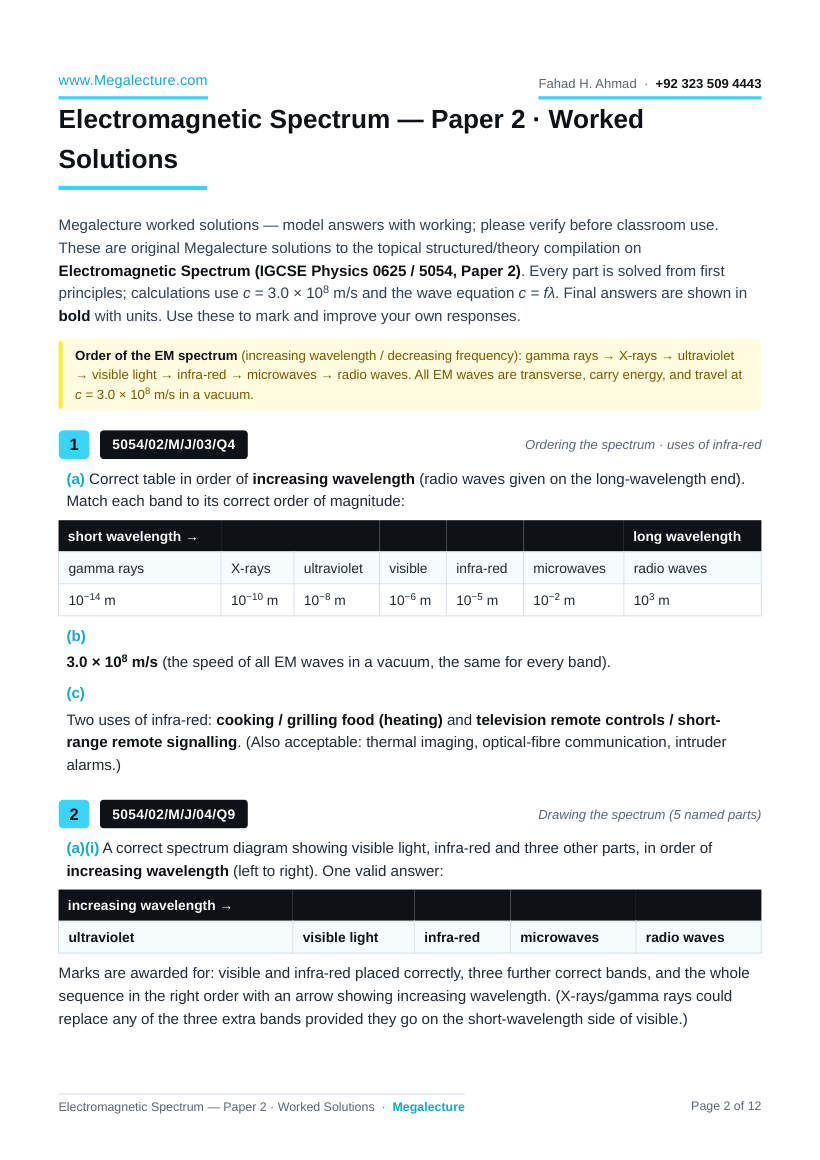
Electromagnetic Spectrum — Paper 2 · Worked Solutions
Megalecture worked solutions — model answers with working; please verify before classroom use.
These are original Megalecture solutions to the topical structured/theory compilation on
Electromagnetic Spectrum (IGCSE Physics 0625 / 5054, Paper 2). Every part is solved from first principles; calculations use c = 3.0 × 10⁸ m/s and the wave equation c = fλ. Final answers are shown in bold with units. Use these to mark and improve your own responses.
Order of the EM spectrum (increasing wavelength / decreasing frequency): gamma rays → X-rays → ultraviolet
→ visible light → infra-red → microwaves → radio waves. All EM waves are transverse, carry energy, and travel at c = 3.0 × 10⁸ m/s in a vacuum.
5054/02/M/J/03/Q4 Ordering the spectrum · uses of infra-red
- Correct table in order of increasing wavelength (radio waves given on the long-wavelength end).
Match each band to its correct order of magnitude:
short wavelength → long wavelength gamma rays X-rays ultraviolet visible infra-red microwaves radio waves
10−14 m 10−10 m 10−8 m 10−6 m 10−5 m 10−2 m 103 m
(b)
3.0 × 10⁸ m/s (the speed of all EM waves in a vacuum, the same for every band).
(c)
Two uses of infra-red: cooking / grilling food (heating) and television remote controls / short- range remote signalling. (Also acceptable: thermal imaging, optical-fibre communication, intruder alarms.)
5054/02/M/J/04/Q9 Drawing the spectrum (5 named parts)
(a)(i) A correct spectrum diagram showing visible light, infra-red and three other parts, in order of increasing wavelength (left to right). One valid answer:
increasing wavelength → ultraviolet visible light infra-red microwaves radio waves
Marks are awarded for: visible and infra-red placed correctly, three further correct bands, and the whole sequence in the right order with an arrow showing increasing wavelength. (X-rays/gamma rays could replace any of the three extra bands provided they go on the short-wavelength side of visible.) www.Megalecture.com Fahad H. Ahmad · +92 323 509 4443
5054/02/M/J/08/Q5 Emitters · detecting X-rays · imaging bones
- Main type of EM wave emitted:
Object Main type of EM wave emitted radio transmitter radio wave remote control for a television infra-red radioactive source gamma rays
(b)(i)
X-rays are detected by a photographic film / plate (or a digital / fluorescent detector screen).
(b)(ii)
X-rays pass through (are transmitted by) soft flesh / tissue but are absorbed (blocked) by the denser bone. The bone therefore leaves a shadow on the film, producing a clear image of the bone against the exposed background.
5054/21/M/J/11/Q5 Fluorescent tube · UV frequency
(a)
The coating absorbs the ultra-violet radiation and re-emits the energy as visible light
(fluorescence). This converts harmful/invisible UV into useful visible light, making the tube an efficient lamp.
(b)
A region with wavelengths shorter than UV: X-rays (or gamma rays).
- Frequency of the UV radiation (λ = 3.6 × 10⁻⁷ m):
WORKING c = fλ ⇒ f = c / λ = (3.0 × 10⁸) / (3.6 × 10⁻⁷) f = 8.3 × 10¹⁴ Hz www.Megalecture.com Fahad H. Ahmad · +92 323 509 4443
5054/21/M/J/12/Q5 Naming P and Q · properties · satellites
Order shown: gamma · P · ultraviolet · visible · Q · microwaves · radio (shortest → longest λ).
(a)(i)
P (between gamma rays and ultraviolet) = X-rays.
(a)(ii)
Q (between visible light and microwaves) = infra-red.
(b)
Two other properties of all EM waves: they are transverse waves and they travel at the same speed
(3.0 × 10⁸ m/s) in a vacuum. (Also: they transfer energy; can travel through a vacuum; obey c = fλ.)
(c)
Component used for satellite communication: microwaves.
5054/22/M/J/13/Q4 Ordering · satellite TV transmission
(a)
Increasing wavelength: gamma rays → visible light → infra-red.
(b)(i)
Microwaves are used to transmit the television signal up to the satellite.
(b)(ii)
The satellite receives the (weak) signal from the ground station, amplifies it, and re-transmits (re- broadcasts) it back down to receivers over a wide area of the Earth.
(b)(iii)
Advantage: the signal can reach receivers all over a very large region / around the curvature of the Earth, far beyond the range of a ground transmitter.
5054/22/M/J/14/Q5 Two further EM components
(a)
Two components not already listed (visible, radio, X-rays, gamma, microwaves): infra-red and ultraviolet.
www.Megalecture.com Fahad H. Ahmad · +92 323 509 4443
5054/22/M/J/16/Q6 Visible colours · components and uses
(a)(i)
Largest wavelength: red.
(a)(ii)
Highest frequency (of those shown): blue.
- Two further components (not visible, infra-red, UV or radio) with a use of each:
Component Use microwaves satellite / mobile-phone communication (or cooking food)
X-rays medical imaging of bones (or airport security scanning)
(Gamma rays — sterilising equipment or treating cancer — is an equally valid second component.)
5054/21/M/J/18/Q9 True / false statements
- Tick the correct box for each statement:
Statement True / False
Gamma rays are used to kill cancerous cells but can also cause cancer.
True
Infra-red is used in sun-beds. False (sun-beds use ultraviolet)
Radio waves have the highest frequency in the EM spectrum.
False (radio has the lowest frequency; gamma the highest)
The higher the frequency of the radiation the smaller is the wavelength in air.
True (c = fλ, so f ∝ 1/λ)
5054/22/M/J/19/Q4 Star spectrum · peak wavelength · frequency
(a)
From the graph, the brightness peaks at λ = 2.0 × 10⁻⁶ m (allow 1.8–2.0 × 10⁻⁶ m).
(b)
2.0 × 10⁻⁶ m is just longer than visible light (4–7 × 10⁻⁷ m), so the region is infra-red.
- Frequency of the peak radiation:
WORKING f = c / λ = (3.0 × 10⁸) / (2.0 × 10⁻⁶) f = 1.5 × 10¹⁴ Hz www.Megalecture.com Fahad H. Ahmad · +92 323 509 4443
5054/21/M/J/20/Q9 (part) Ultrasound in medical imaging
(a)(i)
Ultrasound is sound of frequency above 20 000 Hz (20 kHz) — above the upper limit of human hearing.
(a)(ii)
At a boundary between two different materials, some of the ultrasound is reflected (and the rest is transmitted/refracted into the second material). The reflected pulse (echo) is detected.
(a)(iii) Distance from emitter to the child. Pulse A (emitted) at 0.02 ms, pulse B (echo) at 0.05 ms:
WORKING time there-and-back Δt = (0.05 − 0.02) ms = 0.03 ms = 3.0 × 10⁻⁵ s total path = speed × time = 1500 × 3.0 × 10−5 = 0.045 m distance to child = half of this = 0.045 / 2 = 0.0225 m (2.25 cm)
(a)(iv)
Approximate speed of sound: in gases ≈ 300–340 m/s; in solids ≈ 5000–6000 m/s (a few thousand m/ s — much faster than in liquids or gases).
5054/21/M/J/20/Q9 (part) X-ray imaging · frequency · safety
(b)(i)
To form the X-ray image, X-rays pass through (are transmitted by) the soft tissue but are absorbed by the bone. Where the rays reach the detector they darken/expose it; behind the bone fewer rays arrive, leaving a lighter shadow — producing an image of the bone.
(b)(ii) Frequency of the X-rays (λ = 2.0 × 10⁻⁹ m):
WORKING f = c / λ = (3.0 × 10⁸) / (2.0 × 10⁻⁹) f = 1.5 × 10¹⁷ Hz
(b)(iii)
X-rays are ionising and can damage / harm the developing cells of the unborn child (risk of cancer or mutation), so ultrasound is used instead.
www.Megalecture.com Fahad H. Ahmad · +92 323 509 4443
5054/22/M/J/20/Q5 Matching components to uses
- One line from each component to a suitable alternative use:
Component Suitable use microwaves satellite television (communication) ultraviolet sunbeds (also valid: detecting forged notes / sterilisation)
(“television controller” uses infra-red and “airport security check of cases” uses X-rays, so neither is the correct match for microwaves or ultraviolet.)
5054/21/M/J/21/Q4 (part) Correcting wave statements
- Suitable correction for each ringed mistake:
Sentence (mistake ringed) Correction
Sound travels at 3.0 × 10⁸ m/s in air. 330 (about 330–340 m/s)
Sound with a higher pitch has a larger amplitude. frequency (higher pitch = higher frequency)
X-rays are used for pre-natal scanning. ultrasound
In the EM spectrum, microwaves have the highest frequency. gamma rays
5054/22/M/J/22/Q8 (part) Satellite internet · microwaves vs infra-red
Setup: station A communicates with station B via a satellite 3.0 × 10⁴ km above the Earth, using microwaves (speed 3.0 × 10⁸ m/s); B then joins the internet by optical fibre.
(d)(i) Time for data to travel from A to B (up to the satellite and back down):
WORKING total path = 2 × 3.0 × 104 km = 6.0 × 10⁴ km = 6.0 × 10⁷ m time = distance / speed = (6.0 × 10⁷) / (3.0 × 10⁸) time = 0.20 s
(d)(ii)
One shared property of infra-red and microwaves: both are electromagnetic / transverse waves and travel at 3.0 × 10⁸ m/s in a vacuum (both carry energy; both obey c = fλ).
(d)(iii)
An advantage of optical fibre over microwave links: it carries much more data / a higher rate of information, with little signal loss and no interference, and it is secure.
www.Megalecture.com Fahad H. Ahmad · +92 323 509 4443
5054/2/O/N/02/Q3 Microwaves · frequency · repeater stations
(a)(i)
EM waves with wavelengths longer than microwaves: radio waves.
(a)(ii)
All EM waves travel at the same speed, and c = fλ. So a longer wavelength must have a lower frequency (frequency is inversely proportional to wavelength).
(b)(i)
Aerials are placed on tall towers because microwaves travel in straight lines (line of sight); height gives a clear path over hills/buildings and around the Earth's curvature.
(b)(ii)
Repeater/booster stations are needed because the signal weakens (attenuates) with distance; each station receives, amplifies and re-transmits it so it can travel on to the receiver.
5054/02/O/N/05/Q4 Ordering · UV use · common properties
- In order of increasing wavelength:
shortest λ → longest λ
X-rays ultra-violet infra-red microwaves
(b)
One use of ultra-violet radiation: sterilising / killing bacteria (also: sunbeds, detecting forged banknotes / security marks).
(c)
Two common properties: all are transverse EM waves that travel at 3.0 × 10⁸ m/s in a vacuum (also:
all transfer energy; all can travel through a vacuum; all obey c = fλ).
5054/02/O/N/06/Q11 Space telescope · microwave travel time
(a)(i) Time for the microwave signal to travel 600 km from the telescope to Earth (speed 300 000 km/s =
3.0 × 10⁸ m/s):
WORKING distance = 600 km = 6.0 × 10⁵ m time = distance / speed = (6.0 × 10⁵) / (3.0 × 10⁸) time = 2.0 × 10⁻³ s (2.0 ms)
(a)(ii)
Two similarities: both are EM/transverse waves; both travel at 3.0 × 10⁸ m/s in a vacuum (and both transfer energy / obey c = fλ). One difference: infra-red has a shorter wavelength (and higher frequency) than microwaves.
www.Megalecture.com Fahad H. Ahmad · +92 323 509 4443
5054/21/O/N/10/Q4 Satellite TV · distance from time delay
(a)(i)
EM waves are used because they can travel through the vacuum of space (no medium needed) and at very high speed, unlike sound. The signal can also be transmitted without wires over long distances.
(a)(ii)
Region used to transmit the TV signal to the satellite: microwaves.
(a)(iii)
Satellites allow the signal to reach receivers over a very wide area / beyond the horizon that a ground transmitter cannot reach directly.
- Distance travelled by the satellite signal in the extra 0.24 s:
WORKING distance = speed × time = (3.0 × 108) × 0.24 distance = 7.2 × 10⁷ m (72 000 km)
5054/22/O/N/10/Q9 (part) Violet light frequency · medical use · risk
(b)(i) Frequency of violet light (λ = 4.0 × 10⁻⁷ m), using c = 3.0 × 10⁸ m/s:
WORKING f = c / λ = (3.0 × 10⁸) / (4.0 × 10⁻⁷) f = 7.5 × 10¹⁴ Hz
(b)(ii)
Two components with wavelengths shorter than violet light: ultraviolet and X-rays (gamma rays also acceptable).
(b)(iii) 1.
Medical application (e.g. X-rays): used to image bones / detect fractures, because X-rays pass through soft tissue but are absorbed by bone, forming a shadow image on a detector. (UV: sterilising instruments; gamma: treating cancer / sterilising.)
(b)(iii) 2.
Health risk of that component: it is ionising and can damage living cells / cause cancer (UV also causes skin burns and eye damage).
www.Megalecture.com Fahad H. Ahmad · +92 323 509 4443
5054/22/O/N/11/Q4 Microwave: speed, wavelength, satellite TV
(a)
Speed of microwaves in air: 3.0 × 10⁸ m/s.
- Wavelength: the 40 cm from A to B contains 3 complete waves:
WORKING
λ = total distance / number of waves = 40 / 3
λ = 13.3 cm (0.133 m)
(c)
Microwaves carry the TV signal from a ground station up to a satellite, which amplifies and re- transmits them; the satellite beams the microwaves back down so receivers over a wide area pick up the signal.
(d)
Two common properties: transverse EM waves and travel at 3.0 × 10⁸ m/s in a vacuum (also transfer energy; obey c = fλ).
5054/21/O/N/12/Q4 Spotting errors · X-rays in engineering
- Three errors in the pupil's notes:
“ultra-sound” should be “ultraviolet” — ultrasound is not part of the EM spectrum.
X-rays and gamma rays are in the wrong order — gamma rays have the shortest wavelength, so the order should be gamma rays, X-rays, ultraviolet… (the diagram should start gamma then X-rays).
infra-red and microwaves are in the wrong order — for increasing wavelength infra-red comes before microwaves; the notes place infra-red after microwaves.
(So the correct increasing-wavelength order is: gamma rays, X-rays, ultraviolet, visible, infra-red, microwaves, radio waves — and the pupil also omits visible light.)
(b)
Application of X-rays in engineering: checking metal welds / castings for hidden cracks or flaws
(radiography). X-rays pass through sound metal but are absorbed differently where there is a crack or void, revealing the defect on a detector.
1.
2.
3.
www.Megalecture.com Fahad H. Ahmad · +92 323 509 4443
5054/22/O/N/16/Q10 (part) Detecting infra-red · intruder alarms
(c)(iii) 2.
A blackened bulb makes a good detector because a black (matt) surface is an excellent absorber of infra-red radiation. It absorbs the IR efficiently, so its temperature rises more, giving a larger, faster thermometer reading.
(d)
In an intruder alarm, an infra-red sensor detects the heat (infra-red radiation) emitted by a warm body. When a person enters the area, the sudden change in infra-red received triggers the alarm circuit.
5054/21/O/N/17/Q10 Naming regions · IR remote frequency
- Naming P, Q, R (order: P, X-rays, Q, visible/infra-red, R, radio):
- P (before X-rays, shortest λ) = gamma rays
- Q (between X-rays and visible light) = ultraviolet
(iii) R (between infra-red and radio waves) = microwaves
(b)
Components with frequency greater than visible light are those with shorter wavelength: tick P (gamma rays), X-rays and Q (ultraviolet).
(c)(i) Frequency of the IR remote signal (λ = 9.4 × 10⁻⁷ m):
WORKING f = c / λ = (3.0 × 10⁸) / (9.4 × 10⁻⁷) f = 3.2 × 10¹⁴ Hz
(c)(ii)
The remote contains an infra-red LED that sends out coded pulses of infra-red radiation; a sensor in the television detects these pulses and the coded signal tells the TV which command to carry out.
•
•
- www.Megalecture.com Fahad H. Ahmad · +92 323 509 4443
5054/21/O/N/19/Q4 Naming regions · X-ray imaging of bone
- Components either side of the central visible band (gamma, X-rays, A, visible, B, C, radio):
A (between X-rays and visible) = ultraviolet
B (just longer than visible) = infra-red
C (between infra-red and radio waves) = microwaves
(b)
Greatest frequency & smallest wavelength: gamma rays (both apply to the same end of the spectrum).
(c)
X-rays are directed through the leg onto a detector / photographic film. They pass through the soft tissue but are absorbed by the denser bone, so fewer rays reach the detector behind the bone.
This leaves a shadow that shows the bone (and any break) on the image.
5054/21/O/N/21/Q3 The Sun · thermal radiation · travel time
(a)
Reaction at the Sun's centre: nuclear fusion.
(b)(i)
The radiation from the Sun's surface is electromagnetic radiation (mainly visible light and infra-red, with some ultraviolet) — a continuous range of EM waves that can travel through the vacuum of space.
(b)(ii)
Speed of this radiation in a vacuum: 3.0 × 10⁸ m/s.
(b)(iii) Time for the radiation to travel 1.5 × 10¹¹ m to Earth:
WORKING time = distance / speed = (1.5 × 10¹¹) / (3.0 × 10⁸) time = 500 s (about 8.3 minutes)
(c)
White clothes are an advantage on sunny days because a white (light, shiny) surface is a poor absorber and good reflector of the Sun's radiation. It reflects most of the incoming infra-red/light, so the wearer absorbs less heat and stays cooler.
Note from Megalecture. These are original Megalecture worked solutions prepared for revision use. All frequency/time calculations use c = fλ with c = 3.0 × 10⁸ m/s. Several questions are drawn from longer past-paper questions; only the parts dealing with the electromagnetic spectrum are shown. Please verify against the official syllabus before classroom use.
•
•
- www.Megalecture.com Fahad H. Ahmad · +92 323 509 4443
