
IGCSE · Physics · Past papers · Paper 2 (Theory)
Worked Solutions (Part 2)
Need more than one subject? All-notes pass: unlimited downloads of every note for a year: unlimited downloads of every note on the site, PKR 999 a year. All packs and courses.
Opens inside this page. Prefer your own PDF app? Open the PDF.
Check yourself
5 quick questions on IGCSE Physics
Tap an answer to see if you are right, and why. Free, no sign-up.
Start the free testNew · free
O Level Physics written answers, marked like a real examiner
Answer a Paper 2 style question by typing or speaking. You get your mark point by point, what the examiner was looking for that you missed, and a model answer. 5 free answers a day with a free account.
Try a written question👍 33 students found these notes useful
Was this note useful?
Full text of Worked Solutions (Part 2)
www.megalecture.com · www.youtube.com/@megalecture
Fahad H. Ahmad
M.Eng NUS Singapore · B.Eng NUST · 15+ years of teaching experience in Singapore, UAE & Pakistan · 60,000+ subscribers and 20 million+ video lecture views.
IGCSEPHYSICS0625·TOPICALPASTPAPERS
Light — Paper 2
Worked Solutions (Theory / Structured) — Part 2 of 2
Free notes, practice tests and live classes Back to megalecture.com
O/N 02 Q2
O/N 03 Q3
O/N 04 Q4
Light — Paper 2 · Worked Solutions (Part 2 of 2)
Megalecture worked solutions — model answers with working; please verify before classroom use. (Part
2 of 2.) Questions are numbered by their position in the topical compilation; the exam reference is shown beside each. All angles measured from the normal unless stated; speed of light in air/vacuum taken as c
= 3.0 × 10⁸ m/s.
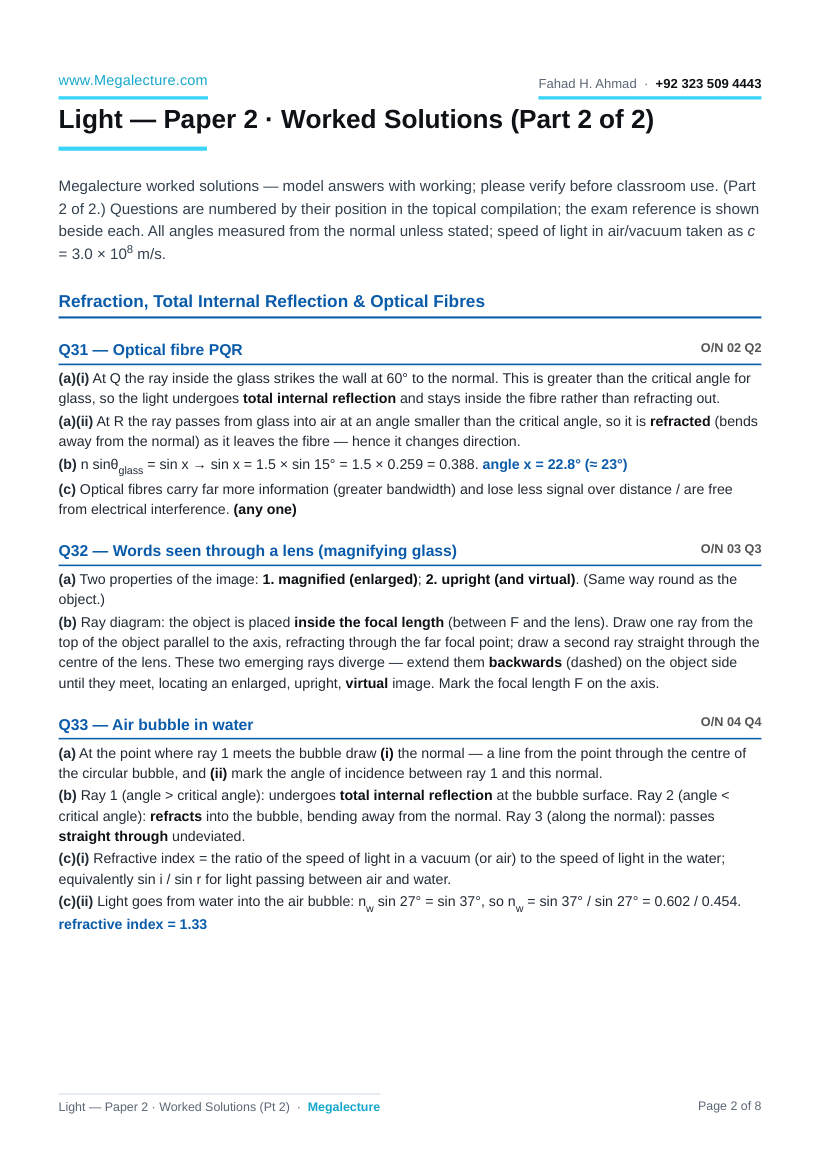
Refraction, Total Internal Reflection & Optical Fibres Q31 — Optical fibre PQR
(a)(i) At Q the ray inside the glass strikes the wall at 60° to the normal. This is greater than the critical angle for glass, so the light undergoes total internal reflection and stays inside the fibre rather than refracting out.
(a)(ii) At R the ray passes from glass into air at an angle smaller than the critical angle, so it is refracted (bends away from the normal) as it leaves the fibre — hence it changes direction.
- n sinθglass = sin x → sin x = 1.5 × sin 15° = 1.5 × 0.259 = 0.388. angle x = 22.8° (≈ 23°)
- Optical fibres carry far more information (greater bandwidth) and lose less signal over distance / are free from electrical interference. (any one)
Q32 — Words seen through a lens (magnifying glass)
- Two properties of the image: 1. magnified (enlarged); 2. upright (and virtual). (Same way round as the object.)
- Ray diagram: the object is placed inside the focal length (between F and the lens). Draw one ray from the top of the object parallel to the axis, refracting through the far focal point; draw a second ray straight through the centre of the lens. These two emerging rays diverge — extend them backwards (dashed) on the object side until they meet, locating an enlarged, upright, virtual image. Mark the focal length F on the axis.
Q33 — Air bubble in water
- At the point where ray 1 meets the bubble draw (i) the normal — a line from the point through the centre of the circular bubble, and (ii) mark the angle of incidence between ray 1 and this normal.
- Ray 1 (angle > critical angle): undergoes total internal reflection at the bubble surface. Ray 2 (angle < critical angle): refracts into the bubble, bending away from the normal. Ray 3 (along the normal): passes straight through undeviated.
(c)(i) Refractive index = the ratio of the speed of light in a vacuum (or air) to the speed of light in the water; equivalently sin i / sin r for light passing between air and water.
(c)(ii) Light goes from water into the air bubble: nw sin 27° = sin 37°, so nw = sin 37° / sin 27° = 0.602 / 0.454.
refractive index = 1.33
Light — Paper 2 · Worked Solutions (Pt 2) · Megalecture
O/N 06 Q4
O/N 07 Q11
O/N 08 Q6
O/N 09 Q4
Q34 — Reflection at a plane mirror
(a)(i) At X draw the normal (perpendicular to the mirror) and the reflected ray on the other side of the normal, at the same angle to the normal as the incident ray.
(a)(ii) The ray makes 50° with the mirror surface, so it makes 40° with the normal. 1. angle of incidence = 40°;
- angle of reflection = 40°.
- Place a pin (object) in front of the mirror. Looking into the mirror, line up a second pin (and the eye) so it lies along the line of sight to the image; repeat from a different position. Each line of sight, traced back behind the mirror, gives a straight line; the point where the two lines cross is the position of the image. The image is found to be as far behind the mirror as the object is in front, upright, same size and virtual.
Q35 — Ray through edge of a converging lens
(a)(i) Entering the glass (air→glass) the ray bends towards the normal; leaving the glass (glass→air) it bends away from the normal. The lens converges the light.
(a)(ii) Speed decreases; frequency stays the same; wavelength decreases.
(a)(iii) n = sin 40° / sin 25° = 0.643 / 0.423. n = 1.52 (≈ 1.5)
(b)(i) The focal length is the distance from the centre of the lens to the principal focus — the point on the axis where rays parallel to the principal axis converge after passing through the lens.
(b)(ii) Scale ray diagram: object 50 cm from lens, f = 20 cm. Using 1/v = 1/f − 1/u = 1/20 − 1/50 gives v = 33 cm; magnification = 33/50 = 0.67 (image height ≈ 0.67 × object). A correctly scaled diagram should show a real, inverted, diminished image about 33 cm from the lens.
(b)(iii) The image is also inverted and diminished (smaller than the object).
Q36 — White light through a prism (dispersion)
- P is the end where the light is bent (deviated) least, so the colour at P is red.
(b)(i) Speed in a vacuum of blue light is equal to that of red light. (b)(ii) Wavelength of blue light is less than that of red light.
- Red light is a single colour, so there is no dispersion: draw the ray refracting towards the normal as it enters the prism, then refracting away from the normal as it leaves, emerging as a single red ray (deviated but not split into a spectrum).
Plane Mirrors, Images & the Wave Equation Q37 — Coin in a museum (plane mirror)
(a)(i)&(ii) From M draw two rays striking the mirror and reflecting (angle of incidence = angle of reflection) towards line P. Extend the two reflected rays back behind the mirror (dashed) until they meet; that intersection is the image, labelled I.
- M is 0.17 m in front of the mirror, so its image is 0.17 m behind it. Distance from M to its image = 0.17 + 0.17. distance = 0.34 m www.Megalecture.com Fahad H. Ahmad · +92 323 509 4443
Light — Paper 2 · Worked Solutions (Pt 2) · Megalecture
O/N 11 Q9
O/N 10 Q9
O/N 11 Q4
O/N 11 Q8
Q38 — Boy at the bottom of a pool (critical angle)
(a)(i) Draw the ray from Q (corner) down to the eye at P; at the water surface the angle between this ray and the normal is the critical angle — mark it C. (For points closer than P the angle exceeds C.)
(a)(ii) When the eye is closer to the wall, the light from Q strikes the underside of the surface at an angle greater than the critical angle, so it is totally internally reflected and cannot leave the water to reach the eye — the boy cannot see the light.
(a)(iii) n = 1 / sin C = 1 / sin 49° = 1 / 0.755. refractive index = 1.33
(a)(iv) Blue light has a shorter wavelength than red light, so the wavelength in air decreases.
Q39 — Inclined mirror beneath a ceiling pattern
(a)(i) Reflect rays R and S at the 45° mirror (angle of incidence = angle of reflection); the vertical rays from C are turned through 90° to travel horizontally to the viewer.
(a)(ii) Extend the two reflected rays back behind the mirror until they cross; mark the intersection I — the image of C.
(a)(iii) The image is 1. virtual and 2. the same size as the object (and laterally inverted / as far behind the mirror as C is from it).
(a)(iv) The mirror turns the light from the high ceiling so that it travels horizontally to the visitors, letting them see the pattern without having to look straight up.
(b)(i) c = fλ, so f = c/λ = (3.0 × 10⁸) / (4.0 × 10⁻⁷), using c = 3.0 × 10⁸ m/s. frequency = 7.5 × 10¹⁴ Hz
Q40 — Glass lens with focal points F1, F2
- The three rays pass through F1 on the way to the lens, so after the lens they emerge parallel to the principal axis (a ray through the focal point leaves parallel to the axis).
(b)(i) Entering the glass from air the speed decreases. (b)(ii) Leaving the lens back into air the speed increases (returns to its original value, 3.0 × 10⁸ m/s).
(c)(i) f = c/λ = (3.0 × 10⁸) / (6.0 × 10⁻⁷). frequency = 5.0 × 10¹⁴ Hz
(c)(ii) The frequency is unchanged when the light enters the glass.
The Eye, Lenses & Refraction Calculations Q41 — Short-sighted eye
(a)(i) Continue the parallel rays so the eye lens converges them to a focus in front of the retina, after which they cross and spread out again before reaching the retina.
(a)(ii) Because the rays focus before the retina and have spread apart again by the time they reach it, they form a patch (not a point) on the retina — so the image is blurred.
(b)(i) On line P draw a diverging (concave) lens — thinner in the middle than at the edges. (b)(ii) The three parallel rays diverge after the lens (appearing to come from a virtual focus in front of it), so that the eye can then bring them to focus on the retina.
Light — Paper 2 · Worked Solutions (Pt 2) · Megalecture
O/N 15 Q10
O/N 13 Q? (part b)
O/N 13 Q10
O/N 14 Q10
Q42 — Laser red light; law of reflection; fibre
- λ = v/f = (2.0 × 10⁸) / (4.7 × 10¹⁴). wavelength = 4.3 × 10⁻⁷ m (425 nm)
- Aim a ray of light from a ray box at a plane mirror standing on paper. Mark the incident ray, the point of incidence and the reflected ray with pins/pencil; draw the normal at the point of incidence. Measure the angle of incidence and the angle of reflection from the normal with a protractor. Repeat for several different angles — each time the angle of reflection equals the angle of incidence, verifying the law.
(c)(i) The ray makes 7° with the side (wall) of the fibre, so the angle of incidence from the normal = 90° − 7°.
angle = 83°
(c)(ii) At 83° the angle of incidence is greater than the critical angle, so the ray undergoes total internal reflection at P and stays inside the fibre.
(d)(i)&(ii) X is 0.19 m in front of the mirror, so the image I is 0.19 m behind it; draw two rays from X reflecting off the mirror and project them back to locate I. Distance of I from mirror = 0.19 m. (d)(iii) The mirror reflects the lamp's light back into the room, making the room appear brighter (and seem to have two lamps).
Q43 — Rainbow / spectrum colours
(b)(i) speed of light in air = 3.0 × 10⁸ m/s.
(b)(ii) λ = c/f = (3.0 × 10⁸) / (7.5 × 10¹⁴). wavelength = 4.0 × 10⁻⁷ m (400 nm)
(b)(iii) In order of increasing wavelength: violet, indigo, blue, green, yellow, orange, red.
Q44 — Blue light into a glass block
- speed of light in air = 3.0 × 10⁸ m/s.
(b)(i) As the light enters the glass: 1. speed decreases; 2. frequency stays the same; 3. wavelength decreases.
(b)(ii) Mark i between the incident ray and the normal (above the surface) and r between the refracted ray and the normal (inside the glass), with r < i.
(c)(i) n = sin i / sin r → sin r = sin 89° / 1.5 = 0.9998 / 1.5 = 0.667. angle of refraction = 41.8° (≈ 42°)
(c)(ii) The largest possible angle of incidence is 90° (grazing), giving sin r = 1/n = 0.667, r = 41.8°. So no refracted ray inside the glass can exceed about 42° — this maximum (the critical angle) is less than 45°, so the angle of refraction is always less than 45°.
Q44(d) — Parallelogram block, critical angle 42°
(d)(i) The ray strikes the side of the block along the normal (angle of incidence 0°); light hitting a surface along the normal is not bent, so it continues in the same direction.
(d)(ii) Inside, the ray meets the lower long face at an angle of incidence of 45°, which is greater than the critical angle (42°), so it totally internally reflects; complete the path to show it reflecting off that face and then leaving the block.
Light — Paper 2 · Worked Solutions (Pt 2) · Megalecture
O/N 15 Q6
O/N 15 Q7
O/N 16 Q4
O/N 16 Q10
Q45 — Candle, converging lens, scale diagram
- Focal length = distance from the centre of the lens to the principal focus (where rays parallel to the principal axis meet after refraction).
(b)(i) Mark F on the axis at 2.4 cm on each side of the lens centre.
(b)(ii) From tip Y of the image, draw a ray back through the centre of the lens (straight) and a ray parallel to the axis on the image side that passes through F on the object side; where they meet on the object side is the top of the object X.
(b)(iii) 1/u = 1/f − 1/v = 1/2.4 − 1/7.2 = 0.4167 − 0.1389 = 0.2778, so u = 3.6 cm (confirmed by the scale diagram). distance = 3.6 cm
Refractive Index, Critical Angle & TIR Calculations Q46 — Parallel-sided block; TIR at B
- The ray makes 35° with the side, so the angle of incidence from the normal = 55°; angle of refraction = 33°. n = sin 55° / sin 33° = 0.819 / 0.545. refractive index = 1.50
(b)(i) The angle of incidence (inside the denser glass) must be greater than the critical angle (and the light must be travelling from the denser to the less dense medium).
(b)(ii) Continue the ray reflecting off the lower face at B (angle of reflection = angle of incidence) and then refracting out as it leaves the block at the far side. (Critical angle here = sin−1(1/1.5) = 41.8°.)
Q47 — Lamp at bottom of a pool; critical angle 49°
- The critical angle is the angle of incidence (in the denser medium, here water) for which the angle of refraction in the less dense medium (air) is exactly 90°. For angles of incidence greater than the critical angle, total internal reflection occurs.
- Measured from the normal (vertical): the 90° ray (vertical) hits at 0° and passes straight out; the 60° ray hits at 30° (< 49°) and refracts out, bending away from the normal; the 30° ray hits at 60° (> 49°) and is totally internally reflected back into the water.
Q48 — Laser red light through a prism
(a)(i) speed of light in air = 3.0 × 10⁸ m/s. (a)(ii) λ = c/f = (3.0 × 10⁸) / (4.3 × 10¹⁴). wavelength = 7.0 × 10⁻⁷ m
(698 nm)
(b)(i) The speed of light decreases as it enters the glass.
(b)(ii) n = sin i / sin r → sin i = 1.5 × sin 30° = 1.5 × 0.5 = 0.75. i = 48.6° (≈ 49°)
(b)(iii) By symmetry the ray leaves the second face at the same angle to the normal as it entered the first face. The angle of incidence inside at the exit face is 30°, so n sin 30° = sin θ → sin θ = 1.5 × 0.5 = 0.75. θ = 48.6° (≈
49°)
(c)(i) Draw the white ray refracting into the prism, dispersing into a spectrum, and emerging spread out onto the screen. (c)(ii) On the screen a spectrum of colours (red → violet) is seen — the prism disperses the white light.
(c)(iii)1 Infra-red is refracted less than visible light (longer wavelength), so mark X just beyond the red end of the spectrum.
Light — Paper 2 · Worked Solutions (Pt 2) · Megalecture
O/N 17 Q10 (part d)
O/N 18 Q9 (part c)
O/N 19 Q10
O/N 20 Q4
Q49 — Green light into a glass prism
(d)(i) Draw the normal at the point of entry (perpendicular to the side of the prism) and mark the angle of incidence i between the ray and this normal.
(d)(ii) sin r = sin i / n = sin 57° / 1.5 = 0.839 / 1.5 = 0.559. angle of refraction = 34.0° (≈ 34°)
(d)(iii) Frequency 1. stays the same; speed 2. decreases; wavelength 3. decreases.
(d)(iv) Draw the ray refracting towards the normal on entry, crossing the prism, then refracting away from the normal as it leaves into the air (overall deviation towards the base of the prism).
Q50 — Light into a rectangular block, TIR at XY
(c)(i) Light is described as electromagnetic and transverse (not longitudinal).
(c)(ii) sin r = sin 60° / 1.6 = 0.866 / 1.6 = 0.541. r = 32.8° (≈ 33°)
(c)(iii)1 sin c = 1/n = 1/1.6 = 0.625. c = 38.7° (≈ 39°)
(c)(iii)2 θ = 90° − r = 90° − 32.8° = 57.2°. This angle of incidence at XY (57°) is greater than the critical angle (39°), so the light is totally internally reflected at XY.
(c)(iii)3 Draw the ray reflecting at P off side XY (equal angles), then travelling up to side QY and refracting out into the air.
Q51 — Visible light; diverging lens
- speed of light in a vacuum = 3.0 × 10⁸ m/s. (b) Colours of the visible spectrum: red, orange, yellow, green, blue, indigo, violet.
(c)(i) Reading the focal point positions from the grid, F is 6.0 cm from the lens centre. focal length = 6.0 cm
(c)(ii) From the tip of O draw a ray parallel to the axis — after the diverging lens it appears to come from F1 (the near focus); draw a second ray straight through the lens centre. Project both back to where they meet on the object side — that is the (virtual, upright, diminished) image I.
(c)(iii) Using 1/v = 1/u + 1/f with diverging f = −6.0 cm and u = 4.0 cm: v = −2.4 cm (virtual, 2.4 cm from lens). Image height = 3.0 × (2.4/4.0). height = 1.8 cm
(c)(iv) magnification = image height / object height = 1.8 / 3.0. magnification = 0.6
(c)(v) A virtual image 1. cannot be formed/caught on a screen (a real image can); 2. is formed where the rays only appear to come from (rays do not actually pass through it / it is upright here).
(c)(vi) A diverging lens is used to correct short sight (in spectacles) — or in a peephole / door viewer. (any
one)
- When the slanted wavefront enters the glass, the side that enters first slows down before the other side. Because one end of the wavefront travels more slowly than the other for a moment, the wavefront swings round — so the direction of travel changes (the light is refracted towards the normal).
Q52 — 45°–45°–90° prism
(a)(i) Wavelength decreases as the light enters the glass. (a)(ii) Frequency stays the same.
(b)(i) sin c = 1/n = 1/1.6 = 0.625. critical angle = 38.7° (≈ 39°)
(b)(ii) The ray enters at Y along the normal (undeviated) and strikes the 45° face at Z at an angle of incidence of 45°, which is greater than the critical angle (39°), so it is totally internally reflected; sketch it reflecting through 90° and leaving the prism through the vertical face (refracting out into the air).
Light — Paper 2 · Worked Solutions (Pt 2) · Megalecture
O/N 20 Q8
O/N 21 Q3
Q53 — Thin converging lens, n = 1.4
(a)(i) sin r = sin i / n = sin 55° / 1.4 = 0.819 / 1.4 = 0.585. angle of refraction = 35.8° (≈ 36°)
(a)(ii) Tick the row “towards the normal — decreases” (light entering glass bends towards the normal and slows down).
(a)(iii) The frequency stays the same (does not change).
(b)(i) Focal length = distance from the centre of the lens to the principal focus, where rays parallel to the principal axis converge after refraction.
(b)(ii) On the full-scale diagram (object 3.0 cm high, f = 2.5 cm, object beyond 2f): draw a ray from the top of O parallel to the axis refracting through F, and a ray through the lens centre; their intersection marks the tip of the real, inverted image I on the far side.
(b)(iii) From the diagram the image is about 5.0 cm from the lens; magnification = image distance / object distance = image height / object height. With the printed full-scale positions, distance ≈ 5.0 cm and magnification = 1.0 (object placed at 2f gives a same-size inverted image). [Read the exact positions from the candidate’s own scaled drawing.]
- In a camera the converging lens refracts light from the object to form a real, inverted, diminished image on the film/sensor. The lens is moved (focused) so that the sharp image falls exactly on the film/sensor for objects at different distances.
Q54 — Light entering a transparent block; TIR
(a)(i) The refracted ray bends towards the normal (the angle of refraction φ is less than the angle of incidence θ). Bending towards the normal shows the light has slowed down on entering the block.
(a)(ii) Wavelength decreases; frequency stays the same.
(b)(i) sinφ = sinθ / n = sin 45° / 1.6 = 0.707 / 1.6 = 0.442. φ = 26.2° (≈ 26°)
(b)(ii) The angle of incidence at the bottom surface i = φ = 26.2°, which is less than the critical angle (39°). Therefore total internal reflection does not occur: the light refracts out of the bottom surface, bending away from the normal (with a little partial reflection back into the block).
Note from Megalecture. These are original Megalecture worked solutions prepared for revision use. Diagram-marking parts (drawing rays, normals, images and lens shapes) are described in words; reproduce them on the figure. For scale- drawing questions, read distances and image positions from your own accurately drawn diagram. Please verify before classroom use. (Part 2 of 2.) www.Megalecture.com Fahad H. Ahmad · +92 323 509 4443
Light — Paper 2 · Worked Solutions (Pt 2) · Megalecture
