
IGCSE · Physics · Past papers · Paper 2 (Theory)
IGCSE Physics Simple Magnetism & Magnetic Fields: Paper 2 Worked Solutions
Opens inside this page. Prefer your own PDF app? Open the PDF.
Check yourself
5 quick questions on IGCSE Physics
Tap an answer to see if you are right, and why. Free, no sign-up.
Start the free test14 of 15 students found these notes useful · 3.7 out of 5 from 3 ratings
Was this note useful?
Full text of IGCSE Physics Simple Magnetism & Magnetic Fields: Paper 2 Worked Solutions
www.megalecture.com · www.youtube.com/@megalecture
Online tutoring for Cambridge IGCSE, O Level & A Level Physics
Fahad H. Ahmad
Contact: +92 323 509 4443
M.Eng NUS Singapore · B.Eng NUST · 15+ years of teaching experience in Singapore, UAE & Pakistan · 60,000+ subscribers and 20 million+ video lecture views.
www.Megalecture.com · +92 323 509 4443
IGCSEPHYSICS0625·TOPICALPASTPAPERS
Simple Magnetism & Magnetic Fields — Paper 2
Worked Solutions (Theory / Structured)
5054/02 M/J/04 Q5 · Recording tape
5054/02 M/J/05 Q5 · Coil & soft-iron pieces
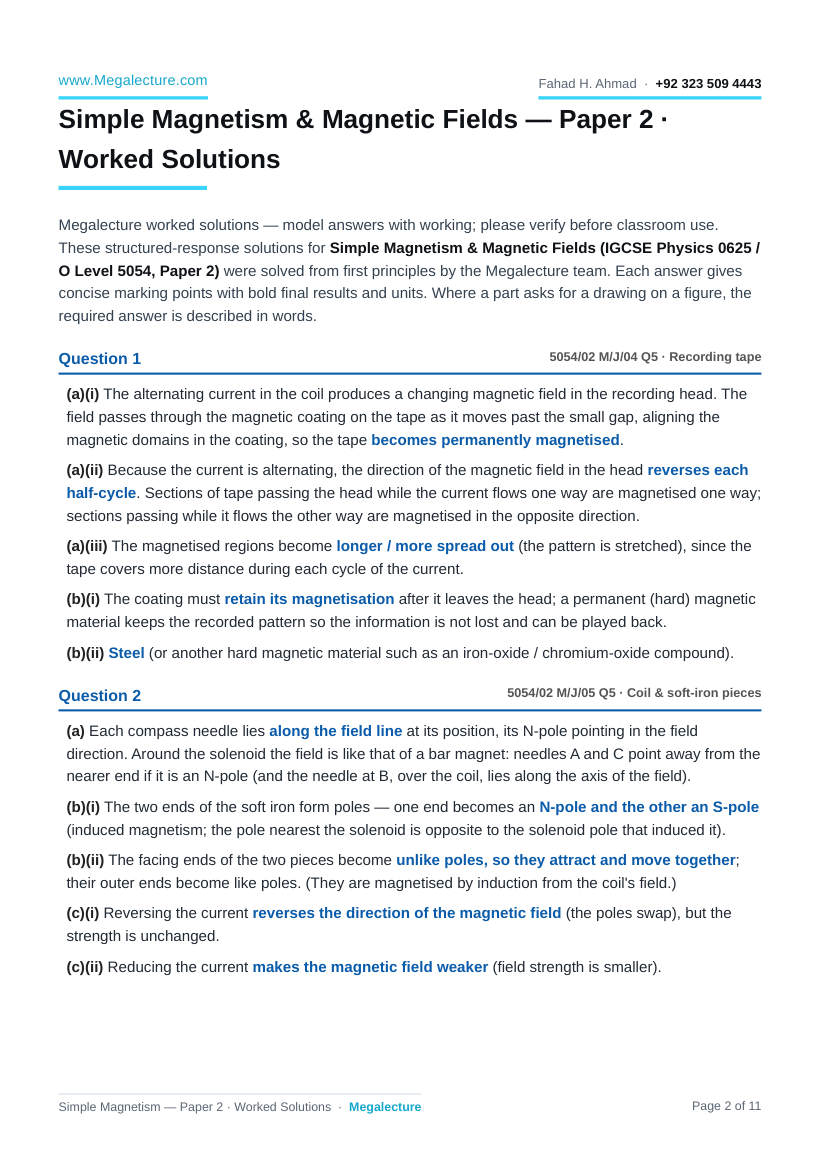
Simple Magnetism & Magnetic Fields — Paper 2 · Worked Solutions
Megalecture worked solutions — model answers with working; please verify before classroom use.
These structured-response solutions for Simple Magnetism & Magnetic Fields (IGCSE Physics 0625 /
O Level 5054, Paper 2) were solved from first principles by the Megalecture team. Each answer gives concise marking points with bold final results and units. Where a part asks for a drawing on a figure, the required answer is described in words.
Question 1
(a)(i) The alternating current in the coil produces a changing magnetic field in the recording head. The field passes through the magnetic coating on the tape as it moves past the small gap, aligning the magnetic domains in the coating, so the tape becomes permanently magnetised.
(a)(ii) Because the current is alternating, the direction of the magnetic field in the head reverses each half-cycle. Sections of tape passing the head while the current flows one way are magnetised one way;
sections passing while it flows the other way are magnetised in the opposite direction.
(a)(iii) The magnetised regions become longer / more spread out (the pattern is stretched), since the tape covers more distance during each cycle of the current.
(b)(i) The coating must retain its magnetisation after it leaves the head; a permanent (hard) magnetic material keeps the recorded pattern so the information is not lost and can be played back.
(b)(ii) Steel (or another hard magnetic material such as an iron-oxide / chromium-oxide compound).
Question 2
- Each compass needle lies along the field line at its position, its N-pole pointing in the field direction. Around the solenoid the field is like that of a bar magnet: needles A and C point away from the nearer end if it is an N-pole (and the needle at B, over the coil, lies along the axis of the field).
(b)(i) The two ends of the soft iron form poles — one end becomes an N-pole and the other an S-pole
(induced magnetism; the pole nearest the solenoid is opposite to the solenoid pole that induced it).
(b)(ii) The facing ends of the two pieces become unlike poles, so they attract and move together;
their outer ends become like poles. (They are magnetised by induction from the coil's field.)
(c)(i) Reversing the current reverses the direction of the magnetic field (the poles swap), but the strength is unchanged.
(c)(ii) Reducing the current makes the magnetic field weaker (field strength is smaller).
www.Megalecture.com Fahad H. Ahmad · +92 323 509 4443
5054/02 M/J/07 Q6 · Coil field & loudspeaker
5054/02 M/J/09 Q7 · Soft iron, reed switch & relay
5054/22 M/J/10 Q7 · Compass needles & relay
5054/22 M/J/10 Q7(c) · LDR relay circuit
Question 3
- The field is that of a solenoid: straight, evenly-spaced field lines running through the centre of the tube, looping round the outside from one end to the other. Using the current key (top wires into the page, bottom wires out of the page), the lines inside point to the left, so the left end is an N-pole.
(b)(i) A frequency of 100 Hz means 100 complete cycles (oscillations) of the current occur each second.
(b)(ii) The current in the coil produces a magnetic field that interacts with the field of the permanent magnet, giving a force on the coil (the motor effect). As the current alternates, the force reverses direction each half-cycle, so the coil (and the attached cone) vibrates back and forth at 100 Hz.
Question 4
- Each piece is magnetised by induction: the end nearest the N-pole becomes an S-pole and its far end an N-pole; the end nearest the S-pole becomes an N-pole and its far end an S-pole.
- The two soft-iron reeds become magnetised by induction. The facing ends become unlike poles, so they attract and the contacts close (the switch is made).
(c)(i) When the air temperature rises, the resistance of the thermistor decreases.
(c)(ii) The lower thermistor resistance allows a larger current in the coil. This makes the magnetic field strong enough to magnetise the reeds, so the reed contacts close, completing the warning-lamp circuit and lighting the lamp.
Question 5
- Each needle aligns with the magnet's field. The N-end of each needle points along the local field line; near the magnet the two compasses point towards the S-pole and away from the N-pole of the bar magnet respectively (N of needle to S of magnet).
- Closing the switch sends a current through the coil, magnetising the soft-iron core (it becomes an electromagnet). The core attracts the iron armature, which pivots and pushes/pulls the contacts together, closing them.
Question 6
(c)(i) When light falls on the LDR its resistance decreases.
(c)(ii) The completed lamp circuit must connect the lamp in series with the battery through the now- closed contacts C: draw a wire from the battery to one side of contacts C, from C to the lamp, and from the lamp back to the battery, so that when light makes C close, current flows and the lamp switches on.
www.Megalecture.com Fahad H. Ahmad · +92 323 509 4443
5054/21 M/J/11 Q7 · Circuit-breaker electromagnet
5054/21 M/J/12 Q8 · Magnet lifting & field round a wire
5054/22 M/J/14 Q7 · Compass needle & force
Question 7
- The arrow on the iron bar should point towards the electromagnet (upward / to the left, i.e. the bar is attracted to the coil).
- When the current is below 10 A the electromagnet's field is weak, so the force of attraction on the iron bar is smaller than the force of the spring holding the contacts closed, and the bar does not move.
- A current greater than 10 A makes the electromagnet strong enough that the force on the iron bar exceeds the spring force. The bar is pulled towards the electromagnet, it pivots and separates the contacts, breaking the circuit so the current stops.
- Use more turns on the electromagnet coil (or a coil that is more easily magnetised). With more turns the field is stronger for a given current, so the bar is pulled off at a smaller current (less than
10 A).
Question 8
(a)(i) The rod is a magnet (a permanent magnet).
(a)(ii) In Fig. 8.1b the end P faces the magnet's N with an unlike pole, so it attracts and lifts that end; in Fig. 8.1c P faces the magnet's S, and again P presents an unlike pole, so it attracts and lifts that end. (A magnet can attract either end of another magnet because it always turns to present an opposite pole / induces attraction.)
(b)(i) The field is concentric circles around the wire. With the current going into the page, the field is clockwise (right-hand grip rule).
(b)(ii) Closer to the wire the field is stronger, shown by the field lines being drawn closer together
(more closely spaced).
Question 9
(a)(i) The arrow from the S-pole of the needle should point towards the N-pole of the bar magnet
(unlike poles attract), i.e. down and to the right towards the magnet's N end.
(a)(ii) When the finger is removed there is a turning effect (couple) from the magnet's field on the needle's poles, so the needle rotates to line up with the magnetic field (N-pole pointing along the field).
- Place the compass on the paper near the magnet; mark a dot at the position of the N-end of the needle. Move the compass so its tail sits on that dot and mark the new N-end position; repeat. Join the dots with a smooth line and add an arrow (pointing the way the compass N-pole pointed) to show the field line.
www.Megalecture.com Fahad H. Ahmad · +92 323 509 4443
5054/22 M/J/15 Q10 · Relay, thermistor & calculations
5054/21 M/J/16 Q7 · Loudspeaker & wavelength
5054/21 M/J/18 Q6 · Magnetising a steel rod
Question 10
(a)(i) Mark the right-hand end of the core (the other end) as the S-pole. The armature end nearest the core's N-pole becomes an S-pole (attraction) and its far end an N-pole.
(a)(ii) Reversing the cell reverses the current, so the poles of the core and armature all swap (N↔S).
The armature is still attracted to the core (unlike poles still face), so the armature behaves the same / stays attracted.
(a)(iii) Iron is a soft magnetic material: it magnetises strongly when the current is on but loses its magnetism when the current is switched off, so the armature can be released. Steel would stay magnetised.
(b)(i) Component X is a thermistor.
(b)(ii) As the temperature of X rises its resistance falls, so the current in the coil increases; the electromagnet becomes strong enough to close the relay contacts, completing the bell circuit so the bell rings.
(b)(iii)1 p.d. across X: V = IR = (1.5×10-3) × 2000 = 3.0 V.
(b)(iii)2 The coil is in series with X across the 12 V supply, so p.d. across coil = 12 − 3.0 = 9.0 V.
(b)(iii)3 The coil circuit and bell circuit are separate; the "current in the battery" of the coil circuit is the coil current = 1.5 mA (1.5×10⁻³ A). (The 12 V battery drives only the series coil circuit, current = 1.5 mA.)
(b)(iv) Component Y is a light-dependent resistor (LDR).
Question 11
- The current in the coil sets up a magnetic field which interacts with the field of the permanent magnet, producing a force on the coil (motor effect). The coil and the attached paper cone therefore move.
- An alternating current reverses direction each half-cycle, so the force on the coil reverses; the coil and cone vibrate / oscillate back and forth at the frequency of the a.c., producing sound.
- λ = v / f = 320 / 500 = 0.64 m.
Question 12
- Place the steel rod inside a solenoid (coil of insulated wire) and pass a large direct current through the coil for a short time. The magnetic field of the coil magnetises the rod; the rod retains its magnetism when the current is switched off (it becomes a permanent magnet).
- Bring one end of the rod near a plotting compass / another magnet: if it attracts one pole and repels the other (i.e. it can repel a known pole), the rod is magnetised. (Repulsion is the sure test of magnetisation; alternatively, it can pick up iron filings/pins at its ends.) www.Megalecture.com Fahad H. Ahmad · +92 323 509 4443
5054/22 M/J/18 Q7 · Hard disk & induced voltage
5054/02 O/N/03 Q6 · Compass above a wire
5054/02 O/N/05 Q7 · Coil with iron / copper rods
Question 13
- Bring a magnet close to a small sample of the material. If the material is attracted to the magnet, it is magnetic; if there is no attraction (no force), it is non-magnetic. (More certain: see whether the sample can be repelled by a magnet — only a magnetic, magnetised material repels.)
(b)(i) In region 2 the poles are all S, while region 1 has N…N facing across the boundary, so at the boundary like poles (N and N, or S and S) meet, so the magnetic force is repulsion (the regions repel). It acts because like poles repel.
(b)(ii) At the boundary between region 1 and region 2, draw the field-line arrows pointing away from each other on the two sides (lines diverge / point apart), consistent with like poles repelling.
(b)(iii)1 As the magnetised layer moves, the magnetic field through the coil changes. A changing magnetic field linking the coil induces a voltage (e.m.f.) in the coil (electromagnetic induction).
(b)(iii)2 The coil must be close so that the magnetic field through it is strong (large flux linkage); if it were far away the field would be too weak to induce a usable voltage.
Question 14
(a)(i) The current sets up a magnetic field (circles) around the wire. Above the wire this field is perpendicular to the Earth's field, so the compass needle deflects (turns) away from North, settling along the resultant of the two fields.
(a)(ii) Below the wire the circular field is in the opposite direction, so the needle deflects the other way (turns in the opposite sense to when it was above the wire).
- A 50 Hz alternating current makes the field around the wire reverse 50 times each second. The needle cannot follow such rapid reversals, so it is observed to stay pointing North (it merely vibrates slightly / appears stationary) — the average deflecting effect is zero.
Question 15
- The current in the coil magnetises both iron rods by induction; their adjacent ends become the same
(like) pole, so they repel and move apart to the sides of the tube.
- Copper is non-magnetic, so only the iron rod becomes magnetised by the coil's field. Nothing happens / they do not repel (there is no magnetic force between an unmagnetised copper rod and the magnetised iron rod strong enough to push them apart; the copper is not affected).
www.Megalecture.com Fahad H. Ahmad · +92 323 509 4443
5054/02 O/N/06 Q5 · Magnet, compasses & nails
5054/02 O/N/07 Q7 · Make a magnet & magnetic screening
Question 16
- Each compass needle aligns with the field: its N-end points along the local field line. The compass beyond the N-end of the magnet points away from the magnet (along the axis); the compass beyond the S-end points towards the magnet's S-pole.
- Each nail is magnetised by induction. The end of a nail nearest the magnet's N-pole becomes an S- pole, and its far end an N-pole; (for the second nail, the end nearest the first nail's N becomes S, its far end N) — nearest end always opposite to the pole inducing it.
- To demagnetise: place the nails inside a solenoid carrying alternating current and slowly withdraw them from the coil (to a distance) while the a.c. flows. The steadily decreasing alternating field leaves the domains randomly arranged, so the nails lose their magnetism. (Diagram: nail in a.c.- carrying coil, arrow showing it pulled out.)
Question 17
(a)(i) The steel rod is used to make a permanent magnet.
(a)(ii) Put the steel rod inside the coil and switch on a large direct current for a short time. The coil's magnetic field magnetises the steel; being a hard material it keeps its magnetism after the current is switched off.
(b)(i) Best material for the box: soft iron.
(b)(ii) Draw the field lines so that they bend into and pass through the (soft-iron) box walls, going round the inside region and rejoining on the right. The lines are concentrated in the iron, leaving few/no field lines inside the box, so the component is screened.
www.Megalecture.com Fahad H. Ahmad · +92 323 509 4443
5054/02 O/N/08 Q10 · Wire, compass & bar magnet
5054/21 O/N/10 Q6 · Loudspeaker
Question 18
(a)(i) Seen from above, the field around the upward current is a set of anticlockwise concentric circles (right-hand grip rule, thumb up → fingers anticlockwise from above). The compass needle lies tangent to the circle at its position.
(a)(ii) When the current increases, the magnetic field gets stronger, so the compass deflects through a larger angle (turns further from North).
(b)(i) Total resistance: R = V / I = 6.0 / 8.0 = 0.75 Ω.
(b)(ii) Charge: Q = I × t = 8.0 × (2.0 × 60) = 8.0 × 120 = 960 C.
(c)(i) By the motor effect the bar magnet exerts a force on the current-carrying wire. With current up and the field from N→S, the force on the wire is horizontal, perpendicular to both (use Fleming's left- hand rule); state the appropriate direction (e.g. out of, or into, the page depending on orientation).
(c)(ii) When the current is reversed, the force on the wire reverses direction (the wire is pushed the opposite way).
(c)(iii) A flexible wire carrying alternating current in the magnet's field feels a force that reverses each half-cycle, so the wire vibrates back and forth.
(c)(iv) This force-on-a-current effect is used in a d.c. motor: current in a coil in a magnetic field produces forces on the two sides of the coil that act in opposite directions, giving a turning effect
(couple) that rotates the coil; a split-ring commutator reverses the current every half-turn to keep it spinning the same way.
Question 19
(a)(i) The alternating current in the coil produces a changing magnetic field that interacts with the field of the cylindrical permanent magnet, giving a force on the coil that reverses each half-cycle. The coil and cone are pushed back and forth, so the cone vibrates.
(a)(ii) The vibrating cone pushes and pulls the air next to it, creating regions of compression and rarefaction that travel outward as a longitudinal sound wave.
- A stronger magnet gives a larger force on the coil for the same current, so the cone vibrates with a larger amplitude — the note is louder (greater loudness/volume).
www.Megalecture.com Fahad H. Ahmad · +92 323 509 4443
5054/22 O/N/10 Q6 · Solenoid & paper clips
5054/22 O/N/11 Q5 · Electric bell electromagnet
5054/21 O/N/13 Q6 · Permanent magnet & demagnetising
Question 20
- Aluminium bar: Aluminium is non-magnetic, so the bar is not magnetised. The paper-clips are not attracted at any time (they stay where they are).
- Iron bar: While the current is on, the soft-iron bar becomes a strong electromagnet and attracts and picks up the paper-clips. When the current is switched off, iron is soft, so it loses its magnetism and the paper-clips fall off (drop back).
- Steel bar: While the current is on, the steel bar is magnetised and picks up the paper-clips. When the current is switched off, steel is hard, so it stays magnetised and the paper-clips remain attached.
Question 21
(a)(i) The iron bar is magnetised by induction. Its end nearest the core's S-pole becomes an N-pole, and its end nearest the core's N-pole becomes an S-pole (mark N at the top facing S of the core, S at the bottom facing N of the core).
(a)(ii) Once magnetised, the iron bar has unlike poles facing the core's poles, so it is attracted towards the core (it moves towards the electromagnet).
- When the switch is opened there is no current, so the soft-iron core loses its magnetism; the induced poles in the iron bar disappear (the bar is no longer magnetised).
Question 22
- A material for a permanent magnet: steel (a hard magnetic material).
- Close to the permanent magnet its field is much stronger than the Earth's, so each compass needle aligns with the magnet's field, not North. At A (off the S-end) and B (off the N-end) draw the needles pointing along the field lines of the bar magnet — N-end of the needle pointing towards the magnet's
S-pole at A and away from the magnet's N-pole at B.
- To demagnetise: place the magnet inside a solenoid carrying alternating current aligned E–W, then slowly withdraw it from the coil while the a.c. flows. The diminishing alternating field randomises the domains, removing the magnetism. (Diagram: magnet in a.c. coil with arrow showing it being pulled out.) www.Megalecture.com Fahad H. Ahmad · +92 323 509 4443
5054/22 O/N/15 Q10 · Induction in a solenoid + calculations
Question 23
(a)(i) Plastic is an insulator because it has no free (mobile) charge carriers / electrons; its electrons are tightly bound to atoms, so charge cannot flow through it.
(a)(ii)1 Not aluminium: aluminium is non-magnetic, so it cannot be made into a magnet (it cannot be magnetised).
(a)(ii)2 Not iron: iron is a soft magnetic material — it does not keep its magnetism, so it cannot be a permanent magnet.
(b)(i) As the magnet moves, the magnetic field through (linking) the solenoid changes. A changing magnetic field induces an e.m.f. (voltage) in the coil, which drives a current through the ammeter
(electromagnetic induction).
(b)(ii)1 p.d. across solenoid: V = IR = (0.045 × 10-3) × 1.2 = 5.4 × 10⁻⁵ V (0.000054 V).
(b)(ii)2 Charge: Q = I × t = (0.045 × 10-3) × 0.14 = 6.3 × 10⁻⁶ C.
(c)(i) The current is larger than in the first experiment. The magnet moves faster, so the magnetic field through the coil changes more quickly, inducing a larger e.m.f. and hence a larger current.
(c)(ii) The same total change of magnetic field (flux) occurs in both experiments (the magnet travels the same distance from Y to X). Charge depends on the total flux change, not the speed, so although the second current is larger it flows for a shorter time and the charge (Q = I×t) is the same.
- To reverse the current direction: 1. move the magnet in the opposite direction (from X to Y / pull it out instead of pushing it in); 2. reverse the magnet so that its S-pole (instead of the N-pole) faces the solenoid.
www.Megalecture.com Fahad H. Ahmad · +92 323 509 4443
5054/22 O/N/16 Q9 · Solenoid circuit + calculations
5054/21 O/N/18 Q6 · Compass, field plotting & induced magnetism
Question 24
- Current is the rate of flow of (electric) charge (charge passing a point per unit time).
(b)(i) e.m.f. of battery = 5 × 1.5 = 7.5 V.
(b)(ii) Total resistance: R = V / I = 7.5 / 4.0 = 1.875 Ω (≈ 1.9 Ω).
(b)(iii) Power in solenoid: P = V × I = 6.5 × 4.0 = 26 W.
(b)(iv) As the copper warms up, its resistance increases. With the e.m.f. fixed, a higher total resistance means the current (ammeter reading) decreases.
(c)(i) Draw the solenoid's field like a bar magnet: field lines emerging from the lower N-pole, curving round the outside to enter the top end, with straight lines through the core; arrows point out of the
N-pole (downward/outward at the bottom).
(c)(ii)1 The current magnetises the iron core (electromagnet); the core magnetises the iron cylinder by induction, so an unlike pole forms in the cylinder and it is attracted to the core. This attractive
(magnetic) force is greater than the cylinder's weight, so it does not fall.
(c)(ii)2 When S is opened there is no current, so the soft-iron core loses its magnetism; there is no longer a force holding the cylinder, so the iron cylinder falls (does not remain in contact).
Question 25
- The compass needle is made of steel (a hard magnetic material, permanently magnetised).
- Place the compass on the paper near a pole and mark a dot at its N-end. Move the compass so its tail is on that dot, mark the new N-end position, and repeat across the paper. Join the dots into a smooth curve and add an arrow (in the direction the compass N-pole pointed) — this is one field line.
Repeat from other starting points to plot the full pattern.
- As the magnet's N-pole approaches end P, the iron bar is magnetised by induction: end P becomes an S-pole (unlike pole nearest the magnet). Unlike poles attract, and the closer the magnet comes the stronger the (rapidly increasing) attractive force, so the iron bar is pulled quickly towards the magnet.
Note from Megalecture. These are original Megalecture worked solutions prepared for revision use. Several items recur across the paper (induced magnetism of soft iron, the motor effect in loudspeakers, and the hard/soft material distinction for permanent magnets vs. electromagnets) — they are answered consistently throughout. Please verify before classroom use.
www.Megalecture.com Fahad H. Ahmad · +92 323 509 4443
