
IGCSE · Physics · Past papers · Paper 1 (Multiple Choice)
Answer Key
Need more than one subject? All-notes pass: unlimited downloads of every note for a year: unlimited downloads of every note on the site, PKR 999 a year. All packs and courses.
Opens inside this page. Prefer your own PDF app? Open the PDF.
Check yourself
5 quick questions on IGCSE Physics
Tap an answer to see if you are right, and why. Free, no sign-up.
Start the free testNew · free
O Level Physics written answers, marked like a real examiner
Answer a Paper 2 style question by typing or speaking. You get your mark point by point, what the examiner was looking for that you missed, and a model answer. 5 free answers a day with a free account.
Try a written question👍 33 students found these notes useful
Was this note useful?
Full text of Answer Key
www.megalecture.com · www.youtube.com/@megalecture
Fahad H. Ahmad
M.Eng NUS Singapore · B.Eng NUST · 15+ years of teaching experience in Singapore, UAE & Pakistan · 60,000+ subscribers and 20 million+ video lecture views.
IGCSEPHYSICS0625·TOPICALPASTPAPERS
Mass, Weight & Density — Paper 1
Worked Answer Key (Multiple Choice)
Free notes, practice tests and live classes Back to megalecture.com
Mass, Weight & Density — Paper 1 · Worked Answer Key
These are Megalecture worked answers for the topical multiple-choice compilation on Mass, Weight &
Density (IGCSE Physics 0625, Paper 1). Every answer below was solved from first principles by the
Megalecture team; calculations use the data given in each question, with the equations ρ = m/V
(density) and W = mg (weight), taking g as stated. Use this key to mark your work and to see the one- line reasoning behind each correct letter. Question numbers follow the compilation's own numbering as printed on the question paper.
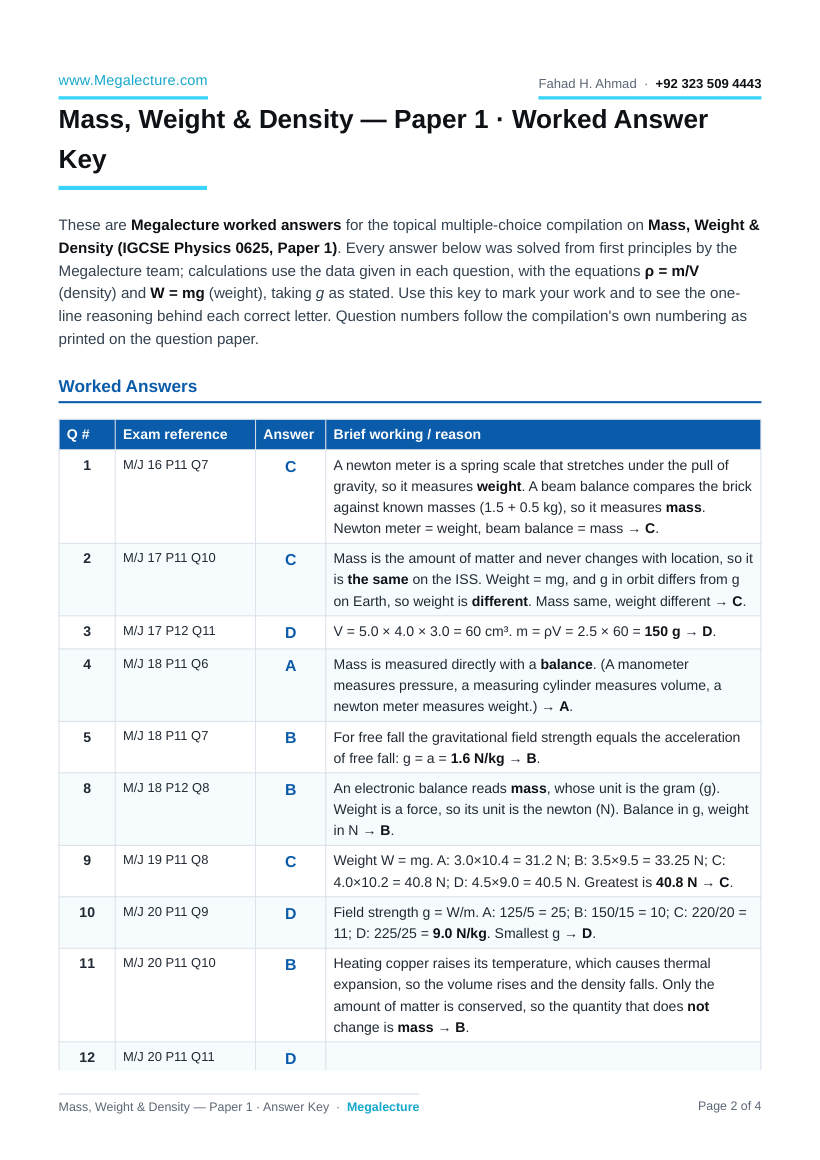
Worked Answers Q # Exam reference Answer Brief working / reason
M/J 16 P11 Q7
C
A newton meter is a spring scale that stretches under the pull of gravity, so it measures weight. A beam balance compares the brick against known masses (1.5 + 0.5 kg), so it measures mass.
Newton meter = weight, beam balance = mass → C.
M/J 17 P11 Q10
C
Mass is the amount of matter and never changes with location, so it is the same on the ISS. Weight = mg, and g in orbit differs from g on Earth, so weight is different. Mass same, weight different → C.
M/J 17 P12 Q11
D
V = 5.0 × 4.0 × 3.0 = 60 cm³. m = ρV = 2.5 × 60 = 150 g → D.
M/J 18 P11 Q6
A
Mass is measured directly with a balance. (A manometer measures pressure, a measuring cylinder measures volume, a newton meter measures weight.) → A.
M/J 18 P11 Q7
B
For free fall the gravitational field strength equals the acceleration of free fall: g = a = 1.6 N/kg → B.
M/J 18 P12 Q8
B
An electronic balance reads mass, whose unit is the gram (g).
Weight is a force, so its unit is the newton (N). Balance in g, weight in N → B.
M/J 19 P11 Q8
C
Weight W = mg. A: 3.0×10.4 = 31.2 N; B: 3.5×9.5 = 33.25 N; C:
4.0×10.2 = 40.8 N; D: 4.5×9.0 = 40.5 N. Greatest is 40.8 N → C.
M/J 20 P11 Q9
D
Field strength g = W/m. A: 125/5 = 25; B: 150/15 = 10; C: 220/20 =
11; D: 225/25 = 9.0 N/kg. Smallest g → D.
M/J 20 P11 Q10
B
Heating copper raises its temperature, which causes thermal expansion, so the volume rises and the density falls. Only the amount of matter is conserved, so the quantity that does not change is mass → B.
M/J 20 P11 Q11
D
Mass, Weight & Density — Paper 1 · Answer Key · Megalecture
Q # Exam reference Answer Brief working / reason
Volume of 3 bolts = 42 − 30 = 12 cm³. Total mass = 3 × 34 = 102 g.
ρ = m/V = 102/12 = 8.5 g/cm³ → D.
M/J 20 P12 Q9
B
Mass is unchanged: m = W/g = 40/10 = 4.0 kg. Weight on the new planet = mg = 4.0 × 4.0 = 16 N. Mass 4.0 kg, weight 16 N → B.
M/J 20 P12 Q10
A
Mass of liquid = (mass of beaker + liquid) − (mass of empty beaker). Then ρ = mass of liquid / volume of liquid → A.
O/N 16 P11 Q5
A
A mass placed in a gravitational field experiences a downward force = its weight (W = mg). So "a mass experiences a weight due to a gravitational field" → A. (Mass and weight have different units, kg vs N, so B and C are wrong.)
O/N 16 P12 Q7
A
The spring's extension is proportional to the load, so the marker scale reads a definite, fixed quantity. The block always contains the same amount of matter, so the calibrated scale gives the mass of the block in kg → A. (Moment in N·m and "weight in kg" use wrong units.)
O/N 16 P12 Q8
B
Thickness 2.0 mm = 0.20 cm. V = area × thickness = 4.5 × 0.20 =
0.90 cm³. m = ρV = 19 × 0.90 = 17.1 ≈ 17 g → B.
O/N 17 P11 Q6
C
In balance the moments are equal, so the weights are equal, hence the masses are equal. The two objects can still be of different materials, so their volumes may be different → C.
O/N 17 P12 Q6
C
Left block: V = 1.0×1.0×1.0 = 1 cm³, m = 6.0×1 = 6.0 g. Right block:
V = 2.0×1.0×1.0 = 2 cm³, m = 9.0×2 = 18 g. Overall ρ = (6+18)/
(1+2) = 24/3 = 8.0 g/cm³ → C.
O/N 18 P11 Q6
C
Greater g means greater W = mg. Mass, volume and density are properties of the object and do not change with location, so only the weight increases → C.
O/N 18 P11 Q7
C
Density depends only on the material, not on size or shape. Both cylinders are copper, so the density of P equals the density of Q
→ C.
O/N 18 P12 Q5
A
A (beam) balance compares an unknown object against another by balancing their weights, which compares their masses → A.
O/N 18 P12 Q6
D
Extension ∝ load = mg. For the same mass, the spring extends more on planet X (steeper line). The slope ratio is about 3 : 1 (X reaches 30 cm at ≈2 kg, Y reaches 30 cm at 6 kg), so g on X is three times g on Y → D.
O/N 20 P11 Q6
A
Same reasoning as Q16: the spring scale gives a fixed reading proportional to the constant load, so it determines the mass of the block in kg → A.
O/N 20 P11 Q7
B
Mass, Weight & Density — Paper 1 · Answer Key · Megalecture
Q # Exam reference Answer Brief working / reason
The ball has charge, so it creates an electric field, and it has mass, so it creates a gravitational field. It is at rest (no moving charge), so there is no magnetic field. Electric and gravitational only → B.
O/N 20 P11 Q8
D
Weight is the force of gravity acting on a mass (W = mg) → D.
(Mass ≠ weight; they have different units; weight is a vector force, mass is a scalar.)
O/N 20 P11 Q9
B
Density is mass per unit volume: ρ = mass / volume → B.
O/N 20 P12 Q8
D
The balance is calibrated for Earth, so it converts the force it feels into a "mass" by dividing by gEarth. Force on it = N × 0.1 × (gEarth/5).
Reading = force / gEarth = N × 0.1/5 = 0.02N kg. Set 0.02N = 1.0 →
N = 50 → D.
Note from Megalecture. Throughout, mass (kg) is the constant amount of matter in a body, while weight (N) is the gravitational force on it, W = mg. Density is ρ = m/V and depends only on the material, not on size or shape. These are original Megalecture worked solutions prepared for revision use.
Mass, Weight & Density — Paper 1 · Answer Key · Megalecture
