
IGCSE · Physics · Past papers · Paper 1 (Multiple Choice)
Answer Key
Need more than one subject? All-notes pass: unlimited downloads of every note for a year: unlimited downloads of every note on the site, PKR 999 a year. All packs and courses.
Opens inside this page. Prefer your own PDF app? Open the PDF.
Check yourself
5 quick questions on IGCSE Physics
Tap an answer to see if you are right, and why. Free, no sign-up.
Start the free testNew · free
O Level Physics written answers, marked like a real examiner
Answer a Paper 2 style question by typing or speaking. You get your mark point by point, what the examiner was looking for that you missed, and a model answer. 5 free answers a day with a free account.
Try a written question👍 33 students found these notes useful
Was this note useful?
Full text of Answer Key
www.megalecture.com · www.youtube.com/@megalecture
Fahad H. Ahmad
M.Eng NUS Singapore · B.Eng NUST · 15+ years of teaching experience in Singapore, UAE & Pakistan · 60,000+ subscribers and 20 million+ video lecture views.
IGCSEPHYSICS0625·TOPICALPASTPAPERS
Turning Effect of Forces — Paper 1
Worked Answer Key (Multiple Choice)
Free notes, practice tests and live classes Back to megalecture.com
Turning Effect of Forces — Paper 1 · Worked Answer Key
These are Megalecture worked answers for the topical multiple-choice compilation on Turning Effect of Forces (IGCSE Physics 0625, Paper 1). Every answer was solved from first principles by the
Megalecture team using the principle of moments (sum of clockwise moments = sum of anticlockwise moments) and moment = force × perpendicular distance from the pivot. Read the one-line working to see exactly which forces and distances were balanced. The compilation is organised into two parts — watch the part heading, as the exam-paper question numbering restarts in each part.
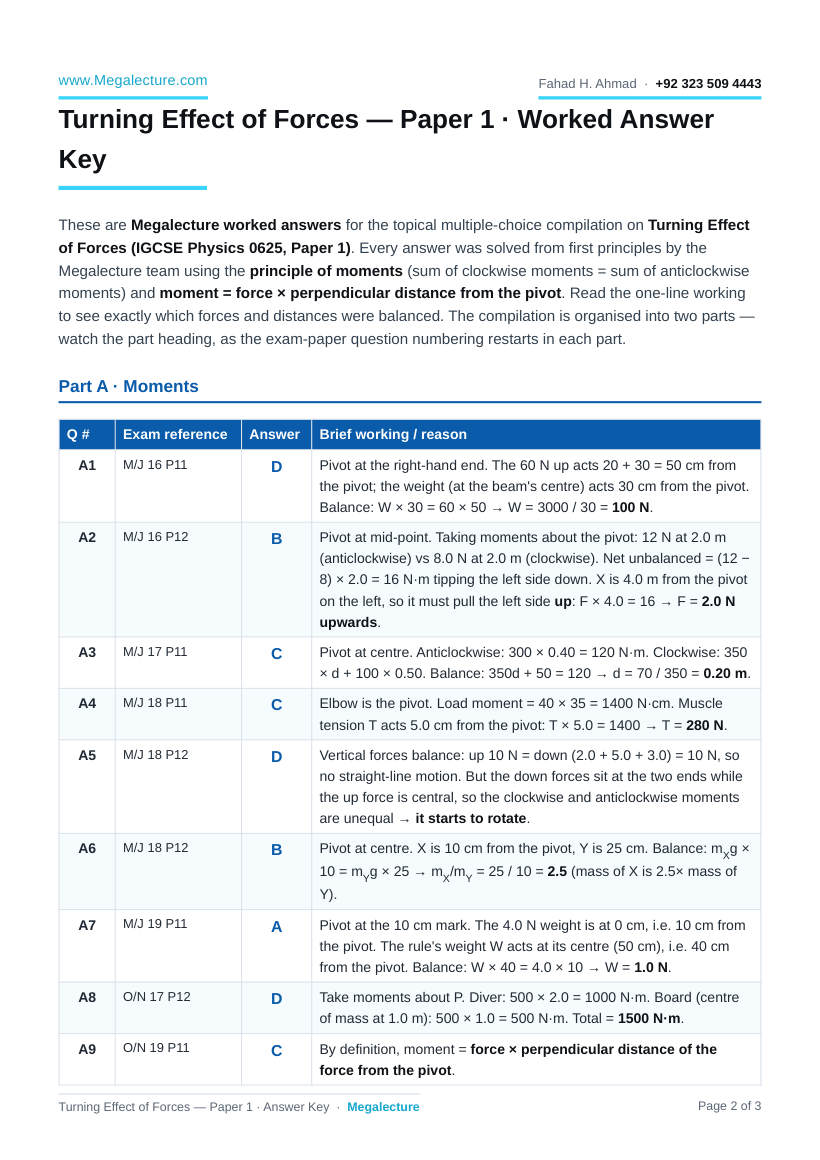
Part A · Moments Q # Exam reference Answer Brief working / reason A1
M/J 16 P11
D
Pivot at the right-hand end. The 60 N up acts 20 + 30 = 50 cm from the pivot; the weight (at the beam's centre) acts 30 cm from the pivot.
Balance: W × 30 = 60 × 50 → W = 3000 / 30 = 100 N.
A2
M/J 16 P12
B
Pivot at mid-point. Taking moments about the pivot: 12 N at 2.0 m
(anticlockwise) vs 8.0 N at 2.0 m (clockwise). Net unbalanced = (12 −
- × 2.0 = 16 N·m tipping the left side down. X is 4.0 m from the pivot on the left, so it must pull the left side up: F × 4.0 = 16 → F = 2.0 N upwards.
A3
M/J 17 P11
C
Pivot at centre. Anticlockwise: 300 × 0.40 = 120 N·m. Clockwise: 350
× d + 100 × 0.50. Balance: 350d + 50 = 120 → d = 70 / 350 = 0.20 m.
A4
M/J 18 P11
C
Elbow is the pivot. Load moment = 40 × 35 = 1400 N·cm. Muscle tension T acts 5.0 cm from the pivot: T × 5.0 = 1400 → T = 280 N.
A5
M/J 18 P12
D
Vertical forces balance: up 10 N = down (2.0 + 5.0 + 3.0) = 10 N, so no straight-line motion. But the down forces sit at the two ends while the up force is central, so the clockwise and anticlockwise moments are unequal → it starts to rotate.
A6
M/J 18 P12
B
Pivot at centre. X is 10 cm from the pivot, Y is 25 cm. Balance: mXg ×
10 = mYg × 25 → mX/mY = 25 / 10 = 2.5 (mass of X is 2.5× mass of
Y).
A7
M/J 19 P11
A
Pivot at the 10 cm mark. The 4.0 N weight is at 0 cm, i.e. 10 cm from the pivot. The rule's weight W acts at its centre (50 cm), i.e. 40 cm from the pivot. Balance: W × 40 = 4.0 × 10 → W = 1.0 N.
A8
O/N 17 P12
D
Take moments about P. Diver: 500 × 2.0 = 1000 N·m. Board (centre of mass at 1.0 m): 500 × 1.0 = 500 N·m. Total = 1500 N·m.
A9
O/N 19 P11
C
By definition, moment = force × perpendicular distance of the force from the pivot.
Turning Effect of Forces — Paper 1 · Answer Key · Megalecture
Q # Exam reference Answer Brief working / reason A10
O/N 20 P11
C
F is horizontal, applied at P. The perpendicular (shortest) distance from pivot Q to the horizontal line of action of F is the vertical distance y (x is horizontal and runs along the force's direction, so it is not the lever arm). Moment = F × y = Fy.
Part B · Centre of Mass and Stability Q # Exam reference Answer Brief working / reason B1
M/J 16 P11
A
Most stable = lowest centre of mass over a wide base. Lamp A has its mark M lowest down (in the bulbous base) → A.
B2
M/J 18 P11
B
Least stable = highest centre of mass over the narrowest base. The tall, thin column (B) has G highest with a small base → B topples most easily.
B3
M/J 19 P11
B
For a given height of centre of mass, a wider base means a larger toppling angle → more stable: objects with a centre of mass at the same height are more stable when the base is larger.
B4
M/J 19 P12
D
When balanced on the table edge (the pivot), the centre of mass of the hook + pencil must lie vertically below the support point. That is point D, directly under the balance point.
B5
M/J 20 P12
D
The plumb-line method: hang the lamina from a pin and let a vertical pin / plumb line mark the vertical; repeat from another point — the centre of mass is where the lines cross → a vertical pin.
B6
M/J 20 P12
C
Hanging weights below the rim drop the combined centre of mass below the balance point, making the toy stable: they lower the centre of mass below the top of the rod.
B7
O/N 19 P11
C
For the loaded object to balance, the centre of mass of the object alone must sit just to the right of the pivot (so its clockwise moment matches the weight's anticlockwise moment). Of the marked points, that is C, essentially above the pivot.
Note from Megalecture. Every numerical answer above was obtained with the principle of moments (clockwise moments = anticlockwise moments) taking moments about the stated pivot, and checked independently. These are original Megalecture worked solutions prepared for revision use.
Turning Effect of Forces — Paper 1 · Answer Key · Megalecture
