
IGCSE · Physics · Past papers · Paper 1 (Multiple Choice)
Answer Key
Need more than one subject? All-notes pass: unlimited downloads of every note for a year: unlimited downloads of every note on the site, PKR 999 a year. All packs and courses.
Opens inside this page. Prefer your own PDF app? Open the PDF.
Check yourself
5 quick questions on IGCSE Physics
Tap an answer to see if you are right, and why. Free, no sign-up.
Start the free testNew · free
O Level Physics written answers, marked like a real examiner
Answer a Paper 2 style question by typing or speaking. You get your mark point by point, what the examiner was looking for that you missed, and a model answer. 5 free answers a day with a free account.
Try a written question👍 33 students found these notes useful
Was this note useful?
Full text of Answer Key
www.megalecture.com · www.youtube.com/@megalecture
Fahad H. Ahmad
M.Eng NUS Singapore · B.Eng NUST · 15+ years of teaching experience in Singapore, UAE & Pakistan · 60,000+ subscribers and 20 million+ video lecture views.
IGCSEPHYSICS0625·TOPICALPASTPAPERS
Motion (Kinematics) — Paper 1
Worked Answer Key (Multiple Choice)
Free notes, practice tests and live classes Back to megalecture.com
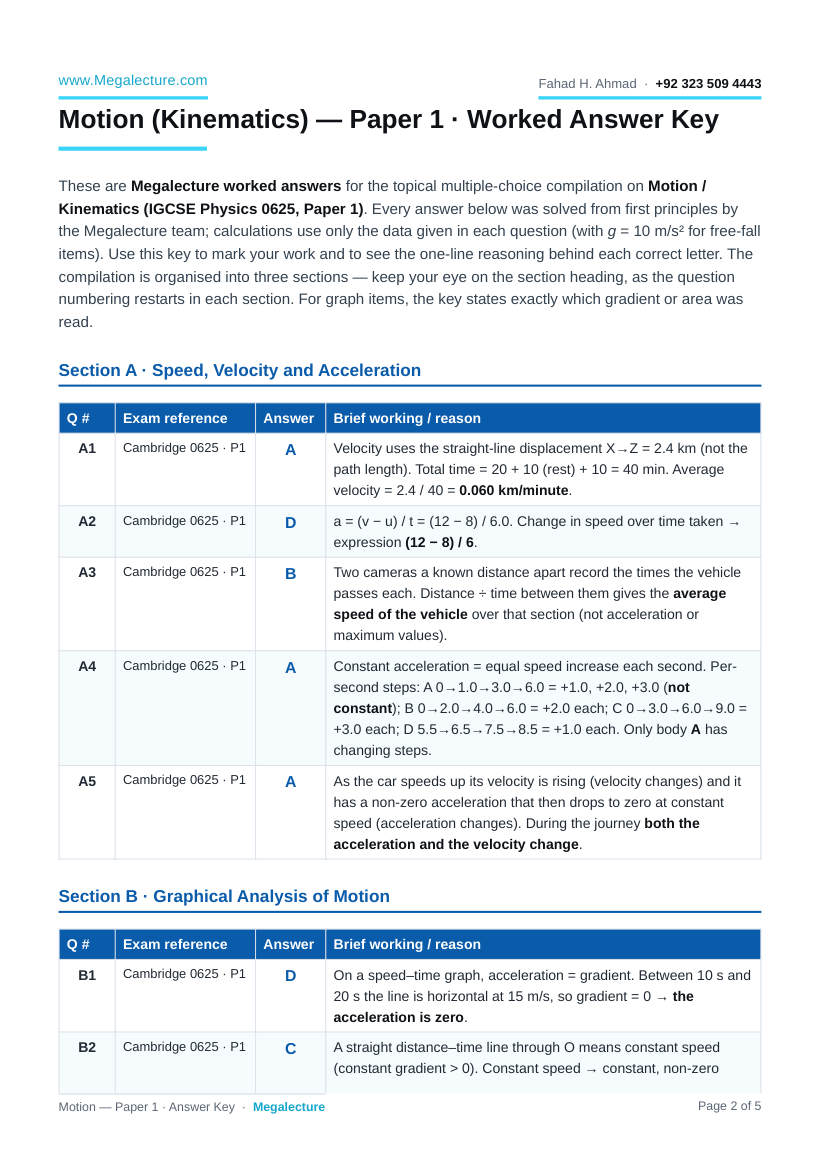
Motion (Kinematics) — Paper 1 · Worked Answer Key
These are Megalecture worked answers for the topical multiple-choice compilation on Motion /
Kinematics (IGCSE Physics 0625, Paper 1). Every answer below was solved from first principles by the Megalecture team; calculations use only the data given in each question (with g = 10 m/s² for free-fall items). Use this key to mark your work and to see the one-line reasoning behind each correct letter. The compilation is organised into three sections — keep your eye on the section heading, as the question numbering restarts in each section. For graph items, the key states exactly which gradient or area was read.
Section A · Speed, Velocity and Acceleration Q # Exam reference Answer Brief working / reason A1
Cambridge 0625 · P1
A
Velocity uses the straight-line displacement X→Z = 2.4 km (not the path length). Total time = 20 + 10 (rest) + 10 = 40 min. Average velocity = 2.4 / 40 = 0.060 km/minute.
A2
Cambridge 0625 · P1
D
a = (v − u) / t = (12 − 8) / 6.0. Change in speed over time taken → expression (12 − 8) / 6.
A3
Cambridge 0625 · P1
B
Two cameras a known distance apart record the times the vehicle passes each. Distance ÷ time between them gives the average speed of the vehicle over that section (not acceleration or maximum values).
A4
Cambridge 0625 · P1
A
Constant acceleration = equal speed increase each second. Per- second steps: A 0→1.0→3.0→6.0 = +1.0, +2.0, +3.0 (not constant); B 0→2.0→4.0→6.0 = +2.0 each; C 0→3.0→6.0→9.0 =
+3.0 each; D 5.5→6.5→7.5→8.5 = +1.0 each. Only body A has changing steps.
A5
Cambridge 0625 · P1
A
As the car speeds up its velocity is rising (velocity changes) and it has a non-zero acceleration that then drops to zero at constant speed (acceleration changes). During the journey both the acceleration and the velocity change.
Section B · Graphical Analysis of Motion Q # Exam reference Answer Brief working / reason B1
Cambridge 0625 · P1
D
On a speed–time graph, acceleration = gradient. Between 10 s and
20 s the line is horizontal at 15 m/s, so gradient = 0 → the acceleration is zero.
B2
Cambridge 0625 · P1
C
A straight distance–time line through O means constant speed
Motion — Paper 1 · Answer Key · Megalecture
Q # Exam reference Answer Brief working / reason
kinetic energy. (GPE rises as it climbs, acceleration is zero, resultant force is zero.)
B3
Cambridge 0625 · P1
A
Resultant force falls linearly to zero at t₀, so acceleration (= gradient of speed) falls to zero. Speed keeps rising but ever more slowly, levelling off at t₀ → the rise-and-flatten curve, graph A.
B4
Cambridge 0625 · P1
C
Distance = area under speed–time graph. Uniform rise 0→6.0 m/s over 4.0 s: area = ½ × 4.0 × 6.0 = 12 m.
B5
Cambridge 0625 · P1
D
A train making a short stop: speed falls to zero, stays briefly at zero, then rises again. The graph that dips to zero and back up (V- shape with a flat bottom) is graph D.
B6
Cambridge 0625 · P1
D
The distance–time curve rises then flattens to horizontal → the object slows and stops (speed → 0, distance constant). That matches a train braking to a halt as it stops at a station.
B7
Cambridge 0625 · P1
C
Greatest speed = highest point of the speed–time graph = the flat top at 3 m/s → 3 m/s.
B8
Cambridge 0625 · P1
C
Constant acceleration from rest → distance ∝ time², so the curve has increasing gradient and starts at O. This needs time on the x- axis and distance on the y-axis → row C.
B9
Cambridge 0625 · P1
C
On a distance–time graph, deceleration is where the gradient
(speed) is decreasing — the curve bending over toward horizontal.
That is region C (just before the flat section D).
B10
Cambridge 0625 · P1
A
Speed rises uniformly (constant acceleration from rest), so distance
∝ time². The matching distance–time graph is the upward-curving parabola from O → graph A.
B11
Cambridge 0625 · P1
B
Area under speed–time graph. First 20 s at 10 m/s = 200 m. Next
10 s, 10→20 m/s (trapezium) = ½(10 + 20) × 10 = 150 m. Total =
200 + 150 = 350 m.
B12
Cambridge 0625 · P1
B
Average speed = total distance ÷ total time = 300 m ÷ 250 s =
1.2 m/s.
B13
Cambridge 0625 · P1
D
Between 10 s and 20 s the speed is constant at 15 m/s (horizontal line), so gradient = acceleration = 0 → the acceleration is zero.
B14
Cambridge 0625 · P1
C
Both lines are horizontal → each runner moves at constant speed
(zero acceleration). Runner 1’s line is higher, so runner 1 is moving faster than runner 2. The graph does not show start times or separation.
B15
Cambridge 0625 · P1
C
Non-uniform acceleration = a curved part of the speed–time graph
(changing gradient). A is a straight rise, B is flat, D is a straight fall
— all uniform. The curved section is C.
Motion — Paper 1 · Answer Key · Megalecture
Section C · Free-fall Q # Exam reference Answer Brief working / reason C1
Cambridge 0625 · P1
C
As speed rises, air resistance increases until it balances the weight; the resultant force is then zero, so acceleration is zero and the speed stays constant → air resistance increases and balances his weight so that his acceleration is zero.
C2
Cambridge 0625 · P1
A
A falling skydiver always has weight (down) and air resistance (up);
at terminal velocity they are equal and opposite but both still act → air resistance and weight.
C3
Cambridge 0625 · P1
C
At t₁ (just dropped) speed = 0 so air resistance = 0 and acceleration
= g = 10 m/s². At t₂ (terminal velocity) the forces balance, so acceleration = 0 → row C (10 then 0).
C4
Cambridge 0625 · P1
A
At terminal velocity the resultant force is zero, so the acceleration is zero throughout → constant at 0 m/s².
C5
Cambridge 0625 · P1
C
Equal-volume spheres, masses P = 0.50 kg, Q = 1.0 kg. Released together they fall with the same acceleration g, so the force
(weight) on each is W = mg: Q’s mass is double, so the force on Q is double the force on P.
C6
Cambridge 0625 · P1
C
At terminal velocity forces balance. Opening the parachute raises the upward air resistance above the weight, so the resultant force is upwards and the acceleration (deceleration) is also upwards → row C (upwards, upwards).
C7
Cambridge 0625 · P1
C
Before terminal velocity the weight (downward force) stays the same; as speed grows the air resistance (upward force) increases;
so the resultant (weight − air resistance) decreases → row C
(stays the same, increases, decreases).
C8
Cambridge 0625 · P1
C
At terminal velocity the resultant force is zero, so acceleration = zero; the velocity is steady and non-zero (constant) → row C.
C9
Cambridge 0625 · P1
C
The apple speeds up as it falls, so the forces on it are unbalanced
(weight greatly exceeds the small air resistance) and the motion is acceleration → row C (unbalanced, acceleration).
C10
Cambridge 0625 · P1
D
The Moon has no atmosphere, so no air resistance: all objects fall with the same acceleration regardless of mass. Dropped from the same height at the same time, the two spheres hit the ground together.
C11
Cambridge 0625 · P1
C
Acceleration equals free-fall g at all times only with no air resistance, i.e. in a vacuum. A feather in an evacuated tube falls in a vacuum, so a = g throughout → a feather falling in a vertical tube that contains a vacuum.
C12
Cambridge 0625 · P1
D
Motion — Paper 1 · Answer Key · Megalecture
Q # Exam reference Answer Brief working / reason
Falling at steady speed → forces balanced. Just after the parachute opens, air resistance suddenly exceeds the weight, so the resultant force is upwards and the acceleration is also upwards → row D (upwards, upwards).
Note from Megalecture. This compilation mixes pure-kinematics items (speed, velocity, acceleration and motion graphs) with free-fall / terminal-velocity questions. All graph answers were obtained by reading the gradient (for acceleration) or the area (for distance) directly from each figure; free-fall items take g = 10 m/s². These are original
Megalecture worked solutions prepared for revision use.
Motion — Paper 1 · Answer Key · Megalecture
