
IGCSE · Physics · Past papers · Paper 2 (Theory)
IGCSE Physics Mass, Weight & Density: Paper 2 Worked Solutions
Opens inside this page. Prefer your own PDF app? Open the PDF.
Check yourself
5 quick questions on IGCSE Physics
Tap an answer to see if you are right, and why. Free, no sign-up.
Start the free test14 of 15 students found these notes useful · 3.7 out of 5 from 3 ratings
Was this note useful?
Full text of IGCSE Physics Mass, Weight & Density: Paper 2 Worked Solutions
www.megalecture.com · www.youtube.com/@megalecture
Online tutoring for Cambridge IGCSE, O Level & A Level Physics
Fahad H. Ahmad
Contact: +92 323 509 4443
M.Eng NUS Singapore · B.Eng NUST · 15+ years of teaching experience in Singapore, UAE & Pakistan · 60,000+ subscribers and 20 million+ video lecture views.
www.Megalecture.com · +92 323 509 4443
IGCSEPHYSICS0625·TOPICALPASTPAPERS
Mass, Weight & Density — Paper 2
Worked Solutions (Theory / Structured)
Mass, Weight & Density — Paper 2 · Worked Solutions
These are Megalecture worked solutions for the topical compilation on Mass, Weight & Density
(IGCSE Physics 0625, Paper 2 — Theory / Structured questions). Every answer has been solved from first principles by the Megalecture team. Where calculations are required, all working is shown step- by-step and verified using g = 10 N/kg (except where the question specifies otherwise). Use this guide to mark your work, understand the solution method, and master each concept in density, mass, weight, and their measurement techniques.
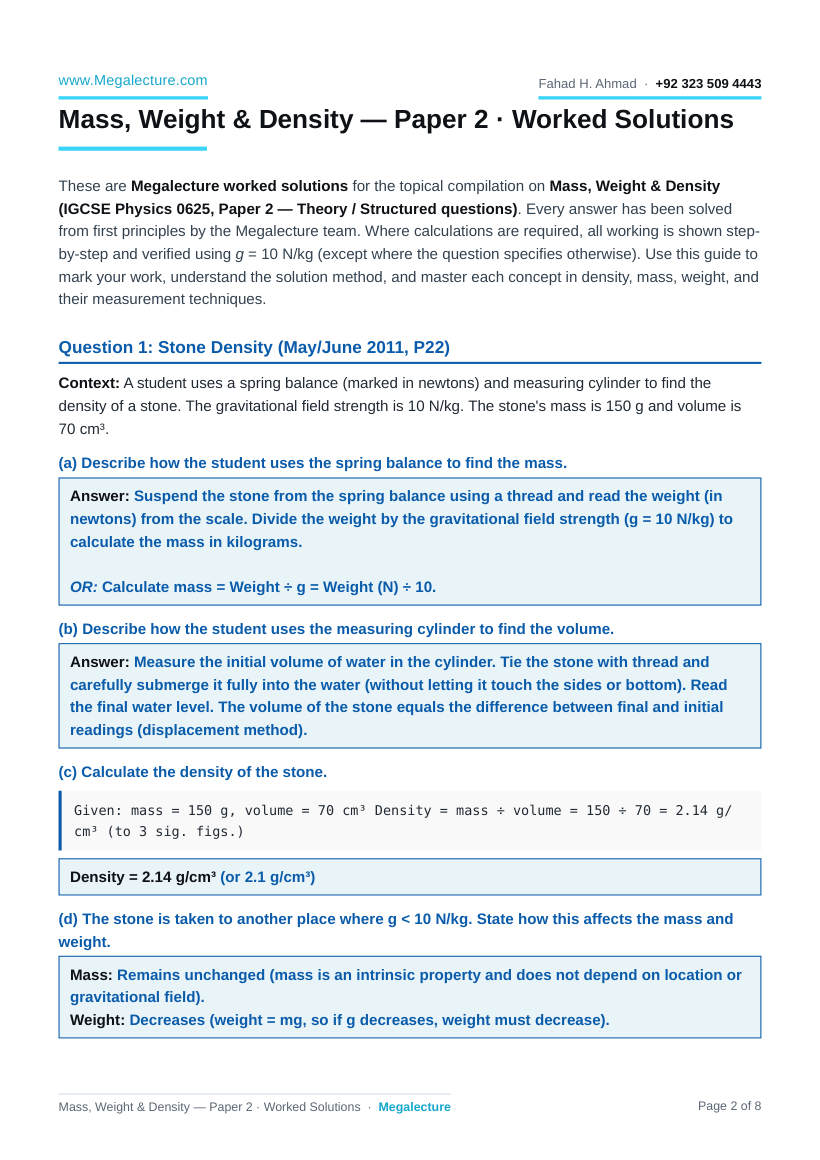
Question 1: Stone Density (May/June 2011, P22)
Context: A student uses a spring balance (marked in newtons) and measuring cylinder to find the density of a stone. The gravitational field strength is 10 N/kg. The stone's mass is 150 g and volume is
70 cm³.
- Describe how the student uses the spring balance to find the mass.
Answer: Suspend the stone from the spring balance using a thread and read the weight (in newtons) from the scale. Divide the weight by the gravitational field strength (g = 10 N/kg) to calculate the mass in kilograms.
OR: Calculate mass = Weight ÷ g = Weight (N) ÷ 10.
- Describe how the student uses the measuring cylinder to find the volume.
Answer: Measure the initial volume of water in the cylinder. Tie the stone with thread and carefully submerge it fully into the water (without letting it touch the sides or bottom). Read the final water level. The volume of the stone equals the difference between final and initial readings (displacement method).
- Calculate the density of the stone.
Given: mass = 150 g, volume = 70 cm³ Density = mass ÷ volume = 150 ÷ 70 = 2.14 g/ cm³ (to 3 sig. figs.)
Density = 2.14 g/cm³ (or 2.1 g/cm³)
- The stone is taken to another place where g < 10 N/kg. State how this affects the mass and weight.
Mass: Remains unchanged (mass is an intrinsic property and does not depend on location or gravitational field).
Weight: Decreases (weight = mg, so if g decreases, weight must decrease).
www.Megalecture.com Fahad H. Ahmad · +92 323 509 4443
Question 2: Plastic Sheet Thickness (May/June 2016, P21)
Context: A thin plastic sheet is too thin to measure directly with a ruler. Its mass is 0.12 g and density is
0.91 g/cm³. Length = 3.0 cm, width = 2.0 cm.
(a)(i) State what is meant by mass.
Answer: Mass is the amount of matter in an object. (It is a measure of the quantity of substance and is constant regardless of location or gravitational field strength.)
(a)(ii) Calculate the volume of the plastic sheet.
Given: mass = 0.12 g, density = 0.91 g/cm³ Using: density = mass ÷ volume ∴ volume
= mass ÷ density = 0.12 ÷ 0.91 = 0.132 cm³ (to 3 sig. figs.)
Volume = 0.132 cm³ (or 0.13 cm³)
(a)(iii) Calculate the thickness of the sheet.
Given: volume = 0.132 cm³, length = 3.0 cm, width = 2.0 cm Area of sheet = length × width = 3.0 × 2.0 = 6.0 cm² Thickness = volume ÷ area = 0.132 ÷ 6.0 = 0.022 cm (or
0.22 mm)
Thickness = 0.022 cm (or 0.22 mm, or 2.2 × 10⁻² cm)
- State a measuring instrument that can be used to measure the thickness accurately.
Answer: A micrometer screw gauge (or vernier calliper), which can measure to 0.01 mm precision.
Question 3: Metal Volume (May/June 2018, P22)
Context: A metal object has a mass of 5.0 kg and a density of 7.5 × 10³ kg/m³.
(c)(i) Define density.
Answer: Density is the mass per unit volume of a substance (ρ = m ÷ V).
OR: Density is the mass of substance contained in a unit volume.
(c)(ii) Calculate the volume of the metal.
Given: mass = 5.0 kg, density = 7.5 × 10³ kg/m³ Using: density = mass ÷ volume ∴ volume = mass ÷ density = 5.0 ÷ (7.5 × 10³) = 5.0 ÷ 7500 = 6.67 × 10⁻⁴ m³ (to 3 sig. figs.)
Volume = 6.67 × 10⁻⁴ m³ (or 6.7 × 10⁻⁴ m³)
www.Megalecture.com Fahad H. Ahmad · +92 323 509 4443
Question 4: Iron & Copper Density (May/June 2019, P22)
Context: A student measures the mass and volume of iron and copper objects using a measuring cylinder. Iron: 400 g, 51 cm³. Copper: 350 g, 39 cm³.
- Describe how to determine the volume of an irregular object with a measuring cylinder.
Answer: Record the initial water level in the measuring cylinder. Tie the irregular object with thread and carefully submerge it fully into the water without letting it touch the sides or bottom of the cylinder. Record the final water level. The volume of the object equals the difference between the final and initial water levels (water displacement method).
- Calculate the density of iron.
Given: mass of iron = 400 g, volume of iron = 51 cm³ Density = mass ÷ volume = 400
÷ 51 = 7.84 g/cm³ (to 3 sig. figs.)
Density of iron = 7.84 g/cm³ (or 7.8 g/cm³)
- A third copper object has the same volume as the iron object (51 cm³). Calculate its mass.
First, find the density of copper: Density of copper = 350 ÷ 39 = 8.97 g/cm³ For copper object with volume = 51 cm³: Mass = density × volume = 8.97 × 51 = 458 g (to
3 sig. figs.)
Mass of copper object = 458 g (or 460 g)
- State and explain what happens to the density of the iron object when it is heated.
Answer: The density decreases. When heated, the iron expands (its volume increases). Since mass remains constant and density = mass ÷ volume, an increase in volume causes the density to decrease.
Question 5: Rock Densities (October/November 2007, P2)
Context: A student measures the mass and volume of four rock samples: A (101 g, 22 cm³), B (202 g, 44 cm³), C (448 g, 80 cm³), D (4508 g, 978 cm³).
(a)(i) Describe in detail how a measuring cylinder is used to find the volume of rock A.
Answer: Record the initial volume of water (or other suitable liquid) in a measuring cylinder by reading at eye level at the bottom of the meniscus. Tie rock A with thread and carefully lower it into the water, ensuring it is fully submerged but does not touch the cylinder walls or bottom.
Read the final water level at eye level. The volume of rock A equals the difference: (final reading) minus (initial reading).
(a)(ii) Explain why the volume of rock D cannot be found with an ordinary laboratory measuring cylinder.
www.Megalecture.com Fahad H. Ahmad · +92 323 509 4443
Answer: Rock D has a volume of 978 cm³. A standard laboratory measuring cylinder typically has a maximum capacity of 100 cm³ (or at most 500 cm³). Rock D is too large to fit inside the cylinder; therefore, the displacement method cannot be used.
- Calculate the density of rock A.
Given: mass of rock A = 101 g, volume of rock A = 22 cm³ Density = mass ÷ volume =
101 ÷ 22 = 4.59 g/cm³ (to 3 sig. figs.)
Density of rock A = 4.59 g/cm³
- Three of the rocks are made from the same material. State and explain which rock is made from a different material.
Calculate the density of each rock: Rock A: 101 ÷ 22 = 4.59 g/cm³ Rock B: 202 ÷ 44
= 4.59 g/cm³ Rock C: 448 ÷ 80 = 5.60 g/cm³ Rock D: 4508 ÷ 978 = 4.61 g/cm³ Rocks A,
B, and D all have a density of approximately 4.6 g/cm³. Rock C has a different density of 5.60 g/cm³.
Rock C is made from a different material.
Explanation: Rocks A, B, and D all have approximately the same density (~4.6 g/cm³), indicating they are made from the same material. Rock C has a noticeably higher density (5.60 g/cm³), which indicates it is composed of different material with greater density.
Question 6: Ice Cube (October/November 2011, P21)
Context: An ice cube has sides of length 0.040 m. Ice at 0°C has a density of 920 kg/m³.
(a)(i) Calculate the mass of the ice cube.
Given: side length = 0.040 m, density of ice = 920 kg/m³ Volume of cube = (side length)³ = (0.040)³ = 6.4 × 10⁻⁵ m³ Using: density = mass ÷ volume ∴ mass = density
× volume = 920 × 6.4 × 10⁻⁵ = 0.0589 kg = 0.059 kg (to 2 sig. figs.) = 59 g
Mass = 0.059 kg (or 59 g)
(a)(ii) Calculate the weight of the ice cube.
Given: mass = 0.059 kg, g = 10 N/kg Weight = mass × g = 0.059 × 10 = 0.59 N
Weight = 0.59 N Question 7: Petrol Tanker (October/November 2012, P21)
www.Megalecture.com Fahad H. Ahmad · +92 323 509 4443
Context: An empty petrol tanker has mass 2800 kg. It holds 30 m³ of petrol (density = 740 kg/m³). When full, a resultant braking force of 30,000 N acts on the tanker.
- Calculate the total mass of the tanker when full of petrol.
Given: mass of tanker (empty) = 2800 kg volume of petrol = 30 m³ density of petrol
= 740 kg/m³ Mass of petrol = density × volume = 740 × 30 = 22,200 kg Total mass = mass of tanker + mass of petrol = 2800 + 22,200 = 25,000 kg
Total mass = 25,000 kg (or 25 tonnes)
- Calculate the deceleration of the tanker.
Given: resultant force = 30,000 N, total mass = 25,000 kg Using: F = ma ∴ acceleration = F ÷ m = 30,000 ÷ 25,000 = 1.2 m/s² Since this is a braking force, the deceleration is 1.2 m/s².
Deceleration = 1.2 m/s² Question 8: Water Container (October/November 2013, P22)
Context: A water container in a wheelbarrow has a volume of 0.15 m³ and is filled with water (density =
1000 kg/m³).
- Calculate the mass of water in the full container.
Given: volume of water = 0.15 m³, density of water = 1000 kg/m³ Mass = density × volume = 1000 × 0.15 = 150 kg
Mass = 150 kg
- It is harder to stop the wheelbarrow when full than when empty. Explain this.
Answer: When the wheelbarrow is full, the total mass (wheelbarrow + water = 150 kg) is greater than when empty. To produce the same deceleration, a larger force must be applied
(since F = ma). Therefore, it requires greater effort to apply the necessary braking force when the container is full.
Alternatively: The full wheelbarrow has greater inertia (resistance to change in motion), so it requires a larger force to achieve the same deceleration.
Question 9: Oil Density from Lever (October/November 2014, P21)
Context: A metre rule balances on a triangular prism at the 50 cm mark. A block of wood is at the 10 cm mark, and a measuring cylinder at the 80 cm mark. When a weight of 0.39 N is placed on the wood, the rule balances again when 60 cm³ of oil is in the cylinder.
www.Megalecture.com Fahad H. Ahmad · +92 323 509 4443
(a)(i) Calculate the weight of the oil in the cylinder.
At balance, moments about the pivot (50 cm mark) are equal: Moment (clockwise) =
Moment (counterclockwise) Let W_oil = weight of oil Moment from wood + weight =
(mass of wood) × (50 − 10) + 0.39 × (50 − 10) = M_wood × 40 + 0.39 × 40 The rule was initially balanced with only wood, so: M_wood × 40 = 0 (the wood must have been placed such that no additional weight is needed) Actually, the problem states the rule balances with wood & empty cylinder initially. When 0.39 N is added and 60 cm³ oil is added: Taking moments about pivot at 50 cm: W_oil × (80 − 50) = 0.39 × (50 −
- W_oil × 30 = 0.39 × 40 W_oil × 30 = 15.6 W_oil = 15.6 ÷ 30 W_oil = 0.52 N
Weight of oil = 0.52 N
(a)(ii) Calculate the mass of the oil in the cylinder.
Given: weight of oil = 0.52 N, g = 10 N/kg Mass = weight ÷ g = 0.52 ÷ 10 = 0.052 kg
= 52 g
Mass of oil = 0.052 kg (or 52 g)
- Calculate the density of the oil.
Given: mass of oil = 0.052 kg, volume of oil = 60 cm³ Convert volume: 60 cm³ = 60 ×
10⁻⁶ m³ = 6.0 × 10⁻⁵ m³ Density = mass ÷ volume = 0.052 ÷ (6.0 × 10⁻⁵) = 867 kg/m³
(to 3 sig. figs.) Alternatively, in g/cm³: Density = 0.052 kg ÷ (60 × 10⁻⁶ m³) =
867 kg/m³ = 0.867 g/cm³ (to 3 sig. figs.)
Density of oil = 867 kg/m³ (or 0.867 g/cm³, or 0.87 g/cm³)
Question 10: Oil Density from Weight-Volume Graph (October/November 2019, P21)
Context: An electronic balance displays weight (in newtons) of a measuring cylinder containing varying volumes of oil. A graph shows weight (N) on the vertical axis and volume (cm³) on the horizontal axis. At v = 0, weight ≈ 1.203 N (empty cylinder). At v = 100 cm³, weight ≈ 2.303 N. The gravitational field strength is 10 N/kg.
Using the graph, determine the density of the oil.
From the graph (Fig. 5.2), extract two points on the line: Point 1: At volume = 0 cm³, weight = 1.203 N (empty cylinder) Point 2: At volume = 100 cm³, weight ≈ 2.303
N The mass of the oil in the cylinder is: Δmass = Δweight ÷ g = (2.303 − 1.203) ÷
10 = 1.100 ÷ 10 = 0.110 kg The change in volume is: Δvolume = 100 cm³ = 100 × 10⁻⁶ m³ = 1.0 × 10⁻⁴ m³ Density = Δmass ÷ Δvolume = 0.110 ÷ (1.0 × 10⁻⁴) = 1100 kg/m³
Alternatively, in g/cm³: Density = 0.110 kg ÷ (100 cm³) = 0.0011 kg/cm³ = 1.1 g/cm³
(to 2 sig. figs.) www.Megalecture.com Fahad H. Ahmad · +92 323 509 4443
Density of oil = 1100 kg/m³ (or 1.1 g/cm³)
www.Megalecture.com Fahad H. Ahmad · +92 323 509 4443
