
IGCSE · Physics · Past papers · Paper 1 (Multiple Choice)
Answer Key
Need more than one subject? All-notes pass: unlimited downloads of every note for a year: unlimited downloads of every note on the site, PKR 999 a year. All packs and courses.
Opens inside this page. Prefer your own PDF app? Open the PDF.
Check yourself
5 quick questions on IGCSE Physics
Tap an answer to see if you are right, and why. Free, no sign-up.
Start the free testNew · free
O Level Physics written answers, marked like a real examiner
Answer a Paper 2 style question by typing or speaking. You get your mark point by point, what the examiner was looking for that you missed, and a model answer. 5 free answers a day with a free account.
Try a written question👍 33 students found these notes useful
Was this note useful?
Full text of Answer Key
www.megalecture.com · www.youtube.com/@megalecture
Fahad H. Ahmad
M.Eng NUS Singapore · B.Eng NUST · 15+ years of teaching experience in Singapore, UAE & Pakistan · 60,000+ subscribers and 20 million+ video lecture views.
IGCSEPHYSICS0625·TOPICALPASTPAPERS
Transfer of Thermal Energy — Paper 1
Worked Answer Key (Multiple Choice)
Free notes, practice tests and live classes Back to megalecture.com
Transfer of Thermal Energy — Paper 1 · Worked Answer Key
These are Megalecture worked answers for the topical multiple-choice compilation on Transfer of
Thermal Energy (IGCSE Physics 0625, Paper 1). Every answer below was reasoned out from first principles by the Megalecture team — there are no formulae to crunch in this topic, so each line gives the one-step physics that fixes the correct letter. Keep three ideas at your fingertips throughout:
conduction (lattice vibrations everywhere, plus fast-moving free electrons in metals), convection (warm fluid becomes less dense and rises, cool fluid is denser and sinks), and radiation (infra-red, travels through a vacuum at the speed of light; dull black surfaces are the best emitters and absorbers, shiny silver surfaces the worst). The questions are grouped by mechanism below; the Exam reference column shows the original Cambridge paper for each item.
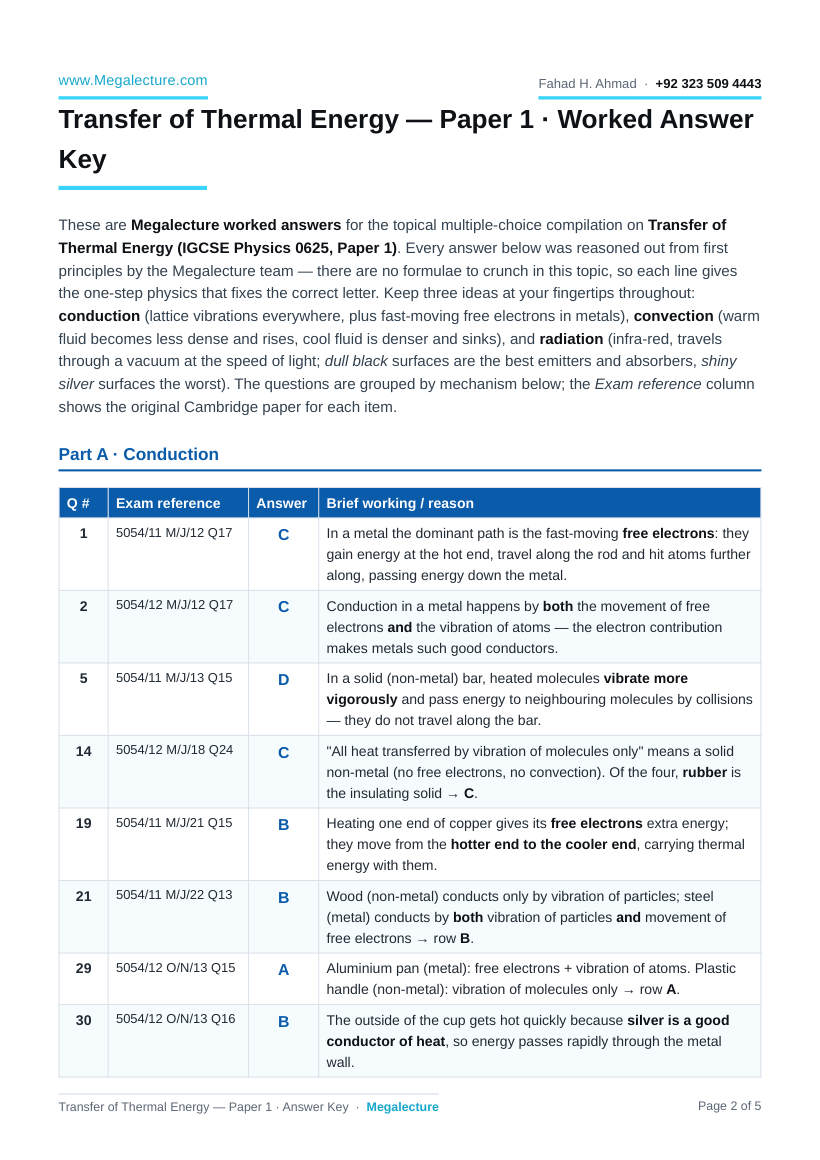
Part A · Conduction Q # Exam reference Answer Brief working / reason
5054/11 M/J/12 Q17
C
In a metal the dominant path is the fast-moving free electrons: they gain energy at the hot end, travel along the rod and hit atoms further along, passing energy down the metal.
5054/12 M/J/12 Q17
C
Conduction in a metal happens by both the movement of free electrons and the vibration of atoms — the electron contribution makes metals such good conductors.
5054/11 M/J/13 Q15
D
In a solid (non-metal) bar, heated molecules vibrate more vigorously and pass energy to neighbouring molecules by collisions
— they do not travel along the bar.
5054/12 M/J/18 Q24
C
"All heat transferred by vibration of molecules only" means a solid non-metal (no free electrons, no convection). Of the four, rubber is the insulating solid → C.
5054/11 M/J/21 Q15
B
Heating one end of copper gives its free electrons extra energy;
they move from the hotter end to the cooler end, carrying thermal energy with them.
5054/11 M/J/22 Q13
B
Wood (non-metal) conducts only by vibration of particles; steel
(metal) conducts by both vibration of particles and movement of free electrons → row B.
5054/12 O/N/13 Q15
A
Aluminium pan (metal): free electrons + vibration of atoms. Plastic handle (non-metal): vibration of molecules only → row A.
5054/12 O/N/13 Q16
B
The outside of the cup gets hot quickly because silver is a good conductor of heat, so energy passes rapidly through the metal wall.
Transfer of Thermal Energy — Paper 1 · Answer Key · Megalecture
Q # Exam reference Answer Brief working / reason
5054/11 O/N/14 Q15
B
Same idea as Q19: in heated copper the energetic free electrons move from the hotter end to the cooler end → B.
5054/12 O/N/14 Q11
D
Copper beats glass as a heat conductor because copper contains free (delocalised) electrons that transport energy quickly; glass has none → D.
5054/11 O/N/17 Q16
C
Conduction "mainly due to the movement of electrons" only happens in metals. Of air, ice, iron, water, the metal is iron → C.
5054/11 O/N/18 Q17
B
Heat flowing through a solid from hot to cold is conduction: energy is passed from one molecule to the next by collisions of vibrating particles → B.
Part B · Convection Q # Exam reference Answer Brief working / reason
5054/11 M/J/13 Q13
B
Convection current: water heated at the base expands, becomes less dense and rises to the surface → B.
5054/12 M/J/15 Q15
B
The heater warms the oil at X; warmed liquid becomes less dense and rises → B.
5054/12 M/J/16 Q16
D
Air near the cooling unit is cooled, so its molecules move closer together and its density increases (it then sinks) → row D.
5054/11 M/J/18 Q20
A
The candle warms the air, which rises and circulates, dragging the smoke round the box. Moving fluid carrying energy is convection →
A.
5054/12 O/N/14 Q12
B
Air at 5 °C lies above the colder ice. Heat reaches the ice by conduction (contact) and radiation. Convection cannot carry heat downward to the ice, so it is conduction and convection only is wrong → conduction and radiation only = B.
5054/12 O/N/16 Q24
B
Convection needs particles free to move and change places, i.e.
fluids: gases and liquids only → B.
5054/12 O/N/20 Q17
A
The loop is B(top-left)–C(top-right)–D(bottom-right)–A(bottom-left). A downward current at P (right side) means the water rises on the left side (A→B). Water rises where it is heated, so the tube is heated at
A.
5054/11 O/N/21 Q12
D
Same physics as Q10: cooled air molecules move closer together and the air density increases → row D.
Part C · Radiation, Emitters & Absorbers
Transfer of Thermal Energy — Paper 1 · Answer Key · Megalecture
Q # Exam reference Answer Brief working / reason
5054/11 M/J/13 Q14
A
A dull black surface is the best absorber and the best emitter, so it absorbs more energy and emits more → "black, black" = A.
5054/11 M/J/15 Q16
A
Solar panels are painted black because black surfaces absorb radiation well, gathering the Sun's energy efficiently → A.
5054/11 M/J/16 Q18
A
Thermal (infra-red) radiation is an electromagnetic wave, so in a vacuum it travels at the speed of light → A. (It is transverse, not longitudinal; black surfaces, not white, emit best.)
5054/12 M/J/16 Q15
D
Heat from a red-hot grill above the bread crosses the air gap as infra-red radiation only (air conducts poorly and convection carries heat upward, away from the bread) → D.
5054/12 M/J/17 Q25
D
Emission ranking: best emitter = dull black, worst = shiny silver. So the surface emitting least is shiny silver and the one emitting most is dull black → row D.
5054/11 M/J/18 Q21
A
The coolest water is in the can that loses heat fastest = best emitter with no lid. Can A is dull black and open (no lid), so it cools most and holds the coolest water → A.
5054/11 M/J/19 Q16
D
Infra-red radiation is electromagnetic, so it can travel in a vacuum and in gases → D.
5054/11 M/J/20 Q21
A
A dull black surface is a good emitter, good absorber and poor reflector of radiation → A.
5054/12 M/J/20 Q23
A
Water cools fastest where most heat is radiated away: the largest exposed face painted black (best emitter, biggest area) → container
A.
5054/12 M/J/22 Q16
C
Space is a vacuum, so only radiation can carry the Sun's energy to the Moon → C.
5054/12 M/J/22 Q17
A
The hottest reading is near the face that emits most radiation = best emitter = dull black → A.
5054/11 O/N/11 Q15
D
A vacuum has no particles, so neither conduction nor convection works; heat crosses it by radiation only → D.
5054/11 O/N/12 Q17
D
The vacuum/space between the walls stops conduction and convection but not radiation. Radiation is cut by making the surfaces shiny, so painting surface S silver reduces the radiated loss → D.
5054/11 O/N/13 Q13
A
The 54 MJ shown is not the whole story; the heater must also replace energy lost by other means (e.g. draughts/air changes), so it supplies more than 54 MJ → A.
5054/11 O/N/16 Q20
A
Transfer by radiation does not require a medium — it is the only mechanism that works through a vacuum → A. (Heat flows hot→cold; transfer up in fluids is mainly convection; solids transfer by conduction, not density changes.) www.Megalecture.com Fahad H. Ahmad · +92 323 509 4443
Transfer of Thermal Energy — Paper 1 · Answer Key · Megalecture
Q # Exam reference Answer Brief working / reason
5054/11 O/N/17 Q17
B
Most radiation absorbed by the best absorber = dull black; most reflected by the best reflector = shiny white → row B.
5054/12 O/N/17 Q18
D
To reduce the radiation emitted, make the surface a poorer emitter, i.e. shinier → D. (A higher temperature or larger area would increase emission.)
5054/12 O/N/21 Q15
B
The best absorber of infra-red radiation is black and dull → B.
Part D · Molecular Behaviour & Cooling Q # Exam reference Answer Brief working / reason
5054/12 M/J/20 Q24
C
Boiling at a constant 100 °C: liquid→gas. The molecule separation increases (3) and the intermolecular forces decrease (1); the speed does not increase because the temperature is unchanged (2 is false) → 1 and 3 only = C.
5054/12 M/J/21 Q18
C
The only process that needs no medium is radiation (conduction and convection both need particles), so "does not require a medium"
= radiation only = C.
5054/11 O/N/12 Q16
D
The drink is kept cool because water evaporating from the wet cloth takes latent heat (energy) from the bottle, cooling the drink →
D.
5054/12 O/N/12 Q17
A
The water cools most rapidly in the can that radiates best = dull
(rough) black surface → "black, rough" = A.
Note from Megalecture. A few items recur across this compilation (the refrigerator-cooling-unit pair Q10/Q41, and the copper-rod conduction pair Q19/Q31); they are answered consistently above. Remember the core rules: in metals conduction is dominated by free electrons; convection only occurs in fluids and is driven by density changes; radiation alone crosses a vacuum, and dull black surfaces are the best emitters and absorbers while shiny silver are the worst.
These are original Megalecture worked solutions prepared for revision use.
Transfer of Thermal Energy — Paper 1 · Answer Key · Megalecture
