
IB Diploma · Maths: Applications and Interpretation · Applications and Interpretation (AI)
Topic 5 Worksheet
Opens inside this page. Prefer your own PDF app? Open the PDF.
Check yourself
5 quick questions on Calculus
Tap an answer to see if you are right, and why. Free, no sign-up.
Start the free testWas this note useful?
Full text of Topic 5 Worksheet
IB DP MATHEMATICS AI Topic 5 · Calculus TOPICAL WORKSHEET
5.1 Differentiation & Rates of Change · 5.2 Kinematics & Optimization
5.3 Integration & Area · 5.4 Kinematics using Integration
Standard and Higher Level · Syllabus 2025
Fahad H. Ahmad
Original exam-style questions written for the IB Diploma Programme Mathematics course (first assessment 2025)
Free notes, practice tests and live classes Back to megalecture.com
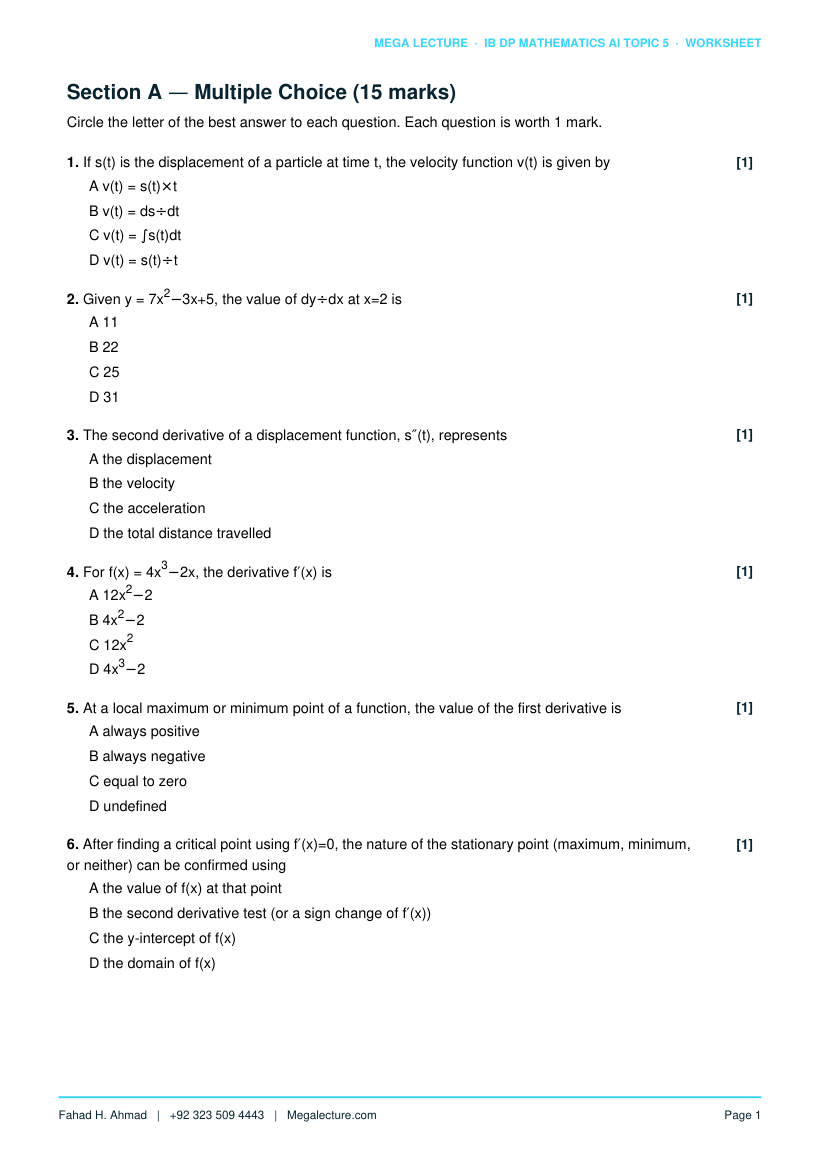
Section A — Multiple Choice (15 marks)
Circle the letter of the best answer to each question. Each question is worth 1 mark.
- If s(t) is the displacement of a particle at time t, the velocity function v(t) is given by [1]
A v(t) = s(t)×t
B v(t) = ds÷dt
C v(t) = ∫s(t)dt
D v(t) = s(t)÷t
- Given y = 7x2−3x+5, the value of dy÷dx at x=2 is [1]
A 11
B 22
C 25
D 31
- The second derivative of a displacement function, s″(t), represents [1]
A the displacement
B the velocity
C the acceleration
D the total distance travelled
- For f(x) = 4x3−2x, the derivative f′(x) is [1]
A 12x2−2
B 4x2−2
C 12x2
D 4x3−2
- At a local maximum or minimum point of a function, the value of the first derivative is [1]
A always positive
B always negative
C equal to zero
D undefined
- After finding a critical point using f′(x)=0, the nature of the stationary point (maximum, minimum, or neither) can be confirmed using
[1]
A the value of f(x) at that point
B the second derivative test (or a sign change of f′(x))
C the y-intercept of f(x)
D the domain of f(x)
- If, at a certain time, a particle's velocity v(t)=0 but its acceleration a(t)≠0, the particle is [1]
A permanently at rest
B moving at constant speed
C instantaneously at rest, and about to change direction
D accelerating forever
- To minimize f(x) = x2+16÷x for x > 0, the value of x at the minimum is [1]
A 1
B 2
C 4
D 8
- ∫3x2dx is equal to [1]
A 6x+C
B x3+C
C 3x3+C
D x2+C
- An indefinite integral always includes [1]
A a definite numerical answer
B a constant of integration, C
C the limits of integration
D a negative sign
- ∫(4x−1)dx is equal to [1]
A 4x2−x+C
B 2x2−x+C
C 4x−x2+C
D 2x2+C
- The definite integral ∫a bf(x)dx represents [1]
A the gradient of f(x) at x=a
B the (net signed) area between the curve y=f(x) and the x-axis, from x=a to x=b
C the maximum value of f(x)
D the value of f(x) at x=b
- If v(t) is the velocity of a particle, ∫v(t)dt represents [1]
A the acceleration
B the displacement
C the speed
D the jerk (rate of change of acceleration)
- The value of ∫0 23x2dx is [1]
A 4
B 6
C 8
D 12
- Unlike displacement, calculating the total distance travelled by a particle over an interval where its velocity changes sign requires
[1]
A integrating v(t) directly over the whole interval
B integrating |v(t)| (splitting the interval at each sign change and taking absolute values)
C differentiating v(t) instead of integrating
D using only the initial and final velocities
Section B — Structured Questions (65 marks)
Answer all questions in the space provided. Working must be shown for full marks.
5.1 Differentiation: Rates of Change
Question 1 [7 marks]
A particle moves in a straight line so that its displacement, s(t) metres, after t seconds, is given by s(t) = t3−6t2+9t. The graph shows s(t) (computed).
Displacement, s(t) = t3−6t2+9t (computed).
- Find an expression for the velocity, v(t), of the particle. [2]
- Calculate the velocity of the particle at t=2. [2]
- Find the times at which the particle is momentarily at rest (v(t)=0). [3]
Question 2 [6 marks]
For the particle in Question 1, the velocity is v(t) = 3t2−12t+9.
- Find an expression for the acceleration, a(t), of the particle. [2]
- Calculate the acceleration of the particle at t=0. [2]
- Find the time at which the acceleration is zero. [2]
5.2 Applications: Kinematics & Optimization
Question 3 [7 marks]
An open-topped box with a square base of side x cm and height h cm is to be built with a fixed volume of 32 000 cm3. The surface area of the box is given by S(x) = x2+128000÷x. The graph shows S(x) (computed).
Box surface area, S(x) = x2+128000÷x (computed).
- Using the graph, estimate the value of x that minimizes the surface area. [2]
- Using calculus, find dS÷dx, and hence find the exact value of x that minimizes the surface area.
[3]
- Calculate the minimum surface area. [2]
Question 4 [6 marks]
A ball is thrown vertically upwards. Its height, h(t) metres, after t seconds, is given by h(t) = 30t−5t2.
- Find an expression for the velocity, v(t) = dh÷dt, of the ball. [2]
- Find the time at which the ball reaches its maximum height (v(t)=0). [2]
- Calculate the maximum height reached by the ball. [2]
5.3 Integration: Anti-differentiation & Area
Question 5 [7 marks]
A particle has acceleration a(t) = 6t−4 (in m s−2), and an initial velocity v(0)=2 m s−1. The graph shows the velocity function v(t) (computed).
Velocity, v(t) = 3t2−4t+2 (computed).
- By integrating a(t), and using the given initial condition, find an expression for the velocity, v(t). [3]
- Calculate the velocity at t=2. [2]
- By considering the discriminant of 3t2−4t+2, explain why the particle's velocity is never zero. [2]
Question 6 [6 marks]
Consider the function f(x) = 4x3−6x+5.
- Find ∫(4x3−6x+5)dx. [2]
- Evaluate the definite integral ∫1
3(4x3−6x+5)dx. [4]
5.4 Applications: Kinematics using Integration
Question 7 [7 marks]
For the particle in Question 5, with velocity v(t) = 3t2−4t+2 and initial displacement s(0)=5 m, the graph shows v(t) with the region representing the displacement between t=0 and t=2 shaded (computed).
Velocity, v(t) = 3t2−4t+2, shaded area [0,2] (computed).
- By integrating v(t), and using the given initial condition, find an expression for the displacement, s(t).
[3]
- Calculate the displacement of the particle at t=2. [2]
- Using the shaded area on the graph (i.e. the definite integral ∫0
2v(t)dt), find the change in displacement (the distance moved) between t=0 and t=2.
[2]
Question 8 [6 marks]
The curve y = 6x−x2−5 intersects the x-axis at two points.
- Find the x-coordinates of the points where the curve intersects the x-axis. [2]
- Calculate the area enclosed between the curve and the x-axis, between these two points. [4]
5.1 Differentiation: Rates of Change
Question 9 [7 marks]
For the particle in Question 1 (with velocity v(t) = 3t2−12t+9), the graph shows v(t) over 0≤t≤4, with the regions where the particle moves forward and backward shaded differently (computed).
Velocity, v(t) = 3t2−12t+9, direction shading (computed).
- Using the graph, write down the time intervals during which the particle is moving forward (v(t) > 0) and backward (v(t) < 0).
[2]
- Using s(t) = t3−6t2+9t, calculate the total displacement of the particle between t=0 and t=4. [2]
- Using s(0)=0, s(1)=4, s(3)=0 and s(4)=4, calculate the total distance travelled by the particle between t=0 and t=4.
[3]
Question 10 [6 marks]
Consider the function f(x) = 5x4−3x2+7x−2.
- Find f′(x). [2]
- Calculate f′(1). [2]
- State, with a reason, whether f(x) is increasing or decreasing at x=1. [2]
