
IB Diploma · Maths: Applications and Interpretation · Applications and Interpretation (AI)
Topic 3: Geometry and Trigonometry
Opens inside this page. Prefer your own PDF app? Open the PDF.
Full text of Topic 3: Geometry and Trigonometry
IB DP MATHEMATICS Applications and Interpretation (AI) Topic 3 Geometry and Trigonometry
Revision Notes · Standard and Higher Level Fahad H. Ahmad
+92 323 509 4443 | Megalecture.com
Original notes prepared for the IB Diploma Programme Mathematics: Applications and Interpretation course (first assessment 2021)
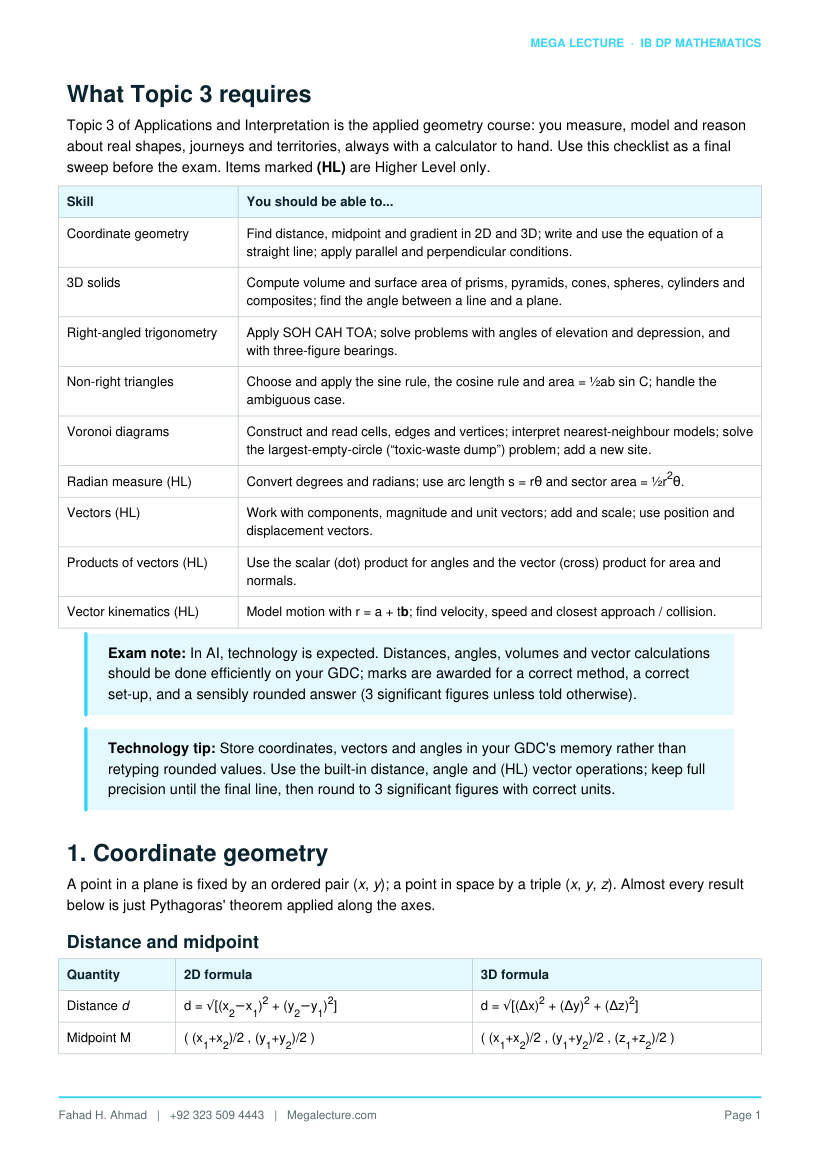
What Topic 3 requires
Topic 3 of Applications and Interpretation is the applied geometry course: you measure, model and reason about real shapes, journeys and territories, always with a calculator to hand. Use this checklist as a final sweep before the exam. Items marked (HL) are Higher Level only.
Skill You should be able to...
Coordinate geometry Find distance, midpoint and gradient in 2D and 3D; write and use the equation of a straight line; apply parallel and perpendicular conditions.
3D solids Compute volume and surface area of prisms, pyramids, cones, spheres, cylinders and composites; find the angle between a line and a plane.
Right-angled trigonometry Apply SOH CAH TOA; solve problems with angles of elevation and depression, and with three-figure bearings.
Non-right triangles Choose and apply the sine rule, the cosine rule and area = ½ab sin C; handle the ambiguous case.
Voronoi diagrams Construct and read cells, edges and vertices; interpret nearest-neighbour models; solve the largest-empty-circle (“toxic-waste dump”) problem; add a new site.
Radian measure (HL) Convert degrees and radians; use arc length s = rθ and sector area = ½r2θ.
Vectors (HL) Work with components, magnitude and unit vectors; add and scale; use position and displacement vectors.
Products of vectors (HL) Use the scalar (dot) product for angles and the vector (cross) product for area and normals.
Vector kinematics (HL) Model motion with r = a + tb; find velocity, speed and closest approach / collision.
Exam note: In AI, technology is expected. Distances, angles, volumes and vector calculations should be done efficiently on your GDC; marks are awarded for a correct method, a correct set-up, and a sensibly rounded answer (3 significant figures unless told otherwise).
Technology tip: Store coordinates, vectors and angles in your GDC's memory rather than retyping rounded values. Use the built-in distance, angle and (HL) vector operations; keep full precision until the final line, then round to 3 significant figures with correct units.
1. Coordinate geometry
A point in a plane is fixed by an ordered pair (x, y); a point in space by a triple (x, y, z). Almost every result below is just Pythagoras' theorem applied along the axes.
Distance and midpoint
Quantity 2D formula 3D formula
Distance d d = √[(x2−x1)2 + (y2−y1)2] d = √[(Δx)2 + (Δy)2 + (Δz)2]
Midpoint M ( (x1+x2)/2 , (y1+y2)/2 ) ( (x1+x2)/2 , (y1+y2)/2 , (z1+z2)/2 )
The distance formula is Pythagoras in disguise: the straight-line gap is the hypotenuse of a right triangle whose legs are the differences in each coordinate. In 3D you simply add a third squared difference.
Gradient and equation of a line
The gradient (slope) of the line through (x1, y1) and (x2, y2) is m = (y2 − y1) / (x2 − x1), the rise over the run. A line can then be written in point-gradient form y − y1 = m(x − x1), in gradient-intercept form y = mx + c, or in general form ax + by + d = 0.
Parallel and perpendicular lines
Parallel lines have equal gradients: m1 = m2. Perpendicular lines have gradients whose product is −1: m1 m2 = −1, so each gradient is the negative reciprocal of the other (m2 = −1 / m1).
Common pitfall: The perpendicular rule needs the negative reciprocal, not just the reciprocal. If m1 = ½ then m2 = −2, not +2. A horizontal line (gradient 0) is perpendicular to a vertical line (undefined gradient) — the product rule breaks down there, so treat that case separately.
Worked example 1 — perpendicular line
Find the equation of the line through P(2, 7) that is perpendicular to the line joining A(−1, 2) and B(3, 4).
Gradient of AB: m1 = (4 − 2) / (3 − (−1)) = 2 / 4 = ½.
Perpendicular gradient: m2 = −1 / m1 = −2.
Through P(2, 7): y − 7 = −2(x − 2), so y = −2x + 11.
Check: m1 m2 = (½)(−2) = −1. ✓
Figure 1. Perpendicular gradients. The line through A(−1, 2) and B(3, 4) has gradient m1 = ½; the perpendicular through the midpoint M(1, 3) has gradient m2 = −2, so m1·m2 = −1 (negative reciprocals; the small square marks the right angle).
Worked example 2 — 3D distance and midpoint
Find the distance and midpoint of A(1, 2, 2) and B(4, 6, 14), and verify that C(2.5, 4, 8) is the midpoint.
Coordinate differences: Δx = 3, Δy = 4, Δz = 12.
Distance: AB = √(32 + 42 + 122) = √(9 + 16 + 144) = √169 = 13.
Midpoint: ((1+4)/2, (2+6)/2, (2+14)/2) = (2.5, 4, 8) = C, so C is the midpoint. ✓
2. Three-dimensional solids
You must know the volume and surface-area formulas for the standard solids and be able to combine them for composite objects (a silo = cylinder + hemisphere, a pencil = cylinder + cone, and so on). All of these are in the AI data booklet, but knowing them saves time.
Solid Volume Surface area
Cuboid / prism V = (base area) × length sum of all faces
Cylinder (r, h) V = πr2h 2πr2 + 2πrh
Cone (r, h, slant l) V = ⅓πr2h πr2 + πrl, l = √(r2+h2)
Sphere (r) V = ⅔πr3 4πr2
Pyramid (base A, height h)
V=⅓×A×h base + triangular faces
Read the wording carefully: height means the perpendicular height, while slant height l is the sloping face of a cone or pyramid. For hemispheres, halve the sphere volume but remember the flat circular face when the surface is “closed”.
Worked example 3 — composite solid (cone + hemisphere)
An ice-cream consists of a cone of radius 3 cm and height 10 cm, topped by a hemisphere of radius 3 cm. Find the total volume, to 3 significant figures.
Cone: V = ⅓πr2h = ⅓π(32)(10) = 30π ≈ 94.2 cm3.
Hemisphere: V = ⅔πr3 = ⅔π(33) = ⅔π(27) = 18π ≈ 56.5 cm3.
Total: 30π + 18π = 48π ≈ 151 cm3.
Figure 2. Composite solid for Worked example 3: a cone of radius r = 3 cm and height h = 10 cm capped by a hemisphere of radius 3 cm. Volume = 30π + 18π = 48π ≈ 151 cm3 (slant l = √109 ≈ 10.4 cm).
Angle between a line and a plane
To find the angle a line makes with a plane, drop a perpendicular from a point on the line onto the plane and join the foot of that perpendicular to where the line meets the plane. The required angle sits in the right triangle so formed — it is the angle between the line and its projection (shadow) on the plane, and it is found with basic right-angled trigonometry.
Method: 1) Sketch the solid. 2) Identify the projection of the line onto the plane. 3) Mark the right angle where the vertical meets the plane. 4) Use tan θ = opposite / adjacent in that triangle.
Worked example 4 — angle between a line and a plane
A rectangular box has a base 8 cm by 6 cm and height 5 cm. Find the angle between the space diagonal (base corner to the opposite top corner) and the base.
The diagonal's projection on the base is the base diagonal: √(82 + 62) = √100 = 10 cm.
The 5 cm height is perpendicular to the base, so tan θ = opposite / adjacent = 5 / 10 = 0.5.
θ = tan−1(0.5) ≈ 26.6°.
Worked example 4B — surface area and volume of a silo
A grain silo is a cylinder of radius 2 m and height 5 m, capped by a hemisphere of radius 2 m. Find its external surface area (including the flat base) and its volume.
Curved cylinder: 2πrh = 2π(2)(5) = 20π. Hemisphere: 2πr2 = 8π. Base circle: πr2 = 4π.
Surface area = 20π + 8π + 4π = 32π ≈ 101 m2.
Volume = πr2h + ⅔πr3 = 20π + ⅔π(8) = 20π + (16/3)π ≈ 79.6 m3.
3. Right-angled trigonometry
In a right-angled triangle, label the sides relative to the angle θ: the hypotenuse (opposite the right angle), the opposite and the adjacent. The three ratios are remembered as SOH CAH TOA.
sin θ = O / H cos θ = A / H tan θ = O / A
To find an unknown angle, apply the inverse function (sin−1, cos−1, tan−1) on your GDC — and make sure the calculator is in degree mode for SL problems.
Elevation, depression and bearings
The angle of elevation is measured upward from the horizontal to a line of sight; the angle of depression is measured downward from the horizontal. These two are equal for the same pair of points (alternate angles between parallel horizontals).
- A three-figure bearing is an angle measured clockwise from north, always written with three digits: 060°, 135°, 305°.
- Due north is 000°, east is 090°, south is 180°, west is 270°.
- Navigation problems are usually solved by resolving each leg into north and east components, or by drawing the triangle and using the sine / cosine rule.
Exam technique: Always draw the north arrow at each point before measuring a bearing. A back-bearing (the return direction) differs from the forward bearing by exactly 180°.
Worked example 5 — angles of depression
From the top of a 40 m lighthouse, the angles of depression of two boats directly in line with the base are 35° (nearer) and 20° (farther). Find the distance between the boats.
Each horizontal distance satisfies tan(depression) = height / distance.
Near boat: d1 = 40 / tan 35° ≈ 57.1 m. Far boat: d2 = 40 / tan 20° ≈ 109.9 m.
Distance between boats = 109.9 − 57.1 ≈ 52.8 m.
Worked example 6 — bearings and the cosine rule
A plane flies 200 km on bearing 040°, then 150 km on bearing 110°. Find its distance and bearing from the start.
The heading turns by 110° − 40° = 70°, so the interior angle of the triangle at the turning point is 180° − 70° = 110°.
Cosine rule: d2 = 2002 + 1502 − 2(200)(150)cos 110° ≈ 83 021, so d ≈ 288 km.
Sine rule at the start: sin θ = 150 sin 110° / 288 ≈ 0.489, so θ ≈ 29.3°.
Bearing of finish from start = 040° + 29.3° ≈ 069°.
4. Non-right-angled triangles
When a triangle has no right angle, use the sine and cosine rules. Label each vertex with a capital letter and the side opposite it with the matching lower-case letter (side a is opposite angle A).
Rule Statement Use it when you know...
Sine rule a / sin A = b / sin B = c / sin C two angles and a side, or two sides and a non-included angle
Cosine rule a2 = b2 + c2 − 2bc cos A two sides and the included angle (find the third side)
Cosine rule (angle) cos A = (b2 + c2 − a2) / (2bc) all three sides (find any angle)
Area Area = ½ ab sin C two sides and the included angle
The ambiguous case
The sine rule can give two valid triangles when you are given two sides and a non-included (“wrong”) angle. Because sin(180° − θ) = sin θ, the calculator returns only the acute angle; the obtuse partner (180° − that angle) may also fit. Always check whether the second angle still leaves a positive third angle.
Worked example 7 — cosine rule
A triangular plot has sides b = 8 m and c = 11 m enclosing an angle A = 40°. Find the third side a and then the angle B.
Cosine rule: a2 = 82 + 112 − 2(8)(11)cos 40° = 64 + 121 − 176(0.766) = 50.2.
So a = √50.2 ≈ 7.08 m.
Sine rule for B: sin B = (b sin A) / a = (8 sin 40°) / 7.08 = 0.726, so B ≈ 46.6° (and C ≈ 93.4°).
Sanity check: the largest side c = 11 faces the largest angle C. ✓
Figure 3. The triangle of Worked example 7. Two sides b = 8 and c = 11 enclose angle A = 40°; the cosine rule gives a ≈
7.08 m, and the sine rule then gives B ≈ 46.6° and C ≈ 93.4° (largest side c faces the largest angle C).
Worked example 8 — area from the sine rule
A triangular field ABC has A = 52°, B = 63° and side a (opposite A) = 45 m. Find its area.
Third angle: C = 180° − 52° − 63° = 65°.
Sine rule for b: b = a sin B / sin A = 45 sin 63° / sin 52° ≈ 50.9 m.
Area = ½ ab sin C = ½(45)(50.9) sin 65° ≈ 1040 m2.
5. Voronoi diagrams
A Voronoi diagram partitions the plane around a set of fixed points, called sites (or seeds), so that every location is assigned to its nearest site. It is the mathematics behind “which store / hospital / cell tower is closest to me?”
Feature Meaning
Site A given fixed point (shop, sensor, town). Each site owns one cell.
Cell The region of all points nearer to that site than to any other site.
Edge A boundary between two cells. It lies on the perpendicular bisector of the segment joining the two sites, so points on it are equidistant from both.
Vertex A point where three (or more) edges meet, equidistant from three sites.
Because every edge is a perpendicular bisector, you can build a diagram by hand: for each neighbouring pair of sites, find the midpoint of the segment, take the negative-reciprocal gradient, and draw that line — then keep only the portion that genuinely separates the two nearest cells.
Worked example 9 — a Voronoi edge
Two mobile masts stand at A(1, 2) and B(5, 4). Find the equation of the Voronoi edge between them, and state which side a phone at the origin connects to.
Midpoint of AB: M = ((1+5)/2, (2+4)/2) = (3, 3).
Gradient of AB: (4 − 2)/(5 − 1) = ½, so the edge gradient is −2.
Edge (perpendicular bisector): y − 3 = −2(x − 3), i.e. y = −2x + 9.
Origin: distance to A = √5 ≈ 2.24; to B = √41 ≈ 6.40. The origin is nearer A, so it connects to mast A (the side where y < −2x + 9).
Figure 4. Voronoi diagram of five sites A to E; each shaded cell holds the points nearest that site. Every edge is the perpendicular bisector of two neighbouring sites — the dashed red line is the bisector of A and D, and all of its points are equidistant from A and D.
Nearest neighbour and the largest empty circle
The toxic-waste-dump (or largest-empty-circle) problem asks for the location inside a region that is as far as possible from every site — useful for siting something you want far from existing facilities, or a new facility in an under-served gap. The optimum almost always lies at a Voronoi vertex: check each vertex, compute its distance to the (equidistant) nearest sites, and pick the largest. Boundary points of the region should also be checked.
Adding a new site
When a new site is added, it “steals” the parts of surrounding cells that are now closer to it. Draw the perpendicular bisectors between the new site and each nearby existing site; these carve out the new cell, and the neighbouring cells shrink accordingly.
Common pitfall: A Voronoi edge is the perpendicular bisector of the segment between two sites — not the segment itself, and not a line through the sites. Points on an edge are equidistant from the two neighbouring sites.
Worked example 10 — largest empty circle
Four sensors sit at the corners of a square: O(0, 0), A(6, 0), B(0, 6), C(6, 6). Find the point inside the square that is as far as possible from every sensor, and that distance.
By symmetry the perpendicular bisectors all meet at the centre, a single Voronoi vertex at (3, 3), equidistant from all four sensors.
Distance from (3, 3) to any corner = √(32 + 32) = √18 ≈ 4.24 units.
A new facility placed at (3, 3) is 4.24 units from the nearest sensor — the maximum possible inside the square, i.e. the largest-empty-circle solution.
Where Voronoi diagrams are used
- Retail and services: assigning each address to its nearest store, depot, school or hospital.
- Telecommunications: deciding which mast or Wi-Fi access point serves each location.
- Ecology and geology: modelling the territory or resource zone nearest each nest, tree or well.
- Planning: finding under-served gaps (large empty circles) where a new facility is most needed.
6. Radian measure (HL)
At HL, angles are also measured in radians. One radian is the angle subtended at the centre of a circle by an arc equal in length to the radius. A full turn is 2π radians, so:
180° = π radians degrees → radians: × π/180 radians → degrees: × 180/π
With θ in radians, arc length and sector area take their simplest form:
arc length s = rθ sector area A = ½ r2 θ
Common pitfall: s = rθ and A = ½r2θ are valid only in radians. If the angle is in degrees, either convert first, or use the fraction (θ/360) of the full circle. Set your GDC to the correct angle mode before every trigonometric calculation.
Worked example 11 — arc and sector in context (HL)
A windscreen wiper of length 45 cm sweeps through an angle of 140°. Find the area of glass it cleans.
Convert to radians: 140° × π/180 ≈ 2.443 rad.
Area = ½ r2 θ = ½(452)(2.443) ≈ 2470 cm2.
The tip travels an arc s = rθ = 45(2.443) ≈ 110 cm.
Figure 5. A circular sector of radius r = 8 cm and angle θ = 1.2 rad (as in ‘Test yourself’ Q9). Arc length s = rθ = 9.6 cm; sector area = ½r2θ = 38.4 cm2.
7. Vectors (HL)
A vector has both magnitude and direction; a scalar has magnitude only. In 2D or 3D a vector is written in component (column) form, for example v = (v1, v2, v3), or as v1i + v2j + v3k using the unit base vectors along the axes.
Concept Definition / formula
Magnitude |v| = √(v1
2 + v2 2 + v3 2)
Addition add components: (a1+b1, a2+b2, ...). Geometrically, tip-to-tail.
Scalar multiple kv scales the length by |k|; a negative k reverses direction.
Unit vector ŵ = v / |v| (same direction, magnitude 1)
Position vector displacement of a point from the origin O; the point P has position vector OP.
Displacement vector AB = OB − OA (from A to B); depends only on the two endpoints.
Distinguish a position vector (where something is, measured from the origin) from a displacement vector (how you get from one point to another). The displacement AB is found by subtracting position vectors: AB = b − a.
Common pitfall: A vector and a scalar are different objects: |v| is a number (a length), while v carries direction too. Never set a vector equal to a scalar, and remember a unit vector is found by dividing by the magnitude, not by subtracting it.
Worked example 13 — resultant velocity (HL)
A boat points due north and moves at 8 km h−1 relative to the water; a current flows due east at 3 km h−1. Find the boat's ground velocity, its ground speed, and its true bearing.
Add the velocity vectors: (0, 8) + (3, 0) = (3, 8) km h−1 (east, north).
Ground speed = |(3, 8)| = √(9 + 64) = √73 ≈ 8.54 km h−1.
Bearing = tan−1(3 / 8) ≈ 20.6° east of north, i.e. bearing ≈ 021°.
8. Scalar and vector products (HL)
There are two ways to “multiply” vectors, and they answer different questions.
Scalar (dot) product
The dot product returns a number. Two equivalent forms are used:
a · b = a1b1 + a2b2 + a3b3 a · b = |a| |b| cos θ
Equating the two forms gives the angle between the vectors: cos θ = (a · b) / (|a| |b|). If a · b = 0 (and neither vector is zero) the vectors are perpendicular.
Worked example 12 — angle between vectors (HL)
Find the angle between u = (2, 3, −1) and v = (1, −2, 4).
Dot product: u · v = (2)(1) + (3)(−2) + (−1)(4) = 2 − 6 − 4 = −8.
Magnitudes: |u| = √(4+9+1) = √14 ≈ 3.742; |v| = √(1+4+16) = √21 ≈ 4.583.
cos θ = −8 / (3.742 × 4.583) = −8 / 17.15 = −0.4666.
So θ = cos−1(−0.4666) ≈ 117.8° (obtuse, as the negative dot product predicts).
Figure 6. Finding the angle between two vectors with the scalar product. For u = (4, 2) and v = (1, 3), u·v = 10 while |u| = √20 and |v| = √10, so cosθ = 10 / (√20·√10) = 0.7071 and θ = 45°.
Vector (cross) product
The cross product a × b returns a vector that is perpendicular to both a and b (a normal to the plane they span). Its magnitude is |a × b| = |a| |b| sin θ, which equals the area of the parallelogram formed by the two vectors; half of that is the area of the triangle. The cross product is therefore the tool for areas and for finding a direction at right angles to a surface.
Remember: Dot product → a scalar, used for angles and perpendicularity. Cross product → a vector, used for area and for a normal direction. Mixing them up is a classic slip.
Worked example 12B — triangle area from the cross product (HL)
A triangle has vertices A, B, C with AB = (2, 1, 2) and AC = (1, 3, 0). Find its area.
Cross product AB × AC = ( (1)(0) − (2)(3), (2)(1) − (2)(0), (2)(3) − (1)(1) ) = (−6, 2, 5).
Magnitude: |AB × AC| = √(36 + 4 + 25) = √65 ≈ 8.06.
Triangle area = ½ |AB × AC| ≈ 4.03 square units.
9. Lines and kinematics with vectors (HL)
A straight line in vector form is written r = a + tb, where a is the position vector of a known point on the line, b is a direction vector, and t is a parameter. Different values of t trace out the whole line.
For a moving object this becomes a motion model. If the object starts at r0 and moves with constant velocity v, its position at time t is:
r = r0 + tv speed = |v|
Figure 7. Constant-velocity motion r = r0 + tv with r0 = (1, 1) and v = (2, 1). The marked positions at t = 0, 1, 2 are (1, 1), (3, 2) and (5, 3); the green arrow is the velocity v, and the speed is |v| = √5 ≈ 2.24.
Here the direction vector is the velocity, and its magnitude |v| is the (constant) speed. Two objects collide only if they occupy the same position at the same value of t; if their paths cross but at different times, there is no collision — only a closest approach.
Closest approach
To find the closest approach between two objects, form the relative displacement d(t) = rB(t) − rA(t), write the squared distance |d(t)|2 as a quadratic in t, and minimise it (vertex of the parabola, or set the derivative to zero).
Worked example 14 — closest approach (HL)
Two drones have positions (in km, t in hours) rA = (−4, 3) + t(3, 1) and rB = (2, −5) + t(1, 3). Find their closest approach.
Relative position: d = rB − rA = (6, −8) + t(−2, 2) = (6 − 2t, −8 + 2t).
Squared distance: |d|2 = (6 − 2t)2 + (2t − 8)2 = 8t2 − 56t + 100.
Minimum where derivative 16t − 56 = 0, i.e. t = 3.5 h.
Then |d|2 = 8(3.5)2 − 56(3.5) + 100 = 2, so the closest distance is √2 ≈ 1.41 km at t = 3.5 h (they do not collide).
10. Applications and modelling with vectors (HL)
Vectors model any quantity with size and direction: displacement, velocity, force, and current or wind. Two frequent AI applications are:
- Navigation in a current or wind. The resultant velocity is the vector sum of the craft's own velocity and the flow. Add the two velocity vectors to find the true course (ground track) and ground speed
|resultant|.
- Relative velocity. The velocity of B as seen from A is vB − vA; this drives interception, pursuit and closest-approach problems.
- Static equilibrium. When forces balance, the vectors sum to the zero vector; components in each direction separately add to zero.
Modelling note: State your assumptions (constant velocity, no acceleration, a flat plane) and give a final answer with units and sensible rounding. AI rewards a clear real-world interpretation of the mathematics as much as the computation itself.
Worked example 13B — relative velocity (HL)
Ship A moves with velocity (5, 2) km h−1 and ship B with velocity (1, 6) km h−1. Find the velocity and speed of B relative to A.
Relative velocity: vB − vA = (1 − 5, 6 − 2) = (−4, 4) km h−1.
Relative speed: |(−4, 4)| = √(16 + 16) = √32 ≈ 5.66 km h−1.
From A's viewpoint, B appears to travel north-west (equal negative-east and positive-north components).
Common pitfalls at a glance
- Using the reciprocal instead of the negative reciprocal for perpendicular gradients (m1 m2 = −1).
- Leaving the GDC in the wrong angle mode: radians vs degrees. Arc and sector formulas need radians; SL bearings and triangles use degrees.
- Forgetting the ambiguous case of the sine rule — checking only the acute angle when an obtuse solution also fits.
- Treating a Voronoi edge as the segment between two sites, when it is the perpendicular bisector of that segment.
- Confusing the scalar (dot) product with the vector (cross) product, or a vector with its magnitude.
- Using slant height for perpendicular height (or vice versa) in cone and pyramid formulas.
- Rounding intermediate values too early; keep full precision on the GDC and round only the final answer.
Quick-reference formula table
Result Formula
Distance (3D) d = √[(Δx)2 + (Δy)2 + (Δz)2]
Midpoint M = ((x1+x2)/2, (y1+y2)/2, (z1+z2)/2)
Gradient m = (y2 − y1)/(x2 − x1); perpendicular: m1m2 = −1
Cone / sphere Vcone = ⅓πr2h; Vsphere = ⅔πr3; Asphere = 4πr2
Result Formula
SOH CAH TOA sin θ = O/H; cos θ = A/H; tan θ = O/A
Sine rule a / sin A = b / sin B = c / sin C
Cosine rule a2 = b2 + c2 − 2bc cos A
Triangle area Area = ½ ab sin C
Voronoi edge perpendicular bisector of the segment joining two sites
Arc / sector (HL) s = rθ; A = ½ r2θ (θ in radians)
Vector magnitude (HL) |v| = √(v1
2 + v2 2 + v3 2)
Dot product (HL) a · b = |a||b| cos θ = a1b1 + a2b2 + a3b3
Vector line / motion (HL) r = a + tb; r = r0 + tv; speed = |v|
Test yourself
Attempt all ten without notes, then check against the full worked answers below. Questions 9 and 10 are Higher Level.
- Points A(1, 2, 2) and B(4, 6, 14). Find the distance AB and the midpoint of AB.
- Find the equation of the line through (4, 1) perpendicular to 2x + 3y = 12.
- A solid is a cone (radius 3 cm, height 10 cm) topped by a hemisphere of radius 3 cm. Find its total volume.
- A cuboid box measures 8 cm × 6 cm (base) × 5 cm (height). Find the angle between the space diagonal (base corner to the opposite top corner) and the base.
- A ship sails 30 km on bearing 060°, then 40 km on bearing 150°. Find its distance and bearing from the start.
- A triangle has sides 5 m, 7 m and 9 m. Find its largest angle.
- In triangle ABC, a = 7, A = 35° and b = 10. Find the possible values of angle B.
- Sites P(−2, 3) and Q(4, 1). Find the equation of the Voronoi edge between them, and state which site a point at (0, 0) is assigned to.
- (HL) A sector of a circle has radius 8 cm and angle 1.2 radians. Find its arc length and area.
- (HL) Particle A has rA = (0, 0) + t(3, 4) and particle B has rB = (15, 0) + t(−2, 4) (km, t in hours). Show that they collide, and give the time and place.
Answers
- Δ = (3, 4, 12): AB = √(9 + 16 + 144) = √169 = 13. Midpoint = (2.5, 4, 8).
- The given line has gradient −⅔: rewrite as y = −⅔x + 4, so gradient = −⅔. Perpendicular gradient = 3/2. Through (4, 1): y − 1 = (3/2)(x − 4), so y = 1.5x − 5.
- Cone = ⅓π(32)(10) = 30π; hemisphere = ½(⅔π(33)) = 18π. Total = 48π ≈ 151 cm3.
- Base diagonal = √(82 + 62) = 10 cm. Angle = tan−1(height / base diagonal) = tan−1(5/10) = tan−1(0.5) ≈ 26.6°.
- The two legs meet at 90° (150° − 60°), so distance = √(302 + 402) = 50 km. Using components (E = 30 sin60° + 40 sin150° = 46.0; N = 30 cos60° + 40 cos150° = −19.6), the bearing is ≈ 113°.
- Largest angle faces the 9 m side: cos C = (52 + 72 − 92)/(2 × 5 × 7) = −7/70 = −0.1, so C = cos−1(−0.1) ≈ 95.7°.
- sin B = (b sin A)/a = (10 sin 35°)/7 = 0.819. Then B ≈ 55.0° or B ≈ 125.0° (ambiguous case: both leave a valid third angle, 90.0° or 20.0°).
- Midpoint of PQ = (1, 2); gradient PQ = (1 − 3)/(4 − (−2)) = −⅓, so edge gradient = 3. Edge: y − 2 = 3(x − 1), i.e. y = 3x − 1. Distance from (0,0): to P = √13, to Q = √17, so (0, 0) is assigned to site P.
- (HL) Arc s = rθ = 8(1.2) = 9.6 cm; area = ½r2θ = ½(64)(1.2) = 38.4 cm2.
- (HL) Set positions equal: x: 3t = 15 − 2t → 5t = 15 → t = 3. Check y: 4(3) = 12 and 0 + 4(3) = 12. ✓ Both coordinates match at t = 3, so they collide at t = 3 h at the point (9, 12).
