
IB Diploma · Maths: Applications and Interpretation · Applications and Interpretation (AI)
Topic 1 Worksheet

Opens inside this page. Prefer your own PDF app? Open the PDF.
Check yourself
5 quick questions on Number and algebra
Tap an answer to see if you are right, and why. Free, no sign-up.
Start the free testWas this note useful?
Full text of Topic 1 Worksheet
IB DP MATHEMATICS AI Topic 1 · Number and Algebra TOPICAL WORKSHEET
1.1 Approximation & Estimation · 1.2 Sequences & Series
1.3 Exponential Growth & Decay · 1.4 Financial Mathematics
Standard and Higher Level · Syllabus 2025
Fahad H. Ahmad
Original exam-style questions written for the IB Diploma Programme Mathematics course (first assessment 2025)
Free notes, practice tests and live classes Back to megalecture.com
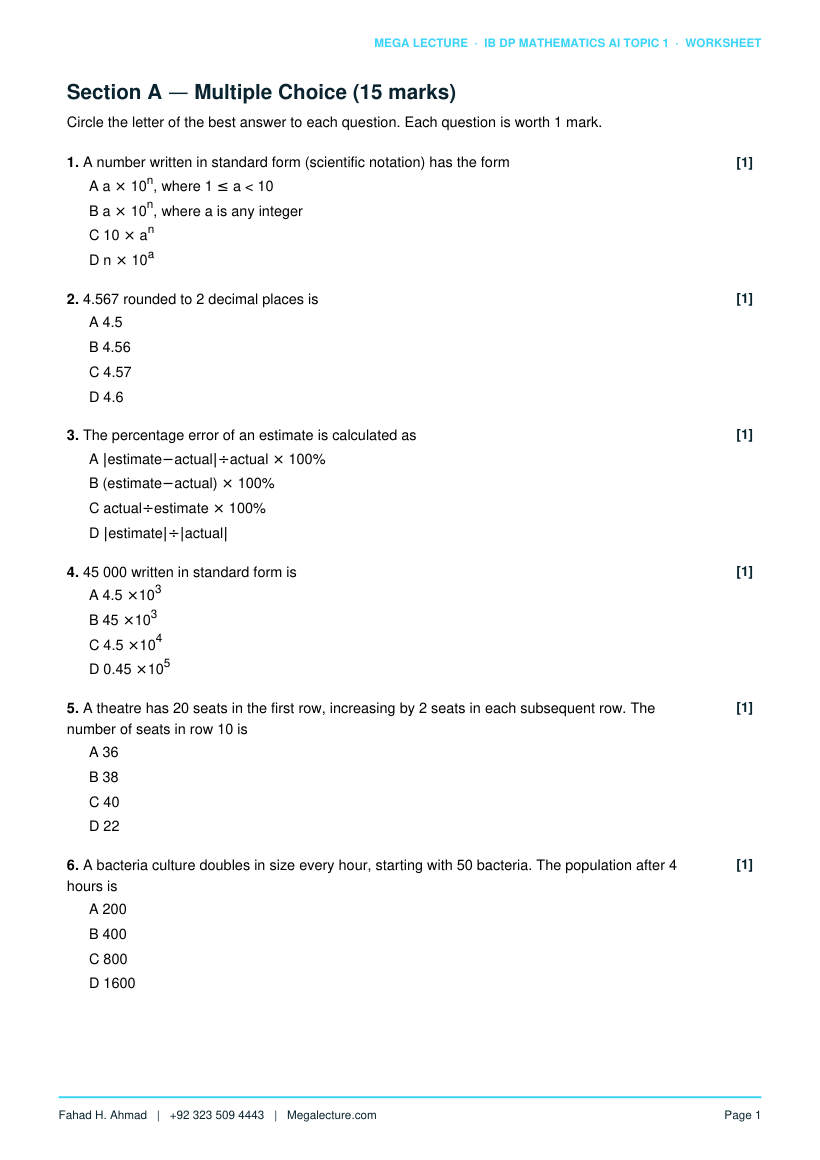
Section A — Multiple Choice (15 marks)
Circle the letter of the best answer to each question. Each question is worth 1 mark.
- A number written in standard form (scientific notation) has the form [1]
A a × 10n, where 1 ≤ a < 10
B a × 10n, where a is any integer
C 10 × an
D n × 10a
- 4.567 rounded to 2 decimal places is [1]
A 4.5
B 4.56
C 4.57
D 4.6
- The percentage error of an estimate is calculated as [1]
A |estimate−actual|÷actual × 100%
B (estimate−actual) × 100%
C actual÷estimate × 100%
D |estimate|÷|actual|
- 45 000 written in standard form is [1]
A 4.5 ×10³
B 45 ×103
C 4.5 ×10⁴
D 0.45 ×10⁵
- A theatre has 20 seats in the first row, increasing by 2 seats in each subsequent row. The number of seats in row 10 is
[1]
A 36
B 38
C 40
D 22
- A bacteria culture doubles in size every hour, starting with 50 bacteria. The population after 4 hours is
[1]
A 200
B 400
C 800
D 1600
- An infinite geometric series has a finite sum (converges) only when [1]
A r > 1
B r = 1
C |r| < 1
D r < 0
- The sum to infinity of a convergent geometric series with first term u1 and common ratio r is given by
[1]
A S∞ = u1÷(1−r)
B S∞ = u1(1−r)
C S∞ = u1÷r
D S∞ = nu1
- An exponential growth model has the general form A(t) = A0bt. In this model, A0 represents [1]
A the growth rate
B the initial (starting) amount, at t=0
C the amount after 1 time period
D the time taken to double
- A car valued at $20 000 depreciates by 15% per year. Its value after 2 years is [1]
A $14 000.00
B $14 450.00
C $17 000.00
D $20 300.00
- The 'half-life' of a radioactive substance is best described as [1]
A the time for half of the sample to decay to zero mass
B the time taken for the mass of the substance to reduce to half its original value
C half of the total decay time of the substance
D the mass remaining after 1 year
- Using the laws of exponents, am × an simplifies to [1]
A am×n
B am+n
C amn
D am−n
- The future value FV of an investment of PV, earning compound interest at rate r per period for n periods, is given by
[1]
A FV = PV(1+r)n
B FV = PV(1+rn)
C FV = PV × rn
D FV = PV + rn
- A traveler converts $200 USD to EUR at an exchange rate of 1 USD = 0.9 EUR. The amount received, before any commission, is
[1]
A €180.00
B €200.90
C €222.22
D €0.90
- 'Amortization' of a loan refers to [1]
A a single lump-sum repayment made at the end of the loan term
B the process of paying off a loan gradually through regular payments, covering both interest and principal
C the interest rate charged on a loan
D converting a loan from one currency to another
Section B — Structured Questions (65 marks)
Answer all questions in the space provided. Working must be shown for full marks.
1.1 Approximation & Estimation
Question 1 [7 marks]
A news report estimates the crowd size at a public event; a more careful count afterwards gives the actual number (given data).
Estimated vs. actual crowd size (given data).
- Using the bar chart, write down the estimated crowd size and the actual crowd size. [2]
- Calculate the percentage error of the estimate, giving your answer to 3 significant figures. [2]
- Round the actual crowd size to 2 significant figures. [3]
Question 2 [6 marks]
Rounding and standard form are used to represent numbers to an appropriate degree of accuracy.
- Round 3456.789 to 3 significant figures. [2]
- Write 0.000456 in standard form. [2]
- A length is measured as 25 cm, when its true value is 24 cm. Calculate the percentage error of this measurement.
[2]
1.2 Sequences & Series
Question 3 [7 marks]
A bacteria culture triples in size every hour. The graph shows the population, P(n), after n hours, starting with 200 bacteria (computed).
Bacteria population P(n) = 200×3n (computed).
- Using the graph, write down the initial population, P(0), and the common ratio of this geometric sequence.
[2]
- Using P(n) = 200×3n, calculate the population after 5 hours. [2]
- Find the smallest whole number of hours, n, after which the population first exceeds 100 000. [3]
Question 4 [6 marks]
A ball is dropped from a height of 10 m. Each time it bounces, it rebounds to 60% of the height of the previous bounce, forming a geometric sequence of bounce heights (first bounce height u1 = 6 m).
- State the formula for the sum to infinity, S∞, of a convergent geometric series, and explain why this series (r = 0.6) converges.
[2]
- Calculate the height of the 4th bounce. [2]
- Calculate S∞ for the sequence of bounce heights, and hence find the total vertical distance travelled by the ball (including the initial 10 m drop).
[2]
Question 5 [7 marks]
The graph shows a savings plan: $50 is saved in week 1, increasing by $10 each subsequent week, with the cumulative total, Sn, plotted against week number, n (computed).
Cumulative savings, Sn, u1=$50, d=$10 (computed).
- Using the graph, estimate the total amount saved after 8 weeks. [2]
- Using Sn = n÷2(2u1+(n−1)d), calculate the exact total saved after 8 weeks. [2]
- Find the smallest whole number of weeks, n, after which the total savings first exceed $1000. [3]
1.3 Exponential Growth & Decay
Question 6 [6 marks]
The population of a town is modelled by P(t) = 500×(1.08)t, where t is the time in years.
- State the initial population of the town (at t=0). [2]
- State the annual percentage growth rate of the population, as modelled by this function. [2]
- Calculate the population predicted by this model after 10 years, giving your answer to the nearest whole number.
[2]
Question 7 [7 marks]
The graph shows the mass, M(t), of a radioactive sample remaining after t days, where M(t) = 80×(0.5)t/5 grams (computed).
Radioactive decay, M(t) = 80×(0.5)t/5 (computed).
- Using the graph, state the initial mass of the sample, and estimate the half-life of the substance.
[2]
- Calculate the mass remaining after 10 days. [2]
- Find the time taken for the mass to decay to 5 grams. [3]
Question 8 [6 marks]
A radioactive isotope has a half-life of 20 years, and an initial mass of 100 g.
- State the general half-life decay formula M(t) = M0(0.5)t/h, and identify what h represents. [2]
- Calculate the mass remaining after 60 years. [2]
- Find the number of half-lives that have passed when the mass has decayed to 6.25 g, and hence find the corresponding time.
[2]
1.4 Financial Mathematics
Question 9 [7 marks]
A $10 000 loan is taken out at an annual interest rate of 6%, to be repaid with equal annual payments over 5 years. The graph shows the outstanding loan balance at the end of each year (computed).
Loan amortization schedule, P=$10 000, r=6%, n=5 years (computed).
- Using the graph, state the initial loan balance, and state after how many years the loan is fully repaid.
[2]
- Explain how this 'amortization' graph differs from a simple compound-interest growth graph. [2]
- Using the amortization formula A = Pr(1+r)n÷((1+r)n−1), calculate the annual payment, A, giving your answer to the nearest dollar.
[3]
Question 10 [6 marks]
A traveler converts USD to EUR at an exchange rate of 1 USD = 0.92 EUR.
- Calculate the amount in EUR received for $500 USD, before any commission. [2]
- The bank charges a 2% commission on the converted amount. Calculate the actual amount of EUR received after commission.
[2]
- Using the same exchange rate, calculate the equivalent USD value of a €200 purchase, giving your answer to 2 decimal places.
[2]
