
IB Diploma · Maths: Applications and Interpretation · Applications and Interpretation (AI)
Topic 2 Worksheet
Opens inside this page. Prefer your own PDF app? Open the PDF.
Check yourself
5 quick questions on Functions
Tap an answer to see if you are right, and why. Free, no sign-up.
Start the free testWas this note useful?
Full text of Topic 2 Worksheet
IB DP MATHEMATICS AI Topic 2 · Functions TOPICAL WORKSHEET
2.1 Linear Models · 2.2 Quadratic Models
2.3 Other Function Models · 2.4 Optimization
Standard and Higher Level · Syllabus 2025
Fahad H. Ahmad
Original exam-style questions written for the IB Diploma Programme Mathematics course (first assessment 2025)
Free notes, practice tests and live classes Back to megalecture.com
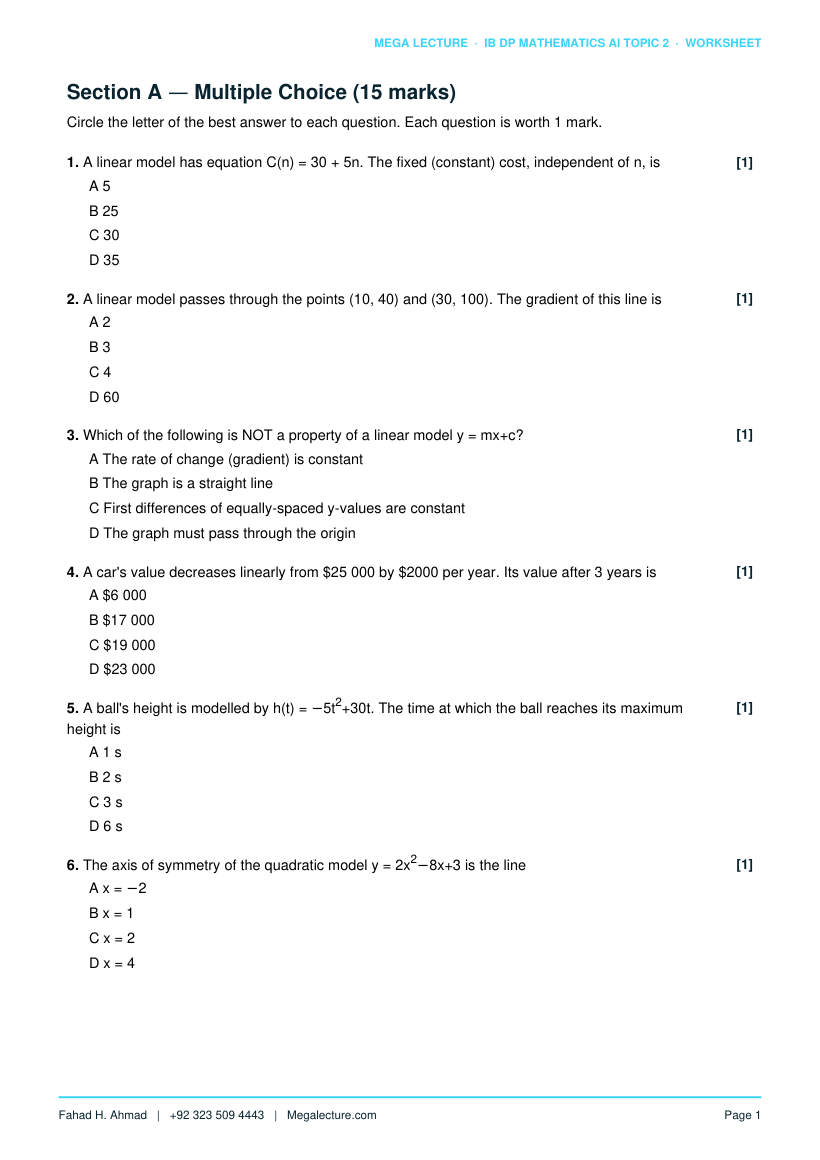
Section A — Multiple Choice (15 marks)
Circle the letter of the best answer to each question. Each question is worth 1 mark.
- A linear model has equation C(n) = 30 + 5n. The fixed (constant) cost, independent of n, is [1]
A 5
B 25
C 30
D 35
- A linear model passes through the points (10, 40) and (30, 100). The gradient of this line is [1]
A 2
B 3
C 4
D 60
- Which of the following is NOT a property of a linear model y = mx+c? [1]
A The rate of change (gradient) is constant
B The graph is a straight line
C First differences of equally-spaced y-values are constant
D The graph must pass through the origin
- A car's value decreases linearly from $25 000 by $2000 per year. Its value after 3 years is [1]
A $6 000
B $17 000
C $19 000
D $23 000
- A ball's height is modelled by h(t) = −5t2+30t. The time at which the ball reaches its maximum height is
[1]
A 1 s
B 2 s
C 3 s
D 6 s
- The axis of symmetry of the quadratic model y = 2x2−8x+3 is the line [1]
A x = −2
B x = 1
C x = 2
D x = 4
- A quadratic model for a ball's height has vertex (4, 80), where x is time in seconds and y is height in metres. The maximum height reached by the ball is
[1]
A 4 m
B 40 m
C 80 m
D 84 m
- A quadratic model y = ax2+bx+c has a negative discriminant (b2−4ac < 0). This means the graph of the model
[1]
A has two distinct x-intercepts
B has exactly one x-intercept (touches the x-axis)
C has no x-intercepts (does not cross the x-axis)
D is a straight line
- For an inverse variation model y = k÷x, if y = 20 when x = 5, the constant k is [1]
A 4
B 15
C 25
D 100
- An open box is formed by cutting squares of side x from a 10 cm square of card and folding up the sides, giving volume V(x) = x(10−2x)2. The valid domain for this model is
[1]
A x > 0 only
B0<x<5
C 0 < x < 10
D x < 10
- For the sinusoidal model y = 4sin(x)+7, the amplitude of the model is [1]
A 4
B 7
C 8
D 11
- The period, in hours, of the sinusoidal model h(t) = 3sin(πt÷6)+5 is [1]
A 3
B 6
C π÷6
D 12
- To find the maximum or minimum value of a function model using a graphing calculator (GDC), you would
[1]
A locate the y-intercept of the graph
B locate the turning point (vertex) of the graph
C find where the graph crosses the x-axis
D find the gradient of the graph at x=0
- For a business model, the 'break-even point(s)' occur where [1]
A Revenue = 0
B Cost = 0
C Revenue = Cost (Profit = 0)
D Profit is at its maximum
- For a profit model P(x) that is a downward-opening (negative leading coefficient) quadratic, the vertex of the graph represents
[1]
A the break-even point
B the maximum profit
C the minimum cost
D the fixed cost
Section B — Structured Questions (65 marks)
Answer all questions in the space provided. Working must be shown for full marks.
2.1 Linear Models
Question 1 [7 marks]
A printing company charges a fixed set-up fee plus a cost per copy. The graph shows the total cost, C(n), for printing n copies, where C(n) = 50+2n (computed).
Linear cost model, C(n) = 50+2n (computed).
- Using the graph, state the fixed cost (the cost when n=0), and the gradient of the line (the cost per copy).
[2]
- Using C(n) = 50+2n, calculate the total cost of printing 80 copies. [2]
- Find the number of copies, n, for which the total cost is $250. [3]
Question 2 [6 marks]
A car is purchased for $20 000, and its value depreciates linearly by $1500 each year, so that V(t) = 20 000−1500t.
- State the initial value of the car (at t=0). [2]
- Calculate the value of the car after 4 years. [2]
- The car is sold for scrap once its value reaches $5000. Find the value of t at which this occurs. [2]
2.2 Quadratic Models
Question 3 [7 marks]
A ball is thrown into the air. The graph shows its height, h(t), after t seconds, where h(t) = −5t2+20t+1 (computed).
Projectile height, h(t) = −5t2+20t+1 (computed).
- Using the graph, write down the maximum height reached by the ball, and the time at which this occurs.
[2]
- Calculate the height of the ball after 1 second. [2]
- Find the time at which the ball hits the ground (h(t)=0), giving your answer to 3 significant figures.
[3]
Question 4 [6 marks]
A farmer has 40 m of fencing to enclose a rectangular field, using an existing wall as one side (so fencing is only needed for the other three sides). If x is the length of each of the two sides perpendicular to the wall, the enclosed area is A(x) = 40x−2x2.
- Calculate the enclosed area when x=5. [2]
- Using the vertex of this quadratic model, find the value of x that maximizes the enclosed area. [2]
- Calculate the maximum enclosed area. [2]
2.3 Other Function Models
Question 5 [7 marks]
Boyle's Law states that, at constant temperature, the pressure P of a fixed mass of gas is inversely proportional to its volume V, so that P(V) = k÷V. The graph shows this relationship (computed).
Boyle's Law, P(V) = 300÷V (computed).
- Using the point marked on the graph (V=2, P=150), find the value of the constant k. [2]
- Using P(V) = 300÷V, calculate the pressure when V=5 L. [2]
- Calculate the volume when the pressure is 100 kPa. [3]
Question 6 [6 marks]
An open-topped box is formed from a square sheet of card of side 20 cm, by cutting squares of side x cm from each corner and folding up the sides, giving volume V(x) = x(20−2x)2.
- Calculate the volume of the box when x=2. [2]
- State the valid domain of x for this model, giving a reason. [2]
- Calculate the volume of the box when x=4. [2]
2.4 Optimization
Question 7 [7 marks]
The graph shows the volume, V(x), of the open-topped box from Question 6, for 0 < x < 10 (computed).
Open-box volume, V(x) = x(20−2x)2 (computed).
- Using the graph, write down the value of x that gives the maximum volume, and state this maximum volume, both to 3 significant figures.
[2]
- State the maximum volume to the nearest whole number. [2]
- Using the graph, state the range of values of x for which V(x) > 500 cm3. [3]
Question 8 [6 marks]
A company's profit, in dollars, from selling x units is modelled by P(x) = −0.1x2+30x−500.
- Find the break-even points (the values of x for which the profit is zero), giving your answers to the nearest whole unit.
[2]
- Find the number of units that maximizes the profit, and state this maximum profit. [2]
- State the range of values of x for which the company makes a profit (P(x) > 0). [2]
2.3 Other Function Models
Question 9 [7 marks]
The height of the tide, h(t) metres, t hours after midnight, is modelled by the sinusoidal function h(t) = 3sin(πt÷6)+5. The graph shows this model over 24 hours (computed).
Tide height model, h(t) = 3sin(πt÷6)+5 (computed).
- Using the graph (or the equation), state the amplitude and the mean (sea) level of this model. [2]
- Calculate the tide height at t=3 (3 a.m.). [2]
- Find the first time after midnight, t > 0, at which the tide height is 6.5 m. [3]
2.1 Linear Models
Question 10 [6 marks]
A mobile phone plan charges a flat fee of $20 for the first 100 minutes of calls each month, then $0.25 per minute for any additional minutes, so that C(m) = 20 for m≤100, and C(m) = 20+0.25(m−100) for m > 100.
- Calculate the cost of 60 minutes of calls. [2]
- Calculate the cost of 150 minutes of calls. [2]
- Find the number of minutes, m, for which the cost is $45. [2]
