
IB Diploma · Biology · SL / HL · Theme D: Continuity and Change
D4.2 Stability and Change
Opens inside this page. Prefer your own PDF app? Open the PDF.
Full text of D4.2 Stability and Change
IB DP BIOLOGY Theme D: Continuity and Change D4.2 Stability and Change
Revision Notes · Standard and Higher Level Fahad H. Ahmad
+92 323 509 4443 | Megalecture.com
Original notes prepared for the IB Diploma Programme Biology course (first assessment 2025)
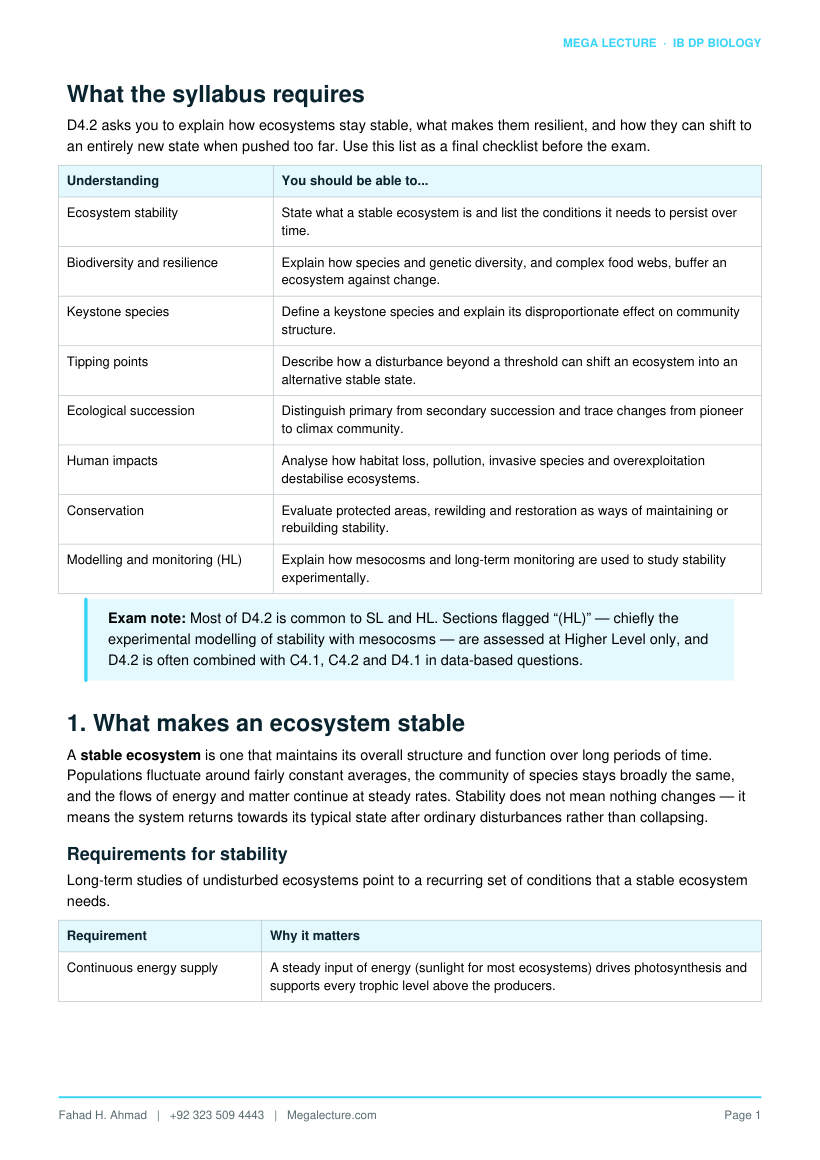
What the syllabus requires
D4.2 asks you to explain how ecosystems stay stable, what makes them resilient, and how they can shift to an entirely new state when pushed too far. Use this list as a final checklist before the exam.
Understanding You should be able to...
Ecosystem stability State what a stable ecosystem is and list the conditions it needs to persist over time.
Biodiversity and resilience Explain how species and genetic diversity, and complex food webs, buffer an ecosystem against change.
Keystone species Define a keystone species and explain its disproportionate effect on community structure.
Tipping points Describe how a disturbance beyond a threshold can shift an ecosystem into an alternative stable state.
Ecological succession Distinguish primary from secondary succession and trace changes from pioneer to climax community.
Human impacts Analyse how habitat loss, pollution, invasive species and overexploitation destabilise ecosystems.
Conservation Evaluate protected areas, rewilding and restoration as ways of maintaining or rebuilding stability.
Modelling and monitoring (HL) Explain how mesocosms and long-term monitoring are used to study stability experimentally.
Exam note: Most of D4.2 is common to SL and HL. Sections flagged “(HL)” — chiefly the experimental modelling of stability with mesocosms — are assessed at Higher Level only, and D4.2 is often combined with C4.1, C4.2 and D4.1 in data-based questions.
1. What makes an ecosystem stable
A stable ecosystem is one that maintains its overall structure and function over long periods of time. Populations fluctuate around fairly constant averages, the community of species stays broadly the same, and the flows of energy and matter continue at steady rates. Stability does not mean nothing changes — it means the system returns towards its typical state after ordinary disturbances rather than collapsing.
Requirements for stability
Long-term studies of undisturbed ecosystems point to a recurring set of conditions that a stable ecosystem needs.
Requirement Why it matters
Continuous energy supply A steady input of energy (sunlight for most ecosystems) drives photosynthesis and supports every trophic level above the producers.
Requirement Why it matters
Nutrient cycling Elements such as carbon, nitrogen and phosphorus must be recycled by decomposers so that finite mineral nutrients remain available and are not locked away.
Genetic diversity Variation within species provides the raw material for adaptation, so populations can withstand disease and environmental change.
Species diversity A wide range of species with overlapping roles keeps essential processes going even if some species decline.
A climate within tolerable limits Temperature, rainfall and other abiotic factors must stay within the range that the resident species can tolerate.
Notice that these requirements are interlinked: nutrient cycling depends on decomposer diversity, and the tolerable climate depends on processes such as carbon storage that the ecosystem itself helps to regulate. Remove one requirement and the others come under strain.
Key distinction: Stability is the tendency to stay in the same state; resilience is the capacity to recover after being disturbed. An ecosystem can be stable most of the time yet have low resilience if a single large disturbance would tip it over.
2. Biodiversity, complexity and resilience
Biodiversity — the variety of species, the genetic variation within them and the range of habitats present — is the single strongest predictor of how resilient an ecosystem is. There are two main reasons.
The insurance effect
Where several species carry out a similar role, the loss or decline of one can be compensated by others. This functional redundancy means that a key process — such as pollination or decomposition — keeps running even when individual species fail. The more species, the more likely it is that some will tolerate whatever conditions arise.
Complex food webs
A simple food chain is fragile: if one link is broken, everything above it collapses. A complex food web offers alternative pathways for energy and matter, so a consumer that loses one prey species can switch to another. This spreads risk and damps out the boom-and-bust swings that destabilise simple systems.
- A diverse producer base captures energy under a wide range of conditions.
- Many overlapping consumer links prevent any one population from exploding or crashing.
- Genetic diversity within each population lets species adapt as conditions shift.
- A varied decomposer community keeps nutrient cycling reliable.
Exam phrasing: Do not simply write “more species is better”. Explain the mechanism: greater diversity provides alternative pathways and functional redundancy, so processes continue and populations stay steady when conditions change.
Worked example 1 — why diversity gives resilience
Two grasslands are each grazed by insects. Grassland A has one dominant grass; grassland B has a dozen plant species. A drought kills the drought-sensitive plants. Explain which grassland is more likely to keep functioning.
In A, the single grass has no back-up: if it is drought-sensitive, primary production collapses and every consumer above it is affected.
In B, some of the twelve species are likely to be drought-tolerant. These continue to photosynthesise, so primary production, food for herbivores and ground cover are maintained. Grassland B is therefore more resilient — diversity provides functional redundancy.
3. Keystone species
A keystone species is a species that has a disproportionately large effect on the structure of its community relative to its abundance. Remove it and the whole community reorganises, often losing many other species. The name comes from the wedge-shaped stone at the top of an arch: small, but the stones on either side collapse without it.
Keystone species are frequently predators that control the population of a dominant competitor, but they can also be ecosystem engineers or key mutualists.
Type of keystone role How it structures the community
Predator Keeps a strong competitor or grazer in check, so that many weaker species are not out-competed or over-grazed.
Ecosystem engineer Physically modifies the habitat (for example by damming water or digging burrows), creating conditions many other species depend on.
Mutualist Provides an essential service such as pollination or seed dispersal on which the reproduction of many other species relies.
Two classic conceptual examples
- A predatory sea star (starfish) on a rocky shore feeds on mussels. By preventing the mussels from monopolising space, it allows many other species to coexist. When the star is removed, mussels take over and diversity crashes.
- Sea otters eat sea urchins. Urchins graze kelp. Where otters are present, urchin numbers stay low and kelp forests flourish, supporting a rich community. Remove the otters and exploding urchin populations strip the kelp, creating barren ground.
Common misconception: A keystone species is not the same as the most abundant or the largest species. Its importance is out of proportion to its numbers — that disproportion is the whole point of the definition.
4. Disturbance, tipping points and alternative states
Every ecosystem experiences disturbances — storms, fires, droughts, disease, human activity. A resilient ecosystem absorbs the disturbance and recovers towards its original state. But resilience is finite. Beyond a certain threshold, called a tipping point, the system flips into a different, self-sustaining state from which it does not easily return.
Why the new state persists
Once a threshold is crossed, new feedbacks lock the system into the alternative state. Recovery often requires conditions to be pushed back well beyond the original tipping point — a lag known as hysteresis. In practice this means degradation can be fast and cheap while restoration is slow and expensive.
Original state Disturbance / threshold crossed Alternative stable state
Coral reef Warming, pollution and overfishing of grazers cause repeated bleaching
Algae-dominated reef with low diversity
Clear lake Nutrient run-off (eutrophication) tips the balance Turbid, algae-dominated water
Tropical or temperate forest
Repeated logging, fire and drying Grassland or scrub that fire keeps open
Vegetated drylands Overgrazing removes plant cover Bare, eroded desert
These transitions share a pattern: a gradual loss of resilience (often invisible) followed by a sudden, hard-to-reverse shift once the tipping point is reached. Recognising the early warning signs — slower recovery from small disturbances, larger fluctuations — is a major goal of ecosystem monitoring.
Figure 1. Potential-energy model V(x) = x4/4 −x2/2. Stable equilibria (d2V/dx2 = 2 > 0) sit at x = −1 (state A) and x = +1 (state
B); an unstable tipping threshold (d2V/dx2 = −1) sits at x = 0, an energy barrier of 0.25 relative units above state A. A small disturbance relaxes back to A; one that crosses the threshold flips the system into the alternative stable state B.
Exam technique: To identify a tipping-point scenario, look for two features: (1) a threshold beyond which change becomes self-reinforcing, and (2) an alternative state that persists even if the original pressure is eased. A change that simply reverses when the pressure stops is not a tipping point.
5. Ecological succession
Succession is the directional change in a community over time, in which each stage alters the environment in ways that make it suitable for the next. It is one of the clearest examples of change leading, eventually, to a relatively stable endpoint.
Primary succession Secondary succession
Starting point Newly exposed bare rock or surface with no soil (lava flow, retreating glacier, new sand dune)
Existing soil after a disturbance has removed the community (fire, flood, abandoned farmland)
Pioneer species Lichens and mosses that can colonise bare rock Fast-growing weeds and grasses from seeds and roots already present
Speed Very slow — soil must form first Faster — soil, seeds and nutrients are already there
The sequence of stages
Succession runs through a series of communities called seral stages, from the pioneer community to a final climax community:
pioneer species → intermediate seral stages → climax community
Each stage changes the abiotic conditions for the next. Pioneers such as lichens break down rock and, as they die, add organic matter. This begins soil formation, which retains water and nutrients and allows small plants to root. These in turn add more organic matter and shade, letting shrubs and then trees establish. The community that persists in dynamic equilibrium with the prevailing climate is the climax community.
How diversity changes through succession
- Species diversity usually rises through the early and middle stages as more niches appear.
- Biomass and the complexity of food webs increase as the community develops.
- Diversity may peak at an intermediate stage and then dip slightly as a few dominant climax species (such as tall trees) shade out others.
- Nutrient cycling becomes tighter and more of the ecosystem's nutrients are held in living biomass.
Figure 2. Succession model: biomass follows a saturating curve reaching 99% of its climax plateau (450 relative units) by 200 years; species richness peaks at 42 species near t = 60 yr then settles 17% lower at the climax plateau (35 species), matching the rise-then-slight-dip pattern described above.
Key idea: The engine of succession is that each community changes the conditions — soil depth, light, moisture, nutrients — in ways that favour the species of the next stage while often making conditions less suitable for itself. Say this explicitly in extended answers.
6. Human impacts on stability
Human activity is now the dominant source of disturbance in most ecosystems, and it tends to erode the very features — diversity, complexity, nutrient balance — that confer stability. Four pressures dominate.
Pressure Effect on stability
Habitat loss and fragmentation Reduces population sizes and genetic diversity, breaks food-web links, and isolates populations so they cannot recolonise — the leading cause of extinction.
Pollution Nutrient run-off drives eutrophication; toxins accumulate along food chains (biomagnification); plastics and acidification alter whole habitats.
Invasive species Introduced species without natural predators out-compete or prey on natives, simplifying communities and sometimes triggering collapse.
Overexploitation Overfishing, overhunting and overharvesting remove species faster than they reproduce, often striking keystone predators first.
These pressures interact and reinforce one another. Habitat fragmentation makes a community more vulnerable to invasion; pollution lowers resilience so that a normally survivable disturbance now crosses a tipping point. The combined effect is to push ecosystems closer to their thresholds.
7. Conservation approaches to maintain stability
Because stability rests on diversity and functioning food webs, conservation aims to protect or rebuild those features rather than single species in isolation.
Approach How it supports stability
Protected areas Reserves and marine protected areas shield habitats and populations from exploitation and fragmentation, preserving diversity and natural food webs.
Rewilding Reintroducing keystone species (often large predators or herbivores) restores the interactions that structure communities and lets natural processes resume.
Ecological restoration Actively rebuilding degraded habitat — replanting native species, removing invasives, re-establishing water flow — pushes a system back across its threshold toward the original state.
Corridors between habitats Linking fragments allows movement, gene flow and recolonisation, maintaining genetic diversity and resilience.
Because of hysteresis, prevention is far cheaper than cure: it is much easier to keep an ecosystem on the stable side of its tipping point than to drag it back once it has flipped. This is the central argument for early, precautionary conservation.
Link: Connect this section to D4.1 and to conservation of biodiversity: the case for protecting biodiversity rests partly on the stability and ecosystem services that diversity provides.
8. Positive feedback and destabilisation
Stable ecosystems are dominated by negative feedback, which opposes change and returns the system toward its set point — for example, a rising prey population supports more predators, which then reduce the prey again.
Positive feedback does the opposite: it amplifies a change, driving the system further from its starting point. Positive feedback is destabilising and is often what carries an ecosystem across a tipping point once one is reached.
- Melting ice exposes dark ground, which absorbs more heat, causing more melting.
- Loss of vegetation reduces rainfall and soil moisture, causing further plant loss and spreading desertification.
- Warming releases stored carbon from soils, adding to warming.
Figure 3. Negative feedback (green) returns the system toward equilibrium with time constant τ = 6 yr, reaching within 5% of equilibrium by t ≈ 18.0 yr. Positive feedback (red, beyond a tipping point) grows exponentially with doubling time 3.5 yr, illustrating why positive feedback destabilises an ecosystem.
Key distinction: Negative feedback = stabilising (opposes change); positive feedback = destabilising (amplifies change). Ordinary ecosystem regulation is negative feedback; tipping points involve positive feedback taking over.
9. Modelling and monitoring stability (HL)
Because real ecosystems are large, slow and impossible to replicate, ecologists study stability using simplified experimental systems and long-term monitoring.
Mesocosms
A mesocosm is an enclosed, self-contained experimental ecosystem set up to be small enough to control yet large enough to behave realistically. Sealed tanks, fenced field plots and enclosed ponds are common examples. Because a mesocosm can be replicated, researchers can vary one factor — for example the number of species — while holding others constant, and measure the effect on stability.
- They allow controlled, replicated experiments that would be impossible in a whole ecosystem.
- Sealed mesocosms can test whether a community is self-sustaining — whether energy input and nutrient cycling keep it going.
- A common design compares mesocosms of differing diversity to test the prediction that more diverse systems are more stable.
Limitations and monitoring
Mesocosms are simplifications: they are small, exclude migration and large predators, and can suffer edge effects, so results must be applied to real ecosystems with care. For that reason they are combined with long-term field monitoring — tracking population sizes, diversity indices and abiotic factors over years to detect slow losses of resilience and early warning signs of an approaching tipping point.
HL exam tip: When evaluating a mesocosm study, comment on both its strength (a controlled, replicated, closed system isolating one variable) and its weakness (small scale and simplification limit how far results extrapolate to real ecosystems).
10. Skills and worked examples
Worked example 2 — predicting the effect of removing a keystone species
In a rocky-shore community a predatory sea star eats mussels, which are strong competitors for space. Predict and explain what happens to community diversity if the sea star is removed.
Without predation, the mussel population grows unchecked and monopolises space on the rock.
Other species that need that space are out-competed and disappear. Community diversity therefore falls sharply. This shows the sea star acting as a keystone predator: its effect on structure is far larger than its abundance would suggest.
Worked example 3 — ordering succession stages
Put these stages of primary succession on bare rock into the correct order: shrubs; bare rock; climax woodland; lichens and mosses; grasses and small herbs.
Correct order: bare rock → lichens and mosses → grasses and small herbs → shrubs → climax woodland.
Justification: each stage builds soil, moisture and shade that the next requires. Lichens begin soil formation on bare rock; only once soil is deep enough can herbs, then shrubs, then trees establish.
Worked example 4 — explaining resilience from a food web
Web X has one herbivore feeding on one plant, eaten by one predator. Web Y has six plants, four herbivores and three predators with many cross-links. A disease removes one herbivore. Which web is more stable, and why?
In Web X, losing the single herbivore breaks the only pathway: the predator starves and the plant is released from grazing — the chain collapses.
In Web Y, predators switch to alternative herbivore prey and the plants are still grazed by other species. Energy and matter keep flowing along other routes. Web Y is more stable because its complexity provides alternative pathways and functional redundancy.
Worked example 5 — identifying a tipping-point scenario
A clear lake receives increasing fertiliser run-off. For years the water stays clear; then, within one season, it turns permanently green and murky and stays that way even after run-off is reduced. Is this a tipping point? Explain.
Yes. Two features are present: a threshold (years of gradual nutrient loading with little visible change, then a sudden shift) and an alternative stable state (the turbid state persists even when the original pressure is eased — hysteresis).
The lake has flipped from a clear, plant-dominated state to a turbid, algae-dominated one and will not return without conditions being pushed well back past the threshold.
11. Common pitfalls
- Writing that a stable ecosystem “never changes”. Populations fluctuate; stability is the tendency to stay near a typical state, not the absence of change.
- Saying “more species is better” without a mechanism. Credit comes from explaining redundancy and alternative food-web pathways.
- Confusing a keystone species with the most abundant species — importance is disproportionate to abundance.
- Forgetting that in succession each stage changes the conditions for the next; just listing the stages misses the mechanism.
- Treating any change as a tipping point. A tipping point needs a threshold and a persistent alternative state, not a change that simply reverses.
- Mixing up feedbacks: negative feedback stabilises, positive feedback destabilises.
12. Quick reference
Term One-line summary
Stable ecosystem Maintains structure and function over time; populations fluctuate around steady averages.
Requirements for stability Energy supply, nutrient cycling, genetic and species diversity, tolerable climate.
Resilience Capacity to recover after disturbance; increased by diversity and food-web complexity.
Keystone species Disproportionately large effect on community structure relative to its abundance.
Tipping point Threshold beyond which an ecosystem shifts to a persistent alternative stable state.
Succession Directional community change; pioneer → seral stages → climax; each stage alters conditions for the next.
Negative feedback Opposes change — stabilising.
Positive feedback Amplifies change — destabilising; drives tipping points.
Mesocosm (HL) Small, replicable, enclosed experimental ecosystem for testing stability.
13. Test yourself
Attempt these without notes; full worked answers follow.
- Define a stable ecosystem and list three conditions it requires. [4]
- Explain, with a mechanism, how high biodiversity increases the resilience of an ecosystem. [4]
- Define a keystone species and explain why it is not necessarily the most abundant species. [3]
- Distinguish between primary and secondary succession, giving one example of each. [4]
- Using coral reefs as an example, explain what is meant by a tipping point. [4]
- Outline two human activities that reduce ecosystem stability and state how each does so. [4]
- Explain how rewilding can help restore ecosystem stability. [3]
- (HL) Evaluate the use of mesocosms to investigate how diversity affects stability. [4]
Answers
- A stable ecosystem maintains its structure and function over time, with populations fluctuating around fairly constant averages. Any three of: a continuous energy supply; nutrient cycling by decomposers; genetic diversity; species diversity; a climate within tolerable limits.
- High diversity provides functional redundancy — several species performing similar roles — so a process continues if one species declines. Complex food webs offer alternative pathways for energy and matter, so consumers can switch prey and populations avoid boom-and-bust. Genetic diversity lets species adapt. Together these let the ecosystem absorb disturbance and recover.
- A keystone species has a disproportionately large effect on community structure relative to its abundance. It need not be abundant because its influence comes from its role — for example controlling a dominant competitor or engineering the habitat — rather than from its numbers. Removing it causes many other species to be lost.
- Primary succession begins on a lifeless surface with no soil (e.g. bare rock after a lava flow), starting with pioneer lichens, and is slow because soil must form first. Secondary succession begins where soil and some organisms remain after a disturbance (e.g. abandoned farmland or after a fire) and is faster because soil, seeds and nutrients are already present.
- A tipping point is a threshold beyond which an ecosystem shifts into a different, self-sustaining state. Warming, pollution and loss of grazers cause repeated coral bleaching; once a threshold is passed the reef flips to an algae-dominated state that persists even if some pressure is eased, so the coral does not readily return.
- Any two, e.g. Habitat loss/fragmentation — reduces population sizes and genetic diversity and breaks food-web links. Pollution — eutrophication and biomagnification alter communities and remove sensitive species. Invasive species — out-compete or prey on natives, simplifying the community. Overexploitation — removes species, often keystones, faster than they can reproduce.
- Rewilding reintroduces keystone species (often predators or large herbivores) that restore the interactions structuring the community — for example controlling grazers, allowing vegetation and dependent species to recover. Natural processes and food-web complexity resume, rebuilding diversity and resilience.
- Strengths: mesocosms are enclosed, small and replicable, so diversity can be varied as an independent variable while other factors are controlled, allowing a fair test of the diversity-stability prediction. Weaknesses: they are simplified and small, exclude migration and large predators, and suffer edge effects, so conclusions extrapolate to real ecosystems only with caution. Best combined with long-term field monitoring.
