
IB Diploma · Biology · SL / HL · Theme D: Continuity and Change
D4.1 Natural Selection
Need more than one subject? All-notes pass: unlimited downloads of every note for a year: unlimited downloads of every note on the site, PKR 999 a year. All packs and courses.
Opens inside this page. Prefer your own PDF app? Open the PDF.
Check yourself
5 quick questions on IB Biology
Tap an answer to see if you are right, and why. Free, no sign-up.
Start the free test👍 16 students found these notes useful
Was this note useful?
Full text of D4.1 Natural Selection
IB DP BIOLOGY Theme D: Continuity and Change D4.1 Natural Selection
Revision Notes · Standard and Higher Level Fahad H. Ahmad
Original notes prepared for the IB Diploma Programme Biology course (2025 syllabus)
Free notes, practice tests and live classes Back to megalecture.com
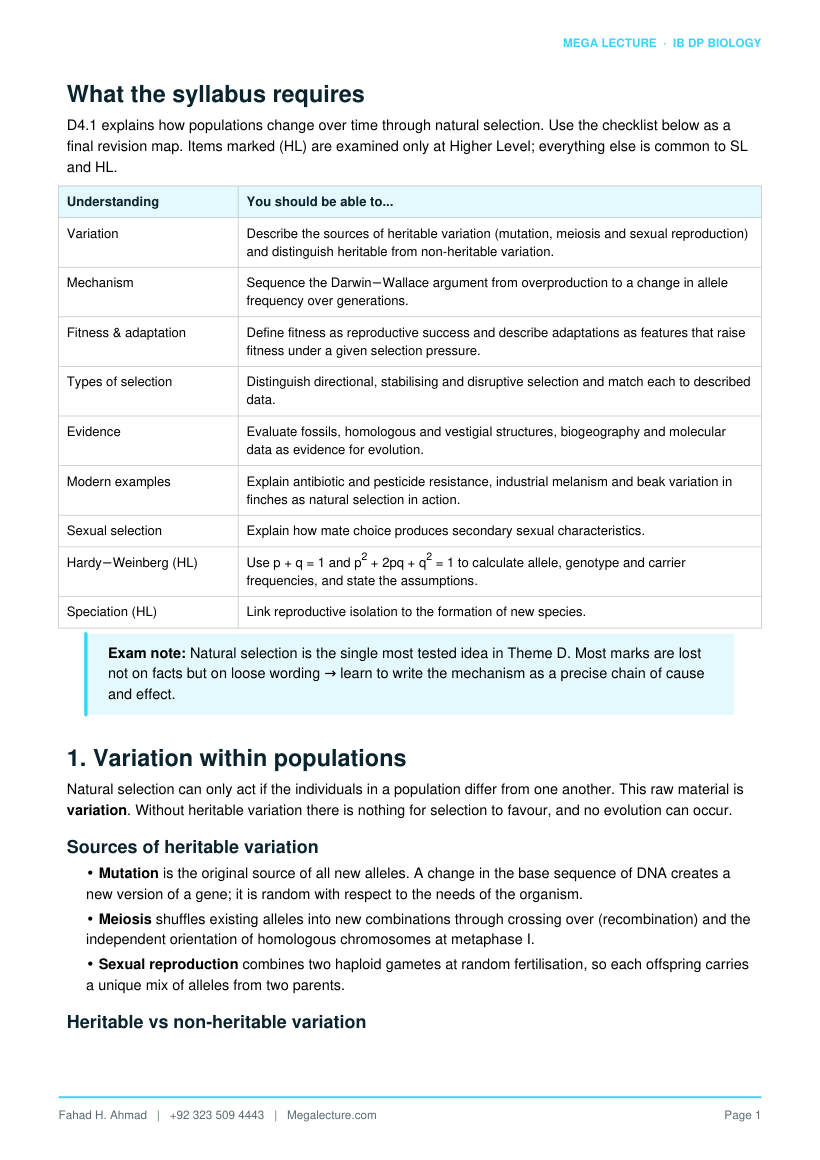
What the syllabus requires
D4.1 explains how populations change over time through natural selection. Use the checklist below as a final revision map. Items marked (HL) are examined only at Higher Level; everything else is common to SL and HL.
Understanding You should be able to...
Variation Describe the sources of heritable variation (mutation, meiosis and sexual reproduction) and distinguish heritable from non-heritable variation.
Mechanism Sequence the Darwin−Wallace argument from overproduction to a change in allele frequency over generations.
Fitness & adaptation Define fitness as reproductive success and describe adaptations as features that raise fitness under a given selection pressure.
Types of selection Distinguish directional, stabilising and disruptive selection and match each to described data.
Evidence Evaluate fossils, homologous and vestigial structures, biogeography and molecular data as evidence for evolution.
Modern examples Explain antibiotic and pesticide resistance, industrial melanism and beak variation in finches as natural selection in action.
Sexual selection Explain how mate choice produces secondary sexual characteristics.
Hardy−Weinberg (HL) Use p + q = 1 and p2 + 2pq + q2 = 1 to calculate allele, genotype and carrier frequencies, and state the assumptions.
Speciation (HL) Link reproductive isolation to the formation of new species.
Exam note: Natural selection is the single most tested idea in Theme D. Most marks are lost not on facts but on loose wording → learn to write the mechanism as a precise chain of cause and effect.
1. Variation within populations
Natural selection can only act if the individuals in a population differ from one another. This raw material is variation. Without heritable variation there is nothing for selection to favour, and no evolution can occur.
Sources of heritable variation
- Mutation is the original source of all new alleles. A change in the base sequence of DNA creates a new version of a gene; it is random with respect to the needs of the organism.
- Meiosis shuffles existing alleles into new combinations through crossing over (recombination) and the independent orientation of homologous chromosomes at metaphase I.
- Sexual reproduction combines two haploid gametes at random fertilisation, so each offspring carries a unique mix of alleles from two parents.
Heritable vs non-heritable variation
Only variation caused by differences in genotype can be passed to offspring and can drive evolution. Variation caused by the environment during an individual's life is not inherited.
Heritable (genetic) Non-heritable (environmental)
Cause Differences in alleles / genotype Environment acting during the lifetime
Passed on? Yes, through gametes No
Example Human blood group; coat colour alleles A muscular build from training; scars; sun-tan
Role in evolution Provides material for natural selection None − lost when the individual dies
Discrete vs continuous: Discontinuous variation (e.g. blood groups) is controlled by one or few genes and falls into distinct classes. Continuous variation (e.g. height) is polygenic, is influenced by the environment, and forms a bell-shaped distribution → the shape that selection reshapes.
2. The mechanism of natural selection
Charles Darwin and Alfred Russel Wallace independently proposed natural selection as the mechanism of evolution (jointly presented in 1858). The argument is a logical chain − each step follows from the one before, and you should be able to reproduce it in order.
Step What happens Why it matters
- Overproduction
Organisms produce many more offspring than can survive.
Populations would grow exponentially, but resources are finite.
- Struggle for existence
Individuals compete for limited resources (food, space, mates, light).
Not all offspring can survive and reproduce.
- Variation in fitness
Individuals vary, and some heritable variants are better suited to the conditions.
Variation is the raw material; some alleles confer an advantage.
- Differential survival
Better-adapted individuals are more likely to survive and reproduce (‘survival of the fittest’).
They leave more offspring than poorly adapted individuals.
- Inheritance Survivors pass their advantageous alleles to their offspring.
The advantageous alleles increase in frequency.
- Change over generations
Over many generations the population's allele frequencies shift; it becomes better adapted.
This cumulative change is evolution.
Stated compactly: overproduction → competition/struggle for existence → variation in fitness → differential survival and reproduction → heritable advantageous alleles rise in frequency over generations.
Key idea: Evolution is a change in allele frequency in a population over time. Individuals do not evolve − populations do.
3. Fitness, adaptation and selection pressures
Fitness in biology does not mean physical strength. It is a measure of reproductive success − the number of viable, fertile offspring an individual contributes to the next generation relative to others. A fast but sterile animal has zero fitness.
An adaptation is a heritable feature − structural, physiological or behavioural − that increases an organism's fitness in its environment. Adaptations are the result of past selection, not a response produced on demand.
Selection pressures
A selection pressure is any environmental factor that affects an organism's chance of surviving and reproducing, so favouring some variants over others. They are grouped as biotic (living) and abiotic (non-living).
Type Examples Selects for...
Biotic Predators, prey, competitors, parasites, pathogens, mates
Camouflage, defences, resistance, competitive ability
Abiotic Temperature, drought, salinity, pH, light, oxygen level Tolerance ranges, water conservation, thermal adaptations
Watch your wording: Say an adaptation ‘increases the chance of survival and reproduction’, never that an organism adapts ‘because it needs to’. Selection has no goal and no foresight.
4. Types of selection
For a continuously varying (polygenic) trait, selection can reshape the population's bell-curve in three characteristic ways, depending on which phenotypes are favoured.
Type Which phenotypes are favoured
Effect on the distribution Example
Directional One extreme Mean shifts toward that extreme
Antibiotic resistance; peppered moth after pollution
Stabilising The intermediate; both extremes selected against
Mean stays put, variation (spread) narrows
Human birth mass; clutch size in birds
Disruptive Both extremes; the intermediate selected against
Distribution splits into two peaks
Beak sizes where only large and small seeds are available
Reading a selection graph
- If the curve slides sideways between generations, selection is directional.
- If the curve stays centred but becomes taller and narrower, selection is stabilising.
- If a single peak becomes two peaks (bimodal), selection is disruptive − and it can be the first step toward forming two species.
Figure 1. Change in the frequency p of an advantageous allele over 60 generations under directional selection (haploid model, pn+1 = pn(1+s) / (1 + s pn), s = 0.15, p0 = 0.05). The allele approaches fixation (p → 1), reaching p = 0.99 by generation
54.
Default in nature: Stabilising selection is the most common type. It keeps well-adapted populations stable when the environment is not changing, which is why most traits vary around a favoured intermediate value.
5. Evidence for evolution by natural selection
No single observation ‘proves’ evolution; rather, independent lines of evidence converge on the same conclusion − that living species share common ancestors and have changed over time.
Line of evidence What it shows
Fossil record Documents change through time and transitional forms; deeper (older) strata contain simpler or extinct forms, showing gradual change and common descent.
Homologous structures Same underlying anatomy (e.g. the pentadactyl limb of mammals) adapted to different uses − evidence of divergent evolution from a common ancestor.
Analogous structures Similar function but different origin (e.g. insect vs bird wings) − evidence of convergent evolution under similar selection pressures.
Vestigial structures Reduced, non-functional remnants (e.g. the human appendix, pelvic bones in whales) inherited from ancestors in which they were useful.
Biogeography The geographic distribution of species (e.g. island endemics resembling the nearest mainland species) reflects descent with modification, not independent creation.
Molecular / DNA Comparing DNA and protein sequences: the more closely related two species, the more similar their sequences. A molecular ‘clock’ dates divergence.
Selective breeding Artificial selection by humans (crops, dogs, cattle) rapidly reshapes species, showing by analogy how powerful selection on heritable variation can be.
Artificial selection as an analogy
In selective breeding, humans take the role of the environment: they choose which individuals reproduce. Over a few generations this produces large changes − modern maize from teosinte, or the many dog breeds from wolves. It demonstrates the same core process as natural selection: differential reproduction of heritable variants. The difference is only in the selecting agent − a human choice rather than an environmental pressure.
6. Modern examples of natural selection
These cases are favourites in exams because selection is observable within a human lifetime. In each, learn to identify the variation, the selection pressure and the change in allele frequency.
Antibiotic resistance in bacteria
A bacterial population varies: a few cells carry a random mutation (or an acquired plasmid gene) giving resistance. Adding an antibiotic is a strong selection pressure that kills susceptible cells. Resistant cells survive, reproduce rapidly by binary fission, and pass on the resistance allele, so the resistant proportion rises with each generation. Overuse of antibiotics accelerates this. It is directional selection.
Figure 2. Antibiotic resistance as directional selection in a modelled bacterial population of 48 cells. Before treatment 5 of 48 cells (10%) already carry a resistance mutation; the antibiotic kills susceptible cells (selection coefficient s = 2.0), so after 5 generations the resistant fraction rises to 96% (46 of 48 cells).
Pesticide (and herbicide) resistance
The identical logic applies to insects sprayed with pesticides or weeds treated with herbicides: pre-existing resistant variants survive and multiply, and resistance spreads through the population. The pesticide does not create resistance − it selects for variants that were already present.
Peppered moth (industrial melanism)
Before industrialisation, pale (typica) peppered moths were camouflaged on lichen-covered bark, while dark (melanic) moths were conspicuous and eaten by birds. Soot from coal darkened the bark; now the dark form was camouflaged and the pale form conspicuous. In polluted areas the melanic allele rose in
Darwin's finches
On the Galápagos, finch species differ in beak size and shape, each suited to a food source (small beaks for small soft seeds, deep strong beaks for large hard seeds). During droughts, when only large hard seeds remain, birds with deeper, stronger beaks survive better and the mean beak depth increases in the next generation − directional selection measured in the wild by the Grants.
Common thread: In every case the advantageous variant already existed by mutation. The environment does not create the useful allele − it merely changes which existing alleles survive and reproduce.
7. Sexual selection
Sexual selection is a form of natural selection driven by competition for mates rather than survival. It explains traits that seem to lower survival yet persist because they raise mating success.
- Intrasexual selection: members of one sex (usually males) compete directly − e.g. antlers or horns used in contests. Winners gain access to mates.
- Intersexual selection (mate choice): one sex (usually females) chooses mates on the basis of displayed traits − e.g. the peacock's tail, birdsong, bright colouration.
Traits favoured by mate choice are called secondary sexual characteristics: they develop at sexual maturity, are not directly involved in reproduction, and often differ between the sexes (sexual dimorphism). A costly ornament can act as an honest signal of good genes or good health, because only a high-quality individual can afford it. The result can be exaggerated features that increase reproductive success even at some cost to survival.
Fitness reminder: Sexual selection makes clear why fitness = reproductive success, not survival. A trait that shortens life but greatly increases mating can still be favoured.
8. The Hardy−Weinberg principle (HL)
The Hardy−Weinberg principle gives the expected allele and genotype frequencies of a population that is not evolving. Deviations from these expected values are evidence that evolution (or non-random mating) is occurring. Consider one gene with two alleles, dominant A (frequency p) and recessive a (frequency q).
p + q = 1 and p2 + 2pq + q2 = 1
Symbol Meaning p Frequency of the dominant allele A q Frequency of the recessive allele a p2 Frequency of homozygous dominant genotype (AA)
2pq Frequency of heterozygous genotype (Aa) − the carriers
Symbol Meaning q2 Frequency of homozygous recessive genotype (aa)
Figure 3. Hardy−Weinberg worked genotype frequencies for q2 = 0.16: q = 0.40, p = 0.60, giving p2 = 0.36, 2pq = 0.48, q2 =
0.16. Audit: the three genotype frequencies sum to 1.00.
How to use it
The usual entry point is the recessive phenotype, because only aa individuals show it. So q2 = frequency of the recessive phenotype. Take the square root to get q, then p = 1 − q, and finally compute any genotype frequency, including the carrier frequency 2pq.
Assumptions (conditions for equilibrium)
- Large population (no genetic drift).
- Random mating with respect to the gene.
- No mutation altering allele frequencies.
- No migration (no gene flow in or out).
- No natural selection − all genotypes equally likely to survive and reproduce.
Why it matters: If a real population's genotype frequencies match the Hardy−Weinberg prediction, no evolution is detected at that gene. A significant mismatch signals that one or more assumptions are broken → evolution is happening.
9. From selection to speciation (HL)
Natural selection changes allele frequencies within a population. Speciation is the formation of new species, and it happens when populations become reproductively isolated so that gene flow between them stops.
Outline of the process
- A barrier isolates two populations. In allopatric speciation the barrier is geographic (a river, mountain, ocean); in sympatric speciation isolation arises without physical separation (e.g. behavioural or temporal barriers).
- With gene flow stopped, each population experiences its own mutations and its own selection pressures (and drift).
- Allele frequencies diverge over many generations until the two populations can no longer interbreed to produce fertile offspring even if reunited.
- At that point they are separate species (biological species concept).
Link back: Disruptive selection (Section 4) can begin this process by favouring two extremes; if it is reinforced by reproductive isolation, one population can split into two species.
10. Worked examples and exam skills
The skills examined most often are: (i) explaining a real case using the natural-selection chain, (ii) identifying the type of selection from data, and (iii) Hardy−Weinberg calculations. Work through these before the exam.
Worked example 1 − explain a case with the mechanism
A hospital finds that a bacterial strain is now resistant to a common antibiotic. Explain how this resistance arose. [4]
- Within the bacterial population there was variation; a few cells carried a random mutation giving resistance.
- The antibiotic is a selection pressure: it kills non-resistant (susceptible) cells.
- Resistant cells survive and reproduce, passing the resistance allele to offspring.
- Over generations the frequency of the resistance allele increases, so the population becomes resistant (directional selection).
Worked example 2 − identify the type of selection
Human newborns of intermediate birth mass have the lowest infant mortality; very low and very high birth masses both have higher mortality. Which type of selection is this, and what happens to the distribution? [3]
Both extremes are selected against and the intermediate is favoured → this is stabilising selection.
The mean birth mass stays about the same, but the spread of the distribution narrows, so the bell curve becomes taller and thinner over generations.
Worked example 3 (HL) − Hardy−Weinberg carrier frequency
Cystic fibrosis is caused by a recessive allele and affects about 1 in 2500 people in a population. Assuming Hardy−Weinberg equilibrium, estimate the frequency of carriers. [4]
Affected individuals are aa, so q2 = 1 / 2500 = 0.0004.
q = (0.0004)1/2 = 0.02, so p = 1 − 0.02 = 0.98.
Carrier (heterozygote) frequency = 2pq = 2 × 0.98 × 0.02 = 0.0392 ≈ 0.039, i.e. about 1 in 25 people is a carrier.
Worked example 4 (HL) − allele and genotype frequencies
In a plant population, 16% of individuals show the recessive phenotype. Find the allele frequencies and the frequency of heterozygotes. [4] q2 = 0.16, so q = 0.4 and p = 1 − 0.4 = 0.6.
Homozygous dominant p2 = 0.36; heterozygotes 2pq = 2 × 0.6 × 0.4 = 0.48 (48%).
Check: 0.36 + 0.48 + 0.16 = 1.00 → consistent.
Worked example 5 − explain the peppered moth
Explain, in terms of natural selection, why the dark form of the peppered moth became common in industrial areas. [4]
- Moths varied: pale and dark (melanic) forms existed, controlled by alleles.
- Soot darkened tree bark; on dark bark the dark form is camouflaged and the pale form is conspicuous to bird predators (the selection pressure).
- Dark moths survive better, reproduce, and pass on the melanic allele.
- The frequency of the melanic allele increased over generations in polluted areas.
Common pitfalls
- Individuals do not evolve or adapt in their lifetime. An individual cannot change its alleles to suit the environment; selection acts across generations on a varying population.
- Avoid ‘need’ and Lamarck. Organisms do not develop a trait because they need it, and characteristics acquired during life (e.g. muscle from exercise) are not inherited. Variation arises first, by mutation; selection acts afterwards.
- Fitness = reproductive success, not strength or speed. An organism that survives but leaves no offspring has zero fitness.
- Mutations are random, selection is not. The environment does not direct which mutations occur; it only selects among those that exist.
- Populations, not organisms, are the unit of evolution. Always describe change as a change in allele frequency.
Quick-reference summary
Term One-line definition
Variation Differences between individuals; only heritable (genetic) variation drives evolution
Natural selection Differential survival and reproduction of heritable variants in a population
Fitness An individual's reproductive success relative to others
Adaptation A heritable feature that increases fitness in a given environment
Selection pressure An environmental factor (biotic or abiotic) that favours some variants
Directional selection One extreme favoured; the mean shifts
Stabilising selection Intermediate favoured; variation narrows
Disruptive selection Both extremes favoured; distribution becomes bimodal
Sexual selection Selection driven by competition for mates; gives secondary sexual characters
Hardy−Weinberg (HL) p + q = 1; p2 + 2pq + q2 = 1 for a non-evolving population
Speciation (HL) Formation of new species when populations become reproductively isolated
11. Practice questions
Attempt all eight without notes, then check against the worked answers that follow.
- Distinguish between heritable and non-heritable variation, giving one example of each. [3]
- List the three sources of heritable variation in a sexually reproducing species. [3]
- Put the steps of natural selection in order and use them to explain how a pesticide-resistant insect population arises. [5]
- Define fitness and adaptation, and explain the difference between them. [3]
- A trait shows two peaks after several generations of selection. Name the type of selection and describe what happened to the distribution. [3]
- Outline three independent lines of evidence for evolution by natural selection. [3]
- Explain how the peacock's tail can be favoured even though it makes males more visible to predators. [3]
- (HL) Albinism is recessive and affects 1 in 10 000 people. Assuming Hardy−Weinberg equilibrium, calculate the frequency of the albinism allele and the proportion of carriers. [4]
Worked answers
- Heritable variation results from differences in genotype (alleles) and can be passed to offspring through gametes − e.g. human blood group. Non-heritable variation is caused by the environment during life and is not inherited − e.g. a sun-tan or muscle gained from training. Only heritable variation provides material for natural selection.
- Mutation (source of new alleles); meiosis (crossing over and independent assortment producing new allele combinations); and random fertilisation in sexual reproduction (combining alleles from two parents).
- Overproduction → struggle for existence/competition → variation in fitness → differential survival and reproduction → advantageous alleles rise in frequency. Applied: insects vary, and a few carry a resistance mutation; spraying pesticide (selection pressure) kills susceptible insects; resistant insects survive and reproduce, passing on the resistance allele; over generations the resistant allele frequency increases so the population becomes resistant.
- Fitness is an individual's reproductive success (number of fertile offspring) relative to others. An adaptation is a heritable feature that increases fitness in a given environment. Difference: fitness is a measurable outcome (offspring produced); an adaptation is a feature that helps to achieve that outcome.
- Disruptive selection. Both extremes were favoured while the intermediate phenotype was selected against, so the single peak split into two (a bimodal distribution).
- Any three: fossil record (change and transitional forms through time); homologous structures such as the pentadactyl limb (divergent evolution from a common ancestor); vestigial structures (reduced remnants of ancestral features); biogeography (distribution reflecting descent); molecular/DNA similarity increasing with closeness of relationship; artificial selection as a demonstration by analogy.
- Sexual selection through mate choice: females prefer males with larger, brighter tails, so those males mate more and pass on the alleles for the tail. The gain in reproductive success outweighs the survival cost, so the trait (a secondary sexual characteristic) spreads − fitness is reproductive success, not survival.
- Affected are aa, so q2 = 1 / 10 000 = 0.0001. q = (0.0001)1/2 = 0.01, so p = 0.99. Carriers 2pq = 2 × 0.99 × 0.01 = 0.0198 ≈ 0.02, i.e. about 1 in 50 people is a carrier.
