
IB Diploma · Biology · SL / HL · Theme D: Continuity and Change
D2.3 Water Potential
Need more than one subject? All-notes pass: unlimited downloads of every note for a year: unlimited downloads of every note on the site, PKR 999 a year. All packs and courses.

Opens inside this page. Prefer your own PDF app? Open the PDF.
Check yourself
5 quick questions on D Continuity and change
Tap an answer to see if you are right, and why. Free, no sign-up.
Start the free test👍 16 students found these notes useful
Was this note useful?
Full text of D2.3 Water Potential
IB DP BIOLOGY Theme D: Continuity and Change D2.3 Water Potential
Revision Notes · Standard and Higher Level Fahad H. Ahmad
Original notes prepared for the IB Diploma Programme Biology course (first assessment 2025)
Free notes, practice tests and live classes Back to megalecture.com
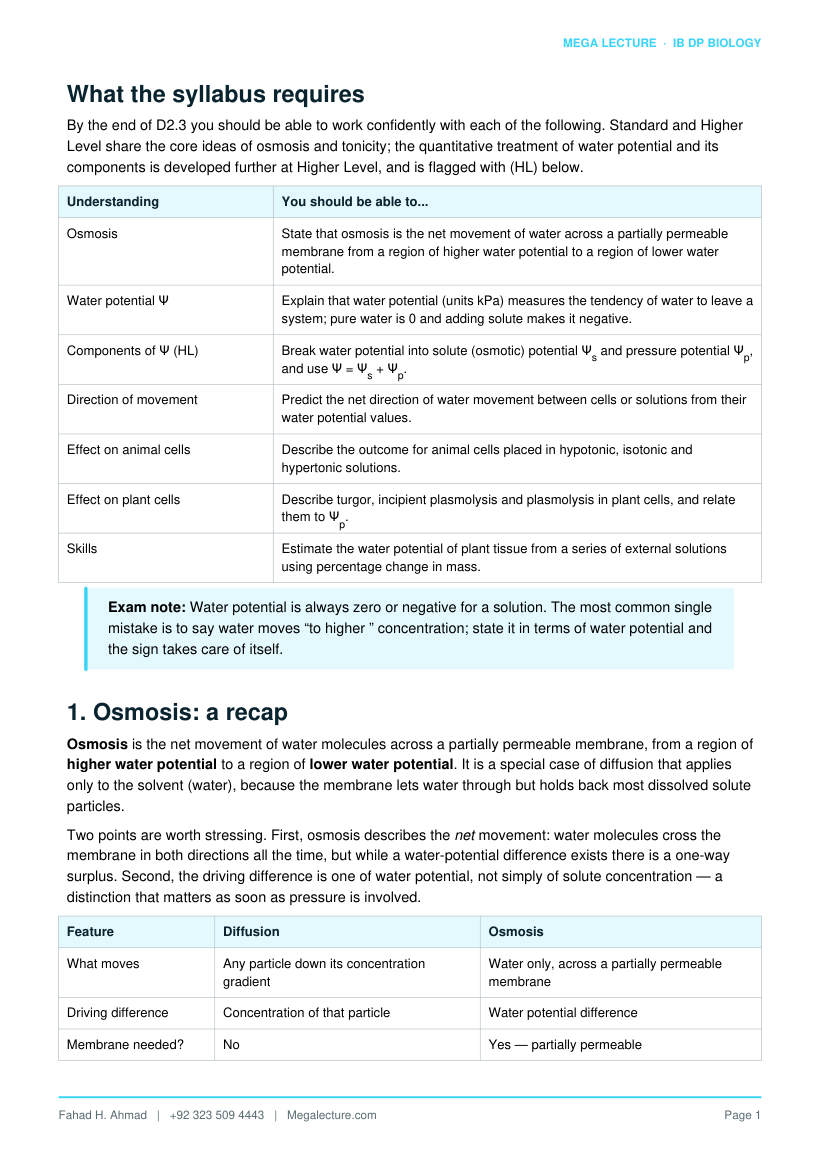
What the syllabus requires
By the end of D2.3 you should be able to work confidently with each of the following. Standard and Higher Level share the core ideas of osmosis and tonicity; the quantitative treatment of water potential and its components is developed further at Higher Level, and is flagged with (HL) below.
Understanding You should be able to...
Osmosis State that osmosis is the net movement of water across a partially permeable membrane from a region of higher water potential to a region of lower water potential.
Water potential Ψ Explain that water potential (units kPa) measures the tendency of water to leave a system; pure water is 0 and adding solute makes it negative.
Components of Ψ (HL) Break water potential into solute (osmotic) potential Ψs and pressure potential Ψp, and use Ψ = Ψs + Ψp.
Direction of movement Predict the net direction of water movement between cells or solutions from their water potential values.
Effect on animal cells Describe the outcome for animal cells placed in hypotonic, isotonic and hypertonic solutions.
Effect on plant cells Describe turgor, incipient plasmolysis and plasmolysis in plant cells, and relate them to Ψp.
Skills Estimate the water potential of plant tissue from a series of external solutions using percentage change in mass.
Exam note: Water potential is always zero or negative for a solution. The most common single mistake is to say water moves “to higher ” concentration; state it in terms of water potential and the sign takes care of itself.
1. Osmosis: a recap
Osmosis is the net movement of water molecules across a partially permeable membrane, from a region of higher water potential to a region of lower water potential. It is a special case of diffusion that applies only to the solvent (water), because the membrane lets water through but holds back most dissolved solute particles.
Two points are worth stressing. First, osmosis describes the net movement: water molecules cross the membrane in both directions all the time, but while a water-potential difference exists there is a one-way surplus. Second, the driving difference is one of water potential, not simply of solute concentration — a distinction that matters as soon as pressure is involved.
Feature Diffusion Osmosis
What moves Any particle down its concentration gradient
Water only, across a partially permeable membrane
Driving difference Concentration of that particle Water potential difference
Membrane needed? No Yes — partially permeable
Key definition: “Net movement of water across a partially permeable membrane from higher to lower water potential.” Memorise this wording — it is the definition examiners award marks for.
2. Water potential, Ψ
Water potential, given the Greek symbol Ψ (psi), is a measure of the tendency of water molecules to move out of a system by osmosis. It is measured as a pressure, in kilopascals (kPa). You can picture it as “how much water wants to leave here”: the higher the water potential, the more freely water tends to move away.
Ψ of pure water = 0 kPa
- Pure water has the highest water potential of all, defined as exactly 0 kPa (at standard temperature and pressure).
- Adding solute lowers the water potential, making Ψ negative. Solute particles attract and hold water molecules, reducing their freedom to leave.
- The more concentrated the solution, the more negative Ψ becomes. A value of −800 kPa is a lower water potential than −400 kPa.
Because solutions are always at or below zero, comparing water potentials means comparing negative numbers. “Higher” water potential means less negative (closer to zero); “lower” means more negative (further below zero).
Watch the signs: −200 kPa is higher than −600 kPa, just as −2 °C is warmer than −6 °C. Treat Ψ as a number on a scale that runs from 0 downwards.
3. Components of water potential (HL)
At Higher Level water potential is split into two contributions that add together. This lets you explain what happens inside a plant cell, where a rigid wall allows pressure to build up.
Ψ = Ψs + Ψp
Component Meaning Sign
Solute (osmotic) potential, Ψs
The lowering of water potential caused by dissolved solute. More solute gives a more negative Ψs.
Always 0 or negative (0 only for pure water)
Pressure potential, Ψp The contribution of physical pressure on the water, such as the wall of a turgid plant cell pushing inward.
Usually positive in a turgid living cell; can be 0 or negative
In an animal cell there is no wall to resist expansion, so pressure potential stays near zero and the water potential is essentially just the solute potential. In a plant cell the wall resists swelling, so as water enters Ψp rises and opposes further net uptake. This is why plant and animal cells behave so differently in the same solution (Sections 5 and 6).
HL predictions: To compare two plant cells, work out Ψ for each from Ψ = Ψs + Ψp, then apply the single rule of Section 4: water moves to the more negative Ψ.
Figure 1. Worked example: Ψ = Ψs + Ψp. With Ψs = -0.7 MPa and Ψp = +0.3 MPa, Ψ = -0.4 MPa (computed and audit-checked in the script).
4. Which way does water move?
Every osmosis question reduces to one rule:
Water moves from HIGH (less negative) Ψ → LOW (more negative) Ψ
Net movement continues until the two water potentials are equal (equilibrium), or until rising pressure potential in a walled cell brings the system to a stop. To predict a direction, simply compare the two Ψ values and send water towards the more negative one.
Worked predictions
System A System B Water moves Why
Cell Ψ = −800 kPa Solution Ψ = −400 kPa B → A (into the cell) The cell is more negative, so it draws water in.
Cell Ψ = −300 kPa Solution Ψ = −900 kPa A → B (out of the cell) The solution is more negative, so water leaves the cell.
Cell Ψ = −500 kPa Solution Ψ = −500 kPa No net movement Equal water potentials — the system is at equilibrium.
One-line method: Circle the more negative Ψ. That is where the water is heading. If the two values are equal, there is no net movement.
5. Animal cells in solutions
An animal cell (for example a red blood cell) has a plasma membrane but no cell wall. Nothing resists a change in volume, so water entering or leaving changes the cell's size directly — and, in extreme cases, destroys it.
External solution Relative Ψ Net water movement Effect on an animal cell
Isotonic Equal to the cell None (balanced) Cell keeps its normal volume and shape.
Hypotonic Higher than the cell (less negative)
Into the cell Cell swells; may burst (lysis). In red blood cells this is haemolysis.
Hypertonic Lower than the cell (more negative)
Out of the cell Cell shrinks and its surface puckers (crenation).
Because there is no wall, an animal cell in a very hypotonic medium keeps taking in water until the membrane can no longer contain it and the cell lyses. This is why the water potential of blood plasma and of intravenous fluids must be controlled carefully so that blood cells sit in effectively isotonic surroundings.
Remember: Hypo = below, so a hypotonic solution has less solute and a higher (less negative) water potential than the cell — water floods in. Hyper = above, so water floods out.
6. Plant cells in solutions
A plant cell has the same osmotic behaviour but is enclosed in a strong, slightly elastic cellulose cell wall. The wall cannot stop water entering, but it can resist the swelling that follows, and this changes the outcome completely.
Hypotonic surroundings: turgid
In a hypotonic solution (higher Ψ outside), water enters the cell by osmosis and the cell contents press outward on the wall. The wall pushes back, so the pressure potential Ψp rises (HL). Net uptake slows and then stops when the rising Ψp raises the cell's Ψ to match the outside. The cell is now firm and turgid. Turgor in every cell together gives a non-woody plant its support and keeps leaves and stems firm.
Isotonic surroundings: incipient plasmolysis
When the external Ψ equals the cell's Ψ there is no net movement. The cell is on the point of losing turgor, with Ψp about zero — the condition called incipient plasmolysis (the point where the membrane is just about to pull away from the wall).
Hypertonic surroundings: plasmolysis
In a hypertonic solution (lower Ψ outside), water leaves the cell. The cytoplasm and vacuole shrink and the plasma membrane pulls away from the cell wall — the cell is plasmolysed. Because the wall keeps its shape, a plant cell does not burst or fully collapse the way an animal cell would; it simply loses turgor. When many cells lose turgor the whole plant wilts.
External solution Water movement State of the cell Ψp (HL)
Hypotonic Into the cell Turgid (firm, supported) High and positive
Isotonic No net movement Incipient plasmolysis About zero
External solution Water movement State of the cell Ψp (HL)
Hypertonic Out of the cell Plasmolysed (membrane off wall) Zero / not raised
Contrast: Same osmosis, different result. The wall lets a plant cell become turgid instead of bursting, and lets it plasmolyse instead of fully collapsing. The wall is the reason plant and animal cells behave differently.
Figure 2. Osmotic outcomes across hypotonic, isotonic and hypertonic solutions. Plant cells (top) become turgid, reach incipient plasmolysis, or plasmolyse; animal cells (bottom) risk haemolysis, stay normal, or crenate - because only the plant cell has a wall to resist swelling.
7. Terminology you must control
Marks are often lost simply by muddling these words. Group them into two families: terms that describe the solution, and terms that describe the cell.
Term Applies to Meaning
Hypertonic A solution Lower water potential (more negative) than the cell — water leaves the cell.
Hypotonic A solution Higher water potential (less negative) than the cell — water enters the cell.
Isotonic A solution Same water potential as the cell — no net water movement.
Turgid A plant cell Full of water, firm, wall stretched; high positive Ψp (HL).
Flaccid A plant cell Limp, having lost turgor; Ψp about zero, membrane still against the wall.
Plasmolysed A plant cell So much water lost that the membrane has pulled away from the wall.
Spot the mix-up: “Hypertonic” and “turgid” are not opposites and are not interchangeable: the first describes a solution, the second describes a cell. Keep solution-words and cell-words apart.
8. Skills: estimating the water potential of plant tissue
A standard practical estimates the water potential of a tissue such as potato by placing identical pieces in a series of sucrose solutions of known concentration and measuring how their mass changes.
Method in outline
- Cut potato cylinders of equal length and blot them; record the initial mass of each.
- Place one in each sucrose solution across a concentration series, for example 0.0, 0.2, 0.4, 0.6, 0.8 and 1.0 mol dm-3.
- After a fixed time, remove, blot and reweigh each cylinder.
- Calculate the percentage change in mass for each concentration and plot it against concentration.
Interpreting the graph
Where the external Ψ is higher than the tissue Ψ (dilute solutions) water enters and mass increases (positive % change). Where the external Ψ is lower (concentrated solutions) water leaves and mass decreases (negative % change). The graph is a downward-sloping line that crosses zero at the concentration where there is no net change in mass. At that point the external solution and the tissue have the same water potential, so reading off that concentration — and converting it to a water potential using a calibration table — gives an estimate of the tissue's Ψ.
The same crossing point corresponds to incipient plasmolysis: the concentration at which cells are, on average, just at the point of losing turgor.
Figure 3. Percentage change in tissue mass vs external sucrose concentration (data from Worked example 3). The line crosses zero - no net water movement - at 0.31 mol dm-3, found by linear interpolation between the bracketing points; this is the isotonic (incipient-plasmolysis) point.
Why percentage change? The cylinders never start at exactly the same mass. Using percentage change, ( change in mass / initial mass ) × 100, removes that difference so the results can be compared fairly.
9. Why water potential matters
Water potential is not just a calculation — it underlies how plants stay upright, how they open and close their pores, and how they draw water from the soil.
- Support (turgor). In non-woody plants, turgid cells pressing against their walls provide the rigidity that holds stems and leaves up. When cells lose turgor in dry conditions the plant wilts.
- Guard cells and stomata. When guard cells take in water and become turgid they bow apart and open the stoma; when they lose water and become flaccid the stoma closes. Controlling guard-cell water potential therefore controls gas exchange and water loss.
- Water uptake by roots. Root cells and the soil form a water-potential gradient: soil water (high Ψ) moves into root cells (lower Ψ) and on across the root, so water is absorbed continuously as long as the gradient is maintained.
Big picture: From a wilting seedling to an open stoma, the same single rule is at work: water moves down a water-potential gradient, towards the more negative Ψ.
10. Worked examples
Worked example 1 — predict the direction of movement
A cell has a water potential of −750 kPa and is placed in a solution of water potential −300 kPa. State, with a reason, the net direction of water movement.
Compare the two values: the cell (−750 kPa) is more negative than the solution (−300 kPa).
Water moves from higher (less negative) to lower (more negative) Ψ, so water moves from the solution into the cell. The cell will gain water and swell (or, if it is a plant cell, become more turgid).
Worked example 2 — predict the cell outcome
A plant cell is placed in a strongly hypertonic sucrose solution. Predict and explain what happens to the cell.
Hypertonic means the solution has a lower (more negative) Ψ than the cell, so water leaves the cell by osmosis.
The cytoplasm and vacuole shrink and the plasma membrane pulls away from the cell wall: the cell becomes plasmolysed. It does not burst, because the wall keeps its shape — unlike an animal cell in a hypertonic solution, which would simply shrink and crenate.
Worked example 3 — interpret a potato mass-change graph
Potato cylinders are left in sucrose solutions. The percentage change in mass is +12% at 0.0 mol dm-3, +4% at 0.2 mol dm-3, −3% at 0.4 mol dm-3 and −10% at 0.6 mol dm-3. Estimate the concentration at which the tissue neither gains nor loses water, and state what this tells you.
Plotting % change against concentration gives a downward line. It crosses zero between 0.2 and 0.4 mol dm-3 — by interpolation at about 0.3 mol dm-3.
At this concentration there is no net water movement, so the external solution and the potato tissue have the same water potential. Reading off this concentration on a calibration table gives an estimate of the tissue's Ψ.
Worked example 4 — calculate the percentage change in mass
A potato cylinder has an initial mass of 5.20 g. After two hours in a sucrose solution its mass is 4.55 g. Calculate the percentage change in mass and say what it shows.
Change in mass = 4.55 − 5.20 = −0.65 g.
Percentage change = ( −0.65 / 5.20 ) × 100 = −12.5%.
The mass fell, so water left the cylinder: the solution was hypertonic to the potato tissue (lower, more negative Ψ).
11. Common pitfalls
- Saying water moves “to lower concentration” without care — in osmosis, water moves to the lower (more negative) water potential, which is the higher solute concentration.
- Forgetting that solute lowers Ψ: more solute means a more negative water potential, not a more positive one.
- Getting the signs the wrong way round: −200 kPa is higher than −600 kPa.
- Assuming a plant cell can burst like an animal cell — the cell wall prevents lysis; a plant cell becomes turgid instead.
- Mixing solution-words with cell-words: a solution is hypertonic or hypotonic; a cell is turgid, flaccid or plasmolysed.
- Quoting a water potential as positive. For any real solution Ψ is zero or negative.
12. Quick reference
Idea Statement
Osmosis Net movement of water across a partially permeable membrane from higher to lower Ψ.
Water potential Ψ in kPa; pure water = 0; adding solute makes Ψ negative.
Components (HL) Ψ = Ψs + Ψp; Ψs ≈ negative, Ψp usually positive in a turgid cell.
Direction rule Water moves to the more negative Ψ; equal Ψ means no net movement.
Idea Statement
Animal cell Hypotonic → lysis; isotonic → normal; hypertonic → crenation (no wall).
Plant cell Hypotonic → turgid; isotonic → incipient plasmolysis; hypertonic → plasmolysed.
% change in mass ( change in mass / initial mass ) × 100; the zero-crossing gives tissue Ψ.
13. Test yourself
Attempt these without notes; full answers follow.
- Define osmosis in terms of water potential.
- A cell has Ψ = −550 kPa and sits in a solution of Ψ = −900 kPa. State the net direction of water movement and explain.
- Explain why pure water has a water potential of 0 kPa while a sucrose solution has a negative water potential.
- A red blood cell is placed in distilled water. Predict and explain the outcome.
- (HL) A plant cell has Ψs = −1200 kPa and Ψp = +500 kPa. Calculate its water potential.
- Distinguish between a cell that is turgid and one that is plasmolysed.
- A potato cylinder starts at 6.00 g and ends at 6.45 g. Calculate the percentage change in mass and state whether the solution was hypotonic or hypertonic to the tissue.
- Explain how turgor lets a stoma open.
Answers
- Osmosis is the net movement of water molecules across a partially permeable membrane from a region of higher water potential to a region of lower water potential.
- The solution (−900 kPa) is more negative than the cell (−550 kPa), so water moves out of the cell into the solution — water always moves towards the more negative Ψ. The cell loses water.
- Pure water has the maximum freedom of its molecules to move, defined as Ψ = 0. Dissolved sucrose attracts and holds water molecules, lowering their tendency to leave, so Ψs and therefore Ψ become negative.
- Distilled water (Ψ = 0) is hypotonic to the cell, so water enters by osmosis. With no cell wall to resist, the cell swells and bursts (haemolysis / lysis).
- (HL) Ψ = Ψs + Ψp = −1200 + 500 = −700 kPa.
- A turgid cell is full of water with the membrane pressed firmly against the wall and a high positive Ψp; a plasmolysed cell has lost so much water that the membrane has pulled away from the wall.
- Change = 6.45 − 6.00 = +0.45 g; percentage change = ( 0.45 / 6.00 ) × 100 = +7.5%. Mass increased, so water entered: the solution was hypotonic to the tissue.
- When guard cells gain water and become turgid, their unevenly thickened walls make them bow apart, opening the pore between them (the stoma). Loss of water makes them flaccid and the stoma closes.
