
IB Diploma · Biology · SL / HL · Theme D: Continuity and Change
D3.1 Reproduction
Opens inside this page. Prefer your own PDF app? Open the PDF.
Full text of D3.1 Reproduction
IB DP BIOLOGY Theme D: Continuity and Change D3.1 Reproduction
Revision Notes · Standard and Higher Level Fahad H. Ahmad
+92 323 509 4443 | Megalecture.com
Original notes prepared for the IB Diploma Programme Biology course (first assessment 2025)
What the syllabus requires
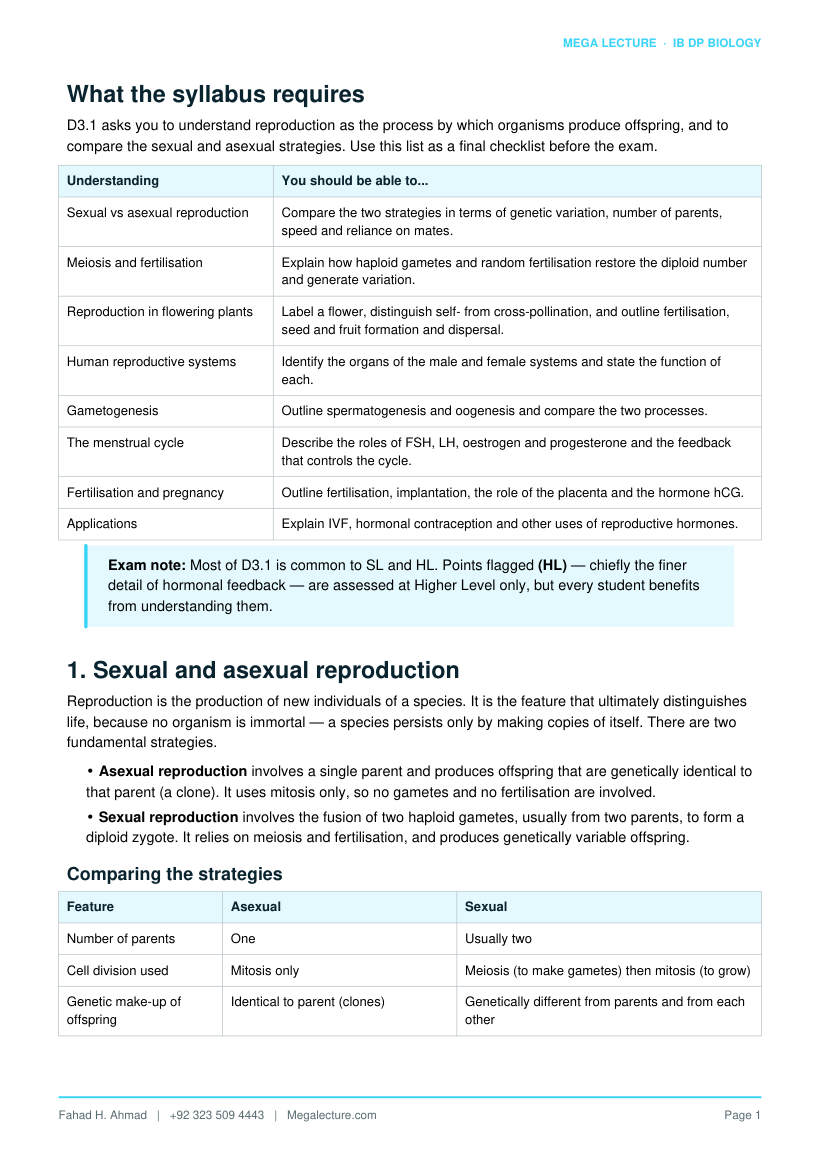
D3.1 asks you to understand reproduction as the process by which organisms produce offspring, and to compare the sexual and asexual strategies. Use this list as a final checklist before the exam.
Understanding You should be able to...
Sexual vs asexual reproduction Compare the two strategies in terms of genetic variation, number of parents, speed and reliance on mates.
Meiosis and fertilisation Explain how haploid gametes and random fertilisation restore the diploid number and generate variation.
Reproduction in flowering plants Label a flower, distinguish self- from cross-pollination, and outline fertilisation, seed and fruit formation and dispersal.
Human reproductive systems Identify the organs of the male and female systems and state the function of each.
Gametogenesis Outline spermatogenesis and oogenesis and compare the two processes.
The menstrual cycle Describe the roles of FSH, LH, oestrogen and progesterone and the feedback that controls the cycle.
Fertilisation and pregnancy Outline fertilisation, implantation, the role of the placenta and the hormone hCG.
Applications Explain IVF, hormonal contraception and other uses of reproductive hormones.
Exam note: Most of D3.1 is common to SL and HL. Points flagged (HL) — chiefly the finer detail of hormonal feedback — are assessed at Higher Level only, but every student benefits from understanding them.
1. Sexual and asexual reproduction
Reproduction is the production of new individuals of a species. It is the feature that ultimately distinguishes life, because no organism is immortal — a species persists only by making copies of itself. There are two fundamental strategies.
- Asexual reproduction involves a single parent and produces offspring that are genetically identical to that parent (a clone). It uses mitosis only, so no gametes and no fertilisation are involved.
- Sexual reproduction involves the fusion of two haploid gametes, usually from two parents, to form a diploid zygote. It relies on meiosis and fertilisation, and produces genetically variable offspring.
Comparing the strategies
Feature Asexual Sexual
Number of parents One Usually two
Cell division used Mitosis only Meiosis (to make gametes) then mitosis (to grow)
Genetic make-up of offspring
Identical to parent (clones) Genetically different from parents and from each other
Feature Asexual Sexual
Source of variation Mutation only Meiosis, random fertilisation and mutation
Need for a mate No Usually yes (except self-fertilising species)
Speed / numbers Rapid; many offspring quickly Slower; costly in time and energy
Advantages and disadvantages
Advantages Disadvantages
Asexual Fast; no mate or gametes needed; a single well-adapted individual can colonise a habitat; energetically cheap.
No variation, so a whole population is vulnerable to the same disease or environmental change; harmful mutations accumulate.
Sexual Generates genetic variation, the raw material for adaptation and evolution; variation spreads useful alleles and lets a population survive changing conditions.
Needs a mate and courtship; energetically costly; only half of each parent's genes pass on; slower.
Examples of asexual reproduction
Asexual reproduction takes many forms across the kingdoms; all rely on mitosis and produce clones.
Method Example Outline
Binary fission Bacteria, Amoeba The cell replicates its DNA and splits into two equal daughter cells.
Budding Yeast, Hydra A small outgrowth (bud) forms on the parent, grows, then detaches as a new individual.
Spore formation Fungi, ferns, mosses Many spores are made by mitosis and dispersed; each can grow into a new organism.
Vegetative propagation Strawberry runners, potato tubers, bulbs
Part of a plant (stem, root or leaf) grows into a new, independent plant.
Fragmentation Starfish, flatworms, filamentous algae
The body breaks into pieces, each of which regenerates a whole organism.
Key idea: The single biggest difference is variation. Asexual reproduction copies a successful genotype exactly; sexual reproduction shuffles genes so that offspring differ, which is an advantage when the environment changes but a cost when conditions are stable.
2. Meiosis and fertilisation: the basis of sexual reproduction
Sexual reproduction depends on a precise arithmetic of chromosome number. If two gametes each carried the full diploid number, fusion would double the chromosome count every generation. Two processes prevent this and, in doing so, create variation.
- Meiosis is a reduction division that halves the chromosome number, turning one diploid cell (2n) into four haploid gametes (n). In humans this takes the 46 chromosomes of a body cell down to 23 in each gamete.
- Fertilisation is the fusion of a haploid male gamete with a haploid female gamete to form a diploid zygote, restoring the full chromosome number (23 + 23 → 46).
The life cycle therefore alternates between the diploid and haploid states: diploid body cells → meiosis → haploid gametes → fertilisation → diploid zygote → mitosis → new diploid organism.
How variation is generated
- Crossing over in prophase I exchanges segments between homologous chromosomes, producing new combinations of alleles on a single chromosome.
- Independent assortment in metaphase I randomly orients each homologous pair, so the maternal and paternal chromosomes are mixed. In humans this alone gives 223 ≈ 8.4 million possible gametes.
- Random fertilisation means any one of millions of genetically distinct sperm may fuse with any one egg, multiplying the variation still further.
Exam tip: When asked how sexual reproduction produces variation, give three sources — crossing over, independent assortment and random fertilisation. Naming only one rarely earns full marks.
3. Sexual reproduction in flowering plants
The flower is the reproductive organ of a flowering plant (an angiosperm). Many flowers are hermaphrodite, containing both male parts (stamens) and female parts (carpels).
Flower structure
Part Belongs to Function
Anther Stamen (male) Produces pollen grains (which contain the male gametes) by meiosis.
Filament Stamen (male) Stalk that holds the anther in position to release pollen.
Stigma Carpel (female) Sticky surface that receives and traps pollen grains.
Style Carpel (female) Column of tissue through which the pollen tube grows to the ovary.
Ovary Carpel (female) Encloses and protects the ovules; develops into the fruit after fertilisation.
Ovule Carpel (female) Contains the female gamete (egg cell); becomes the seed after fertilisation.
Petals Accessory Often coloured and scented to attract insect pollinators.
Sepals Accessory Protect the flower bud before it opens.
Pollination
Pollination is the transfer of pollen from an anther to a stigma. It is not the same as fertilisation, which happens later inside the ovule.
- Self-pollination: pollen lands on a stigma of the same plant. It guarantees reproduction without a partner but gives little variation.
- Cross-pollination: pollen is carried to a different plant of the same species. It promotes variation but depends on a pollinating agent.
Feature Insect-pollinated flower Wind-pollinated flower
Petals Large, brightly coloured, scented Small, dull or absent
Nectar Present, to reward visitors Absent
Anthers Firm, held inside the flower Loose, dangling outside to release pollen into the air
Stigma Sticky, inside the flower Large and feathery, hanging outside to catch airborne pollen
Pollen Sticky or spiky, in small amounts Smooth, light and abundant
Fertilisation, seed and fruit
A pollen grain that lands on a compatible stigma grows a pollen tube down the style to an ovule. A male gamete travels down the tube and fuses with the egg cell inside the ovule — this is fertilisation. Afterwards:
- each fertilised ovule becomes a seed containing an embryo and a food store;
- the ovary wall develops into the fruit, which encloses and protects the seeds;
- the petals, stamens and stigma wither once their job is done.
Seed dispersal
Seeds are dispersed away from the parent to reduce competition for light, water and minerals and to colonise new areas. Common methods are wind (light, winged seeds), animal (hooked or fleshy fruits), water (buoyant seeds) and explosive mechanisms (pods that split open).
Watch the sequence: pollination → pollen tube growth → fertilisation → seed and fruit formation → dispersal. Confusing pollination with fertilisation is one of the commonest errors.
4. Human reproductive systems
Humans reproduce sexually, with separate male and female individuals. Each system produces gametes and, in the female, supports the developing embryo.
Male reproductive system ♂
Structure Function
Testes Produce sperm (in the seminiferous tubules) and secrete the hormone testosterone.
Scrotum Sac holding the testes outside the body, keeping them slightly below core temperature for sperm production.
Epididymis Coiled tube where sperm are stored and mature.
Sperm duct (vas deferens) Carries sperm from the epididymis towards the urethra during ejaculation.
Structure Function
Seminal vesicles / prostate gland
Add fluids (semen) that nourish the sperm and provide a medium for swimming.
Urethra Carries semen (and, separately, urine) out through the penis.
Penis Delivers sperm into the female reproductive tract.
Female reproductive system ♀
Structure Function
Ovaries Contain follicles that produce egg cells; secrete oestrogen and progesterone.
Oviduct (Fallopian tube) Carries the egg towards the uterus; the usual site of fertilisation. Cilia and muscle move the egg along.
Uterus Muscular organ whose lining (endometrium) receives the embryo and supports the fetus during pregnancy.
Endometrium The uterine lining that thickens each cycle and is shed during menstruation if no embryo implants.
Cervix Ring of muscle at the base of the uterus; opens into the vagina.
Vagina Receives the penis during intercourse and forms the birth canal.
Exam tip: Learn each organ with a one-line function. Questions often give a function and ask for the organ, or point to a labelled diagram — either way a crisp function statement scores the mark.
5. Gametogenesis: making the gametes
Gametogenesis is the formation of gametes by meiosis. The male process is spermatogenesis, in the testes; the female process is oogenesis, in the ovaries. Both start with diploid cells and end with haploid gametes, but the details differ.
Feature Spermatogenesis Oogenesis
Location Seminiferous tubules of the testes Ovaries
Product per meiosis Four functional sperm One functional egg plus (up to three) polar bodies that break down
Size of gamete Small, motile, little cytoplasm Large, non-motile, rich in cytoplasm and nutrients
Timing Continuous from puberty, millions per day Begins before birth, then pauses; one egg matures per cycle
Duration Completed in weeks, then released May be arrested for years before completion
Both processes share the same logic — one diploid parent cell → DNA replication → meiosis I → meiosis II → haploid gametes — but oogenesis concentrates resources into a single large egg, while spermatogenesis maximises numbers of small, mobile sperm.
Sperm and egg cell adaptations
The two gametes are specialised for very different jobs: the sperm must travel to and penetrate the egg, while the egg must supply the early embryo.
Feature Sperm cell Egg cell (ovum)
Size and number Very small; produced in vast numbers Large; usually one released per cycle
Movement Flagellum (tail) for swimming Non-motile; moved by cilia and muscle in the oviduct
Mitochondria Many, in the mid-piece, to power swimming
Present to supply the early embryo
Cytoplasm and food store
Very little Large store of nutrients for the embryo
Special features Acrosome with enzymes to digest into the egg
Zona pellucida / membrane that hardens after fertilisation to block extra sperm
Why the asymmetry? Unequal cytoplasmic division in oogenesis gives the egg a large food store for the early embryo, while the tiny polar bodies simply remove the extra chromosome sets.
Figure 1. Gametogenesis by meiosis: a diploid (2n = 46) germ cell gives haploid (n = 23) gametes. Spermatogenesis divides its cytoplasm equally to give 4 functional sperm; oogenesis divides it unequally, giving 1 egg plus 3 polar bodies that break down.
6. The menstrual cycle
The menstrual cycle is a roughly 28-day cycle that prepares the female body for possible pregnancy. It is controlled by four hormones acting through negative and positive feedback. Day 1 is defined as the first day of menstruation.
The four hormones
Hormone Secreted by Main roles
FSH (follicle-stimulating hormone)
Pituitary gland Stimulates a follicle in the ovary to grow and mature; stimulates the follicle to secrete oestrogen.
Oestrogen Growing follicle (ovary) Repairs and thickens the endometrium; at high levels triggers the LH surge (positive feedback).
LH (luteinising hormone) Pituitary gland A mid-cycle surge triggers ovulation and converts the empty follicle into the corpus luteum.
Progesterone Corpus luteum (ovary) Maintains and further thickens the endometrium; inhibits FSH and LH (negative feedback).
Events of the cycle
- Follicular phase (days 1-13): FSH stimulates a follicle to develop; the follicle secretes oestrogen, which rebuilds the endometrium. Rising oestrogen eventually triggers a surge of LH.
- Ovulation (about day 14): the LH surge causes the mature follicle to burst and release its egg into the oviduct.
- Luteal phase (days 15-28): LH turns the empty follicle into the corpus luteum, which secretes progesterone (and some oestrogen) to maintain the endometrium. If no embryo implants, the corpus luteum breaks down, progesterone falls, and the endometrium is shed as menstruation — beginning the next cycle.
Feedback control
- Negative feedback: high progesterone (and oestrogen) in the luteal phase inhibits FSH and LH from the pituitary, preventing new follicles from developing while one cycle is under way.
- Positive feedback: near the end of the follicular phase, high oestrogen stimulates the pituitary to release the LH surge — a rare example of positive feedback in the body, and the trigger for ovulation.
Reading the graph: On a menstrual-cycle graph, find ovulation first — it sits just after the sharp LH peak, around day 14. Oestrogen peaks just before the LH surge; progesterone peaks in the luteal phase, around day 21, then falls before menstruation.
Figure 2. Modelled hormone levels across the menstrual cycle (day 0-28). The LH surge peaks at day 14, triggering ovulation;
oestrogen peaks just before it (day 12.6) and progesterone peaks in the luteal phase (day 21.0).
7. Fertilisation, implantation and pregnancy
If sperm are present when an egg is released, fertilisation may occur in the oviduct. A single sperm penetrates the egg; their haploid nuclei fuse to form a diploid zygote. The egg membrane then changes to block further sperm.
- The zygote divides by mitosis as it travels down the oviduct, forming a ball of cells (an early embryo).
- Implantation: about a week after fertilisation the embryo embeds itself in the thickened endometrium of the uterus.
- The embryo secretes hCG (human chorionic gonadotropin), which keeps the corpus luteum alive so it continues to make progesterone. Progesterone maintains the endometrium, so menstruation does not occur and the pregnancy continues. hCG is the hormone detected by pregnancy tests.
The placenta
The placenta is an organ that develops from embryonic and maternal tissue. It brings maternal and fetal blood very close together (without mixing them) so that materials can be exchanged: oxygen, glucose, amino acids and antibodies pass to the fetus, while carbon dioxide and urea pass to the mother. The placenta also secretes progesterone and oestrogen, taking over from the corpus luteum later in pregnancy.
Identical and non-identical twins
- Identical (monozygotic) twins come from a single zygote that splits into two embryos early in development. They share the same genotype and are always the same sex — a natural example of cloning within sexual reproduction.
- Non-identical (dizygotic) twins come from two separate eggs fertilised by two separate sperm. They are no more genetically alike than ordinary siblings and may be different sexes.
Hormone hand-over: Early pregnancy relies on the corpus luteum (kept going by hCG); from roughly the second trimester the placenta itself makes enough progesterone and oestrogen, so the corpus luteum can regress.
8. Applications of reproductive biology
Understanding reproductive hormones has led to important medical applications.
In-vitro fertilisation (IVF)
IVF helps couples who cannot conceive naturally. In outline:
- drugs stop the normal cycle, then high doses of FSH (and LH) stimulate several follicles to mature at once (superovulation);
- the mature eggs are collected from the ovaries;
- eggs are mixed with sperm in a dish so that fertilisation occurs outside the body (in vitro);
- one or two healthy early embryos are transferred into the uterus, where one may implant.
Hormonal contraception
Hormonal contraceptives contain synthetic oestrogen and/or progesterone. By keeping these hormone levels artificially high, they exploit negative feedback: FSH and LH release is inhibited, so no follicle matures and no LH surge occurs — ovulation is prevented. Progesterone also thickens cervical mucus, making it harder for sperm to pass.
Use Hormone(s) involved How it works
Contraceptive pill Oestrogen and/or progesterone Negative feedback inhibits FSH and LH, so ovulation does not occur.
Fertility treatment / IVF FSH, LH Stimulate multiple follicles to mature for egg collection.
Pregnancy test detects hCG hCG in urine confirms implantation has occurred.
Hormone replacement Oestrogen, progesterone Relieve symptoms when natural hormone levels fall (e.g. menopause).
Neat symmetry: Contraception and IVF pull the same levers in opposite directions — contraception suppresses FSH/LH to stop ovulation, while IVF boosts FSH/LH to force several eggs to mature.
9. Hormonal feedback in more detail (HL)
At Higher Level you should be able to trace the feedback loops of the menstrual cycle in full, explaining why each hormone rises and falls when it does.
- (HL) Early follicular phase: with progesterone low, there is little inhibition, so FSH rises and recruits a follicle. The follicle secretes rising oestrogen.
- (HL) Low-to-moderate oestrogen exerts negative feedback on the pituitary, helping to keep FSH from stimulating too many follicles.
- (HL) Once oestrogen passes a high threshold, the feedback switches sign: high oestrogen now exerts positive feedback, driving a rapid surge of LH (and a smaller FSH peak).
- (HL) The LH surge triggers ovulation and forms the corpus luteum, which secretes progesterone. Progesterone plus oestrogen now exert strong negative feedback, shutting down FSH and LH so no further ovulation occurs in that cycle.
- (HL) If fertilisation fails, the corpus luteum degenerates; progesterone and oestrogen fall; the endometrium is shed, and the loss of inhibition lets FSH rise again to start the next cycle.
(HL) The key insight: The same hormone (oestrogen) can give either negative or positive feedback depending on its concentration and how long it is sustained. This sign-switch is what makes the LH surge, and therefore ovulation, possible.
10. Skills, worked examples and pitfalls
Worked example 1 — labelling a flower
A diagram shows a hermaphrodite flower. Name the part that (a) produces pollen, (b) receives pollen, (c) becomes the seed, (d) becomes the fruit.
- Anther — produces pollen grains. (b) Stigma — receives and traps pollen. (c) The ovule becomes the seed after fertilisation. (d) The ovary (its wall) becomes the fruit.
Tip: link male parts (anther, filament) to the stamen and female parts (stigma, style, ovary, ovule) to the carpel.
Worked example 2 — comparing pollination adaptations
A flower has small green petals, no scent, large feathery stigmas hanging outside the flower, and produces huge amounts of light, smooth pollen. How is it pollinated, and how do you know?
It is wind-pollinated. Reasoning: dull petals and no scent or nectar mean it does not attract insects; feathery exposed stigmas catch airborne pollen; and light, smooth, abundant pollen is easily carried on the wind.
Worked example 3 — interpreting a hormone graph
A menstrual-cycle graph shows a large hormone peak at day 14 and a broad, lower peak around day 21. Identify each and state what is happening.
The sharp day-14 peak is LH (the LH surge) — it triggers ovulation. The broad day-21 peak is progesterone, secreted by the corpus luteum to maintain the endometrium in the luteal phase.
If both peaks then fall away by day 28, no implantation occurred, so menstruation follows.
Worked example 4 — explaining feedback
Explain why taking a contraceptive pill containing oestrogen and progesterone prevents ovulation.
The pill keeps oestrogen and progesterone levels high. By negative feedback these hormones inhibit the pituitary, so it releases little FSH and LH. Without FSH no follicle matures, and without the LH surge ovulation cannot occur, so no egg is released.
Common pitfalls
- Confusing pollination (pollen reaches the stigma) with fertilisation (gametes fuse inside the ovule) — they are separate steps.
- Muddling the hormones: remember FSH grows the Follicle, LH triggers ovulation (the LH surge), oestrogen rebuilds the lining, progesterone maintains it.
- Forgetting that the LH surge is driven by positive feedback from high oestrogen — most other feedback in the cycle is negative.
- Saying meiosis alone causes variation — remember to add independent assortment, crossing over and random fertilisation.
- Writing that asexual reproduction produces "no variation ever" — mutation still creates rare differences even among clones.
- Assuming the ovary becomes the seed — it becomes the fruit; the ovule becomes the seed.
Quick reference
Term One-line summary
Asexual reproduction One parent, mitosis only, clones, fast, no variation except mutation.
Sexual reproduction Two gametes fuse, meiosis + fertilisation, variable offspring.
Meiosis Reduction division: 2n → four haploid (n) gametes; a source of variation.
Fertilisation Fusion of haploid gametes → diploid zygote (n + n = 2n).
Pollination Transfer of pollen from anther to stigma (self or cross).
FSH Stimulates follicle growth and oestrogen secretion.
Oestrogen Rebuilds endometrium; high levels trigger the LH surge (positive feedback).
LH Mid-cycle surge triggers ovulation; forms the corpus luteum.
Progesterone Maintains endometrium; inhibits FSH/LH (negative feedback).
hCG Made by the embryo; maintains the corpus luteum in early pregnancy.
Placenta Exchanges materials between mother and fetus; later secretes progesterone.
Test yourself
Attempt these without notes; full answers follow.
- State three ways sexual reproduction differs from asexual reproduction.
- Explain how meiosis and fertilisation together keep the chromosome number constant from one generation to the next.
- Give three sources of genetic variation in sexually reproducing organisms.
- Distinguish between pollination and fertilisation in a flowering plant.
- Describe two adaptations of an insect-pollinated flower and explain each.
- Outline the roles of FSH, LH, oestrogen and progesterone in the menstrual cycle.
- Explain how hCG allows a pregnancy to continue past the time when menstruation would normally occur.
- (HL) Explain why high oestrogen has different effects at different points in the menstrual cycle.
Answers
- Any three: asexual has one parent, sexual usually two; asexual uses mitosis only, sexual uses meiosis and fertilisation; asexual gives identical clones, sexual gives variable offspring; asexual is faster and needs no mate.
- Meiosis halves the number, making haploid gametes (n); fertilisation fuses two gametes to restore the diploid number (n + n = 2n). Without meiosis, fusion would double the number each generation.
- Crossing over (prophase I), independent assortment of homologous pairs (metaphase I), and random fertilisation of one gamete by another.
- Pollination is the transfer of pollen from an anther to a stigma; fertilisation is the later fusion of the male and female gametes inside the ovule after a pollen tube has grown down the style.
- Any two, e.g. large scented petals to attract insects; nectar as a reward that lures insects in so pollen brushes onto them; sticky stigma inside the flower to pick up pollen carried on the insect's body.
- FSH stimulates a follicle to grow and to secrete oestrogen; oestrogen rebuilds the endometrium and, at high levels, triggers the LH surge; the LH surge causes ovulation and forms the corpus luteum; progesterone (from the corpus luteum) maintains the endometrium and inhibits FSH and LH.
- The embryo secretes hCG, which keeps the corpus luteum alive. The corpus luteum continues to secrete progesterone, which maintains the endometrium, so it is not shed and menstruation does not occur — the pregnancy continues.
- (HL) At low-to-moderate levels oestrogen exerts negative feedback that limits FSH; once it exceeds a high threshold late in the follicular phase it switches to positive feedback, driving the LH surge that causes ovulation. The effect depends on the concentration and duration of oestrogen.
