
IB Diploma · Biology · SL / HL · Theme D: Continuity and Change
D3.2 Inheritance
Opens inside this page. Prefer your own PDF app? Open the PDF.
Full text of D3.2 Inheritance
IB DP BIOLOGY Theme D: Continuity and Change D3.2 Inheritance
Revision Notes · Standard and Higher Level Fahad H. Ahmad
+92 323 509 4443 | Megalecture.com
Original notes prepared for the IB Diploma Programme Biology course (2025 syllabus)
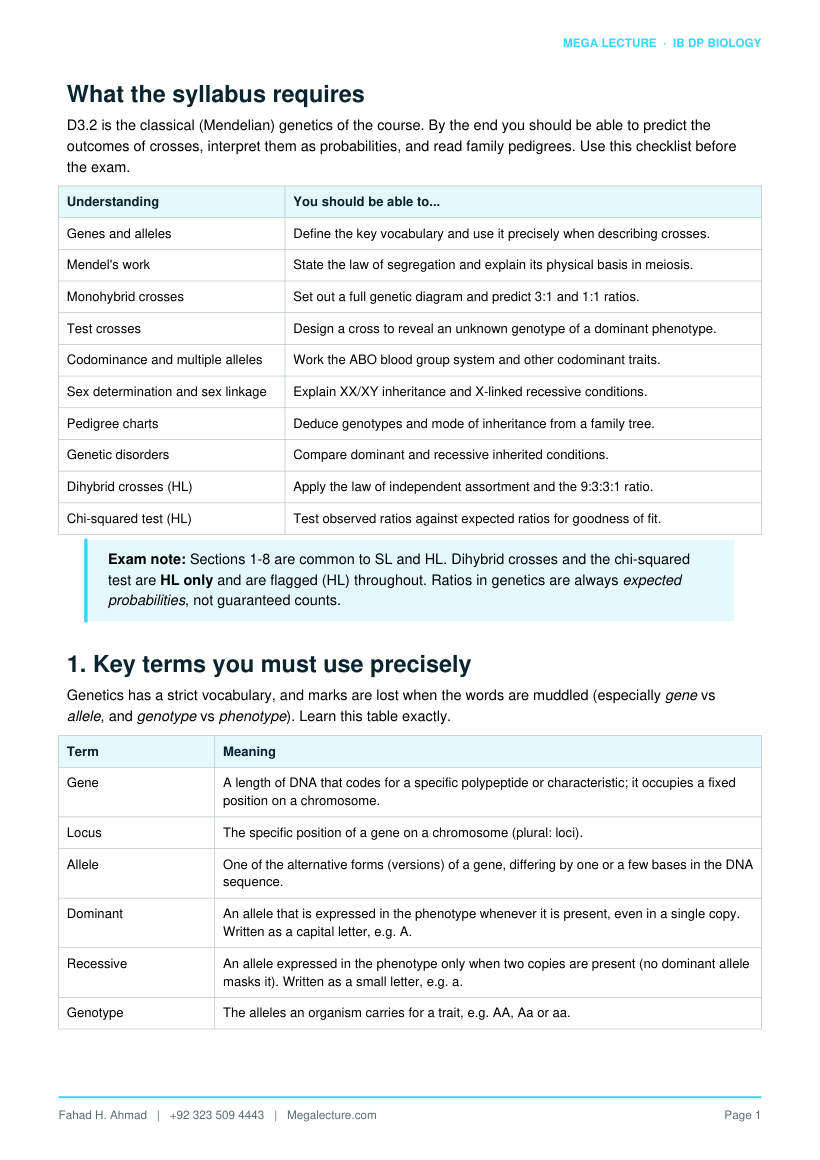
What the syllabus requires
D3.2 is the classical (Mendelian) genetics of the course. By the end you should be able to predict the outcomes of crosses, interpret them as probabilities, and read family pedigrees. Use this checklist before the exam.
Understanding You should be able to...
Genes and alleles Define the key vocabulary and use it precisely when describing crosses.
Mendel's work State the law of segregation and explain its physical basis in meiosis.
Monohybrid crosses Set out a full genetic diagram and predict 3:1 and 1:1 ratios.
Test crosses Design a cross to reveal an unknown genotype of a dominant phenotype.
Codominance and multiple alleles Work the ABO blood group system and other codominant traits.
Sex determination and sex linkage Explain XX/XY inheritance and X-linked recessive conditions.
Pedigree charts Deduce genotypes and mode of inheritance from a family tree.
Genetic disorders Compare dominant and recessive inherited conditions.
Dihybrid crosses (HL) Apply the law of independent assortment and the 9:3:3:1 ratio.
Chi-squared test (HL) Test observed ratios against expected ratios for goodness of fit.
Exam note: Sections 1-8 are common to SL and HL. Dihybrid crosses and the chi-squared test are HL only and are flagged (HL) throughout. Ratios in genetics are always expected probabilities, not guaranteed counts.
1. Key terms you must use precisely
Genetics has a strict vocabulary, and marks are lost when the words are muddled (especially gene vs allele, and genotype vs phenotype). Learn this table exactly.
Term Meaning
Gene A length of DNA that codes for a specific polypeptide or characteristic; it occupies a fixed position on a chromosome.
Locus The specific position of a gene on a chromosome (plural: loci).
Allele One of the alternative forms (versions) of a gene, differing by one or a few bases in the DNA sequence.
Dominant An allele that is expressed in the phenotype whenever it is present, even in a single copy. Written as a capital letter, e.g. A.
Recessive An allele expressed in the phenotype only when two copies are present (no dominant allele masks it). Written as a small letter, e.g. a.
Genotype The alleles an organism carries for a trait, e.g. AA, Aa or aa.
Term Meaning
Phenotype The observable characteristic that results from the genotype (and environment), e.g. purple flowers.
Homozygous Having two identical alleles at a locus (AA or aa). A homozygote breeds true.
Heterozygous Having two different alleles at a locus (Aa). Also called a carrier for a recessive condition.
Carrier A heterozygous individual who does not show a recessive trait but can pass the recessive allele on.
P, F1, F2 The parental generation, the first filial (offspring) generation, and the second filial generation.
Gene vs allele: A gene is the 'slot' (e.g. the gene for flower colour); an allele is a particular 'setting' of that slot (e.g. the purple allele or the white allele). Every diploid organism has two alleles per gene, one on each homologous chromosome.
2. Mendel and the law of segregation
Gregor Mendel worked out the rules of inheritance in the 1860s by breeding pea plants and counting offspring across thousands of crosses. He studied clear-cut, true-breeding characters (such as seed colour and plant height), which made the ratios easy to see. His great insight was that inheritance is particulate: traits are passed on as discrete units (now called alleles) that do not blend.
The law of segregation
The two alleles of a gene separate (segregate) from each other during the formation of gametes, so that each gamete receives only one allele of the pair. When two gametes fuse at fertilisation, the diploid number is restored and the offspring again carries two alleles.
Its physical basis is meiosis: homologous chromosomes (which carry the two alleles) are pulled to opposite poles in anaphase I, so the alleles end up in different gametes. Mendel deduced this rule decades before chromosomes were understood.
Key idea: Dominant does not mean 'stronger' or 'more common'. It only means the allele that is expressed in a heterozygote. Many dominant alleles are rare, and some recessive alleles are very common.
3. Monohybrid crosses and the Punnett square
A monohybrid cross follows the inheritance of a single gene. A clear genetic diagram is expected in the exam and is marked step by step, so always set it out in full even when you can see the answer.
How to set out a genetic diagram Worked cross A: heterozygous × heterozygous
Cross two black guinea pigs that are both heterozygous (Bb × Bb). Gametes from each parent are B and b.
Bb × Bb
B b B BB Bb b Bb bb
Genotype ratio 1 BB : 2 Bb : 1 bb. Phenotype ratio 3 black : 1 brown. So each pup has a ¾ (75%) chance of being black and a ¼ (25%) chance of being brown. This 3:1 ratio is the signature of a heterozygous × heterozygous cross for a fully dominant allele.
Worked cross B: heterozygous × homozygous recessive
Now cross a heterozygous black guinea pig with a brown one (Bb × bb). Gametes are B and b from the first parent, and b and b from the second.
Bb × bb
B b b Bb bb b Bb bb
Genotype ratio 1 Bb : 1 bb. Phenotype ratio 1 black : 1 brown, i.e. a 50:50 outcome. A 1:1 ratio is the signature of a heterozygote crossed with a homozygous recessive.
Reading ratios: A 3:1 ratio is a probability for each offspring, not a promise about a small litter. Four pups could easily be all black; the ratio only emerges reliably over large numbers, exactly as when tossing a coin.
Figure 1. Punnett square for a monohybrid cross Aa × Aa. Computed offspring: 3 dominant (A_) : 1 recessive (aa), i.e. 75% :
25% - the classic 3:1 ratio.
4. The test cross
An organism showing the dominant phenotype could be homozygous (BB) or heterozygous (Bb) - you cannot tell by looking. A test cross reveals which, by crossing the unknown individual with a homozygous recessive (bb).
Why the homozygous recessive? Because it can only donate recessive alleles, so the offspring phenotypes directly expose the alleles hidden in the unknown parent.
If the unknown is...
Cross Offspring Conclusion
Homozygous BB BB × bb all Bb, all black (dominant) No recessive offspring → parent is BB.
Heterozygous Bb Bb × bb 1 Bb : 1 bb, i.e. 1 black : 1 brown About half show the recessive → parent is Bb.
So the appearance of even one recessive-phenotype offspring shows the tested parent must be heterozygous. In practice, larger numbers of offspring make the conclusion safer, because a Bb parent could by chance produce several dominant offspring in a small sample.
5. Codominance and multiple alleles
Not all alleles are simply dominant or recessive.
Codominance
Two alleles are codominant when both are fully and separately expressed in the heterozygote - neither masks the other, and the phenotype is not a blend but shows both features together. Codominant alleles are written as capital letters with a superscript, both attached to the gene symbol.
CRCR × CWCW
CR CR CW CRCW CRCW CW CRCW CRCW
All F1 are roan. Crossing two roans (CRCW × CRCW) then gives 1 red : 2 roan : 1 white - here the genotype ratio and phenotype ratio are the same (1:2:1), because every genotype looks different.
Multiple alleles: the ABO blood group system
A gene can have more than two alleles in the population - these are multiple alleles - although any one diploid individual still carries only two. The human ABO blood group gene has three alleles:
Allele Effect Relationship
IA Adds antigen A to red blood cells Codominant with IB; dominant to i
IB Adds antigen B to red blood cells Codominant with IA; dominant to i i Adds no antigen Recessive to both IA and IB
Because IA and IB are codominant but both are dominant to i, the four blood groups arise from six genotypes:
Blood group (phenotype) Possible genotype(s)
A IAIA or IAi
B IBIB or IBi
AB IAIB (both antigens - codominance)
O ii (no antigen)
Worked cross C: blood groups
A man of group AB (IAIB) has children with a woman who is group O (ii). His gametes are IA and IB; hers are both i.
IAIB × ii
IA IB i IAi IBi i IAi IBi
Offspring are 1 IAi : 1 IBi, i.e. a 1:1 ratio of group A to group B. Notably, this couple can have no group AB and no group O children - a point often tested.
6. Sex determination and sex linkage
In humans, sex is decided by one pair of chromosomes, the sex chromosomes (the other 22 pairs are autosomes). Females are XX and males are XY.
Because a mother (♀ XX) can only pass on an X, while a father (♂ XY) passes on either an X or a Y, it is the father's gamete that determines the sex of the child - and the expected ratio is 1 female : 1 male.
XX × XY
X Y X XX XY X XX XY
Half the offspring are XX (female) and half XY (male): a 1:1 sex ratio.
Sex linkage
A sex-linked gene lies on a sex chromosome. Almost all such genes are on the much larger X chromosome; the tiny Y carries very few genes. Alleles of an X-linked gene are written as superscripts on the X, e.g. XH and Xh.
A male has only one X, so he has only one allele of any X-linked gene - he is said to be hemizygous. He therefore expresses whatever allele his single X carries, even a recessive one. This is why X-linked recessive conditions affect males far more often than females.
Condition Inheritance Key features
Haemophilia X-linked recessive Blood fails to clot normally; caused by a faulty clotting-factor allele.
Condition Inheritance Key features
Red-green colour blindness
X-linked recessive Difficulty distinguishing red and green; common in males (about 1 in 12).
Why males are more affected Worked cross D: carrier mother × unaffected father
A carrier mother (XHXh) and an unaffected father (XHY) for haemophilia. Mother's gametes are XH and Xh; father's are XH and Y.
XHXh × XHY
XH Y XH XHXH XHY Xh XHXh XhY
Offspring: XHXH (unaffected girl), XHXh (carrier girl), XHY (unaffected boy), XhY (affected boy). So all daughters are unaffected (half of them carriers), while half the sons are affected. Overall ¼ of the children are affected, and every affected child is male.
Notation warning: Always keep the X (and Y) in the genotype for sex-linked genes: write XHXh, never just Hh. Dropping the X hides the sex linkage and loses marks.
7. Pedigree charts
A pedigree (family tree) records a trait across generations and is used to deduce genotypes and the mode of inheritance. Learn the standard symbols.
Symbol Meaning
Square Male
Circle Female
Shaded (filled) shape Individual showing the trait (affected)
Unshaded (empty) shape Individual not showing the trait (unaffected)
Horizontal line joining two shapes A mating (parents)
Vertical line down to a horizontal sibship line
Their children, listed left to right
Generations Labelled with Roman numerals I, II, III from the top
How to read a pedigree
Deduction tip: The single most useful rule is: two unaffected parents with an affected child prove the condition is recessive and both parents are carriers. This one observation unlocks most pedigree questions.
Worked example E: reading a pedigree Worked example E - deduce the inheritance
In a family, two unaffected parents (generation I) have three children: two unaffected daughters and one affected son. Determine the mode of inheritance and the parents' genotypes.
Step 1 - Two unaffected parents produced an affected child, so the trait is recessive and both parents must be carriers.
Step 2 - The affected individual is male. This is consistent with X-linked recessive inheritance (though not yet proof). If autosomal recessive, let A = unaffected, a = affected: parents are Aa × Aa, and ¼ of children are expected affected.
Step 3 - If X-linked, the mother is a carrier XAXa and the father is XAY; the affected son is XaY, having inherited Xa from his carrier mother. More affected males in the wider family, and no father-to-son transmission, would confirm X-linkage.
Figure 2. Pedigree for an autosomal recessive trait: two unaffected carrier (Aa) parents produce 1 affected child out of 4
(25%), matching the 25% recessive-phenotype probability of an Aa × Aa cross.
8. Genetic disorders
Many human conditions are inherited as single-gene traits. Whether an allele is dominant or recessive dramatically changes how a disorder runs in families.
Disorder Inheritance Key points
Cystic fibrosis Autosomal recessive Faulty CFTR chloride-channel protein → thick, sticky mucus in lungs and gut. Affected individuals are homozygous recessive; unaffected carriers are common.
Sickle cell anaemia Autosomal (codominant / recessive)
Altered haemoglobin; heterozygotes (sickle-cell trait) are largely healthy and have some malaria resistance.
Huntington's disease Autosomal dominant Progressive nerve-cell degeneration; a single dominant allele causes it, so an affected person usually has an affected parent. Symptoms often appear after age 30.
Haemophilia X-linked recessive Impaired blood clotting; mainly affects males, passed via carrier females.
Dominant vs recessive disorders
9. Dihybrid crosses and independent assortment (HL)
(HL) A dihybrid cross follows two genes at the same time, for example seed shape and seed colour in peas. It relies on Mendel's second law.
The law of independent assortment (HL)
(HL) The alleles of different genes segregate independently of one another during meiosis, provided the genes are on different chromosomes (or far apart on the same chromosome). Physically this comes from the random orientation of homologous pairs on the equator in metaphase I: how one pair lines up does not affect any other pair, so all combinations of alleles are equally likely in the gametes.
Setting up a dihybrid cross (HL)
(HL) Take true-breeding round yellow peas (RRYY) crossed with wrinkled green peas (rryy), where R = round (dominant), r = wrinkled, Y = yellow (dominant), y = green. The F1 are all RrYy (round and yellow). A heterozygote RrYy makes four equally likely gamete types, because each gene assorts independently: RY, Ry, rY and ry.
Self-crossing the F1 (RrYy × RrYy) needs a 4×4 Punnett grid of the 16 combinations:
RrYy × RrYy
RY Ry rY ry RY RRYY RRYy RrYY RrYy Ry RRYy RRyy RrYy Rryy rY RrYY RrYy rrYY rrYy ry RrYy Rryy rrYy rryy
Grouping the 16 offspring by phenotype gives the classic 9:3:3:1 ratio:
Phenotype Count Description round, yellow at least one R and one Y round, green at least one R, but yy wrinkled, yellow rr, but at least one Y wrinkled, green rryy - both homozygous recessive
The two recessive-only classes (3 and 1) and the double recessive (rryy, the rarest, 1/16) are favourite checkpoints. A dihybrid test cross (RrYy × rryy) instead gives a 1:1:1:1 ratio of the four phenotypes.
(HL) Note: The 9:3:3:1 ratio only holds when the two genes assort independently. Genes close together on the same chromosome are linked and give distorted ratios - a topic connected to D3.2's HL extension on gene linkage.
Figure 3. Dihybrid cross AaBb × AaBb: the 16-cell Punnett grid gives 9 : 3 : 3 : 1 (sum = 16), the classic 9:3:3:1 ratio.
10. The chi-squared test for goodness of fit (HL)
(HL) When we count real offspring, the numbers rarely match the expected ratio exactly. The chi-squared (χ2) test tells us whether the difference between observed and expected results is small enough to be due to chance, or large enough to suggest the ratio is wrong.
The test compares observed counts (O) with the expected counts (E) calculated from the predicted ratio, using:
χ2 = Σ ( O − E )2 / E
How to use it, conceptually (HL)
(HL) Interpretation: A significant result (reject the null hypothesis) does not say the genetics is 'wrong'; it flags that another factor - such as gene linkage, reduced viability of one genotype, or a sampling problem - may be influencing the numbers.
11. More worked examples
Worked example 1 - monohybrid (flower colour)
Purple flower (P) is dominant to white (p). A heterozygous purple plant is crossed with a white plant. Predict the offspring.
Parents Pp × pp. Gametes: P and p from the first; p and p from the second.
Offspring: 1 Pp : 1 pp, i.e. 1 purple : 1 white. Each seedling has a ½ chance of being purple.
Worked example 2 - test cross
A black mouse (B dominant) is crossed with a brown mouse (bb) and produces 6 black and 5 brown pups. What is the black parent's genotype?
Brown pups (bb) must have received a b allele from each parent. Since the black parent passed on b, it must carry b as well as B.
Therefore the black parent is heterozygous, Bb. The roughly 1:1 ratio of black to brown confirms this.
Worked example 3 - codominance (roan cattle)
Cross a roan bull (CRCW) with a red cow (CRCR). Predict the calves.
Gametes: CR and CW from the bull; CR and CR from the cow.
Offspring: 1 CRCR : 1 CRCW, i.e. 1 red : 1 roan. No white calves are possible from this cross.
Worked example 4 - blood groups
A woman of group A whose father was group O has a child with a man of group B whose mother was group O. What blood groups are possible in their children?
The woman is group A but had a group O (ii) father, so she must carry i: she is IAi. Likewise the man is IBi.
Cross IAi × IBi → IAIB (AB), IAi (A), IBi (B), ii (O), each with probability ¼. All four groups A, B, AB and O are possible, in a 1:1:1:1 ratio.
Worked example 5 - sex linkage (colour blindness)
A colour-blind man (XbY) marries a woman who is homozygous normal-vision (XBXB). Describe the children and grandchildren risk.
Cross XbY × XBXB → daughters XBXb (all carriers, normal vision), sons XBY (all normal vision).
None of the children is colour-blind, but every daughter is a carrier, so the condition can reappear in her sons - it appears to 'skip' a generation, a hallmark of X-linked recessive inheritance.
Worked example 6 - dihybrid ratio (HL)
(HL) In tomatoes, tall (T) is dominant to dwarf (t) and smooth skin (S) is dominant to peach (fuzzy) skin (s). Two plants heterozygous for both genes are crossed (TtSs × TtSs). Predict the phenotype ratio.
Each parent produces four gamete types (TS, Ts, tS, ts). A 4×4 grid of 16 offspring gives the ratio 9 tall smooth : 3 tall peach : 3 dwarf smooth : 1 dwarf peach.
Only 1 in 16 offspring is dwarf with peach skin (ttss, both homozygous recessive).
12. Common pitfalls 13. Quick reference
Cross / situation Expected ratio
Aa × Aa (monohybrid, full dominance) 3 dominant : 1 recessive (genotype 1:2:1)
Aa × aa (heterozygote × homozygous recessive) 1 dominant : 1 recessive
AA × aa all heterozygous, all dominant phenotype
Codominant heterozygote × heterozygote 1 : 2 : 1 (three distinct phenotypes)
Test cross (dominant × homozygous recessive) all dominant → homozygous; 1:1 → heterozygous
Sex determination (XX × XY) 1 female : 1 male
Sex-linked: carrier ♀ × unaffected ♂ all daughters unaffected; ½ sons affected
(HL) Dihybrid RrYy × RrYy 9:3:3:1
(HL) Dihybrid test cross RrYy × rryy 1:1:1:1
14. Practice questions
Attempt each fully - define symbols and draw the diagram - then check the worked answers that follow.
Q1. In pea plants, tall (T) is dominant to dwarf (t). A tall plant is crossed with a dwarf plant and the offspring are all tall. Give the genotypes of both parents.
Q2. Two heterozygous black rabbits (Bb) are crossed. What fraction of the offspring are expected to be brown (bb), and what is the expected phenotype ratio?
Q3. A plant with red flowers is crossed with a white-flowered plant and all offspring are pink. Explain the inheritance and give the offspring ratio if two pink plants are then crossed.
Q4. A woman of blood group O has a child with a man of blood group AB. List the possible blood groups of their children and their probabilities.
Q5. Haemophilia is X-linked recessive. A carrier woman (XHXh) marries a man with haemophilia (XhY). Work out the expected genotypes and phenotypes of their children.
Q6. In a pedigree, two unaffected parents have a daughter who shows a condition. Is the allele dominant or recessive, and is it likely to be autosomal or X-linked? Justify your answer.
Q7. A black guinea pig of unknown genotype is crossed with a brown one (bb). Explain the name of this cross and how the results reveal the black parent's genotype.
Q8. Huntington's disease is autosomal dominant. An affected heterozygous man (Hh) has children with an unaffected woman (hh). What is the chance each child inherits the disease?
Q9. (HL) In a dihybrid cross RrYy × RrYy, what fraction of offspring are expected to be wrinkled and green (rryy)? What is the full phenotype ratio?
Q10. (HL) A geneticist expects a 3:1 ratio and counts 74 dominant and 26 recessive offspring (total 100). Outline how a chi-squared test would decide whether these results fit the expected ratio.
Worked answers
Answer 1
The offspring are all tall, and the dwarf parent can only be tt. For every offspring to be tall, the tall parent must supply T to all of them, so it is homozygous TT.
Parents: TT (tall) × tt (dwarf); all offspring Tt (tall).
Answer 2
Bb × Bb gives genotypes 1 BB : 2 Bb : 1 bb. Brown (bb) is ¼ = 25% (1 in 4) of the offspring.
Expected phenotype ratio 3 black : 1 brown.
Answer 3
All F1 are pink, an intermediate - this is codominance / incomplete dominance of the red and white alleles (CRCW shows both/blended).
Pink × pink (CRCW × CRCW) gives 1 CRCR : 2 CRCW : 1 CWCW, i.e. 1 red : 2 pink : 1 white.
Answer 4
Woman ii (O) × man IAIB (AB). Her gametes are i, i; his are IA, IB.
Offspring: ½ IAi (group A) and ½ IBi (group B). No AB or O children are possible.
Answer 5
XHXh × XhY. Mother's gametes XH, Xh; father's Xh, Y.
Offspring: XHXh (carrier daughter), XhXh (affected daughter), XHY (unaffected son), XhY (affected son).
So half the daughters and half the sons are affected - here haemophilia can appear in girls because the father passes an Xh to every daughter.
Answer 6
Two unaffected parents produced an affected child, so the allele is recessive and both parents are carriers.
The affected individual is female. An X-linked recessive daughter would need an affected father (XaY), but here the father is unaffected. The trait is therefore most likely autosomal recessive.
Answer 7
This is a test cross: crossing an individual of unknown genotype with a homozygous recessive (bb), which can only pass on b.
If any brown (bb) offspring appear, the black parent must carry b and is heterozygous (Bb), giving roughly 1 black : 1 brown. If all offspring are black, the black parent is homozygous (BB).
Answer 8
Hh × hh gives 1 Hh : 1 hh, i.e. affected : unaffected = 1 : 1.
Each child therefore has a ½ (50%) chance of inheriting the dominant allele and developing Huntington's disease.
Answer 9 (HL)
Each gene is heterozygous, so each recessive homozygote occurs with probability ¼. rryy = ¼ × ¼ = 1/16 of the offspring.
Full phenotype ratio 9 round yellow : 3 round green : 3 wrinkled yellow : 1 wrinkled green.
Answer 10 (HL)
Null hypothesis: the data fit a 3:1 ratio. Expected numbers from 100 offspring are 75 dominant and 25 recessive.
χ2 = Σ(O−E)2/E = (74−75)2/75 + (26−25)2/25 = 1/75 + 1/25 ≈ 0.013 + 0.040 = 0.053.
Degrees of freedom = 2 − 1 = 1; the 5% critical value is 3.84. Since 0.053 is much less than 3.84, the deviation is not significant: accept the null hypothesis - the results fit the 3:1 ratio.
