
IB Diploma · Physics · SL / HL · Theme E: Nuclear and Quantum Physics
E.5 Fusion and Stars
Opens inside this page. Prefer your own PDF app? Open the PDF.
Full text of E.5 Fusion and Stars
IB DP PHYSICS Theme E: Nuclear and Quantum Physics E.5 Fusion and Stars
Revision Notes · Standard and Higher Level Fahad H. Ahmad
+92 323 509 4443 | Megalecture.com
Original notes prepared for the IB Diploma Programme Physics course (first assessment 2025)
What the syllabus requires
Understanding You should be able to...
Nuclear fusion Explain why fusing light nuclei releases energy, and compute the energy from mass data.
Conditions for fusion Explain why extreme temperature and density are needed, on Earth and in stars.
Stellar equilibrium Describe the balance between outward radiation/gas pressure and inward gravity.
Stellar quantities Use luminosity L = σAT4, apparent brightness b = L/4πd2, and Wien's law together.
Stellar spectra Explain what absorption lines reveal about composition and temperature.
The HR diagram Place main-sequence stars, giants and white dwarfs; infer radius from position.
Stellar evolution Outline the life cycles of Sun-like and massive stars.
1. Nuclear fusion: energy from joining nuclei
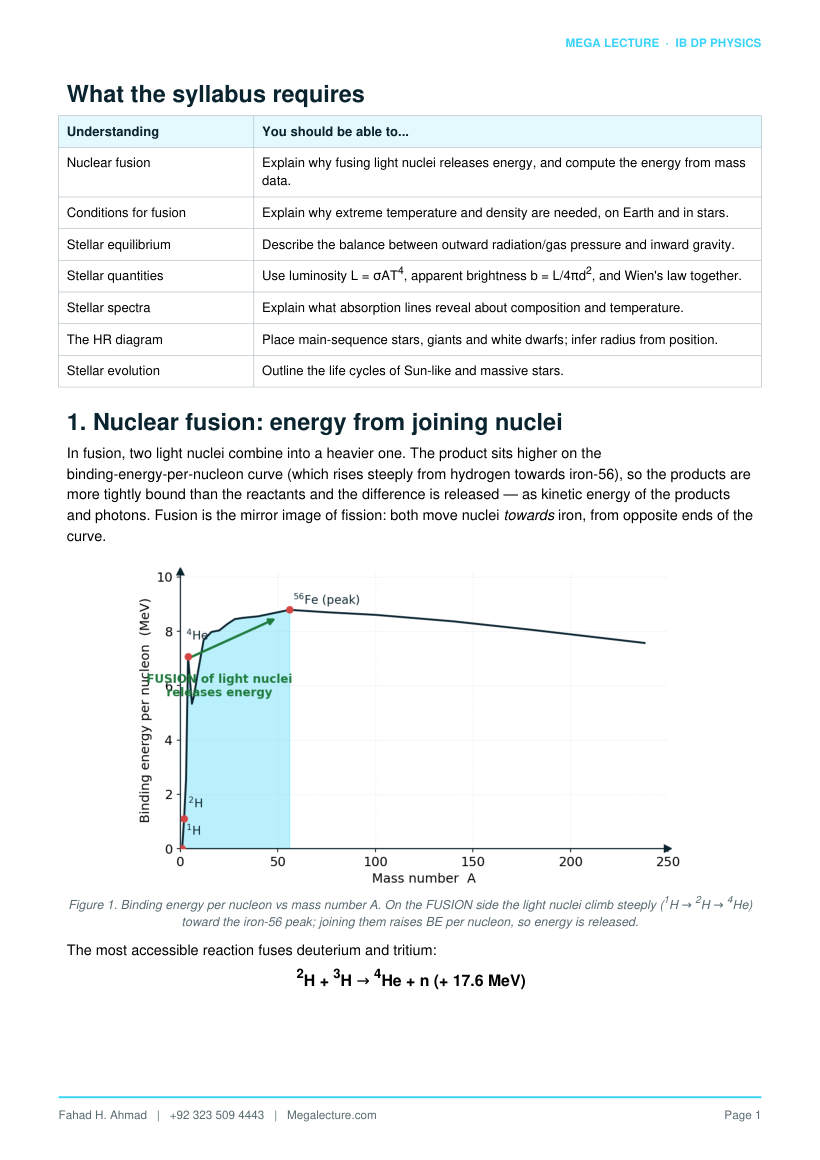
In fusion, two light nuclei combine into a heavier one. The product sits higher on the binding-energy-per-nucleon curve (which rises steeply from hydrogen towards iron-56), so the products are more tightly bound than the reactants and the difference is released — as kinetic energy of the products and photons. Fusion is the mirror image of fission: both move nuclei towards iron, from opposite ends of the curve.
Figure 1. Binding energy per nucleon vs mass number A. On the FUSION side the light nuclei climb steeply (1H → 2H → 4He) toward the iron-56 peak; joining them raises BE per nucleon, so energy is released.
The most accessible reaction fuses deuterium and tritium:
2H + 3H → 4He + n (+ 17.6 MeV)
Worked example 1 — energy of the D-T reaction
Masses: 2H = 2.014102 u, 3H = 3.016049 u, 4He = 4.002602 u, n = 1.008665 u. Find the energy released.
Mass before = 2.014102 + 3.016049 = 5.030151 u. Mass after = 4.002602 + 1.008665 = 5.011267 u.
Δm = 5.030151 - 5.011267 = 0.018884 u. E = 0.018884 × 931.5 MeV ≈ 17.6 MeV.
Most of this energy (14.1 MeV) is carried by the neutron, the rest by the helium nucleus.
Worked example 2 — fusion vs fission, per kilogram
Compare the energy released per nucleon and per kilogram for D-T fusion (17.6 MeV from 5 nucleons) and U-235 fission (about 200 MeV from 235 nucleons).
Fusion: 17.6/5 = 3.5 MeV per nucleon. Fission: 200/235 ≈ 0.85 MeV per nucleon — fusion releases roughly four times more per unit mass of fuel.
Per kilogram of D-T mixture: 17.6 × 1.60 × 10-13 J / (5 × 1.66 × 10-27 kg) ≈ 3.4 × 10¹⁴ J kg-1 — about ten million times the 3 × 10⁷ J kg-1 of coal.
2. Why fusion is hard: the conditions
Both nuclei are positively charged, so they repel electrostatically. They only fuse if they approach to within the range of the strong nuclear force (a few femtometres), which means overcoming a Coulomb barrier of order 0.1-1 MeV. This requires:
- Extreme temperature — of order 107-108 K, so that nuclei have enough kinetic energy; matter at these temperatures is a plasma of bare nuclei and free electrons.
- High density and confinement — enough collisions per second, sustained long enough for the energy released to exceed the energy invested.
A star achieves these conditions with gravity: the enormous weight of its outer layers compresses and heats the core. On Earth we must do it artificially: magnetic confinement (tokamaks hold the charged plasma on circular paths with strong magnetic fields, away from any wall) or inertial confinement (laser pulses compress a fuel pellet). Fusion power is attractive because fuel is abundant (deuterium from seawater), products are not long-lived radioactive waste, and there is no chain reaction to run away — if confinement fails, the reaction simply stops.
Exam point: Do not say fusion needs high temperature “to start the reaction like ignition”. Say: nuclei need sufficient kinetic energy to overcome their mutual electrostatic repulsion and come within range of the strong nuclear force.
3. Stars as fusion reactors
A main-sequence star fuses hydrogen to helium in its core. In Sun-like stars the dominant route is the proton-proton chain; its net effect is:
4 1H → 4He + 2e+ + 2ν + 2γ (about 26.7 MeV)
Figure 2. The proton-proton chain (net): four 1H fuse to one 4He, emitting 2 positrons, 2 neutrinos and 2 γ photons. The mass defect 0.02870 u releases ≈ 26.7 MeV per helium nucleus formed.
About 0.7% of the hydrogen's mass is converted to energy. The neutrinos escape directly and are detected on Earth — direct evidence of core fusion.
Worked example 3 — the Sun's mass loss
The Sun's luminosity is L = 3.8 × 1026 W. At what rate does it lose mass?
Δm/Δt = L/c2 = 3.8 × 1026 / (9.0 × 10¹⁶) ≈ 4.2 × 10⁹ kg s-1 — over four million tonnes of mass converted to radiation every second.
Stellar equilibrium
A stable star is in hydrostatic equilibrium: at every layer, the inward pull of gravity is balanced by the outward push of gas pressure and radiation pressure generated by the hot fusing core. The balance is self-regulating: if the core contracts slightly, it heats up, fusion accelerates, pressure rises and the core re-expands. When the hydrogen fuel in the core is exhausted, energy production falls, the balance is lost, and the core contracts — driving the star into its next evolutionary stage.
Figure 3. Stellar (hydrostatic) equilibrium: inward gravity (red) is balanced at every layer by outward gas and radiation pressure (green) from the fusing core. A rough central-pressure scale GM2/R4 gives P ≈ 1015 Pa for the Sun.
4. Measuring stars: luminosity, brightness, temperature, radius
Quantity Definition / relation Notes
Luminosity L Total power radiated (W) Intrinsic property
Apparent brightness b b = L / 4πd2 (W m-2) What we measure; falls with inverse square of distance d
Surface temperature T Wien: λmaxT = 2.9 × 10⁻³ m K From the peak wavelength of the spectrum
Radius R L = 4πR2σT4 Star treated as a black body; σ = 5.67 × 10⁻⁸ W m-2 K-4
Worked example 4 — temperature from the spectrum
A star's spectrum peaks at 400 nm. Estimate its surface temperature.
T = 2.9 × 10⁻³ / 4.0 × 10⁻⁷ ≈ 7300 K (hotter than the Sun's 5800 K — a blue-white star).
Worked example 5 — chaining to the radius
The same star has luminosity 100 times the Sun's (L = 3.8 × 1028 W). Find its radius.
R = √[ L / (4πσT4) ]. T4 = (7250)4 ≈ 2.76 × 10¹⁵ K4.
4πσT4 = 4π × 5.67 × 10-8 × 2.76 × 1015 ≈ 1.97 × 10⁹ W m-2.
R = √(3.8 × 1028 / 1.97 × 10⁹) ≈ 4.4 × 10⁹ m — about six solar radii.
Worked example 6 — apparent brightness
How bright does this star appear from 100 light years (d = 9.46 × 10¹⁷ m)?
b = L/4πd2 = 3.8 × 1028 / (4π × (9.46 × 1017)2) ≈ 3.4 × 10⁻⁹ W m-2.
Stellar spectra
The continuous black-body spectrum from a star's surface passes through its cooler outer atmosphere, whose atoms absorb their characteristic wavelengths. The resulting dark absorption lines identify the elements present; their relative strengths indicate temperature, and any Doppler shift of the whole pattern reveals motion towards or away from us (C.5). This is how we know the composition of objects we can never visit.
5. The Hertzsprung-Russell diagram
The HR diagram plots luminosity (vertical, logarithmic) against surface temperature (horizontal, decreasing to the right — the classic trap). Stars do not scatter randomly:
- Main sequence — the diagonal band from hot-and-luminous (top left) to cool-and-dim (bottom right); stars here fuse core hydrogen. Position along it is set by mass: more massive means hotter, far more luminous, and shorter-lived (roughly L ∝ M3.5).
- Red giants / supergiants — top right: cool surfaces but huge luminosity, so enormous radii (L = 4πR2σT4 with small T forces large R).
- White dwarfs — bottom left: hot surfaces but tiny luminosity, so Earth-sized radii.
Figure 4. Schematic Hertzsprung-Russell diagram: luminosity (log, high at top) against surface temperature (hot on the
LEFT). The main sequence runs from top-left to bottom-right; red giants and supergiants lie upper-right, white dwarfs lower-left.
Lines of constant radius run diagonally across the diagram: at fixed T, higher L means bigger R. Given any star's position you can rank its radius against the Sun's.
Exam technique: Always check the temperature axis direction before reading an HR diagram. Hot is LEFT. A star at top-right is big and cool, not hot.
6. Stellar evolution in outline
Birth: a cold nebula of gas and dust collapses under gravity; the contracting protostar heats up until core hydrogen fusion begins and the star settles onto the main sequence, where it spends most of its life.
Sun-like stars (up to a few solar masses): when core hydrogen is exhausted, the core contracts and heats while the envelope expands and cools — a red giant, now fusing helium to carbon. The outer layers drift away as a planetary nebula; the exposed carbon-oxygen core remains as a white dwarf, supported by electron degeneracy pressure, slowly cooling forever. A white dwarf cannot exceed the Chandrasekhar limit (about 1.4 solar masses).
Massive stars (more than about 8 solar masses): fusion proceeds through successively heavier elements up to iron, in shells. Since fusing iron absorbs energy rather than releasing it, the core suddenly has no pressure support and collapses; the rebound blows the star apart as a supernova — briefly outshining a galaxy and forging elements heavier than iron. The remnant core becomes a neutron star (supported by neutron degeneracy pressure) or, if too massive even for that, a black hole.
7. Common pitfalls
- Saying fusion “burns” fuel chemically — it is a nuclear process, a million times more energetic per kilogram.
- Using diameter instead of radius (or forgetting the 4π) in L = 4πR2σT4.
- Confusing luminosity (intrinsic, W) with apparent brightness (measured, W m-2).
- Reading the HR temperature axis left-to-right as increasing.
- Claiming the Sun will explode as a supernova — it is far too light; it ends as a white dwarf.
- Forgetting T must be in kelvin, and to fourth power, in Stefan-Boltzmann calculations.
8. Quick reference
Result Statement
D-T fusion 2H + 3H → 4He + n + 17.6 MeV p-p chain (net) 4 1H → 4He + 2e+ + 2ν + 2γ (26.7 MeV)
Stellar equilibrium gravity (inward) = gas + radiation pressure (outward)
Brightness b = L / 4πd2
Wien λmaxT = 2.9 × 10⁻³ m K
Stefan-Boltzmann L = 4πR2σT4
HR regions main sequence (H fusion), red giants (top right), white dwarfs (bottom left)
9. Test yourself
- Two deuterium nuclei (2.014102 u each) fuse to form 3He (3.016029 u) plus a neutron (1.008665 u). Find the energy released.
- Explain why fusion requires temperatures of order 108 K while fission works at room temperature.
- State the net proton-proton chain equation and explain what the detected neutrinos tell us.
- Explain how a main-sequence star remains stable against gravitational collapse.
- Star X has λmax = 580 nm and luminosity 3.8 × 1026 W. Find its temperature and radius.
- Two stars have equal luminosity, but star B appears 25 times dimmer than star A. Compare their distances.
- A star lies at the top right of the HR diagram. Deduce, with reasoning, how its radius compares with the Sun's.
- Estimate the main-sequence lifetime of the Sun, given that about 10% of its mass (M = 2.0 × 1030 kg) is available for fusion with 0.7% mass-to-energy conversion, at L = 3.8 × 1026 W.
Answers
- Δm = 4.028204 - 4.024694 = 0.003510 u → 0.003510 × 931.5 ≈ 3.27 MeV.
- Fusion requires two positive nuclei to overcome their mutual Coulomb repulsion and touch; only at ~108
K is the mean kinetic energy sufficient. Fission is triggered by a neutral neutron, which feels no electrostatic repulsion, so no kinetic energy barrier exists.
- 4 1H → 4He + 2e+ + 2ν + 2γ. Neutrinos interact so weakly they escape the core directly; detecting them confirms fusion is happening in the Sun's core right now.
- Every layer is in hydrostatic equilibrium: the outward pressure gradient (hot gas + radiation, powered by core fusion) balances the inward gravitational pull; the balance is self-correcting through the temperature dependence of the fusion rate.
- T = 2.9 × 10⁻³/5.8 × 10-7 = 5000 K. R = √[L/(4πσT4)] = √[3.8 × 1026/(4π × 5.67 × 10-8 × 6.25 × 1014)] ≈ 9.2 × 10⁸ m (about 1.3 solar radii).
- b ∝ 1/d2, so dB/dA = √25 = 5: star B is five times more distant.
- Top right = low surface temperature but very high luminosity. From L = 4πR2σT4, small T with large L forces R to be very large — a giant, radius tens to hundreds of solar radii.
- Available energy E = 0.007 × 0.10 × 2.0 × 1030 × (3.0 × 108)2 ≈ 1.3 × 1044 J. Lifetime t = E/L = 1.3 × 1044/3.8 × 1026 ≈ 3.3 × 10¹⁷ s ≈ 10 billion years — the Sun is about halfway through.
