
IB Diploma · Physics · SL / HL · Theme E: Nuclear and Quantum Physics
E.1 Structure of the Atom
Opens inside this page. Prefer your own PDF app? Open the PDF.
Full text of E.1 Structure of the Atom
IB DP PHYSICS Theme E: Nuclear and Quantum Physics E.1 Structure of the Atom
Revision Notes · Standard and Higher Level Fahad H. Ahmad
+92 323 509 4443 | Megalecture.com
Original notes prepared for the IB Diploma Programme Physics course (first assessment 2025)
What the syllabus requires
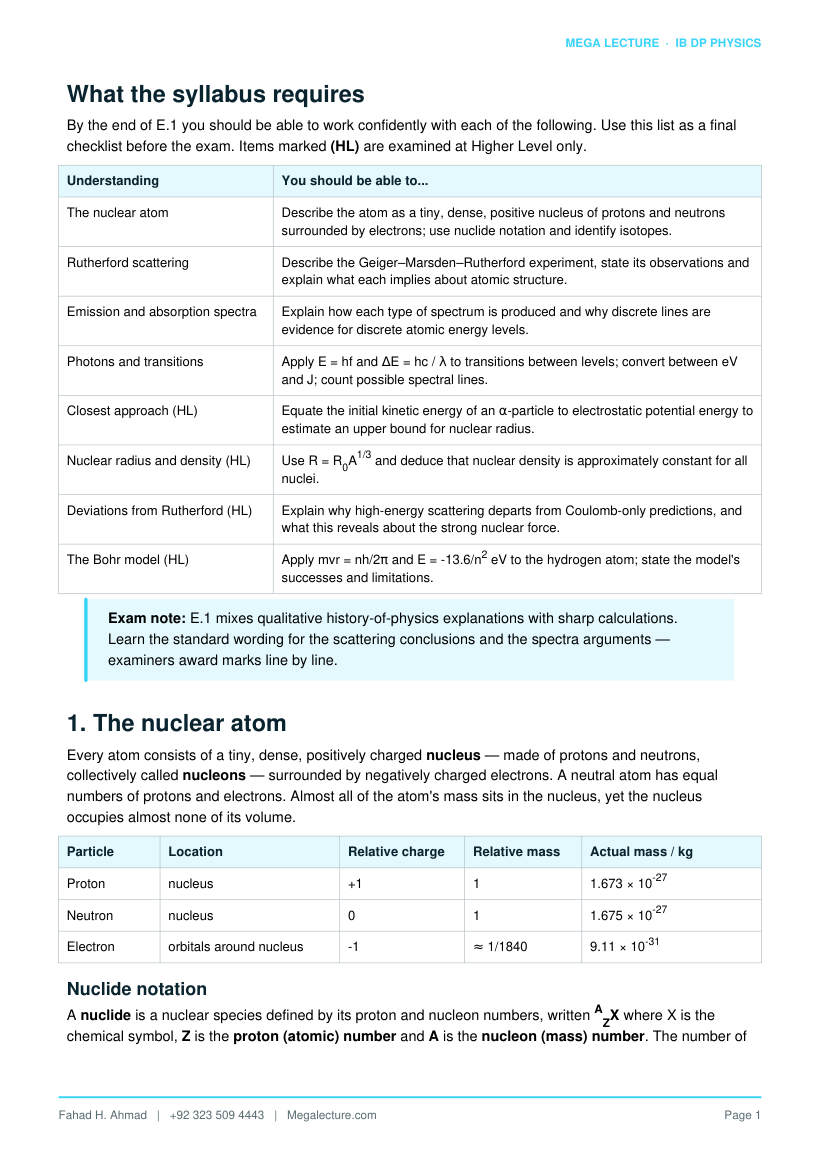
By the end of E.1 you should be able to work confidently with each of the following. Use this list as a final checklist before the exam. Items marked (HL) are examined at Higher Level only.
Understanding You should be able to...
The nuclear atom Describe the atom as a tiny, dense, positive nucleus of protons and neutrons surrounded by electrons; use nuclide notation and identify isotopes.
Rutherford scattering Describe the Geiger–Marsden–Rutherford experiment, state its observations and explain what each implies about atomic structure.
Emission and absorption spectra Explain how each type of spectrum is produced and why discrete lines are evidence for discrete atomic energy levels.
Photons and transitions Apply E = hf and ΔE = hc / λ to transitions between levels; convert between eV and J; count possible spectral lines.
Closest approach (HL) Equate the initial kinetic energy of an α-particle to electrostatic potential energy to estimate an upper bound for nuclear radius.
Nuclear radius and density (HL) Use R = R0A1/3 and deduce that nuclear density is approximately constant for all nuclei.
Deviations from Rutherford (HL) Explain why high-energy scattering departs from Coulomb-only predictions, and what this reveals about the strong nuclear force.
The Bohr model (HL) Apply mvr = nh/2π and E = -13.6/n2 eV to the hydrogen atom; state the model's successes and limitations.
Exam note: E.1 mixes qualitative history-of-physics explanations with sharp calculations. Learn the standard wording for the scattering conclusions and the spectra arguments — examiners award marks line by line.
1. The nuclear atom
Every atom consists of a tiny, dense, positively charged nucleus — made of protons and neutrons, collectively called nucleons — surrounded by negatively charged electrons. A neutral atom has equal numbers of protons and electrons. Almost all of the atom's mass sits in the nucleus, yet the nucleus occupies almost none of its volume.
Particle Location Relative charge Relative mass Actual mass / kg
Proton nucleus +1 1.673 × 10⁻²⁷
Neutron nucleus 1.675 × 10⁻²⁷
Electron orbitals around nucleus -1 ≈ 1/1840 9.11 × 10⁻³¹
Nuclide notation
A nuclide is a nuclear species defined by its proton and nucleon numbers, written A
ZX where X is the chemical symbol, Z is the proton (atomic) number and A is the nucleon (mass) number. The number of neutrons is N = A - Z. For example 197
79Au has 79 protons and 197 - 79 = 118 neutrons.
Isotopes are nuclides of the same element (same Z) with different numbers of neutrons (different A). Because chemical behaviour is fixed by the electron arrangement — and hence by Z — isotopes are chemically identical but differ in mass and in nuclear stability. Example: 1
1H, 2 1H and 3 1H are the three isotopes of hydrogen.
Relative sizes
An atomic radius is of order 10-10 m; a nuclear radius is of order 10-15 to 10-14 m. The nucleus is therefore roughly 104 to 105 times smaller than the atom — if a nucleus were a marble on the centre spot of a stadium, the electrons would roam the outer stands. By volume ( ∝ r3), the nucleus fills only about one part in 1013 of the atom: matter is overwhelmingly empty space.
Worked example 1 — reading nuclide notation
State the number of protons, neutrons and electrons in (a) a neutral atom of 235
92U, (b) the ion 8O2-.
- Z = 92 protons; N = 235 - 92 = 143 neutrons; neutral, so 92 electrons.
- 8 protons; 16 - 8 = 8 neutrons; charge 2- means two extra electrons: 10 electrons.
Ionising an atom changes only the electron count — A and Z are untouched.
2. The Geiger–Marsden–Rutherford experiment
In 1909 Geiger and Marsden, directed by Rutherford, fired α-particles (helium nuclei, charge +2e) from a radioactive source at an extremely thin gold foil inside an evacuated chamber. Scattered particles were detected as tiny flashes (scintillations) on a zinc sulfide screen viewed through a movable microscope, so the number scattered at each angle could be counted.
Why gold, and why a vacuum?
- Gold is extremely malleable, so it can be beaten into a foil only a few hundred atoms thick — thin enough that each α-particle scatters essentially once. Its high atomic number (Z = 79) also gives a large repulsive force and clear deflections.
- A vacuum is essential because α-particles travel only a few centimetres in air: collisions with air molecules would absorb and scatter them before they ever reached the foil.
Observations and what each one implies
Observation Inference about the atom
The great majority of α-particles passed straight through the foil undeflected (or nearly so).
The atom is mostly empty space; mass and charge are not spread evenly through it (as the earlier 'plum pudding' model claimed).
A small fraction were deflected through large angles.
The positive charge is concentrated in a very small region, producing an intense electric field close to it.
Observation Inference about the atom
About 1 in 8000 bounced back through more than 90°. That region — the nucleus — is tiny, very dense and positively charged, and contains nearly all the atom's mass; only a head-on approach to something massive can reverse an α-particle.
Rutherford's analysis assumed only Coulomb repulsion between the α-particle (charge +2e) and the gold nucleus (charge +79e). The predicted distribution of scattering angles matched the data precisely — strong evidence that, down to the distances probed, the nucleus behaves as a point positive charge.
Exam technique: Give observation and inference as a pair. 'Most passed straight through, so the atom is mostly empty space' earns both marks; the observation alone earns one.
Figure 1. Geiger–Marsden–Rutherford scattering: most α-particles pass straight through the mostly empty atom; a few are deflected and rare head-on ones backscatter off the tiny, dense, positive nucleus.
3. Distance of closest approach (HL)
A head-on α-particle slows as it climbs the electrostatic potential hill of the nucleus, stopping momentarily at the distance of closest approach d before being repelled back. At that instant all of its initial kinetic energy has become electrostatic potential energy:
EK = kq1q2 / d = k(2e)(Ze) / d → d = 2kZe2 / EK where k = 1/(4πε0) = 8.99 × 10⁹ N m2 C-2, Z is the proton number of the target nucleus and 2e is the α-particle's charge. Because the α-particle stops outside the nucleus, d is only an upper bound on the nuclear radius: the real nucleus must be smaller than (or at most comparable to) d. Faster α-particles get closer and give a tighter bound.
Worked example 2 (HL) — closest approach to a gold nucleus
A 5.0 MeV α-particle approaches a gold nucleus (Z = 79) head-on. Estimate the distance of closest approach.
Convert the energy: EK = 5.0 × 106 × 1.60 × 10-19 = 8.0 × 10⁻¹³ J.
d = 2kZe2 / EK = (2 × 8.99 × 109 × 79 × (1.60 × 10-19)2) / (8.0 × 10⁻¹³) d = 3.64 × 10⁻²⁶ / 8.0 × 10-13 = 4.5 × 10⁻¹⁴ m (about 45 fm).
This is an upper bound: the gold nucleus (radius ≈ 7 fm, Section 4) is several times smaller, which is why Rutherford's Coulomb-only prediction worked so well at this energy.
Common pitfall: Forgetting the factor 2 from the α-particle's charge of +2e, or leaving EK in MeV. Convert to joules first: 1 eV = 1.60 × 10⁻¹⁹ J.
4. Nuclear radius and nuclear density (HL)
Electron-scattering and other experiments show that nuclear radii follow a remarkably simple rule:
R = R0 A1/3 with R0 = 1.2 × 10⁻¹⁵ m (1.2 fm)
Cubing both sides shows why the exponent is 1/3: the nuclear volume V = (4/3)πR3 = (4/3)πR0
3A is directly proportional to A, the number of nucleons. Each added nucleon brings the same additional volume, exactly as if nucleons were incompressible spheres packed tightly together. Two consequences follow:
- Nuclear density is the same for all nuclei, from hydrogen to uranium, because both mass and volume scale with A.
- Nuclear matter is almost incomprehensibly dense compared with ordinary matter, because the empty space of the atom is absent.
Worked example 3 (HL) — radius of a gold nucleus
Estimate the radius of a 197
79Au nucleus.
R = R0A1/3 = 1.2 × 10-15 × 1971/3 = 1.2 × 10-15 × 5.82 = 7.0 × 10⁻¹⁵ m.
Note the compressing effect of the cube root: gold has 197 times the nucleons of hydrogen but a radius only about 5.8 times larger.
Worked example 4 (HL) — the density of nuclear matter
Show that nuclear density is about 2 × 10¹⁷ kg m-3 and is independent of A. (Take the mass of one nucleon as u = 1.66 × 10⁻²⁷ kg.)
ρ = mass / volume = Au / ((4/3)πR0
3A) = 3u / (4πR0
- — A cancels, so the density is the same for every nucleus.
ρ = (3 × 1.66 × 10-27) / (4π × (1.2 × 10-15)3) = 4.98 × 10⁻²⁷ / 2.17 × 10-44 ≈ 2.3 × 10¹⁷ kg m-3.
A teaspoon (5 cm3) of nuclear matter would have a mass of about 1012 kg — a billion tonnes. Neutron stars are essentially nucleus-density objects the size of a city.
5. Deviations from Rutherford scattering (HL)
Rutherford's formula assumes the only interaction is Coulomb repulsion between point charges. It works perfectly while the α-particle stays well outside the nucleus. But as the α-particle energy is increased, the distance of closest approach shrinks (d ∝ 1/EK), and above a certain energy — roughly 25–30 MeV for gold — the measured scattering at large angles falls below the Coulomb prediction.
The interpretation:
- The α-particle is now approaching to within about 10-14 m, close enough to touch the nuclear surface, so the nucleus can no longer be treated as a point charge — the deviation marks the finite size of the nucleus.
- At these separations a new, short-range attractive strong nuclear force acts on the α-particle, modifying (and partly absorbing) the scattering that pure electrostatic repulsion would give.
The onset energy of the deviation therefore provides a direct measurement of the nuclear radius — and historically it gave the first evidence that the strong force has a range of only a few femtometres.
Link: The same idea returns in E.3: the strong force must exist, because something short-ranged and attractive has to hold protons together against their mutual Coulomb repulsion inside a nucleus only femtometres across.
6. Emission and absorption spectra
Pass the light from a glowing solid through a prism and you get a continuous spectrum — all colours. Do the same with light from a low-pressure gas and the result is strikingly different, and it is this difference that first revealed the quantum structure of the atom.
Spectrum How it is produced Appearance
Emission (line) spectrum
A low-pressure gas is excited (heated, or by an electric discharge). Electrons are promoted to higher energy levels and then fall back, emitting photons of specific energies.
Discrete bright lines of definite wavelengths on a dark background.
Spectrum How it is produced Appearance
Absorption spectrum White (continuous) light passes through a cool, low-pressure gas. Atoms absorb only those photons whose energies exactly match a jump between two of their levels, promoting electrons upward.
Continuous spectrum crossed by dark lines at exactly the wavelengths the same gas would emit.
Why the absorption lines look dark: the absorbed light is re-emitted as the electrons fall back, but it is re-radiated in all directions, so the intensity remaining in the original beam direction is greatly reduced.
Why discrete lines imply discrete energy levels
Each line corresponds to photons of one definite energy E = hf. If atoms could possess any energy, they would emit and absorb photons of every energy and the spectrum would be continuous. The fact that only certain photon energies appear means the atom can only ever gain or lose certain fixed amounts of energy — in other words, atomic electrons exist only in discrete (quantised) energy levels, and each spectral line is a transition between one specific pair of levels.
Spectral fingerprinting
The level structure — and therefore the pattern of lines — is unique to each element: a spectrum identifies an element as a fingerprint identifies a person. Astronomers exploit this daily: dark absorption lines in starlight (Fraunhofer lines in the Sun's spectrum) reveal which elements are present in a star's outer layers — helium was discovered in the solar spectrum before it was found on Earth. Shifts of the whole line pattern also measure the star's motion (Doppler effect, C.5).
Figure 2. Visible (Balmer) emission lines of hydrogen, n→2, from 1/λ = R(1/22 − 1/n2). Hα (n=3→2) lies at 656 nm.
7. Photons and energy levels
Light of frequency f is emitted and absorbed in packets — photons — each of energy:
E = hf = hc / λ h = 6.63 × 10⁻³⁴ J s
When an electron drops from a level of energy E2 to a lower level E1, one photon is emitted carrying exactly the energy difference; absorption is the reverse jump, upward:
ΔE = E2 - E1 = hf = hc / λ
Level energies are conventionally negative: zero is defined as a free electron at rest just outside the atom, so a bound electron has less energy than a free one. The ground state is the lowest (most negative) level;
the ionisation energy is the energy needed to lift a ground-state electron to zero — 13.6 eV for hydrogen.
Figure 3. Hydrogen energy levels En = −13.6/n2 eV. A 3→2 drop emits a 1.89 eV photon (656 nm, Hα); a 2→1 drop emits
10.2 eV.
The electronvolt
Atomic energies are tiny in joules, so we use the electronvolt: the energy gained by charge e crossing a potential difference of 1 V.
1 eV = 1.60 × 10⁻¹⁹ J (multiply by 1.60 × 10⁻¹⁹ to go eV → J; divide to go J → eV)
Counting spectral lines
An atom with n occupied-or-reachable levels can make a downward transition between any pair of them, so the maximum number of distinct emission lines is:
number of lines = n(n - 1) / 2
For example, 4 levels give 4 × 3 / 2 = 6 lines. Remember the pairing of extremes: the largest energy jump gives the shortest wavelength (since λ = hc/ΔE), and the smallest jump gives the longest wavelength.
Worked example 5 — photon energy from wavelength
A hydrogen lamp emits a blue-green line at λ = 486 nm. Find the photon energy in joules and in eV, and identify the transition on the hydrogen level diagram.
E = hc/λ = (6.63 × 10-34 × 3.00 × 108) / (486 × 10-9) = 4.09 × 10⁻¹⁹ J.
In eV: 4.09 × 10⁻¹⁹ / 1.60 × 10-19 = 2.56 eV.
Hydrogen levels: E4 - E2 = (-0.85) - (-3.40) = 2.55 eV — the match identifies this as the n = 4 → 2 transition.
Worked example 6 — an energy-level diagram problem
The lowest three levels of hydrogen are E1 = -13.6 eV, E2 = -3.40 eV, E3 = -1.51 eV. An electron is excited to n = 3. (a) How many different emission lines can result? (b) Find the longest and shortest wavelengths.
- n(n - 1)/2 with n = 3 gives 3 lines: 3→2, 3→1 and 2→1.
- Longest λ = smallest ΔE = E3 - E2 = 1.89 eV = 3.02 × 10⁻¹⁹ J. λ = hc/ΔE = 1.989 × 10⁻²⁵ / 3.02 × 10⁻¹⁹ ≈ 6.6 × 10⁻⁷ m (660 nm, red).
Shortest λ = largest ΔE = E3 - E1 = 12.1 eV = 1.93 × 10⁻¹⁸ J. λ = 1.989 × 10⁻²⁵ / 1.93 × 10⁻¹⁸ ≈ 1.0 × 10⁻⁷ m (103 nm, ultraviolet).
Worked example 7 — frequency of an emitted photon
Find the frequency of the photon emitted in the hydrogen transition n = 2 → 1 (E2 = -3.40 eV, E1 = -13.6 eV).
ΔE = -3.40 - (-13.6) = 10.2 eV = 10.2 × 1.60 × 10-19 = 1.63 × 10⁻¹⁸ J.
f = ΔE / h = 1.63 × 10⁻¹⁸ / 6.63 × 10-34 = 2.46 × 10¹⁵ Hz (λ = c/f ≈ 122 nm, ultraviolet).
Common pitfall: Direction matters. Emission: electron falls, arrow points down the diagram, photon leaves. Absorption: photon energy must match a gap exactly, electron jumps up. A photon with 'nearly enough' energy is simply not absorbed.
8. The Bohr model of hydrogen (HL)
Bohr (1913) kept Rutherford's nuclear atom but added a radical postulate: the electron may occupy only those circular orbits in which its angular momentum is an integer multiple of h/2π:
mvr = nh / 2π n = 1, 2, 3, ...
In such an orbit the electron does not radiate; radiation occurs only in jumps between orbits. Combining the quantisation condition with Coulomb attraction as the centripetal force yields discrete orbit radii and the celebrated energy ladder:
En = -13.6 / n2 eV
so E1 = -13.6 eV (ground state), E2 = -3.40 eV, E3 = -1.51 eV, E4 = -0.85 eV, converging towards zero as n → ∞. Transitions down to n = 1 form the ultraviolet Lyman series; transitions down to n = 2 form the partly visible Balmer series.
Worked example 8 (HL) — a Balmer wavelength from the Bohr model
Use En = -13.6/n2 eV to find the wavelength of the n = 3 → 2 (Balmer-α) line.
E3 = -13.6/9 = -1.51 eV; E2 = -13.6/4 = -3.40 eV. ΔE = 3.40 - 1.51 = 1.89 eV = 3.02 × 10⁻¹⁹ J.
λ = hc/ΔE = (6.63 × 10-34 × 3.00 × 108) / 3.02 × 10-19 = 6.6 × 10⁻⁷ m ≈ 660 nm — the familiar red line of hydrogen (measured value 656 nm).
Worked example 9 (HL) — using the quantisation condition
The radius of the ground-state (n = 1) orbit of hydrogen is r = 5.3 × 10⁻¹¹ m. Find the speed of the electron (me = 9.11 × 10⁻³¹ kg).
mvr = nh/2π with n = 1 gives v = h / (2πmr).
v = 6.63 × 10⁻³⁴ / (2π × 9.11 × 10-31 × 5.3 × 10-11) = 2.2 × 10⁶ m s-1 — under 1% of c, so a non-relativistic treatment is (just) acceptable.
Successes and limitations
Successes Limitations
Predicts every wavelength of the hydrogen spectrum (Lyman, Balmer, ... series) with impressive accuracy.
Works only for hydrogen and other one-electron ions; fails for helium and beyond.
Gives the correct ionisation energy of hydrogen (13.6 eV) and a first physical meaning for quantised levels.
The quantisation rule is imposed ad hoc, with no underlying justification; it cannot predict line intensities or splitting in fields.
Explains why atoms are stable: the electron cannot spiral below n = 1.
Mixes classical orbits with quantum jumps inconsistently; superseded by the wavefunction picture of quantum mechanics (E.2), in which electrons do not follow defined orbits.
9. Common pitfalls
- Forgetting to convert eV to J (or MeV to J) before using E = hf or closest-approach formulae — the single most common error in E.1.
- Mixing up A and Z, or forgetting that N = A - Z; ions change the electron count only.
- Treating level energies as positive, or subtracting them the wrong way: ΔE is always the (positive) difference between the two levels.
- Confusing emission (downward jump, bright line) with absorption (upward jump, dark line) — and forgetting that absorption requires an exact energy match.
- Pairing wavelengths wrongly: the biggest energy gap gives the shortest wavelength, not the longest.
- (HL) Quoting the closest-approach distance as 'the nuclear radius' — it is only an upper bound.
- (HL) Writing R = R0A/3 or R0A3 instead of R0A1/3; and forgetting the factor 2e for the α-particle's charge.
10. Quick reference
Result Statement
Nuclide notation A
ZX: Z protons, A - Z neutrons; isotopes share Z, differ in A
Sizes atom ≈ 10-10 m; nucleus ≈ 10-15–10-14 m
Photon energy E = hf = hc/λ; 1 eV = 1.60 × 10⁻¹⁹ J
Transitions ΔE = E2 - E1 = hf; emission down, absorption up; lines from n levels = n(n-1)/2
Closest approach (HL) EK = k(2e)(Ze)/d gives d = 2kZe2/EK (upper bound on R)
Nuclear radius (HL) R = R0A1/3, R0 = 1.2 fm; ρ = 3u/(4πR0
- ≈ 2.3 × 10¹⁷ kg m-3, same for all nuclei
Bohr model (HL) mvr = nh/2π; En = -13.6/n2 eV; ionisation energy of H = 13.6 eV
11. Test yourself
Attempt these without notes; full answers below. HL-only questions are flagged.
- State the number of protons, neutrons and electrons in the ion 59 27Co2+.
- In the Geiger–Marsden–Rutherford experiment, state the three key observations and the conclusion drawn from each.
- Explain (a) why the gold foil had to be very thin, (b) why the apparatus was evacuated.
- A photon has wavelength 620 nm. Find its energy in joules and in eV.
- An atom has energy levels at -10.4 eV, -5.5 eV, -3.7 eV and -1.6 eV. (a) How many emission lines can transitions among these four levels produce? (b) Find the longest emitted wavelength.
- Explain why the dark lines of an element's absorption spectrum occur at exactly the same wavelengths as the bright lines of its emission spectrum, and why the absorption lines appear dark even though the absorbed energy is re-emitted.
- (HL) A 4.0 MeV α-particle is fired head-on at an aluminium nucleus (Z = 13). Find the distance of closest approach, and comment on whether pure Rutherford scattering should be expected.
- (HL) (a) Calculate the radius of a 56 26Fe nucleus. (b) Show that a nucleus with A = 216 has exactly twice the radius of one with A = 27.
- (HL) Explain, starting from R = R0A1/3, why all nuclei have approximately the same density.
- (HL) Use the Bohr model to find the wavelength of the n = 3 → 1 transition in hydrogen, and state the series to which it belongs.
Answers
- 27 protons; 59 - 27 = 32 neutrons; 27 - 2 = 25 electrons (2+ means two electrons removed).
- Most α-particles passed straight through → the atom is mostly empty space. A few were deflected through large angles → the positive charge is concentrated in a very small region. About 1 in 8000 returned through more than 90° → that region (the nucleus) is tiny, positive and contains almost all the atom's mass.
- (a) So that each α-particle undergoes essentially a single scattering event — multiple scattering would blur the angular distribution. (b) α-particles are stopped by a few centimetres of air; in a vacuum they reach the foil and screen unimpeded.
- E = hc/λ = 1.989 × 10⁻²⁵ / 6.20 × 10-7 = 3.2 × 10⁻¹⁹ J = 3.2 × 10⁻¹⁹ / 1.60 × 10-19 = 2.0 eV.
- (a) n(n - 1)/2 = 4 × 3/2 = 6 lines. (b) Longest λ comes from the smallest gap, (-3.7) - (-5.5) = 1.8 eV = 2.88 × 10⁻¹⁹ J; λ = 1.989 × 10⁻²⁵ / 2.88 × 10⁻¹⁹ ≈ 6.9 × 10⁻⁷ m (690 nm).
- Both processes involve the same pairs of energy levels, so the photon energies — and hence wavelengths — are identical: absorption is the upward jump, emission the downward one. The lines stay dark because the re-emitted photons leave in all directions, so almost none rejoin the original beam.
- EK = 4.0 × 106 × 1.60 × 10-19 = 6.4 × 10⁻¹³ J. d = 2kZe2/EK = (2 × 8.99 × 109 × 13 × 2.56 × 10-38) / 6.4 × 10⁻¹³ ≈ 9.4 × 10⁻¹⁵ m. The aluminium nuclear radius is R = 1.2 × 271/3 = 3.6 fm, so d is only about 2.6 R — close enough that some deviation from pure Coulomb scattering may begin to appear at the largest angles.
- (a) R = 1.2 × 10-15 × 561/3 = 1.2 × 10-15 × 3.83 ≈ 4.6 × 10⁻¹⁵ m. (b) R216/R27 = (216/27)1/3 = 81/3 = 2.
- Mass ≈ Au and volume = (4/3)πR3 = (4/3)πR0 3A, so ρ = 3u/(4πR0 3): A cancels, giving the same density (≈ 2.3 × 10¹⁷ kg m-3) for every nucleus. Physically, nucleons pack like incompressible spheres, each occupying the same volume.
- E3 = -1.51 eV, E1 = -13.6 eV, so ΔE = 12.1 eV = 1.93 × 10⁻¹⁸ J. λ = hc/ΔE = 1.989 × 10⁻²⁵ / 1.93 × 10⁻¹⁸
≈ 1.0 × 10⁻⁷ m (103 nm) — ultraviolet, a member of the Lyman series (transitions ending on n = 1).
