
IB Diploma · Physics · SL / HL · Theme E: Nuclear and Quantum Physics
E.2 Quantum Physics (HL)
Opens inside this page. Prefer your own PDF app? Open the PDF.
Full text of E.2 Quantum Physics (HL)
IB DP PHYSICS Theme E: Nuclear and Quantum Physics E.2 Quantum Physics
Revision Notes · Higher Level only Fahad H. Ahmad
+92 323 509 4443 | Megalecture.com
Original notes prepared for the IB Diploma Programme Physics course (first assessment 2025)
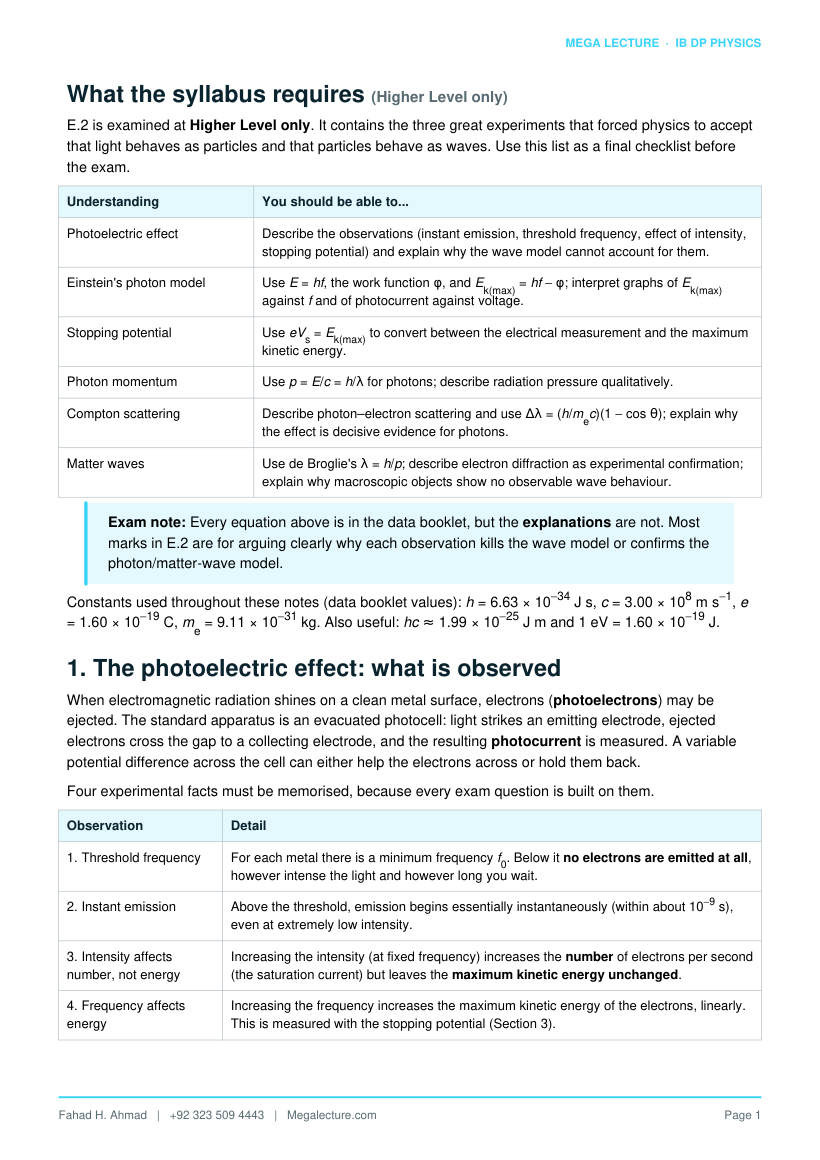
What the syllabus requires (Higher Level only)
E.2 is examined at Higher Level only. It contains the three great experiments that forced physics to accept that light behaves as particles and that particles behave as waves. Use this list as a final checklist before the exam.
Understanding You should be able to...
Photoelectric effect Describe the observations (instant emission, threshold frequency, effect of intensity, stopping potential) and explain why the wave model cannot account for them.
Einstein's photon model Use E = hf, the work function φ, and Ek(max) = hf − φ; interpret graphs of Ek(max) against f and of photocurrent against voltage.
Stopping potential Use eVs = Ek(max) to convert between the electrical measurement and the maximum kinetic energy.
Photon momentum Use p = E/c = h/λ for photons; describe radiation pressure qualitatively.
Compton scattering Describe photon–electron scattering and use Δλ = (h/mec)(1 − cos θ); explain why the effect is decisive evidence for photons.
Matter waves Use de Broglie's λ = h/p; describe electron diffraction as experimental confirmation; explain why macroscopic objects show no observable wave behaviour.
Exam note: Every equation above is in the data booklet, but the explanations are not. Most marks in E.2 are for arguing clearly why each observation kills the wave model or confirms the photon/matter-wave model.
Constants used throughout these notes (data booklet values): h = 6.63 × 10⁻³⁴ J s, c = 3.00 × 10⁸ m s−1, e = 1.60 × 10⁻¹⁹ C, me = 9.11 × 10⁻³¹ kg. Also useful: hc ≈ 1.99 × 10⁻²⁵ J m and 1 eV = 1.60 × 10⁻¹⁹ J.
1. The photoelectric effect: what is observed
When electromagnetic radiation shines on a clean metal surface, electrons (photoelectrons) may be ejected. The standard apparatus is an evacuated photocell: light strikes an emitting electrode, ejected electrons cross the gap to a collecting electrode, and the resulting photocurrent is measured. A variable potential difference across the cell can either help the electrons across or hold them back.
Four experimental facts must be memorised, because every exam question is built on them.
Observation Detail
- Threshold frequency For each metal there is a minimum frequency f0. Below it no electrons are emitted at all, however intense the light and however long you wait.
- Instant emission Above the threshold, emission begins essentially instantaneously (within about 10−9 s), even at extremely low intensity.
- Intensity affects number, not energy
Increasing the intensity (at fixed frequency) increases the number of electrons per second (the saturation current) but leaves the maximum kinetic energy unchanged.
- Frequency affects energy
Increasing the frequency increases the maximum kinetic energy of the electrons, linearly. This is measured with the stopping potential (Section 3).
Why the wave model fails
In the classical wave picture, light delivers energy continuously, spread over the whole wavefront, at a rate set by the intensity. Each observation contradicts a definite wave prediction:
Wave-model prediction What is actually seen
Any frequency should eject electrons, provided the light is bright enough or shines long enough — energy just needs to accumulate.
Below f0 nothing is emitted, ever. Frequency, not energy delivered, is what matters.
At low intensity an electron should need a long ‘soaking time’ (hours, on a classical estimate) to gather enough energy.
Emission is instantaneous even in the faintest light.
Brighter light means bigger wave amplitude, so electrons should leave with more kinetic energy.
Intensity changes only how many electrons leave per second; Ek(max) is fixed by frequency alone.
Frequency should be irrelevant to the electron energy. Ek(max) rises linearly with f.
Exam technique: A ‘why does the wave model fail?’ answer must pair each prediction with the contradicting observation. Stating the observations alone, without the classical expectation, usually loses half the marks.
2. Einstein's photon explanation
Einstein (1905) proposed that light of frequency f is absorbed in discrete packets — photons — each carrying energy
E = hf = hc / λ
Figure 1. Photon energy E = hc/λ ∝ 1/λ; a 500 nm (green) photon carries ≈ 2.48 eV.
where h = 6.63 × 10⁻³⁴ J s is Planck's constant. One photon interacts with one electron in an all-or-nothing event: the photon is absorbed completely or not at all. The minimum energy needed to remove an electron from the metal surface is the work function φ (a property of the metal, typically a few eV). Energy conservation for the most weakly bound (surface) electrons gives Einstein's photoelectric equation:
Ek(max) = hf − φ
Electrons ejected from deeper in the metal lose extra energy on the way out, so hf − φ is the maximum kinetic energy; the emitted electrons have a spread of energies from zero up to this value.
The photon model explains all four observations at once:
- Threshold: if hf < φ a single photon cannot free an electron, and multi-photon absorption is negligible. The threshold frequency is f0 = φ / h, with threshold wavelength λ0 = hc / φ.
- Instant emission: the very first photon to arrive can eject an electron — no accumulation time is needed.
- Intensity: brighter light means more photons per second, so more electrons per second — but each photon still carries the same energy hf, so Ek(max) is unchanged.
- Frequency: raising f raises the energy of every photon, so Ek(max) = hf − φ rises linearly.
Stopping potential
Make the collector negative relative to the emitter so that it repels the photoelectrons. As the reverse voltage grows, slower electrons are turned back and the current falls. At the stopping potential Vs even the fastest electrons are just stopped, and the current is zero. The work done against the field equals the maximum kinetic energy:
eVs = Ek(max) = hf − φ
A convenient consequence: the stopping potential in volts is numerically equal to Ek(max) in electronvolts. Light of any intensity at the same frequency gives the same stopping potential.
Definitions to learn: Photon — a quantum of electromagnetic radiation with energy E = hf. Work function φ — the minimum energy required to remove an electron from the surface of a metal. Threshold frequency f0 — the minimum frequency of radiation that can eject electrons from a given surface.
3. The two key graphs
Graph 1: Ek(max) (or Vs) against frequency
Plotting Ek(max) against f for one metal gives a straight line: Ek(max) = hf − φ. Every feature of the line is examinable:
Feature Physical meaning
Gradient Planck's constant h — the same for every metal, so all the lines are parallel.
Intercept on the f-axis Threshold frequency f0 = φ/h. Different metals cut the axis at different places.
Intercept on the energy axis (extrapolated)
−φ — the work function read off as a negative intercept.
If Vs is plotted instead Gradient becomes h/e and the vertical intercept becomes −φ/e.
Figure 2. Photoelectric effect: Ek(max) = hf − φ is a straight line of gradient h, cutting the f-axis at the threshold f0 = φ/h ≈
5.56×10¹⁴ Hz for φ = 2.3 eV.
Graph 2: photocurrent against voltage
With the collector voltage on the horizontal axis (negative = retarding) and photocurrent on the vertical axis, the curve rises from zero at −Vs, climbs as the retarding voltage is reduced, and levels off at the saturation current once every emitted electron is collected.
Change made Saturation current Stopping potential
Double the intensity (same f) Doubles (twice as many photons → twice as many electrons per second)
Unchanged
Increase the frequency (same number of photons per second)
Unchanged Increases (each electron can leave with more energy)
Frequency below f0 Zero at every voltage —
Common misconception: ‘Same intensity’ at a higher frequency actually means fewer photons per second, because each photon carries more energy. If an exam question increases f at constant intensity, the saturation current falls while the stopping potential rises. Read carefully whether intensity or photon rate is held fixed.
Millikan's verification
Robert Millikan (1916) set out sceptical of the photon idea and performed the definitive test. Using freshly cut alkali-metal surfaces in vacuum (a rotating knife shaved the surface clean, since any oxide layer changes φ), he measured the stopping potential over a wide range of frequencies. The plot of Vs against f was exactly the predicted straight line; its gradient h/e gave a value of Planck's constant matching the value from blackbody radiation to better than 1%. This agreement between two utterly different phenomena convinced physicists that photons are real.
Worked example 1 — threshold of sodium
Sodium has work function φ = 2.28 eV. Find (a) the threshold frequency, (b) the longest wavelength that ejects electrons.
- Convert to joules: φ = 2.28 × 1.60 × 10−19 = 3.65 × 10⁻¹⁹ J. Then f0 = φ/h = 3.65 × 10⁻¹⁹ / 6.63 × 10−34 = 5.50 × 10¹⁴ Hz.
- λ0 = c/f0 = 3.00 × 10⁸ / 5.50 × 1014 = 5.45 × 10⁻⁷ m = 545 nm (green). Yellow and red light cannot eject electrons from sodium no matter how bright.
Worked example 2 — stopping potential
Light of wavelength 420 nm falls on the same sodium surface (φ = 2.28 eV). Find (a) the photon energy in eV, (b) Ek(max) in eV and in joules, (c) the stopping potential.
- E = hc/λ = 1.99 × 10⁻²⁵ / 4.20 × 10−7 = 4.74 × 10⁻¹⁹ J = 4.74 × 10⁻¹⁹ / 1.60 × 10−19 = 2.96 eV.
- Ek(max) = 2.96 − 2.28 = 0.68 eV = 0.68 × 1.60 × 10−19 = 1.1 × 10⁻¹⁹ J.
- eVs = Ek(max), so Vs = 0.68 V — numerically the eV answer, which is why working in eV is quicker.
Worked example 3 — finding h and φ from data (Millikan-style)
For a certain metal the stopping potential is 0.20 V at f = 6.0 × 10¹⁴ Hz and 1.03 V at f = 8.0 × 10¹⁴
Hz. Find h and φ.
From eVs = hf − φ, subtracting the two equations: h = eΔVs / Δf = 1.60 × 10−19 × (1.03 − 0.20) / (2.0 × 10¹⁴) = 6.6 × 10⁻³⁴ J s.
Then φ = hf − eVs = 6.64 × 10−34 × 6.0 × 1014 − 1.60 × 10−19 × 0.20 = 3.98 × 10⁻¹⁹ − 0.32 × 10−19
= 3.66 × 10⁻¹⁹ J ≈ 2.3 eV.
4. Photon momentum and radiation pressure
Although a photon has zero rest mass, it carries momentum. From special relativity, for a massless particle E = pc, so p = E / c = hf / c = h / λ
Momentum is a vector: the photon's momentum points along its direction of travel. When light is absorbed or reflected by a surface, momentum is transferred, so light exerts a force — radiation pressure. Qualitatively:
- A surface that absorbs a beam of power P gains momentum at rate F = P/c.
- A perfectly reflecting surface reverses each photon's momentum, so the force is twice as large: F = 2P/c.
- The forces are tiny in everyday life (see below) but drive real applications: solar sails, laser cooling of atoms, and the outward pressure that supports stars against gravity.
Worked example 4 — momentum of laser light
A 5.0 mW helium–neon laser emits light of wavelength 633 nm onto a black (fully absorbing) surface. Find (a) the momentum of one photon, (b) the number of photons emitted per second, (c) the force on the surface.
- p = h/λ = 6.63 × 10⁻³⁴ / 6.33 × 10−7 = 1.05 × 10⁻²⁷ kg m s−1.
- Photon energy E = hc/λ = 1.99 × 10⁻²⁵ / 6.33 × 10−7 = 3.14 × 10⁻¹⁹ J, so N = 5.0 × 10⁻³ / 3.14 × 10⁻¹⁹ ≈ 1.6 × 10¹⁶ photons s−1.
- F = Np = 1.6 × 1016 × 1.05 × 10−27 ≈ 1.7 × 10⁻¹¹ N (equivalently F = P/c) — far too small to feel, which is why radiation pressure went unnoticed for so long.
5. Compton scattering
The photoelectric effect shows photons carry energy; Compton scattering (1923) shows they also carry momentum and collide like particles.
The experiment and the collision picture
Compton fired monochromatic X-rays at a graphite target and measured the wavelength of the scattered radiation as a function of scattering angle θ. He found the scattered X-rays contained a component with a longer wavelength than the incident beam, with a shift that depends only on the angle.
The explanation treats the event as an elastic collision between a photon and a single, effectively free electron, conserving both energy and momentum, exactly like colliding billiard balls. The photon gives some of its energy and momentum to the electron, which recoils. The scattered photon has less energy, so a lower frequency and a longer wavelength. Applying relativistic energy and momentum conservation gives the Compton equation:
Δλ = λ′ − λ = (h / mec) (1 − cos θ)
The constant h/mec = 2.43 × 10⁻¹² m is called the Compton wavelength of the electron. Key features:
- Δλ depends only on the scattering angle — not on the target material, not on the intensity, and not on the incident wavelength.
- Δλ = 0 at θ = 0 (no collision), 2.43 pm at 90°, and a maximum of 4.86 pm at 180° (head-on back-scatter).
- The unshifted component seen alongside comes from photons scattering off tightly bound electrons — effectively off the whole atom, whose large mass makes Δλ negligible.
Why Compton scattering is decisive evidence for photons
A classical electromagnetic wave would set electrons oscillating at the wave's own frequency; they would then re-radiate at that same frequency, so the scattered wavelength should be unchanged at every angle. The observed shift, and the fact that photon + recoil electron together conserve energy and momentum event-by-event, can only be explained if radiation arrives as particle-like quanta with E = hf and p = h/λ. This is why Compton scattering is usually regarded as the conclusive proof of the photon.
Worked example 5 — a Compton collision
X-rays of wavelength 71.0 pm are scattered from carbon. For photons scattered at θ = 90°, find
- the wavelength shift, (b) the scattered wavelength, (c) the kinetic energy given to the electron.
- Δλ = 2.43 × 10−12 × (1 − cos 90°) = 2.43 × 10⁻¹² m (cos 90° = 0).
- λ′ = 71.0 + 2.43 = 73.4 pm.
- Ek = hc(1/λ − 1/λ′) = 1.99 × 10−25 × (1/7.10 × 10−11 − 1/7.34 × 10−11) = 1.99 × 10−25 × 4.6 × 108 ≈ 9.2 × 10⁻¹⁷ J (about 570 eV).
Note the scale: The shift is a few picometres, significant compared with an X-ray wavelength (tens of pm) but hopelessly small compared with visible light (hundreds of nm). That is why Compton needed X-rays: with visible light the fractional shift Δλ/λ would be about 10−5 and unobservable.
6. Matter waves: the de Broglie hypothesis
In 1924 de Broglie inverted the logic: if waves (light) behave as particles, then particles should behave as waves. He proposed that any particle with momentum p has an associated wavelength
λ = h / p = h / mv
Figure 3. de Broglie wavelength λ = h/p ∝ 1/p. An electron at 1.0×10⁶ m s−1 has λ ≈ 0.73 nm.
— the same relation that links momentum and wavelength for photons, now read in the opposite direction. The wave governs where the particle is likely to be detected: where the matter wave has large amplitude, detection is likely. Diffraction and interference of particles are statistical patterns built up from many individual, particle-like detections.
Electron accelerated through a potential difference
An electron accelerated from rest through a p.d. V gains kinetic energy eV = ½mv2, so p = √(2meeV) and
λ = h / √(2meeV)
(valid while eV is much less than mec2 = 511 keV, so that non-relativistic mechanics applies).
Electron diffraction: Davisson and Germer
In 1927 Davisson and Germer fired 54 eV electrons at the surface of a nickel crystal in vacuum and measured the number scattered at each angle. Instead of a smooth distribution they found a strong peak at a particular angle — exactly the behaviour of waves diffracted by the regularly spaced atoms of the crystal, which act as a diffraction grating with spacing ~10−10 m. The wavelength deduced from the diffraction geometry (about 0.165 nm) agreed with de Broglie's prediction h/p (about 0.167 nm) to within experimental uncertainty. In the same year G.P. Thomson passed faster electrons through thin metal foils and obtained ring diffraction patterns, again matching λ = h/p. Interference has since been demonstrated with neutrons, atoms and even large molecules.
A useful check: diffraction is only noticeable when the wavelength is comparable to the spacing of whatever the wave meets. Electron de Broglie wavelengths at laboratory energies (~10−10 m) match atomic spacings in crystals — which is precisely why crystals reveal electron diffraction.
Worked example 6 — electron accelerated through 250 V
Find the de Broglie wavelength of an electron accelerated from rest through 250 V.
p = √(2meeV) = √(2 × 9.11 × 10−31 × 1.60 × 10−19 × 250) = √(7.29 × 10−47) = 8.54 × 10⁻²⁴ kg m s−1.
λ = h/p = 6.63 × 10⁻³⁴ / 8.54 × 10−24 = 7.8 × 10⁻¹¹ m ≈ 0.078 nm — comparable to atomic spacing, so this electron will diffract strongly from a crystal.
Worked example 7 — why you never diffract
Estimate the de Broglie wavelength of (a) a tennis ball, mass 58 g, moving at 30 m s−1, and (b) comment on whether wave behaviour could be observed.
- p = mv = 0.058 × 30 = 1.74 kg m s−1, so λ = 6.63 × 10⁻³⁴ / 1.74 ≈ 3.8 × 10⁻³⁴ m.
- This is about 1019 times smaller than a proton. No slit or structure remotely this small exists, so no diffraction can ever be observed. Macroscopic objects obey de Broglie's relation too — their wavelengths are simply too small, by dozens of orders of magnitude, for wave behaviour to show.
Compare and remember: For a photon, λ = hc/E; for a massive particle, λ = h/√(2mEk). A photon and an electron with the same energy have different wavelengths. Never mix the two formulas.
7. Wave–particle duality: the summary picture
Light and matter each show both faces; which face you see depends on the experiment you perform. Neither the pure wave model nor the pure particle model is complete.
Experiment What it demonstrates
Double-slit interference, diffraction, polarisation of light
Light behaves as a wave (these cannot be explained by particles alone).
Photoelectric effect Light delivers energy in quanta E = hf — particle behaviour.
Compton scattering Photons also carry momentum p = h/λ and collide like particles — the decisive particle evidence.
Electron diffraction (Davisson–Germer; G.P. Thomson)
Matter behaves as a wave with λ = h/p.
Electron detection (tracks, clicks, spots on a screen)
Each electron arrives whole, at one point — particle behaviour. The wave predicts only the probability of where it lands.
Photon versus electron
Property Photon Electron
Rest mass Zero 9.11 × 10⁻³¹ kg
Charge Zero −1.60 × 10⁻¹⁹ C
Speed Always c in vacuum Any speed below c
Energy E = hf = hc/λ Ek = ½mv2 = p2/2m (non-relativistic)
Momentum p = E/c = h/λ p = mv = √(2mEk)
Wavelength λ = c/f = h/p λ = h/p (de Broglie)
Can it be at rest? No — a photon exists only in motion Yes
8. Common pitfalls
- Mixing eV and joules: φ is usually quoted in eV but hf comes out in joules. Convert everything to one unit before subtracting — the classic E.2 error.
- Treating hf − φ as the energy of every photoelectron. It is the maximum; most electrons emerge with less.
- Claiming brighter light gives faster electrons. Intensity fixes the number per second; frequency fixes the maximum energy.
- Using λ = hc/E for an electron, or λ = h/√(2mE) for a photon. Photon and matter-wave formulas are different.
- Forgetting that in λ = h/√(2meeV) doubling the accelerating voltage does not halve the wavelength — λ ∝ 1/√V.
- Writing the Compton shift as depending on the incident wavelength or the material — it depends only on the angle (and the electron mass).
- Saying photons ‘slow down’ when they lose energy in Compton scattering. Photons always travel at c; they lose energy by dropping in frequency.
- Quoting Vs with a wrong sign or comparing stopping potentials of different intensities — intensity has no effect on Vs.
9. Quick reference
Result Statement
Photon energy E = hf = hc/λ
Photoelectric equation Ek(max) = hf − φ (energies in consistent units!)
Threshold f0 = φ/h; λ0 = hc/φ
Stopping potential eVs = Ek(max); Vs in volts = Ek(max) in eV
Ek(max)–f graph gradient h; f-intercept f0; energy-intercept −φ
Photon momentum p = E/c = h/λ; force on absorber P/c, on perfect reflector 2P/c
Compton shift Δλ = (h/mec)(1 − cos θ), with h/mec = 2.43 × 10⁻¹² m de Broglie wavelength λ = h/p = h/mv
Electron through p.d. V λ = h/√(2meeV)
Unit conversion 1 eV = 1.60 × 10⁻¹⁹ J
10. Test yourself
Attempt these without notes; full answers below. Use h = 6.63 × 10⁻³⁴ J s, c = 3.00 × 10⁸ m s−1, e = 1.60 × 10⁻¹⁹ C, me = 9.11 × 10⁻³¹ kg.
- Calculate the energy of a photon of green light, wavelength 500 nm, in joules and in eV.
- Caesium has work function 1.95 eV. Light of wavelength 550 nm shines on it. Find Ek(max) in eV and the stopping potential.
- Zinc has work function 4.31 eV. Show that visible light (400–700 nm) cannot eject electrons from zinc, by finding the threshold wavelength.
- In a photoelectric experiment the light intensity is doubled at constant frequency. State and explain what happens to (a) the saturation current, (b) the stopping potential.
- Find the momentum and the energy (in keV) of an X-ray photon of wavelength 0.100 nm.
- X-ray photons are Compton-scattered straight back (θ = 180°). Calculate the wavelength shift and explain why this is the maximum possible.
- Calculate the de Broglie wavelength of an electron with kinetic energy 100 eV.
- An electron and a proton move at the same speed. Which has the longer de Broglie wavelength, and why?
- Through what potential difference must an electron be accelerated from rest for its de Broglie wavelength to be 0.100 nm?
- Explain how the Davisson–Germer experiment confirms the de Broglie hypothesis.
Answers
- E = hc/λ = 1.99 × 10⁻²⁵ / 5.00 × 10−7 = 3.98 × 10⁻¹⁹ J; dividing by 1.60 × 10⁻¹⁹ gives 2.49 eV.
- Photon energy = 1.99 × 10⁻²⁵ / 5.50 × 10−7 = 3.62 × 10⁻¹⁹ J = 2.26 eV. Ek(max) = 2.26 − 1.95 = 0.31 eV, so Vs = 0.31 V.
- λ0 = hc/φ = 1.99 × 10⁻²⁵ / (4.31 × 1.60 × 10−19) = 2.88 × 10⁻⁷ m = 288 nm, in the ultraviolet. All visible wavelengths exceed 288 nm, so their photons carry too little energy: no emission.
- (a) Doubles: twice as many photons per second arrive, so twice as many electrons are ejected per second. (b) Unchanged: each photon still has energy hf, so Ek(max) and hence Vs are the same.
- p = h/λ = 6.63 × 10⁻³⁴ / 1.00 × 10−10 = 6.63 × 10⁻²⁴ kg m s−1. E = pc = 1.99 × 10⁻¹⁵ J = 1.99 × 10⁻¹⁵ / 1.60 × 10⁻¹⁹ ≈ 12.4 keV.
- Δλ = 2.43 × 10−12 × (1 − cos 180°) = 2.43 × 10−12 × 2 = 4.86 × 10⁻¹² m. It is the maximum because (1 − cos θ) has its greatest value, 2, at 180°.
- Ek = 100 × 1.60 × 10−19 = 1.60 × 10⁻¹⁷ J. p = √(2mEk) = √(2 × 9.11 × 10−31 × 1.60 × 10−17) = 5.40 × 10⁻²⁴ kg m s−1; λ = 6.63 × 10⁻³⁴ / 5.40 × 10−24 = 1.23 × 10⁻¹⁰ m (0.123 nm).
- The electron. At equal speed p = mv is about 1840 times smaller for the electron, and λ = h/p, so its wavelength is about 1840 times longer.
- From λ = h/√(2meeV): V = h2/(2meeλ2) = (6.63 × 10⁻³⁴)2 / (2 × 9.11 × 10−31 × 1.60 × 10−19 × (1.00 × 10−10)2) ≈ 151 V ≈ 150 V.
- Electrons of known energy (54 eV) scattered from a nickel crystal show a strong intensity peak at one angle — a diffraction maximum. The regular atomic planes act as a grating; the wavelength calculated from the diffraction geometry agrees with λ = h/p predicted by de Broglie. Waves alone produce diffraction, so electrons must have wave properties with exactly the predicted wavelength.
