
IB Diploma · Physics · SL / HL · Worksheets
Theme E Worksheet
Need more than one subject? All-notes pass: unlimited downloads of every note for a year: unlimited downloads of every note on the site, PKR 999 a year. All packs and courses.
Opens inside this page. Prefer your own PDF app? Open the PDF.
Check yourself
5 quick questions on Nuclear and quantum physics
Tap an answer to see if you are right, and why. Free, no sign-up.
Start the free test👍 15 students found these notes useful
Was this note useful?
Full text of Theme E Worksheet
IB DP PHYSICS Theme E · Atomic, Nuclear and Particle Physics TOPICAL WORKSHEET
E.1 Structure of the Atom · E.2 Quantum Physics (HL) · E.3 Radioactive Decay
E.4 Fission · E.5 Fusion and Stars
Standard and Higher Level · Syllabus 2025
Fahad H. Ahmad
Original exam-style questions written for the IB Diploma Programme Physics course (first assessment 2025)
Free notes, practice tests and live classes Back to megalecture.com
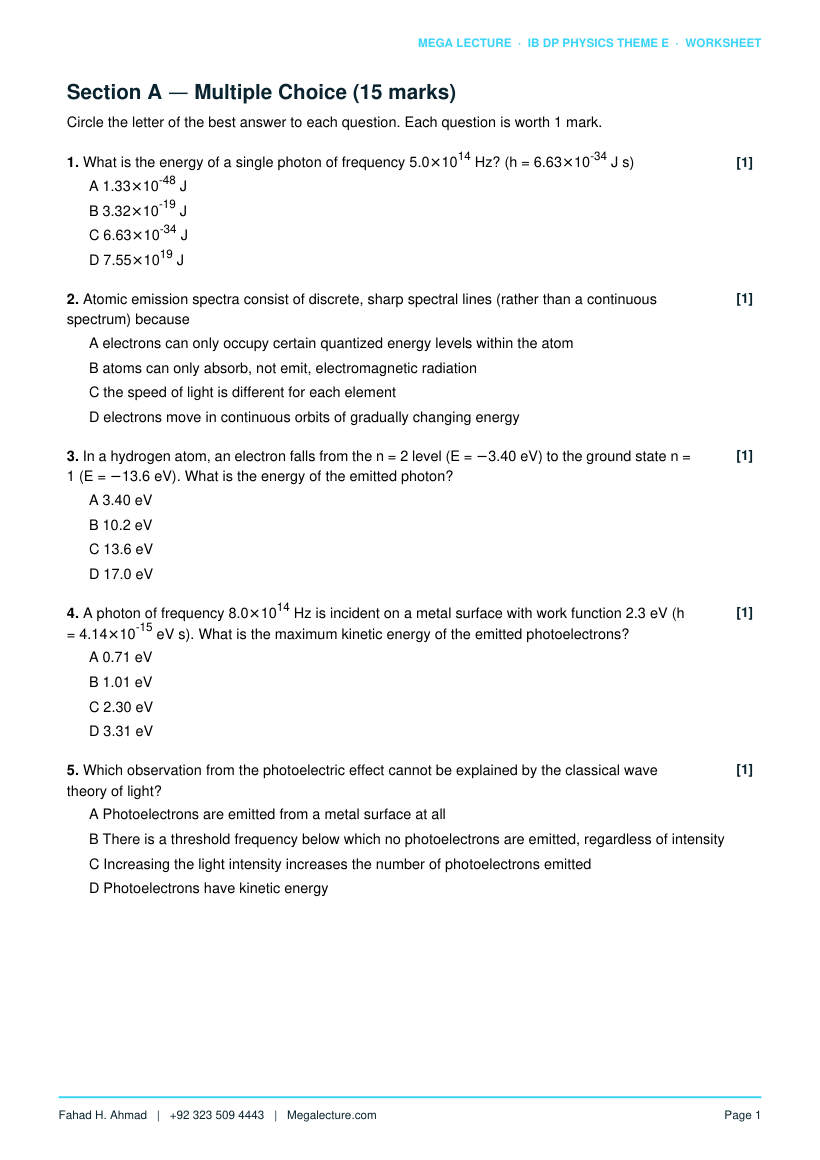
Section A — Multiple Choice (15 marks)
Circle the letter of the best answer to each question. Each question is worth 1 mark.
- What is the energy of a single photon of frequency 5.0×10¹⁴ Hz? (h = 6.63×10⁻³⁴ J s) [1]
A 1.33×10-48 J
B 3.32×10⁻¹⁹ J
C 6.63×10⁻³⁴ J
D 7.55×10¹⁹ J
- Atomic emission spectra consist of discrete, sharp spectral lines (rather than a continuous spectrum) because
[1]
A electrons can only occupy certain quantized energy levels within the atom
B atoms can only absorb, not emit, electromagnetic radiation
C the speed of light is different for each element
D electrons move in continuous orbits of gradually changing energy
- In a hydrogen atom, an electron falls from the n = 2 level (E = −3.40 eV) to the ground state n = 1 (E = −13.6 eV). What is the energy of the emitted photon?
[1]
A 3.40 eV
B 10.2 eV
C 13.6 eV
D 17.0 eV
- A photon of frequency 8.0×10¹⁴ Hz is incident on a metal surface with work function 2.3 eV (h = 4.14×10⁻¹⁵ eV s). What is the maximum kinetic energy of the emitted photoelectrons?
[1]
A 0.71 eV
B 1.01 eV
C 2.30 eV
D 3.31 eV
- Which observation from the photoelectric effect cannot be explained by the classical wave theory of light?
[1]
A Photoelectrons are emitted from a metal surface at all
B There is a threshold frequency below which no photoelectrons are emitted, regardless of intensity
C Increasing the light intensity increases the number of photoelectrons emitted
D Photoelectrons have kinetic energy
- A particle has momentum 2.0×10⁻²⁴ kg m s-1. What is its de Broglie wavelength? (h = 6.63×10⁻³⁴ J s)
[1]
A 1.33×10-58 m
B 3.02×10¹⁰ m
C 3.32×10⁻¹⁰ m
D 1.33×10⁻⁹ m
- A radioactive sample has a half-life of 5.0 days and initially contains 2.0×10¹⁰ nuclei. What is its initial activity?
[1]
A 8.0×10³ Bq
B 1.6×10⁴ Bq
C 3.2×10⁴ Bq
D 4.6×10⁴ Bq
- Which type of radioactive emission has the greatest penetrating power, typically requiring several centimetres of lead (or metres of concrete) to be significantly absorbed?
[1]
A Alpha particles
B Beta particles
C Gamma rays
D All three are absorbed equally
- A radioactive isotope has a half-life of 5.0 years. What fraction of an original sample remains after 15 years?
[1]
A 1/2
B 1/4
C 1/8
D 1/16
- A fission reaction results in a mass defect of 2.0×10⁻²⁸ kg. How much energy is released? (c = 3.0×10⁸ m s-1)
[1]
A 6.0×10⁻²⁰ J
B 1.8×10⁻¹¹ J
C 6.0×10⁻¹² J
D 1.8×10¹⁹ J
- In a nuclear fission chain reaction, the reaction is able to sustain itself because [1]
A each fission event absorbs neutrons, slowing the reaction to a stop
B each fission event releases additional neutrons, which can induce further fission events
C fission fragments are always more massive than the original nucleus
D the process requires no external neutrons after the first fission
- The nuclear binding energy of a nucleus is best defined as [1]
A the total kinetic energy of all the nucleons
B the energy released when the nucleus is formed from its separate, initially stationary nucleons (equivalently, the energy needed to separate the nucleus into individual nucleons)
C the energy required to remove a single proton from the nucleus
D the rest-mass energy of the nucleus
- A fusion reaction has a mass defect of 3.0×10⁻²⁹ kg. How much energy is released? [1]
A 9.0×10⁻²¹ J
B 2.7×10⁻¹² J
C 9.0×10⁻¹³ J
D 2.7×10²⁰ J
- Nuclear fusion is possible in the Sun's core, despite the electrostatic (Coulomb) repulsion between positively charged nuclei, mainly because
[1]
A the nuclei are electrically neutral in the Sun's core
B the extremely high temperature and pressure give nuclei enough kinetic energy (aided by quantum tunnelling) to overcome the Coulomb barrier
C gravity directly converts mass into energy without requiring nuclei to collide
D magnetic fields in the Sun cancel out the electrostatic repulsion
- A star's luminosity is given by L = 4πR2σT4. If a star's radius doubles and its surface temperature halves, its luminosity
[1]
A stays the same
B doubles
C decreases to 1/4 of its original value
D decreases to 1/16 of its original value
Section B — Structured Questions (67 marks)
Answer all questions in the space provided. Working must be shown for full marks.
E.1 Structure of the Atom
Question 1 [7 marks]
The diagram shows some of the energy levels of the hydrogen atom. An electron makes a transition from the n = 3 level to the n = 2 level, emitting a photon.
Energy level diagram for hydrogen (energy values are given data).
- Calculate the energy of the emitted photon, in eV and in joules. [2]
- Calculate the frequency of the emitted photon. [2]
- Calculate the wavelength of the emitted photon, and state whether it lies within the visible spectrum (≈400−700 nm).
[3]
Question 2 [6 marks]
The ionization energy of a hydrogen atom in its ground state is 13.6 eV.
- Express the ionization energy in joules. [2]
- Calculate the minimum frequency of a photon that could ionize a ground-state hydrogen atom. [2]
- State what happens if a photon whose energy is less than 13.6 eV, but exactly equal to the difference between two of the atom's energy levels, is absorbed.
[2]
E.2 Quantum Physics (HL)
Question 3 [7 marks]
In a photoelectric effect experiment, the maximum kinetic energy of emitted photoelectrons, KEmax, is measured for light of different frequencies incident on the same metal surface. The graph shows the results.
Maximum photoelectron kinetic energy against frequency of incident light (two data points shown; the given work function is
1.80 eV).
- Using the two labelled data points, calculate the gradient of the graph in SI units, and explain why this gradient is expected to equal the Planck constant.
[3]
- Use one of the data points to calculate the work function of the metal, in eV. [2]
- Calculate the threshold frequency of the metal. [2]
Question 4 [6 marks]
An electron, initially at rest, is accelerated through a potential difference of 150 V.
- Calculate the kinetic energy gained by the electron. [2]
- Calculate the speed of the electron. [2]
- Calculate the de Broglie wavelength associated with the electron. [2]
E.3 Radioactive Decay
Question 5 [7 marks]
A radioactive source has an initial activity of 800 Bq. The graph shows how its activity varies with time; the half-life can be read from the graph as 4.0 days.
Activity−time decay curve (initial activity and half-life are given data).
- Use the half-life read from the graph to calculate the decay constant of the source. [2]
- Calculate the activity of the source after 10 days. [2]
- Using A = λN, calculate the number of radioactive nuclei present at t = 0. [3]
Question 6 [6 marks]
A sample initially contains 5.0×10¹² radioactive nuclei of an isotope with a half-life of 6.0 hours.
- Calculate the decay constant of the isotope. [2]
- Calculate the initial activity of the sample, in Bq. [2]
- Calculate the number of nuclei remaining after 18 hours. [2]
E.4 Fission
Question 7 [8 marks]
A neutron is absorbed by a U-235 nucleus, inducing fission into barium-141 and krypton-92, releasing 3 neutrons, as shown. (1 u = 1.66×10⁻²⁷ kg; masses: U-235 = 235.0439 u, neutron = 1.0087 u, Ba-141 = 140.9144 u, Kr-92 = 91.9262 u.)
Induced fission of U-235 following neutron capture.
- Calculate the mass defect of this reaction, in u and in kg. [3]
- Calculate the energy released in this single fission event, in joules and in MeV. [3]
- State the additional role played by the 3 emitted neutrons in a nuclear reactor or bomb. [2]
Question 8 [6 marks]
A nuclear reactor generates 1.5 GW of thermal power. Each fission of U-235 releases approximately 200 MeV of usable energy.
- Express the energy released per fission event in joules. [2]
- Calculate the number of fission events needed per second to sustain this power output. [2]
- Estimate the mass of U-235 consumed per second (mass of one U-235 nucleus ≈ 235 u = 3.90×10⁻²⁵ kg).
[2]
E.5 Fusion and Stars
Question 9 [8 marks]
A deuterium nucleus (D) fuses with a tritium nucleus (T) to form helium-4 and a neutron, as shown. (Masses: D = 2.0141 u, T = 3.0160 u, He-4 = 4.0026 u, neutron = 1.0087 u; 1 u = 1.66×10⁻²⁷ kg.)
Deuterium−tritium (D−T) fusion.
- Calculate the mass defect of this fusion reaction, in u and in kg. [3]
- Calculate the energy released in this fusion reaction, in joules and in MeV. [3]
- Explain, in terms of binding energy per nucleon, why energy is released in this fusion reaction. [2]
Question 10 [6 marks]
The Sun has a surface temperature of 5800 K and a radius of 6.96×10⁸ m. (Stefan−Boltzmann constant σ = 5.67×10⁻⁸ W m-2 K-4.)
- Calculate the luminosity of the Sun, using L = 4πR2σT4. [2]
- A second star has the same surface temperature as the Sun but twice its radius. Calculate its luminosity as a multiple of the Sun's luminosity.
[2]
- State how the Sun's luminosity would change if its surface temperature doubled, with its radius unchanged.
[2]
