
IGCSE · Physics · Past papers · Paper 1 (Multiple Choice)
Answer Key
Need more than one subject? All-notes pass: unlimited downloads of every note for a year: unlimited downloads of every note on the site, PKR 999 a year. All packs and courses.
Opens inside this page. Prefer your own PDF app? Open the PDF.
Check yourself
5 quick questions on IGCSE Physics
Tap an answer to see if you are right, and why. Free, no sign-up.
Start the free testNew · free
O Level Physics written answers, marked like a real examiner
Answer a Paper 2 style question by typing or speaking. You get your mark point by point, what the examiner was looking for that you missed, and a model answer. 5 free answers a day with a free account.
Try a written question👍 33 students found these notes useful
Was this note useful?
Full text of Answer Key
www.megalecture.com · www.youtube.com/@megalecture
Fahad H. Ahmad
M.Eng NUS Singapore · B.Eng NUST · 15+ years of teaching experience in Singapore, UAE & Pakistan · 60,000+ subscribers and 20 million+ video lecture views.
IGCSEPHYSICS0625·TOPICALPASTPAPERS
General Wave Properties — Paper 1
Worked Answer Key (Multiple Choice)
Free notes, practice tests and live classes Back to megalecture.com
General Wave Properties — Paper 1 · Worked Answer Key
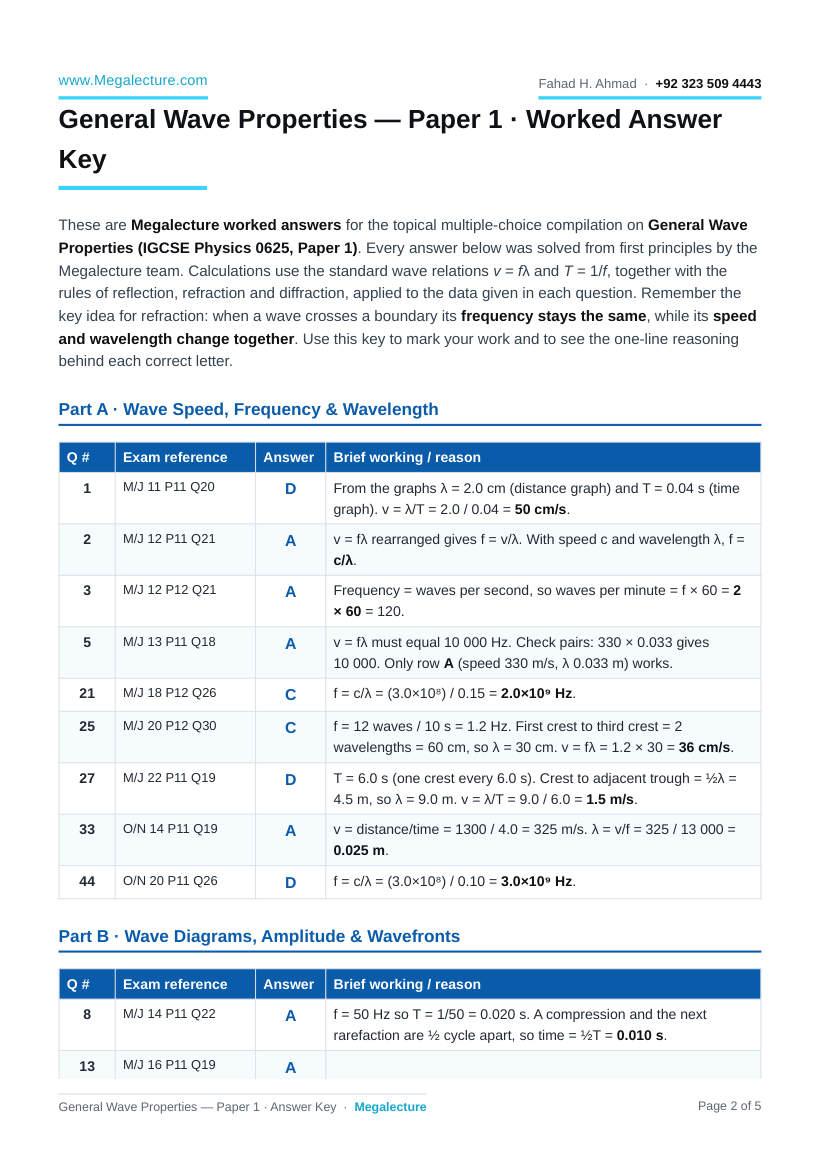
These are Megalecture worked answers for the topical multiple-choice compilation on General Wave
Properties (IGCSE Physics 0625, Paper 1). Every answer below was solved from first principles by the
Megalecture team. Calculations use the standard wave relations v = fλ and T = 1/f, together with the rules of reflection, refraction and diffraction, applied to the data given in each question. Remember the key idea for refraction: when a wave crosses a boundary its frequency stays the same, while its speed and wavelength change together. Use this key to mark your work and to see the one-line reasoning behind each correct letter.
Part A · Wave Speed, Frequency & Wavelength Q # Exam reference Answer Brief working / reason
M/J 11 P11 Q20
D
From the graphs λ = 2.0 cm (distance graph) and T = 0.04 s (time graph). v = λ/T = 2.0 / 0.04 = 50 cm/s.
M/J 12 P11 Q21
A
v = fλ rearranged gives f = v/λ. With speed c and wavelength λ, f = c/λ.
M/J 12 P12 Q21
A
Frequency = waves per second, so waves per minute = f × 60 = 2
× 60 = 120.
M/J 13 P11 Q18
A
v = fλ must equal 10 000 Hz. Check pairs: 330 × 0.033 gives
10 000. Only row A (speed 330 m/s, λ 0.033 m) works.
M/J 18 P12 Q26
C
f = c/λ = (3.0×10⁸) / 0.15 = 2.0×10⁹ Hz.
M/J 20 P12 Q30
C
f = 12 waves / 10 s = 1.2 Hz. First crest to third crest = 2 wavelengths = 60 cm, so λ = 30 cm. v = fλ = 1.2 × 30 = 36 cm/s.
M/J 22 P11 Q19
D
T = 6.0 s (one crest every 6.0 s). Crest to adjacent trough = ½λ =
4.5 m, so λ = 9.0 m. v = λ/T = 9.0 / 6.0 = 1.5 m/s.
O/N 14 P11 Q19
A
v = distance/time = 1300 / 4.0 = 325 m/s. λ = v/f = 325 / 13 000 =
0.025 m.
O/N 20 P11 Q26
D
f = c/λ = (3.0×10⁸) / 0.10 = 3.0×10⁹ Hz.
Part B · Wave Diagrams, Amplitude & Wavefronts Q # Exam reference Answer Brief working / reason
M/J 14 P11 Q22
A
f = 50 Hz so T = 1/50 = 0.020 s. A compression and the next rarefaction are ½ cycle apart, so time = ½T = 0.010 s.
M/J 16 P11 Q19
A
General Wave Properties — Paper 1 · Answer Key · Megalecture
Q # Exam reference Answer Brief working / reason
A wavefront is a line joining all points on the same crest (points vibrating in phase).
M/J 16 P11 Q20
D
On a longitudinal wave one wavelength is the distance between adjacent compressions. The dense (compressed) coils sit at W, Y and Z; adjacent compressions Y and Z are exactly one wavelength apart → Y and Z.
M/J 16 P12 Q22
C
Wavelength = distance from one compression to the next compression. That centre-to-centre spacing is shown by length C.
M/J 17 P12 Q27
D
Original: amplitude 4 mm, λ = 8 cm. Twice amplitude = 8 mm; half frequency at the same speed means double wavelength = 16 cm
(one full wave across the 16 cm axis). Graph D.
M/J 18 P11 Q26
A
Sound is longitudinal, so a molecule oscillates back and forth along the direction of travel (horizontally) and returns to its start after one period → diagram A.
M/J 20 P12 Q29
B
Amplitude = ½ × (peak − trough) = ½ × (74 − 6) = 34 cm.
O/N 12 P12 Q21
A
Reflected circular wavefronts behave as if they came from the image of the vibrator — the same distance behind the surface as the vibrator is in front. That image point is at position A.
O/N 13 P11 Q19
D
For a transverse water wave the floating ball oscillates up and down (vertically) about its rest level → diagram D.
O/N 16 P11 Q22
A
Amplitude = crest height above the rest line = Q; wavelength = crest-to-crest distance = P. (R is peak-to-trough = 2 × amplitude; S is ½λ.)
O/N 17 P11 Q18
B
The 4.0 cm arrow runs from the rest line to a crest = amplitude =
4.0 cm. The 5.0 cm spans one trough = ½λ, so λ = 10 cm → row B
(4.0, 10).
O/N 19 P12 Q22
A
Amplitude is the maximum displacement from rest, i.e. half the vertical distance between a trough and a peak.
O/N 19 P12 Q23
D
Wavefronts from a point source are circular (statement 2) and are always perpendicular to the direction of energy movement
(statement 4) → 2 and 4.
Part C · Transverse & Longitudinal Waves; Energy Transfer Q # Exam reference Answer Brief working / reason
M/J 13 P12 Q22
D
General Wave Properties — Paper 1 · Answer Key · Megalecture
Q # Exam reference Answer Brief working / reason
M/J 13 P12 Q24
B
Sound is longitudinal; radio, infra-red and a side-shaken rope are transverse. So a sound wave in a solid is longitudinal.
M/J 14 P12 Q25
B
The number of waves passing a fixed point per second is the definition of frequency.
M/J 15 P12 Q24
B
A wave transfers energy but not matter; the ball bobs in place. So energy is transferred in the wave direction but water is not.
M/J 17 P11 Q26
A
Of the choices only sound waves in water are longitudinal; UV, X- rays and surface water waves are transverse.
M/J 19 P11 Q23
C
Gamma rays, light and X-rays are EM (transverse). Only ultrasound waves are longitudinal.
M/J 22 P12 Q27
B
A sound wave is longitudinal; point X lies where the molecules are spread out, which is a rarefaction → longitudinal, rarefaction.
O/N 11 P11 Q23
A
A source of sound makes a longitudinal wave. Pushing the spring along its length sends compressions and rarefactions along the coils → diagram A.
O/N 16 P11 Q21
C
Light is an EM wave (transverse); sound is longitudinal → light transverse, sound longitudinal.
O/N 17 P11 Q19
D
The wave travels E–W but the ground vibrates N–S — vibration perpendicular to travel — so it is a transverse wave.
O/N 17 P11 Q19
A
In a longitudinal sound wave, all particles on one line move in the same direction at the same time. (Compression to adjacent rarefaction is ½λ, not λ.)
O/N 18 P12 Q18
B
Crests passing a point per second is the definition of frequency.
O/N 18 P12 Q22
C
Speed is the horizontal distance a crest travels each second → the
speed is the horizontal distance travelled per second by a
peak. (Amplitude is ½ the peak-to-trough height; λ is crest-to-crest, not crest-to-trough.)
O/N 20 P11 Q30
C
Sound is a mechanical longitudinal wave: an oscillation of particles parallel to the direction of travel of the wave energy.
O/N 21 P11 Q18
B
Amplitude = the maximum distance a particle moves from its equilibrium position.
Part D · Reflection, Refraction & Diffraction Q # Exam reference Answer Brief working / reason
M/J 13 P11 Q17
C
Entering the glass block the water becomes shallower, so the wave slows. Frequency is set by the dipper and is unchanged → frequency remains the same, speed decreases.
General Wave Properties — Paper 1 · Answer Key · Megalecture
Q # Exam reference Answer Brief working / reason
M/J 14 P11 Q23
C
At refraction frequency is unchanged; v = fλ means speed and wavelength both change → frequency stays the same;
wavelength and speed change.
M/J 15 P11 Q21
D
Going from deep to shallow water the wave slows; with f fixed, λ = v/f also falls → speed and wavelength decrease.
M/J 16 P12 Q17
D
Refraction changes speed and wavelength while frequency stays constant.
M/J 17 P12 Q26
A
Region P is the deep water (waves wider apart and faster). So in P the wavelength is larger and the speed is faster than in shallow Q
→ row A.
M/J 19 P12 Q25
A
The boat only gains energy, so the wave loses energy: the property that changes is the amplitude. (Frequency, speed and wavelength are unchanged.)
M/J 21 P11 Q20
A
Deep → shallow: the wave slows (speed decreases) but frequency is fixed by the source → speed decreases, frequency stays constant.
O/N 12 P11 Q21
A
The incoming plane waves bounce off the barrier and overlap the incident set at the same spacing — this is waves being reflected.
O/N 15 P11 Q19
D
Reflection does not change the medium, so both the speed and the wavelength stay the same → row D.
O/N 20 P12 Q24
B
Light passing from air into glass slows down; frequency is unchanged and, since v = fλ, the wavelength shortens → the speed of the light waves decreases.
O/N 21 P11 Q17
A
In the slower region the waves bunch up (shorter wavelength) and then return to the original spacing in the faster region; frequency stays constant throughout → side-view A (close-spaced in the middle, normal at both ends).
O/N 21 P11 Q19
B
Moving into shallow water the wave slows → the speed of the wavefront decreases (and so does the wavelength; frequency is unchanged).
O/N 21 P12 Q22
B
Refraction needs a transverse wave changing speed at a boundary: light waves from an object entering a magnifying glass. (Ultrasound is longitudinal; water hitting a barrier is reflection.)
Note from Megalecture. These are original Megalecture worked solutions prepared for revision use. Keep the golden rule in mind: at every reflection and refraction the frequency never changes — only the speed and wavelength can.
These answers were solved independently from first principles using v = fλ and T = 1/f.
General Wave Properties — Paper 1 · Answer Key · Megalecture
