
IGCSE · Physics · Past papers · Paper 1 (Multiple Choice)
Answer Key
Need more than one subject? All-notes pass: unlimited downloads of every note for a year: unlimited downloads of every note on the site, PKR 999 a year. All packs and courses.
Opens inside this page. Prefer your own PDF app? Open the PDF.
Check yourself
5 quick questions on IGCSE Physics
Tap an answer to see if you are right, and why. Free, no sign-up.
Start the free testNew · free
O Level Physics written answers, marked like a real examiner
Answer a Paper 2 style question by typing or speaking. You get your mark point by point, what the examiner was looking for that you missed, and a model answer. 5 free answers a day with a free account.
Try a written question👍 33 students found these notes useful
Was this note useful?
Full text of Answer Key
www.megalecture.com · www.youtube.com/@megalecture
Fahad H. Ahmad
M.Eng NUS Singapore · B.Eng NUST · 15+ years of teaching experience in Singapore, UAE & Pakistan · 60,000+ subscribers and 20 million+ video lecture views.
IGCSEPHYSICS0625·TOPICALPASTPAPERS
Forces (Dynamics) — Paper 1
Worked Answer Key (Multiple Choice)
Free notes, practice tests and live classes Back to megalecture.com
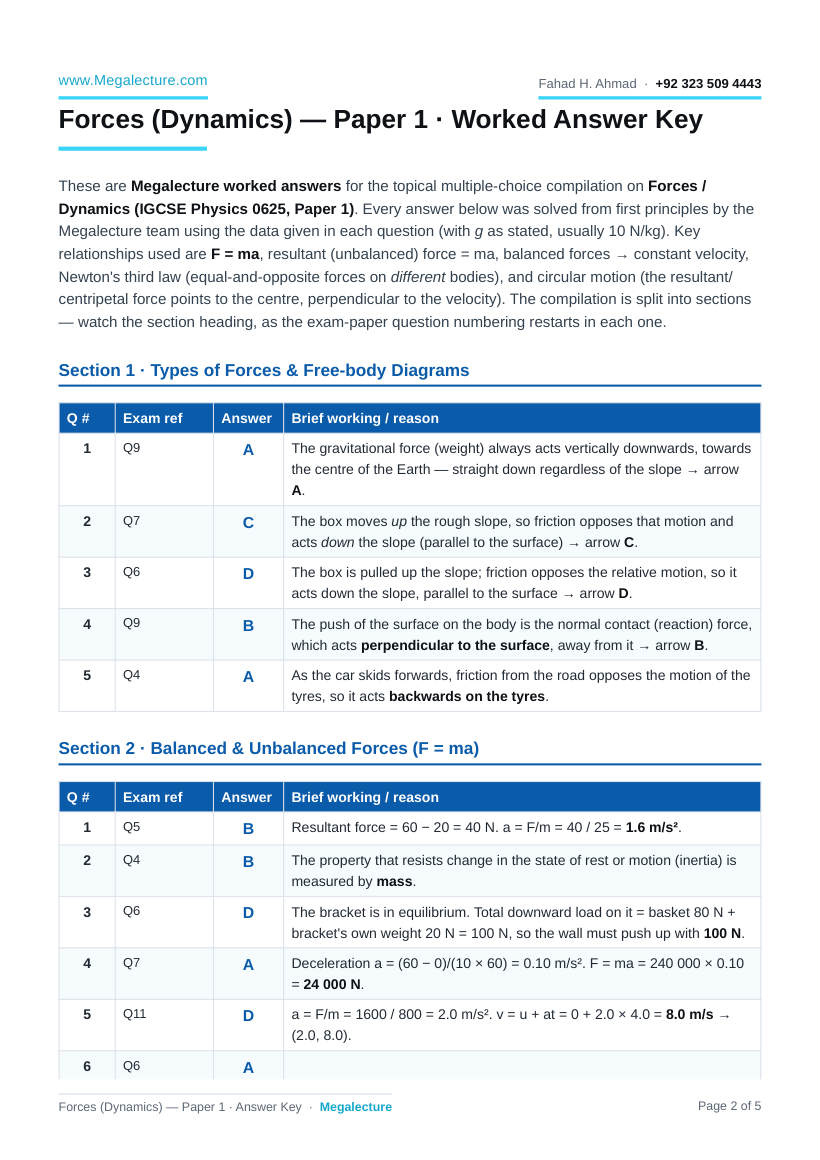
Forces (Dynamics) — Paper 1 · Worked Answer Key
These are Megalecture worked answers for the topical multiple-choice compilation on Forces /
Dynamics (IGCSE Physics 0625, Paper 1). Every answer below was solved from first principles by the
Megalecture team using the data given in each question (with g as stated, usually 10 N/kg). Key relationships used are F = ma, resultant (unbalanced) force = ma, balanced forces → constant velocity,
Newton's third law (equal-and-opposite forces on different bodies), and circular motion (the resultant/ centripetal force points to the centre, perpendicular to the velocity). The compilation is split into sections
— watch the section heading, as the exam-paper question numbering restarts in each one.
Section 1 · Types of Forces & Free-body Diagrams Q # Exam ref Answer Brief working / reason
Q9
A
The gravitational force (weight) always acts vertically downwards, towards the centre of the Earth — straight down regardless of the slope → arrow
A.
Q7
C
The box moves up the rough slope, so friction opposes that motion and acts down the slope (parallel to the surface) → arrow C.
Q6
D
The box is pulled up the slope; friction opposes the relative motion, so it acts down the slope, parallel to the surface → arrow D.
Q9
B
The push of the surface on the body is the normal contact (reaction) force, which acts perpendicular to the surface, away from it → arrow B.
Q4
A
As the car skids forwards, friction from the road opposes the motion of the tyres, so it acts backwards on the tyres.
Section 2 · Balanced & Unbalanced Forces (F = ma) Q # Exam ref Answer Brief working / reason
Q5
B
Resultant force = 60 − 20 = 40 N. a = F/m = 40 / 25 = 1.6 m/s².
Q4
B
The property that resists change in the state of rest or motion (inertia) is measured by mass.
Q6
D
The bracket is in equilibrium. Total downward load on it = basket 80 N + bracket's own weight 20 N = 100 N, so the wall must push up with 100 N.
Q7
A
Deceleration a = (60 − 0)/(10 × 60) = 0.10 m/s². F = ma = 240 000 × 0.10
= 24 000 N.
Q11
D
a = F/m = 1600 / 800 = 2.0 m/s². v = u + at = 0 + 2.0 × 4.0 = 8.0 m/s →
(2.0, 8.0).
Q6
A
Forces (Dynamics) — Paper 1 · Answer Key · Megalecture
Q # Exam ref Answer Brief working / reason
Constant velocity at constant height → all forces balanced. Vertically X =
Z (lift = weight); horizontally W = Y → W and Y equal, X and Z equal.
Q6
D
Steady speed → balanced forces, so upward force = weight = mg = 60 ×
10 = 600 N.
Q8
A
P has the greater mass, so P has the greater amount of matter and the greater resistance to change of motion (inertia) → row A (P and P).
Q4
A
Constant velocity → resultant force is zero, so the opposing force equals the driving force = 5000 N.
Q5
B
When the link breaks, the engine's driving force is unchanged but it now pulls less mass, so it speeds up; the truck has no driving force and friction slows it down.
Q4
B
A resultant force is needed to change velocity (speed or direction). Going round a bend at constant speed changes direction → car moving around a bend at constant speed.
Q6
B
The car is accelerating, so driving force ≠ air resistance (horizontal forces unbalanced). The vertical pair, weight and the contact (normal) forces, are balanced → contact forces and weight.
Q7
B
A force can change a body's speed, direction or position, but it cannot change the mass of the body.
Q3
D
Driving force = ma + friction = (800 × 2.5) + 1200 = 2000 + 1200 =
3200 N.
Section 3 · Newton's Third Law Q # Exam ref Answer Brief working / reason
Q5
B
An action–reaction pair acts between the same two bodies. P (force on
Moon due to Earth) and R (force on Earth due to Moon) are that pair → P and R.
Q5
C
The N3 pair acts between the same two bodies (man & parachute): P
(parachute on man, up) and S (man on parachute, down) → P and S.
Q6
C
Only the electron–nucleus attraction is a true pair (equal, opposite, on different bodies, same type of force). The others act on one body → diagram C.
Q9
C
Same pairing as above: P (parachute on man) and S (man on parachute) act between the same two bodies → P and S.
Section 4 · Friction
Forces (Dynamics) — Paper 1 · Answer Key · Megalecture
Q # Exam ref Answer Brief working / reason
Q5
C
A wet road gives less grip, so the frictional force decreases; with less braking force the car needs a longer distance to stop, so the braking distance increases → row C.
Section 5 · Free Fall & Terminal Velocity Q # Exam ref Answer Brief working / reason
Q6
C
As speed rises, air resistance increases until it balances the weight; the resultant force becomes zero, so acceleration is zero and speed stays constant → air resistance increases and balances his weight.
Q6
A
At terminal velocity two forces still act and are balanced: air resistance and weight.
Q2
D
At release air resistance is zero, so a = g = 10 m/s²; as speed rises air resistance grows and a falls to 0 at terminal velocity → starting at 10 and decreasing to 0 m/s².
Q3
C
Both spheres fall with a = g. The heavier sphere Q (1.0 kg) has double the weight of P (0.50 kg), but also double the mass, so a = F/m is the same → the force on Q is double the force on P.
Q5
D
Opening the parachute makes air resistance exceed the weight, so the resultant force is upwards and the acceleration (deceleration) is also upwards → row D.
Q4
C
Before terminal velocity: downward force (weight) stays the same, upward air resistance increases, so the resultant force decreases → row
C.
Q3
C
At terminal velocity forces are balanced, so acceleration is zero and the velocity is constant → row C.
Q1
C
A falling apple speeds up, so the forces are unbalanced and the motion is acceleration → row C.
Q10
D
With no atmosphere there is no air resistance, so both spheres fall with the same acceleration g and hit the ground together, whatever their masses.
Q7
B
Acceleration equals g (free fall) only when air resistance is absent: a feather falling in a vacuum tube.
Q4
D
When the parachute opens, air resistance > weight, so the resultant force is upwards and the acceleration is upwards (she slows down) → row D.
Section 6 · Circular Motion
Forces (Dynamics) — Paper 1 · Answer Key · Megalecture
Q # Exam ref Answer Brief working / reason
Q6
B
The resultant (centripetal) force points to the centre of the circle, perpendicular to the velocity. The centre is to the side of the car, so the force is the horizontal arrow pointing towards it → arrow B.
Q7
C
Newton's second law: acceleration is always in the same direction as the resultant force → the resultant force and the acceleration.
Q8
B
The centripetal acceleration has constant magnitude (steady speed, fixed radius) but its direction keeps changing to point at the planet → constant in size but not in direction.
Q8
D
Moving in a circle means the velocity direction changes, so the forces are unbalanced with a resultant towards the centre.
Q3
D
The resultant force on the satellite is the gravitational pull towards the planet P; arrow D points from S towards P (the centre) → direction D.
Q5
D
Each planet is held in orbit by gravity, a force directed towards the Sun
(the centre of the orbit).
Q7
C
For circular motion the resultant force points to the centre, at right angles to the velocity. At O the centre lies to the right, so the force is arrow C.
Q7
A
The turning (centripetal) force is the friction of the road acting towards the centre of the turn — to the left → arrow A.
Q8
C
The force keeping the Earth in orbit around the Sun is gravitational.
Q3
D
The resultant force on the car points to the centre of the circular track. The centre is below the car, so the force is the arrow pointing down → arrow
D.
Q8
D
The acceleration points towards the Sun (centre) — arrow R; the velocity is tangential, along the orbit — arrow Q → row D (R, Q).
Q6
B
By Newton's third law the satellite pulls the planet towards itself. The satellite is at the upper right, so the force on the planet points that way → arrow B.
Note from Megalecture. These are original Megalecture worked solutions prepared for revision use. Throughout,
"resultant force" means the single force equivalent to all the forces added together; for any object moving in a circle at steady speed this resultant points to the centre and equals the centripetal force. For falling objects, remember that terminal velocity means zero resultant force (balanced), while opening a parachute briefly makes the resultant — and therefore the acceleration — point upwards.
Forces (Dynamics) — Paper 1 · Answer Key · Megalecture
