
O Level · Pakistan Studies 2059 · Topic Notes (chronological)
The Simon Commission, the Nehru Report and Jinnah’s Fourteen Points 1927-29
Opens inside this page. Prefer your own PDF app? Open the PDF.
New: small group classes for O Level Pakistan Studies are opening, at a lower fee than one-to-one. Join the waiting list
Check yourself
5 quick questions on O Level Pakistan Studies
Tap an answer to see if you are right, and why. Free, no sign-up.
Start the free test4 of 5 students found these notes useful
Was this note useful?
Full text of The Simon Commission, the Nehru Report and Jinnah’s Fourteen Points 1927-29
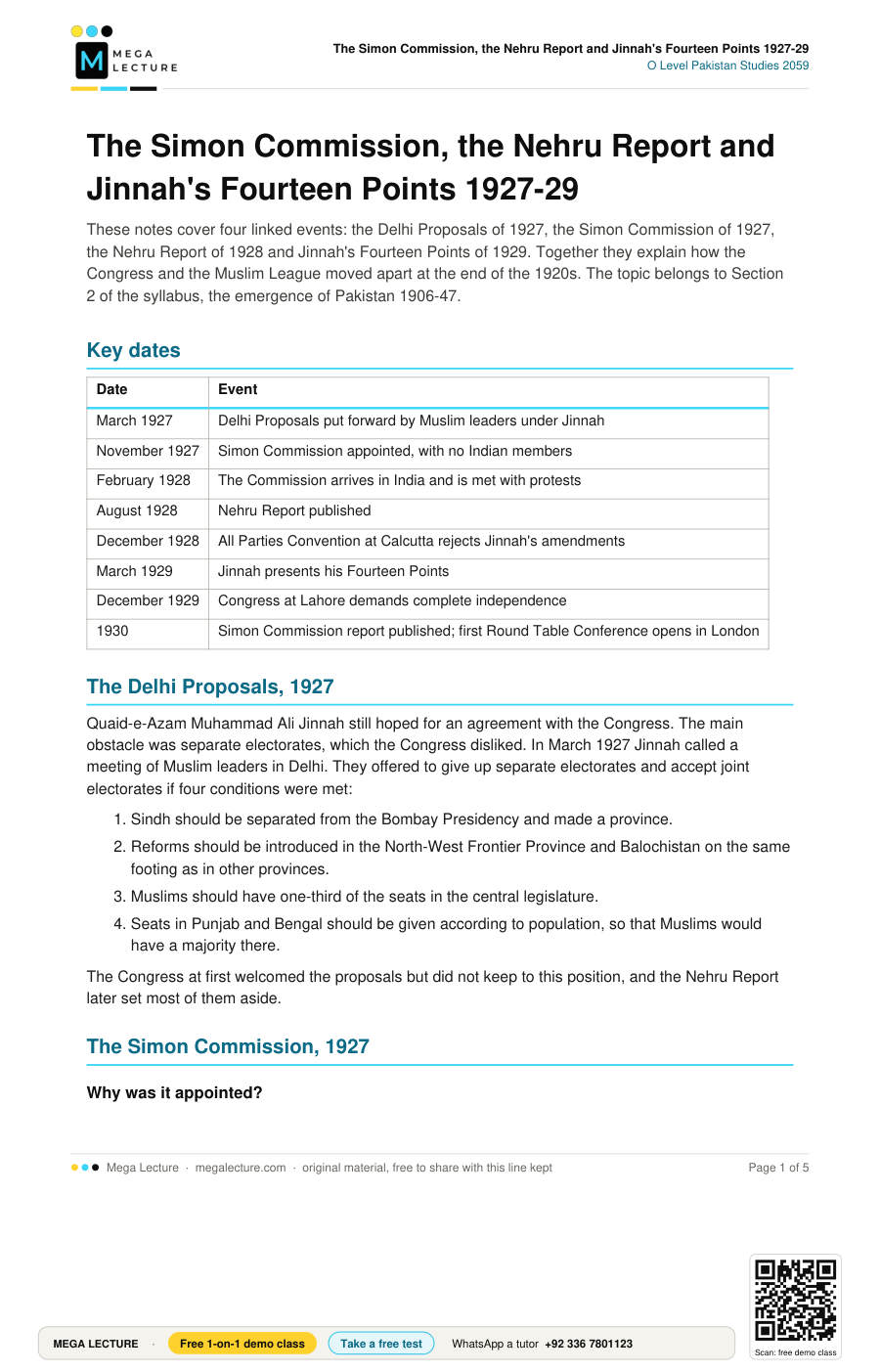
These notes cover four linked events: the Delhi Proposals of 1927, the Simon Commission of 1927, the Nehru Report of 1928 and Jinnah's Fourteen Points of 1929. Together they explain how the Congress and the Muslim League moved apart at the end of the 1920s. The topic belongs to Section 2 of the syllabus, the emergence of Pakistan 1906-47.
Key dates
| Date | Event |
|---|---|
| March 1927 | Delhi Proposals put forward by Muslim leaders under Jinnah |
| November 1927 | Simon Commission appointed, with no Indian members |
| February 1928 | The Commission arrives in India and is met with protests |
| August 1928 | Nehru Report published |
| December 1928 | All Parties Convention at Calcutta rejects Jinnah's amendments |
| March 1929 | Jinnah presents his Fourteen Points |
| December 1929 | Congress at Lahore demands complete independence |
| 1930 | Simon Commission report published; first Round Table Conference opens in London |
The Delhi Proposals, 1927
Quaid-e-Azam Muhammad Ali Jinnah still hoped for an agreement with the Congress. The main obstacle was separate electorates, which the Congress disliked. In March 1927 Jinnah called a meeting of Muslim leaders in Delhi. They offered to give up separate electorates and accept joint electorates if four conditions were met:
- Sindh should be separated from the Bombay Presidency and made a province.
- Reforms should be introduced in the North-West Frontier Province and Balochistan on the same footing as in other provinces.
- Muslims should have one-third of the seats in the central legislature.
- Seats in Punjab and Bengal should be given according to population, so that Muslims would have a majority there.
The Congress at first welcomed the proposals but did not keep to this position, and the Nehru Report later set most of them aside.
The Simon Commission, 1927
Why was it appointed?
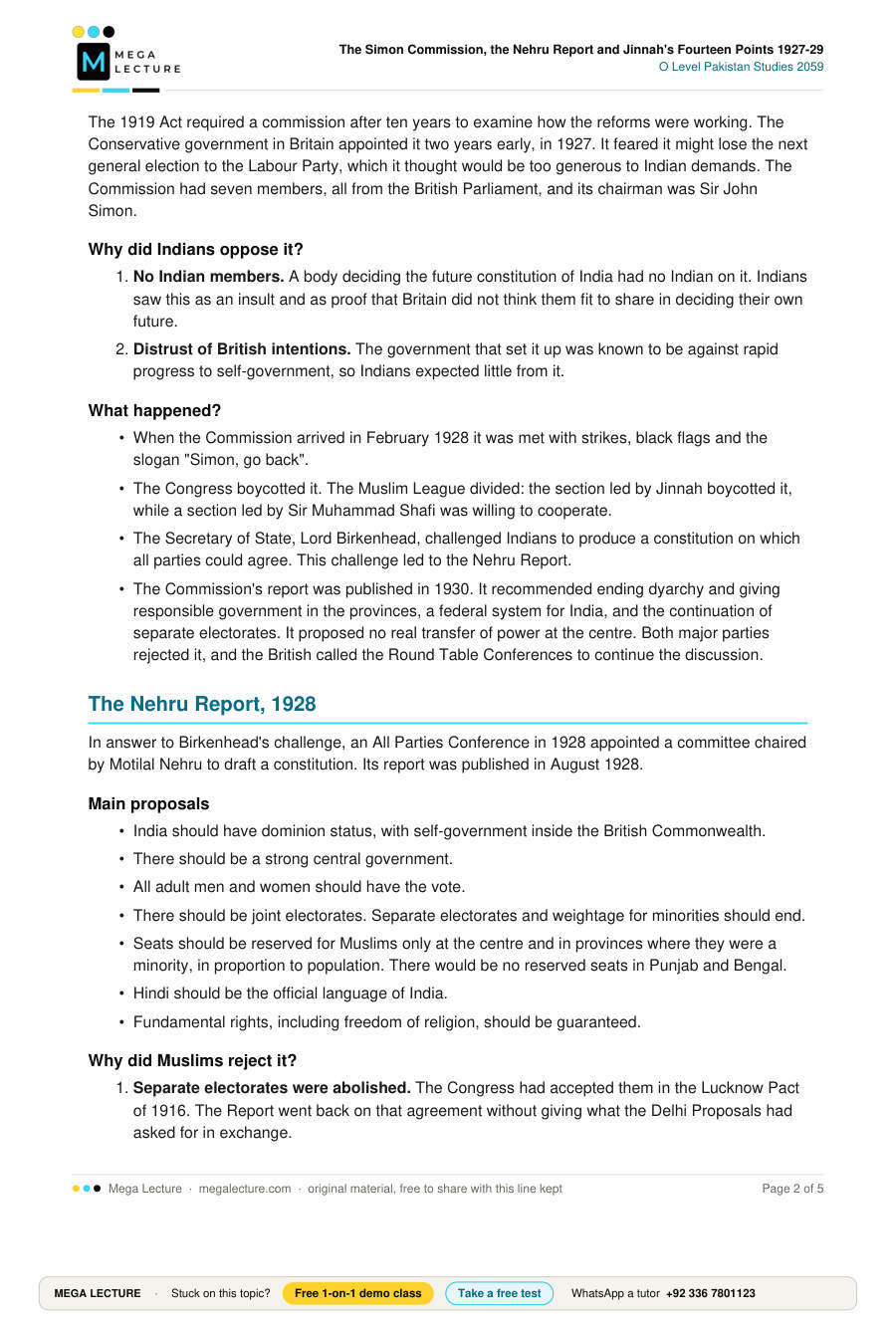
The 1919 Act required a commission after ten years to examine how the reforms were working. The Conservative government in Britain appointed it two years early, in 1927. It feared it might lose the next general election to the Labour Party, which it thought would be too generous to Indian demands. The Commission had seven members, all from the British Parliament, and its chairman was Sir John Simon.
Why did Indians oppose it?
- No Indian members. A body deciding the future constitution of India had no Indian on it. Indians saw this as an insult and as proof that Britain did not think them fit to share in deciding their own future.
- Distrust of British intentions. The government that set it up was known to be against rapid progress to self-government, so Indians expected little from it.
What happened?
- When the Commission arrived in February 1928 it was met with strikes, black flags and the slogan "Simon, go back".
- The Congress boycotted it. The Muslim League divided: the section led by Jinnah boycotted it, while a section led by Sir Muhammad Shafi was willing to cooperate.
- The Secretary of State, Lord Birkenhead, challenged Indians to produce a constitution on which all parties could agree. This challenge led to the Nehru Report.
- The Commission's report was published in 1930. It recommended ending dyarchy and giving responsible government in the provinces, a federal system for India, and the continuation of separate electorates. It proposed no real transfer of power at the centre. Both major parties rejected it, and the British called the Round Table Conferences to continue the discussion.
The Nehru Report, 1928
In answer to Birkenhead's challenge, an All Parties Conference in 1928 appointed a committee chaired by Motilal Nehru to draft a constitution. Its report was published in August 1928.
Main proposals
- India should have dominion status, with self-government inside the British Commonwealth.
- There should be a strong central government.
- All adult men and women should have the vote.
- There should be joint electorates. Separate electorates and weightage for minorities should end.
- Seats should be reserved for Muslims only at the centre and in provinces where they were a minority, in proportion to population. There would be no reserved seats in Punjab and Bengal.
- Hindi should be the official language of India.
- Fundamental rights, including freedom of religion, should be guaranteed.
Why did Muslims reject it?
- Separate electorates were abolished. The Congress had accepted them in the Lucknow Pact of 1916. The Report went back on that agreement without giving what the Delhi Proposals had asked for in exchange.
- Less than one-third of central seats. Representation by population would give Muslims about a quarter of the seats at the centre, not the one-third they had asked for.
- A strong centre. With power concentrated at the centre, where Hindus would always be in the majority, the Muslim-majority provinces would have little independence.
- Language and culture. Making Hindi the official language threatened the position of Urdu.
At the All Parties Convention in Calcutta in December 1928, Jinnah proposed amendments: one-third of central seats for Muslims, seats in Punjab and Bengal on the basis of population, and residuary powers for the provinces. They were rejected. Jinnah described this as "the parting of the ways".
Jinnah's Fourteen Points, 1929
In March 1929, at a meeting of the Muslim League in Delhi, Jinnah set out the minimum Muslim demands for any future constitution. The Fourteen Points were:
- The constitution should be federal, with residuary powers given to the provinces.
- All provinces should have the same measure of autonomy.
- Minorities should have adequate and effective representation in every legislature, without reducing a majority in any province to a minority or to equality.
- Muslims should have at least one-third of the seats in the central legislature.
- Separate electorates should continue, though any community could choose to give them up.
- Any change of boundaries should not affect the Muslim majority in Punjab, Bengal and the North-West Frontier Province.
- All communities should have full religious liberty.
- No bill should be passed if three-quarters of the members of any community in that body opposed it as harmful to their community.
- Sindh should be separated from the Bombay Presidency.
- Reforms should be introduced in the North-West Frontier Province and Balochistan as in other provinces.
- Muslims should have an adequate share in government services.
- Muslim culture, education, language, religion and personal laws should be protected.
- At least one-third of the ministers in every central and provincial cabinet should be Muslim.
- The constitution should not be changed by the central legislature without the agreement of the provinces.
How important were these events?
Why the Fourteen Points and the events of 1927-29 were important
- The Fourteen Points gave Muslims a clear, agreed list of demands. They brought the divided sections of the Muslim League back together under Jinnah's leadership.
- They became the basis of Muslim demands in all later negotiations, including the Round Table Conferences, and several were later met: Sindh was separated and the North-West Frontier Province received reforms in the 1930s.
- The Nehru Report convinced many Muslims that the Congress would not protect their interests in a self-governing India. It ended the cooperation that had begun at Lucknow.
- Jinnah, once the "ambassador of Hindu-Muslim unity", now worked for firm constitutional safeguards for Muslims.
- The Simon Commission showed that Indian opinion could not be ignored and led to the Round Table Conferences, where Indians were consulted directly.
Limits to their importance
- None of the four produced an agreed constitution. The Delhi Proposals were set aside, the Simon report was rejected in India, the Nehru Report was not accepted by Muslims and the Fourteen Points were not accepted by the Congress.
- The Fourteen Points asked for safeguards inside a united India. The demand for a separate state came only in 1940.
Judgement. These years did not settle India's constitution, but they changed the direction of Muslim politics. The Delhi Proposals show that Jinnah was still ready to compromise in 1927. The Nehru Report closed that door, and the Fourteen Points replaced compromise with a fixed list of safeguards. Of the four, the Nehru Report did most to divide the communities and the Fourteen Points did most to shape later Muslim demands.
Key terms and people
- Sir John Simon: chairman of the Simon Commission.
- Lord Birkenhead: Secretary of State for India, who challenged Indians to agree a constitution.
- Motilal Nehru: Congress leader who chaired the committee that wrote the Nehru Report.
- Dominion status: self-government within the British Commonwealth, as in Canada or Australia.
- Residuary powers: powers not listed in the constitution as belonging to either the centre or the provinces.
Exam practice
- What were the Delhi Proposals of 1927? [4]
- Why did Jinnah produce his Fourteen Points in 1929? [7]
- "The Nehru Report was the most important reason for the breakdown of relations between the Congress and the Muslim League between 1927 and 1929." How far do you agree? Explain your answer. [14]
Question 1: proposals made in March 1927 by Muslim leaders meeting in Delhi under Jinnah; Muslims offered to give up separate electorates; in return Sindh was to be separated from Bombay, reforms introduced in the North-West Frontier Province and Balochistan, one-third of central seats given to Muslims, and seats in Punjab and Bengal given by population.
Question 2: (1) The Nehru Report had rejected separate electorates and one-third of central seats, so Muslims needed their own statement of demands. (2) Jinnah's amendments were refused at Calcutta in December 1928, which showed that the Congress would not compromise. (3) The Muslim League was divided, and an agreed list of demands could unite Muslims and guide them in future talks with the British and the Congress.
Question 3: Agree: the Report ended separate electorates, gave about a quarter of central seats, proposed a strong centre and Hindi, and went back on the Lucknow Pact; the rejection of Jinnah's amendments led to "the parting of the ways". Other reasons: the Congress did not follow up the Delhi Proposals; communal riots in the 1920s had already raised distrust; the Congress rejected the Fourteen Points. Judgement: distrust existed before 1928, but the Nehru Report turned it into an open break, so the statement is largely correct.
