
O Level · Pakistan Studies 2059 · Topic Notes (chronological)
Congress Rule 1937-39 and the Day of Deliverance
Opens inside this page. Prefer your own PDF app? Open the PDF.
New: small group classes for O Level Pakistan Studies are opening, at a lower fee than one-to-one. Join the waiting list
Check yourself
5 quick questions on The emergence of Pakistan: 1905 to 1939
Tap an answer to see if you are right, and why. Free, no sign-up.
Start the free test4 of 5 students found these notes useful
Was this note useful?
Full text of Congress Rule 1937-39 and the Day of Deliverance
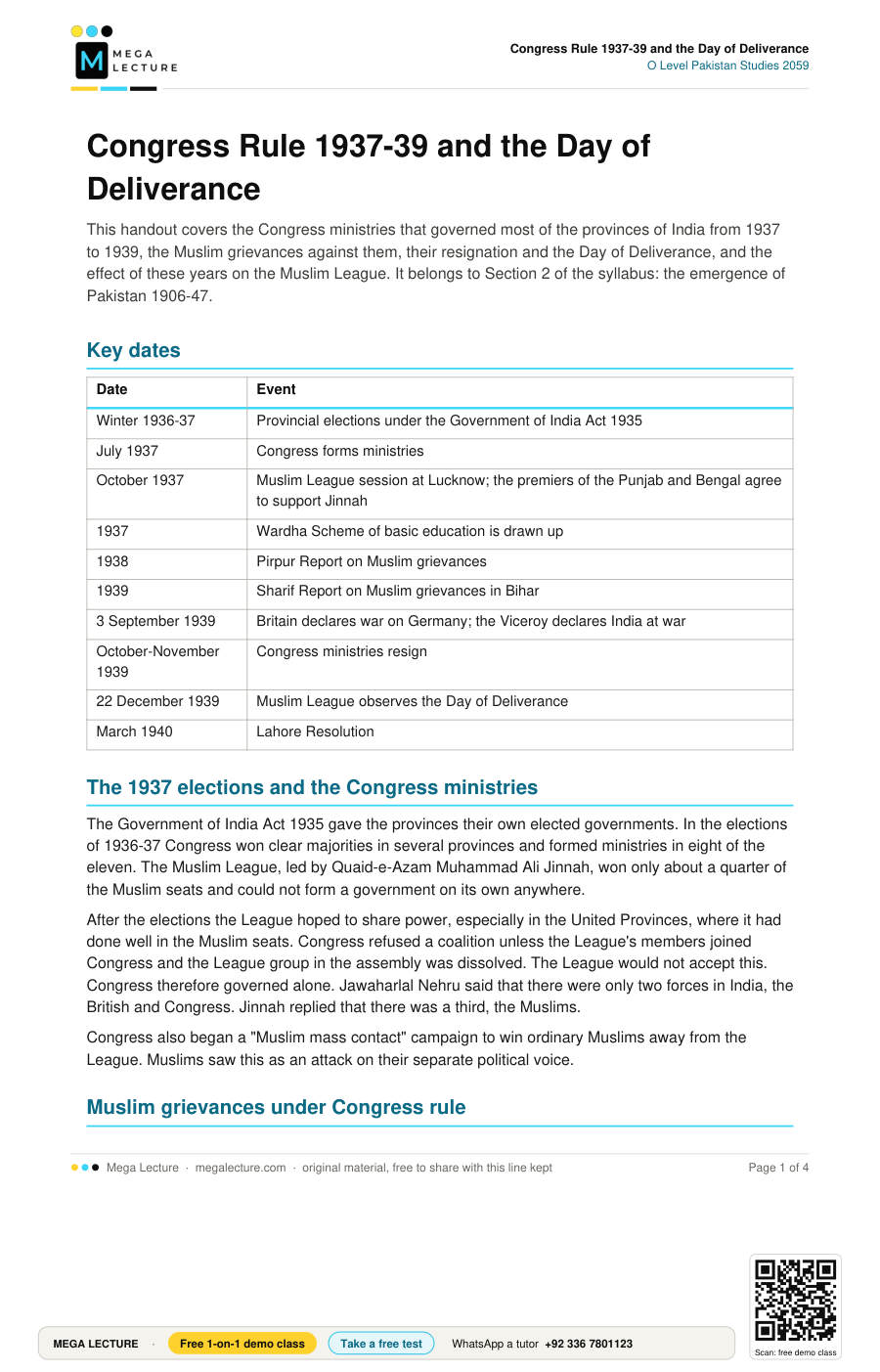
This handout covers the Congress ministries that governed most of the provinces of India from 1937 to 1939, the Muslim grievances against them, their resignation and the Day of Deliverance, and the effect of these years on the Muslim League. It belongs to Section 2 of the syllabus: the emergence of Pakistan 1906-47.
Key dates
| Date | Event |
|---|---|
| Winter 1936-37 | Provincial elections under the Government of India Act 1935 |
| July 1937 | Congress forms ministries |
| October 1937 | Muslim League session at Lucknow; the premiers of the Punjab and Bengal agree to support Jinnah |
| 1937 | Wardha Scheme of basic education is drawn up |
| 1938 | Pirpur Report on Muslim grievances |
| 1939 | Sharif Report on Muslim grievances in Bihar |
| 3 September 1939 | Britain declares war on Germany; the Viceroy declares India at war |
| October-November 1939 | Congress ministries resign |
| 22 December 1939 | Muslim League observes the Day of Deliverance |
| March 1940 | Lahore Resolution |
The 1937 elections and the Congress ministries
The Government of India Act 1935 gave the provinces their own elected governments. In the elections of 1936-37 Congress won clear majorities in several provinces and formed ministries in eight of the eleven. The Muslim League, led by Quaid-e-Azam Muhammad Ali Jinnah, won only about a quarter of the Muslim seats and could not form a government on its own anywhere.
After the elections the League hoped to share power, especially in the United Provinces, where it had done well in the Muslim seats. Congress refused a coalition unless the League's members joined Congress and the League group in the assembly was dissolved. The League would not accept this. Congress therefore governed alone. Jawaharlal Nehru said that there were only two forces in India, the British and Congress. Jinnah replied that there was a third, the Muslims.
Congress also began a "Muslim mass contact" campaign to win ordinary Muslims away from the League. Muslims saw this as an attack on their separate political voice.
Muslim grievances under Congress rule
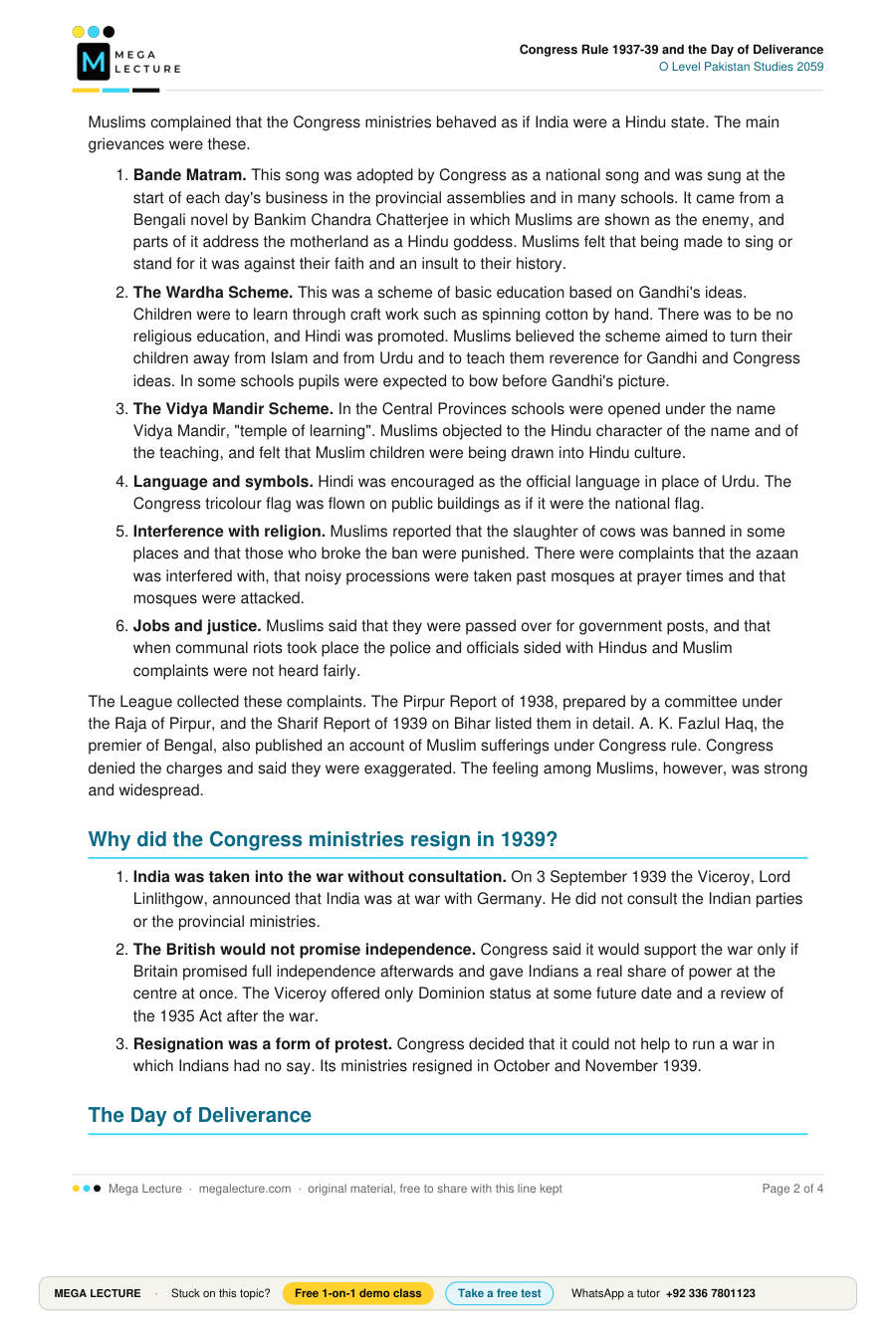
Muslims complained that the Congress ministries behaved as if India were a Hindu state. The main grievances were these.
- Bande Matram. This song was adopted by Congress as a national song and was sung at the start of each day's business in the provincial assemblies and in many schools. It came from a Bengali novel by Bankim Chandra Chatterjee in which Muslims are shown as the enemy, and parts of it address the motherland as a Hindu goddess. Muslims felt that being made to sing or stand for it was against their faith and an insult to their history.
- The Wardha Scheme. This was a scheme of basic education based on Gandhi's ideas. Children were to learn through craft work such as spinning cotton by hand. There was to be no religious education, and Hindi was promoted. Muslims believed the scheme aimed to turn their children away from Islam and from Urdu and to teach them reverence for Gandhi and Congress ideas. In some schools pupils were expected to bow before Gandhi's picture.
- The Vidya Mandir Scheme. In the Central Provinces schools were opened under the name Vidya Mandir, "temple of learning". Muslims objected to the Hindu character of the name and of the teaching, and felt that Muslim children were being drawn into Hindu culture.
- Language and symbols. Hindi was encouraged as the official language in place of Urdu. The Congress tricolour flag was flown on public buildings as if it were the national flag.
- Interference with religion. Muslims reported that the slaughter of cows was banned in some places and that those who broke the ban were punished. There were complaints that the azaan was interfered with, that noisy processions were taken past mosques at prayer times and that mosques were attacked.
- Jobs and justice. Muslims said that they were passed over for government posts, and that when communal riots took place the police and officials sided with Hindus and Muslim complaints were not heard fairly.
The League collected these complaints. The Pirpur Report of 1938, prepared by a committee under the Raja of Pirpur, and the Sharif Report of 1939 on Bihar listed them in detail. A. K. Fazlul Haq, the premier of Bengal, also published an account of Muslim sufferings under Congress rule. Congress denied the charges and said they were exaggerated. The feeling among Muslims, however, was strong and widespread.
Why did the Congress ministries resign in 1939?
- India was taken into the war without consultation. On 3 September 1939 the Viceroy, Lord Linlithgow, announced that India was at war with Germany. He did not consult the Indian parties or the provincial ministries.
- The British would not promise independence. Congress said it would support the war only if Britain promised full independence afterwards and gave Indians a real share of power at the centre at once. The Viceroy offered only Dominion status at some future date and a review of the 1935 Act after the war.
- Resignation was a form of protest. Congress decided that it could not help to run a war in which Indians had no say. Its ministries resigned in October and November 1939.
The Day of Deliverance
Jinnah asked Muslims to observe Friday 22 December 1939 as a "Day of Deliverance" and thanksgiving, to mark the end of Congress rule. Public meetings were held across India and prayers of thanks were offered. Jinnah asked that the day be marked peacefully.
Congress was offended. The day showed how wide the gap between the two parties had become.
The effect on the Muslim League
- Muslims united behind the League. The experience of Congress rule persuaded many Muslims who had voted for other parties in 1937 that only the League would defend them.
- The Lucknow session, October 1937. The premiers of the Punjab (Sir Sikandar Hayat Khan) and Bengal (A. K. Fazlul Haq) agreed to support Jinnah and the League in all-India matters. This gave the League a voice in the two largest Muslim-majority provinces.
- Membership and organisation grew. The League opened branches in the provinces, lowered its membership fee so that ordinary people could join, and won most of the by-elections for Muslim seats in the following years.
- The League's value to the British rose. After Congress resigned, the British needed Muslim support for the war. The Viceroy now treated Jinnah as the spokesman of the Muslims.
- The demand changed. Muslim leaders concluded that safeguards within a united India would not protect them under a permanent Congress majority. About three months after the Day of Deliverance the League passed the Lahore Resolution, asking for independent states in the Muslim-majority areas.
How important was Congress rule?
Why it mattered so much
- It was the first time Muslims lived under elected Hindu-majority governments, and it gave them direct experience of what majority rule could mean.
- The grievances touched religion, language and education.
- The refusal of coalitions showed that Congress would not share power with the League.
- It turned the League from a small party of the educated into a mass movement.
The other side
- Congress denied the charges, and some of the reports were written by the League itself for political use.
- Congress ministries also passed useful measures, for example to help peasants with debt and rent, and had Muslim members and some Muslim ministers.
- Other things also strengthened the League: Jinnah's leadership, the support of the Punjab and Bengal premiers, and the outbreak of war, which made the British turn to the League.
Judgement. Whether or not every complaint was accurate, most Muslims believed them, and that belief changed politics. Congress rule did more than any speech to convince Muslims that the two-nation idea was true in practice. Jinnah's leadership and the war then allowed the League to turn that feeling into the demand for a separate homeland.
Key terms and people
- Bande Matram: song adopted by Congress as a national song, from a novel hostile to Muslims.
- Wardha Scheme: Gandhi's plan of basic education through craft work, without religious teaching.
- Vidya Mandir Scheme: schools called "temples of learning" in the Central Provinces.
- Pirpur Report: the League's report of 1938 on Muslim grievances in Congress provinces.
- Day of Deliverance: 22 December 1939, observed by Muslims to mark the end of Congress rule.
Exam practice
- What was the Day of Deliverance? [4]
- Why did the Congress ministries resign in 1939? [7]
- "The singing of Bande Matram was the main reason why Muslims disliked Congress rule between 1937 and 1939." How far do you agree? Explain your answer. [14]
Outline answers
1. It was observed on 22 December 1939 at Jinnah's call. It marked the resignation of the Congress ministries. Muslims held meetings and offered prayers of thanksgiving for the end of Congress rule. Congress was offended, and it showed how far apart the two parties were.
2. (i) The Viceroy declared India at war in September 1939 without consulting Indian leaders or the elected ministries, which Congress took as proof that Indians had no real power. (ii) Congress asked for a promise of independence after the war and a share of power at the centre in return for its support, and the British offered only Dominion status at an unnamed date. (iii) Congress did not want to be responsible for running a war effort it had not agreed to, so resignation was its way of protesting and putting pressure on the British.
3. Agree: the song came from a novel hostile to Muslims, treated the motherland as a goddess, and was required in assemblies and schools, so it offended Muslim belief daily. Other reasons: the Wardha and Vidya Mandir schemes threatened the religious upbringing of Muslim children; Hindi was promoted over Urdu and the Congress flag flown; cow slaughter bans and interference with worship; unfair treatment in jobs and riots; refusal to share power with the League. Judgement: Bande Matram was a strong symbol, but the education schemes and the threat to religion and language affected Muslims' future more deeply, and it was all the grievances together that made Muslims feel like second-class citizens.
