
O Level · Pakistan Studies 2059 · Topic Notes (chronological)
The Montagu-Chelmsford Reforms 1919 (Government of India Act)
Opens inside this page. Prefer your own PDF app? Open the PDF.
New: small group classes for O Level Pakistan Studies are opening, at a lower fee than one-to-one. Join the waiting list
Check yourself
5 quick questions on The emergence of Pakistan: 1905 to 1939
Tap an answer to see if you are right, and why. Free, no sign-up.
Start the free test4 of 5 students found these notes useful
Was this note useful?
Full text of The Montagu-Chelmsford Reforms 1919 (Government of India Act)
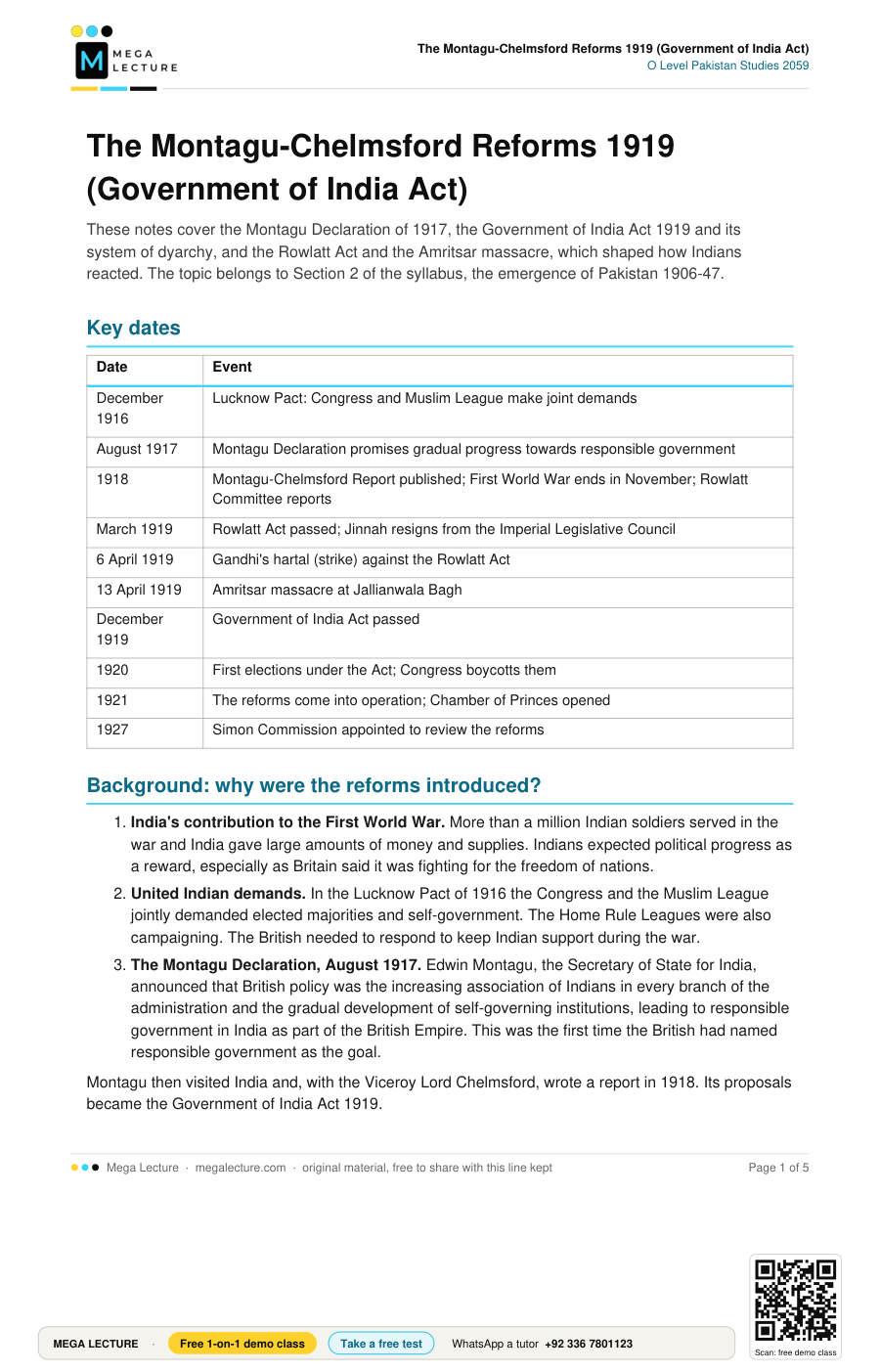
These notes cover the Montagu Declaration of 1917, the Government of India Act 1919 and its system of dyarchy, and the Rowlatt Act and the Amritsar massacre, which shaped how Indians reacted. The topic belongs to Section 2 of the syllabus, the emergence of Pakistan 1906-47.
Key dates
| Date | Event |
|---|---|
| December 1916 | Lucknow Pact: Congress and Muslim League make joint demands |
| August 1917 | Montagu Declaration promises gradual progress towards responsible government |
| 1918 | Montagu-Chelmsford Report published; First World War ends in November; Rowlatt Committee reports |
| March 1919 | Rowlatt Act passed; Jinnah resigns from the Imperial Legislative Council |
| 6 April 1919 | Gandhi's hartal (strike) against the Rowlatt Act |
| 13 April 1919 | Amritsar massacre at Jallianwala Bagh |
| December 1919 | Government of India Act passed |
| 1920 | First elections under the Act; Congress boycotts them |
| 1921 | The reforms come into operation; Chamber of Princes opened |
| 1927 | Simon Commission appointed to review the reforms |
Background: why were the reforms introduced?
- India's contribution to the First World War. More than a million Indian soldiers served in the war and India gave large amounts of money and supplies. Indians expected political progress as a reward, especially as Britain said it was fighting for the freedom of nations.
- United Indian demands. In the Lucknow Pact of 1916 the Congress and the Muslim League jointly demanded elected majorities and self-government. The Home Rule Leagues were also campaigning. The British needed to respond to keep Indian support during the war.
- The Montagu Declaration, August 1917. Edwin Montagu, the Secretary of State for India, announced that British policy was the increasing association of Indians in every branch of the administration and the gradual development of self-governing institutions, leading to responsible government in India as part of the British Empire. This was the first time the British had named responsible government as the goal.
Montagu then visited India and, with the Viceroy Lord Chelmsford, wrote a report in 1918. Its proposals became the Government of India Act 1919.
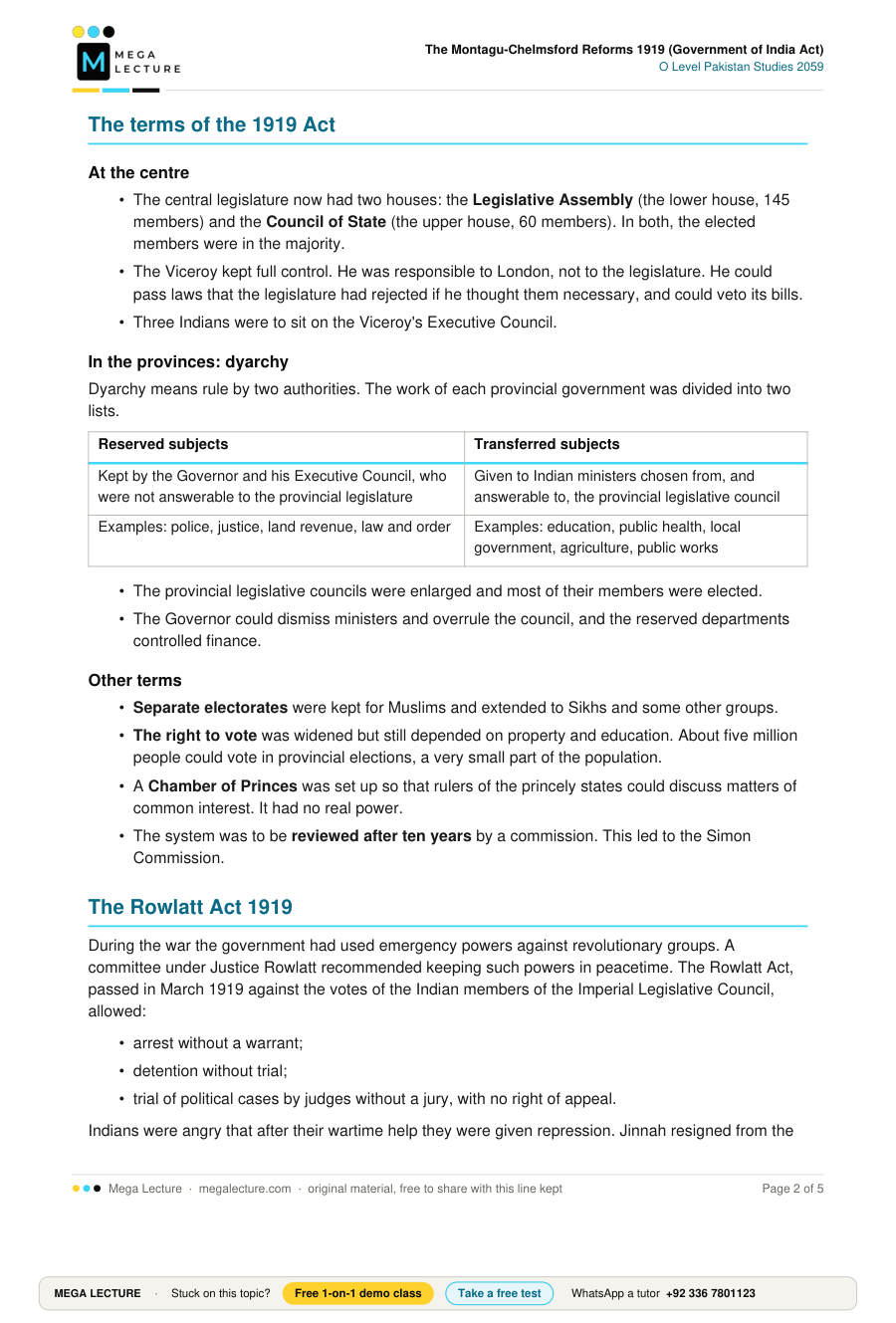
The terms of the 1919 Act
At the centre
- The central legislature now had two houses: the Legislative Assembly (the lower house, 145 members) and the Council of State (the upper house, 60 members). In both, the elected members were in the majority.
- The Viceroy kept full control. He was responsible to London, not to the legislature. He could pass laws that the legislature had rejected if he thought them necessary, and could veto its bills.
- Three Indians were to sit on the Viceroy's Executive Council.
In the provinces: dyarchy
Dyarchy means rule by two authorities. The work of each provincial government was divided into two lists.
| Reserved subjects | Transferred subjects |
|---|---|
| Kept by the Governor and his Executive Council, who were not answerable to the provincial legislature | Given to Indian ministers chosen from, and answerable to, the provincial legislative council |
| Examples: police, justice, land revenue, law and order | Examples: education, public health, local government, agriculture, public works |
- The provincial legislative councils were enlarged and most of their members were elected.
- The Governor could dismiss ministers and overrule the council, and the reserved departments controlled finance.
Other terms
- Separate electorates were kept for Muslims and extended to Sikhs and some other groups.
- The right to vote was widened but still depended on property and education. About five million people could vote in provincial elections, a very small part of the population.
- A Chamber of Princes was set up so that rulers of the princely states could discuss matters of common interest. It had no real power.
- The system was to be reviewed after ten years by a commission. This led to the Simon Commission.
The Rowlatt Act 1919
During the war the government had used emergency powers against revolutionary groups. A committee under Justice Rowlatt recommended keeping such powers in peacetime. The Rowlatt Act, passed in March 1919 against the votes of the Indian members of the Imperial Legislative Council, allowed:
- arrest without a warrant;
- detention without trial;
- trial of political cases by judges without a jury, with no right of appeal.
Indians were angry that after their wartime help they were given repression. Jinnah resigned from the Imperial Legislative Council in protest. Gandhi called for a hartal on 6 April 1919, and strikes and demonstrations took place in many cities.
The Amritsar massacre, April 1919
- In Amritsar two nationalist leaders, Dr Satyapal and Dr Saifuddin Kitchlew, were arrested on 10 April. Riots followed, in which banks were attacked and several Europeans were killed.
- General Dyer took command of the city and banned public meetings.
- On 13 April a large crowd gathered in Jallianwala Bagh, a walled open space with only a few narrow exits. Many had come to the city for the Baisakhi festival.
- Dyer brought troops to the entrance and ordered them to fire without warning. They fired for about ten minutes. The official figures gave 379 killed and about 1,200 wounded. Indian estimates were much higher.
- Martial law followed in Punjab, with public floggings and other humiliating punishments.
- The Hunter Committee inquired into the event. Dyer was removed from active service but was not otherwise punished, and many people in Britain praised him and collected money for him.
The massacre and the mild treatment of Dyer destroyed much of the remaining Indian trust in British rule. It had more effect on Indian opinion than the reforms themselves.
Indian reactions to the reforms
- They fell far short of expectations. Indians had asked for self-government. Instead the Viceroy and Governors kept the power to overrule the legislatures, and the centre stayed entirely under British control. The Congress condemned the proposals as disappointing and unsatisfactory, and the Muslim League was also critical.
- Dyarchy gave responsibility without power. Indian ministers ran departments such as education and health but had little money, because finance was a reserved subject. Important subjects such as the police stayed in British hands.
- Few could vote. The great majority of Indians had no vote.
- The events of 1919. The Rowlatt Act and Amritsar made the reforms look insincere. The Congress, under Gandhi's leadership, turned to non-cooperation and boycotted the 1920 elections.
- Separate electorates. Muslims were satisfied that these were kept. The Congress, which had accepted them in 1916, did not object at the time, but many of its members continued to dislike them.
How successful were the Montagu-Chelmsford Reforms?
Successes
- Responsible government was accepted as the aim of British policy for the first time.
- Indian ministers ran some provincial departments, and Indians gained experience of government and of elections.
- Both houses of the central legislature had elected majorities, and many more people could vote than in 1909.
- Separate electorates were kept, which protected Muslim representation.
Failures
- Real power stayed with the Viceroy and the Governors.
- Dyarchy was awkward to work and was resented by Indian politicians.
- The reforms did not satisfy either major party and did not win Indian cooperation.
- They were overshadowed by the Rowlatt Act and the Amritsar massacre, which turned many moderate Indians against British rule.
Judgement. The reforms were a real constitutional advance compared with 1909, but they failed in their political purpose. They were meant to reward India and keep its loyalty. Because they offered limited power and came in the same year as the Rowlatt Act and Amritsar, they were followed by the largest protest movement British India had yet seen.
Key terms and people
- Edwin Montagu: Secretary of State for India.
- Lord Chelmsford: Viceroy of India 1916-21.
- Dyarchy: the division of provincial government into reserved and transferred subjects.
- Responsible government: government by ministers who answer to an elected legislature.
- Rowlatt Act: the 1919 law allowing arrest without warrant and detention without trial.
- General Dyer: the officer who ordered the firing at Jallianwala Bagh.
- Hunter Committee: the official inquiry into the Punjab disturbances.
- Hartal: a general strike and closure of shops as a protest.
Exam practice
- What was dyarchy? [4]
- Why were the Montagu-Chelmsford Reforms opposed by Indians? [7]
- "The Amritsar massacre was the main reason why British rule became unpopular in India between 1917 and 1920." How far do you agree? Explain your answer. [14]
Question 1: a system introduced in the provinces by the 1919 Act; subjects were divided into two lists; reserved subjects such as police, justice and revenue stayed with the Governor and his council; transferred subjects such as education, health and local government went to Indian ministers answerable to the provincial council; the Governor could overrule ministers.
Question 2: (1) Indians expected self-government after their help in the war, but the Viceroy and Governors kept power to overrule the legislatures. (2) Dyarchy gave Indian ministers the less important subjects and little money, while the British kept police and finance. (3) Only a small part of the population could vote, and the Rowlatt Act and Amritsar in the same year convinced Indians that the British did not intend real change.
Question 3: Agree: the firing on an unarmed crowd, the number of dead, martial law in Punjab and the support for Dyer in Britain shocked all communities and led directly to non-cooperation. Other reasons: the Rowlatt Act removed basic legal rights; the 1919 reforms disappointed hopes raised by the war and the Montagu Declaration; the treatment of Turkey angered Muslims. Judgement: the reforms and the Rowlatt Act caused discontent, but Amritsar turned discontent into a loss of trust, so it can be judged the most important single reason.
