
O Level · Pakistan Studies 2059 · Topic Notes (chronological)
The Morley-Minto Reforms 1909 (Indian Councils Act)
Opens inside this page. Prefer your own PDF app? Open the PDF.
New: small group classes for O Level Pakistan Studies are opening, at a lower fee than one-to-one. Join the waiting list
Check yourself
5 quick questions on The emergence of Pakistan: 1905 to 1939
Tap an answer to see if you are right, and why. Free, no sign-up.
Start the free test4 of 5 students found these notes useful
Was this note useful?
Full text of The Morley-Minto Reforms 1909 (Indian Councils Act)
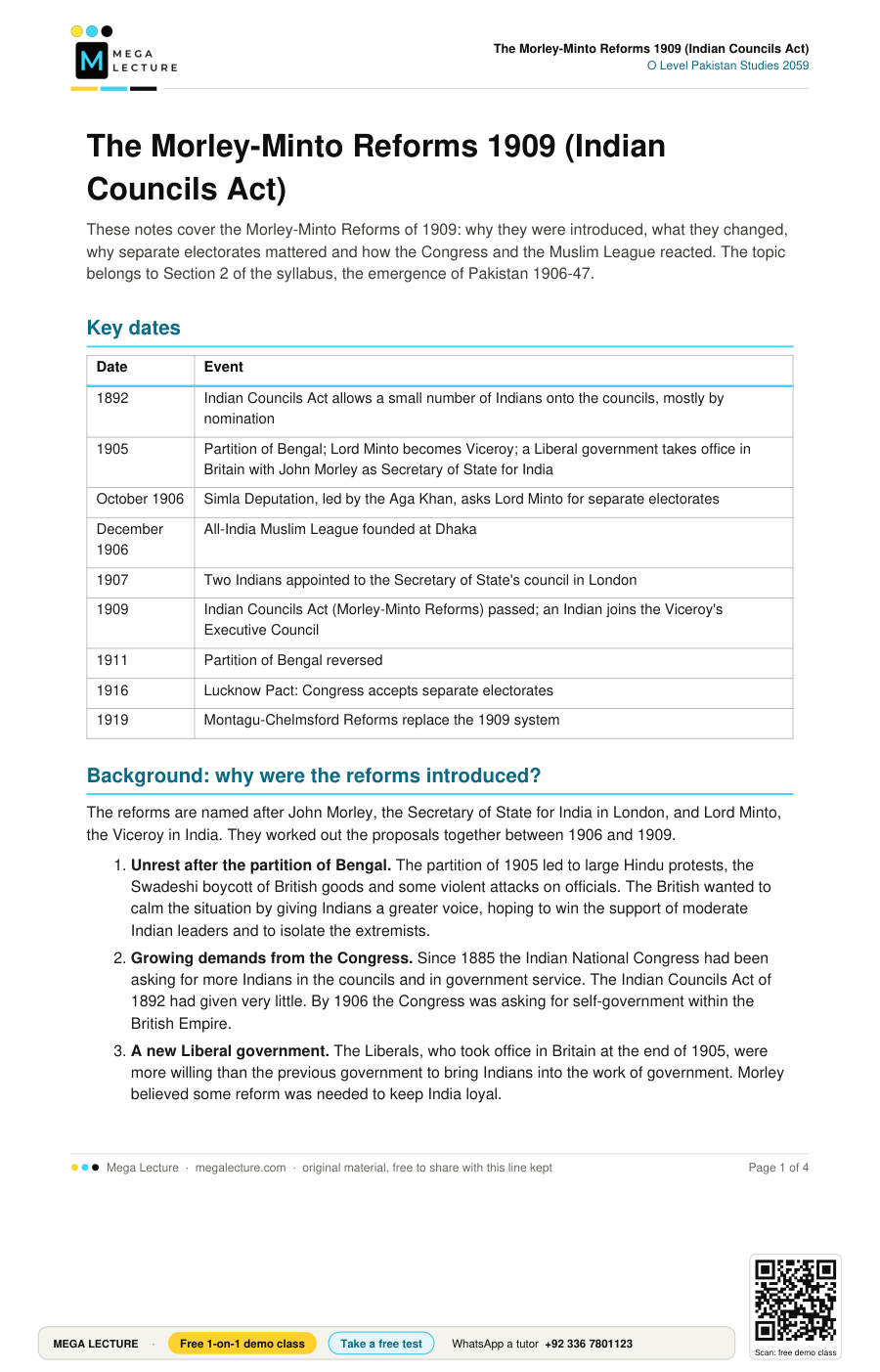
These notes cover the Morley-Minto Reforms of 1909: why they were introduced, what they changed, why separate electorates mattered and how the Congress and the Muslim League reacted. The topic belongs to Section 2 of the syllabus, the emergence of Pakistan 1906-47.
Key dates
| Date | Event |
|---|---|
| 1892 | Indian Councils Act allows a small number of Indians onto the councils, mostly by nomination |
| 1905 | Partition of Bengal; Lord Minto becomes Viceroy; a Liberal government takes office in Britain with John Morley as Secretary of State for India |
| October 1906 | Simla Deputation, led by the Aga Khan, asks Lord Minto for separate electorates |
| December 1906 | All-India Muslim League founded at Dhaka |
| 1907 | Two Indians appointed to the Secretary of State's council in London |
| 1909 | Indian Councils Act (Morley-Minto Reforms) passed; an Indian joins the Viceroy's Executive Council |
| 1911 | Partition of Bengal reversed |
| 1916 | Lucknow Pact: Congress accepts separate electorates |
| 1919 | Montagu-Chelmsford Reforms replace the 1909 system |
Background: why were the reforms introduced?
The reforms are named after John Morley, the Secretary of State for India in London, and Lord Minto, the Viceroy in India. They worked out the proposals together between 1906 and 1909.
- Unrest after the partition of Bengal. The partition of 1905 led to large Hindu protests, the Swadeshi boycott of British goods and some violent attacks on officials. The British wanted to calm the situation by giving Indians a greater voice, hoping to win the support of moderate Indian leaders and to isolate the extremists.
- Growing demands from the Congress. Since 1885 the Indian National Congress had been asking for more Indians in the councils and in government service. The Indian Councils Act of 1892 had given very little. By 1906 the Congress was asking for self-government within the British Empire.
- A new Liberal government. The Liberals, who took office in Britain at the end of 1905, were more willing than the previous government to bring Indians into the work of government. Morley believed some reform was needed to keep India loyal.
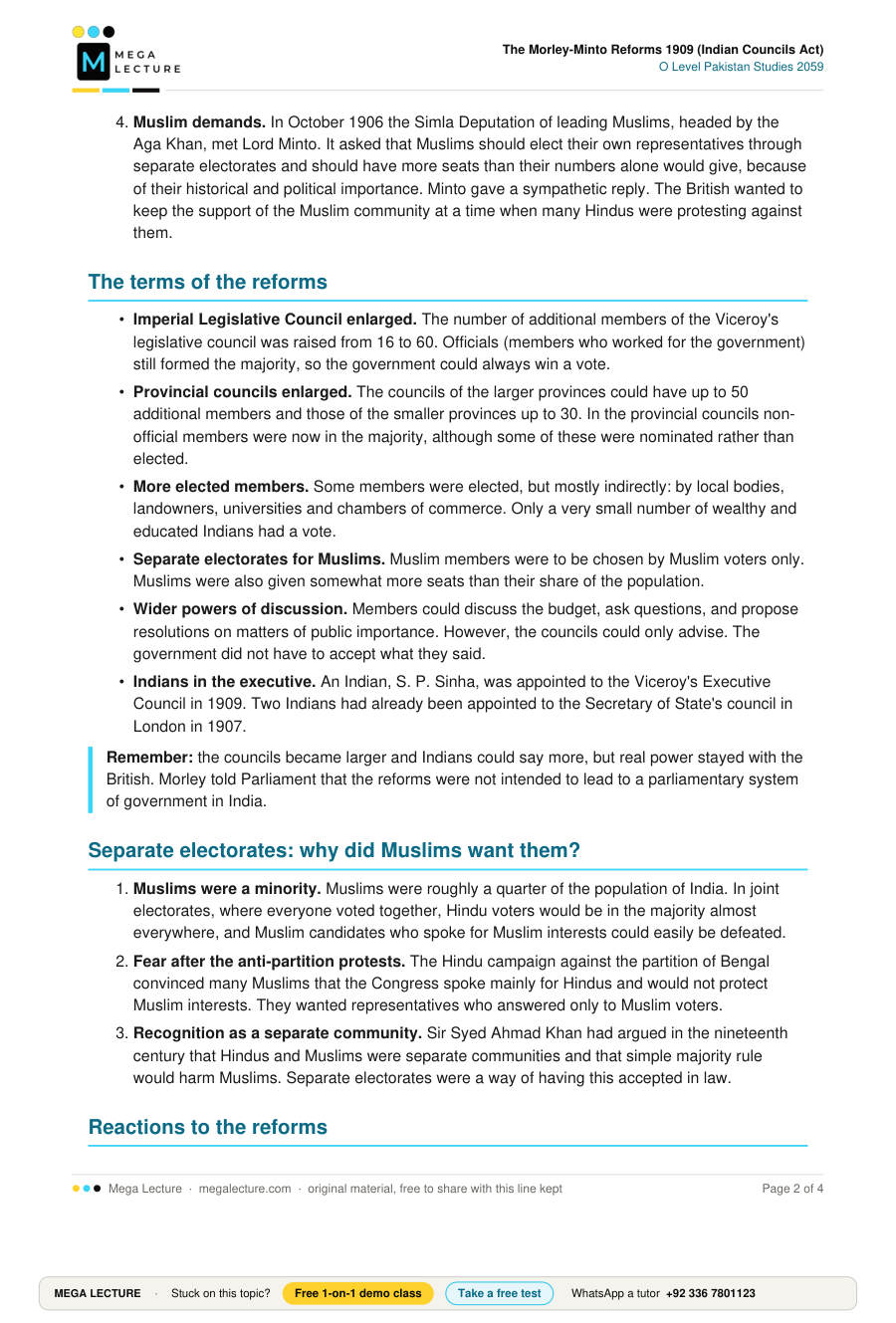
- Muslim demands. In October 1906 the Simla Deputation of leading Muslims, headed by the Aga Khan, met Lord Minto. It asked that Muslims should elect their own representatives through separate electorates and should have more seats than their numbers alone would give, because of their historical and political importance. Minto gave a sympathetic reply. The British wanted to keep the support of the Muslim community at a time when many Hindus were protesting against them.
The terms of the reforms
- Imperial Legislative Council enlarged. The number of additional members of the Viceroy's legislative council was raised from 16 to 60. Officials (members who worked for the government) still formed the majority, so the government could always win a vote.
- Provincial councils enlarged. The councils of the larger provinces could have up to 50 additional members and those of the smaller provinces up to 30. In the provincial councils non-official members were now in the majority, although some of these were nominated rather than elected.
- More elected members. Some members were elected, but mostly indirectly: by local bodies, landowners, universities and chambers of commerce. Only a very small number of wealthy and educated Indians had a vote.
- Separate electorates for Muslims. Muslim members were to be chosen by Muslim voters only. Muslims were also given somewhat more seats than their share of the population.
- Wider powers of discussion. Members could discuss the budget, ask questions, and propose resolutions on matters of public importance. However, the councils could only advise. The government did not have to accept what they said.
- Indians in the executive. An Indian, S. P. Sinha, was appointed to the Viceroy's Executive Council in 1909. Two Indians had already been appointed to the Secretary of State's council in London in 1907.
Separate electorates: why did Muslims want them?
- Muslims were a minority. Muslims were roughly a quarter of the population of India. In joint electorates, where everyone voted together, Hindu voters would be in the majority almost everywhere, and Muslim candidates who spoke for Muslim interests could easily be defeated.
- Fear after the anti-partition protests. The Hindu campaign against the partition of Bengal convinced many Muslims that the Congress spoke mainly for Hindus and would not protect Muslim interests. They wanted representatives who answered only to Muslim voters.
- Recognition as a separate community. Sir Syed Ahmad Khan had argued in the nineteenth century that Hindus and Muslims were separate communities and that simple majority rule would harm Muslims. Separate electorates were a way of having this accepted in law.
Reactions to the reforms
The Congress
- The Congress was disappointed because the reforms did not bring self-government. The councils were advisory, officials kept their majority at the centre and the Viceroy could ignore any resolution.
- It objected that very few Indians could vote and that most elections were indirect.
- It strongly opposed separate electorates. Congress leaders said they were undemocratic and that they divided Indians on religious lines. Some saw them as a British policy of "divide and rule". The Congress also objected that Muslims received more seats than their share of the population.
- Moderate leaders such as G. K. Gokhale were willing to work in the new councils, but more radical leaders rejected the reforms as far too limited.
The Muslim League
- The Muslim League welcomed the reforms. Its main demand, separate electorates, had been granted within three years of its foundation.
- Muslims now had a guaranteed number of their own representatives in the councils.
- The League was therefore encouraged to continue its policy of loyalty to the British, at least until the partition of Bengal was reversed in 1911.
How important were the Morley-Minto Reforms?
Reasons for seeing them as important
- For the first time the British accepted in law that Muslims were a separate political community. Separate electorates remained part of every later constitutional scheme until 1947 and helped the idea of a separate Muslim identity to grow.
- The Muslim League gained confidence and standing. It had shown it could win concessions for Muslims.
- More Indians gained experience of council work, of debating budgets and of questioning the government. This was a step, however small, towards representative government.
- An Indian sat in the Viceroy's Executive Council for the first time.
Reasons for seeing them as limited
- The councils had no real power. They could advise and criticise but could not change government policy.
- The vote was limited to a very small, wealthy group, so the councils did not represent ordinary Indians.
- The reforms increased the distance between the Congress and the Muslim League, because the Congress resented separate electorates.
- They did not satisfy Indian demands. Within ten years the British had to offer further reforms in 1919.
Judgement. As a step towards self-government the reforms were small, because the British kept all real power. Their lasting importance lies in separate electorates. By accepting that Muslims should choose their own representatives, the British gave the Muslim League a firm political base, and the Congress itself accepted the principle in the Lucknow Pact of 1916. For the history of the Pakistan Movement, this was the most significant result of 1909.
Key terms and people
- John Morley: Secretary of State for India in the Liberal government.
- Lord Minto: Viceroy of India 1905-10.
- Imperial Legislative Council: the central law-making council that advised the Viceroy.
- Official member: a council member who was a government officer and voted with the government.
- Separate electorates: a system in which Muslim voters alone elect the Muslim members.
- Joint electorates: a system in which all voters in an area vote together for the same candidates.
- Simla Deputation: the group of Muslim leaders, led by the Aga Khan, who met Lord Minto in October 1906.
- S. P. Sinha: the first Indian member of the Viceroy's Executive Council.
Exam practice
- Describe the terms of the Morley-Minto Reforms of 1909. [4]
- Why did the Congress oppose the Morley-Minto Reforms? [7]
- "The grant of separate electorates was the most important result of the Morley-Minto Reforms." How far do you agree? Explain your answer. [14]
Question 1: the Imperial Legislative Council was enlarged, with 60 additional members; provincial councils were enlarged to up to 50 additional members in large provinces and 30 in small ones; members could discuss the budget, ask questions and move resolutions, but only as advice; Muslims were given separate electorates; an Indian was appointed to the Viceroy's Executive Council.
Question 2: (1) The reforms gave no real power: the councils were advisory and officials kept the majority at the centre, while the Congress wanted self-government. (2) Separate electorates were seen as undemocratic and as dividing Indians by religion, and Muslims received more seats than their numbers. (3) Very few Indians could vote and most elections were indirect, so the councils did not represent the people.
Question 3: Agree: separate electorates recognised Muslims as a separate community, gave the Muslim League its first success, stayed in every later scheme and were accepted by the Congress in 1916. Other results: larger councils and experience of debate; an Indian in the Executive Council; Congress disappointment and wider distance between the two parties; the limits of the reforms led to new demands and the 1919 reforms. Judgement: the other changes were small and soon replaced, while separate electorates had long-term effects, so the statement is largely correct.
