
O Level · Pakistan Studies 2059 · Topic Notes (chronological)
The Khilafat Movement 1919-24
Opens inside this page. Prefer your own PDF app? Open the PDF.
New: small group classes for O Level Pakistan Studies are opening, at a lower fee than one-to-one. Join the waiting list
Check yourself
5 quick questions on The emergence of Pakistan: 1905 to 1939
Tap an answer to see if you are right, and why. Free, no sign-up.
Start the free test4 of 5 students found these notes useful
Was this note useful?
Full text of The Khilafat Movement 1919-24
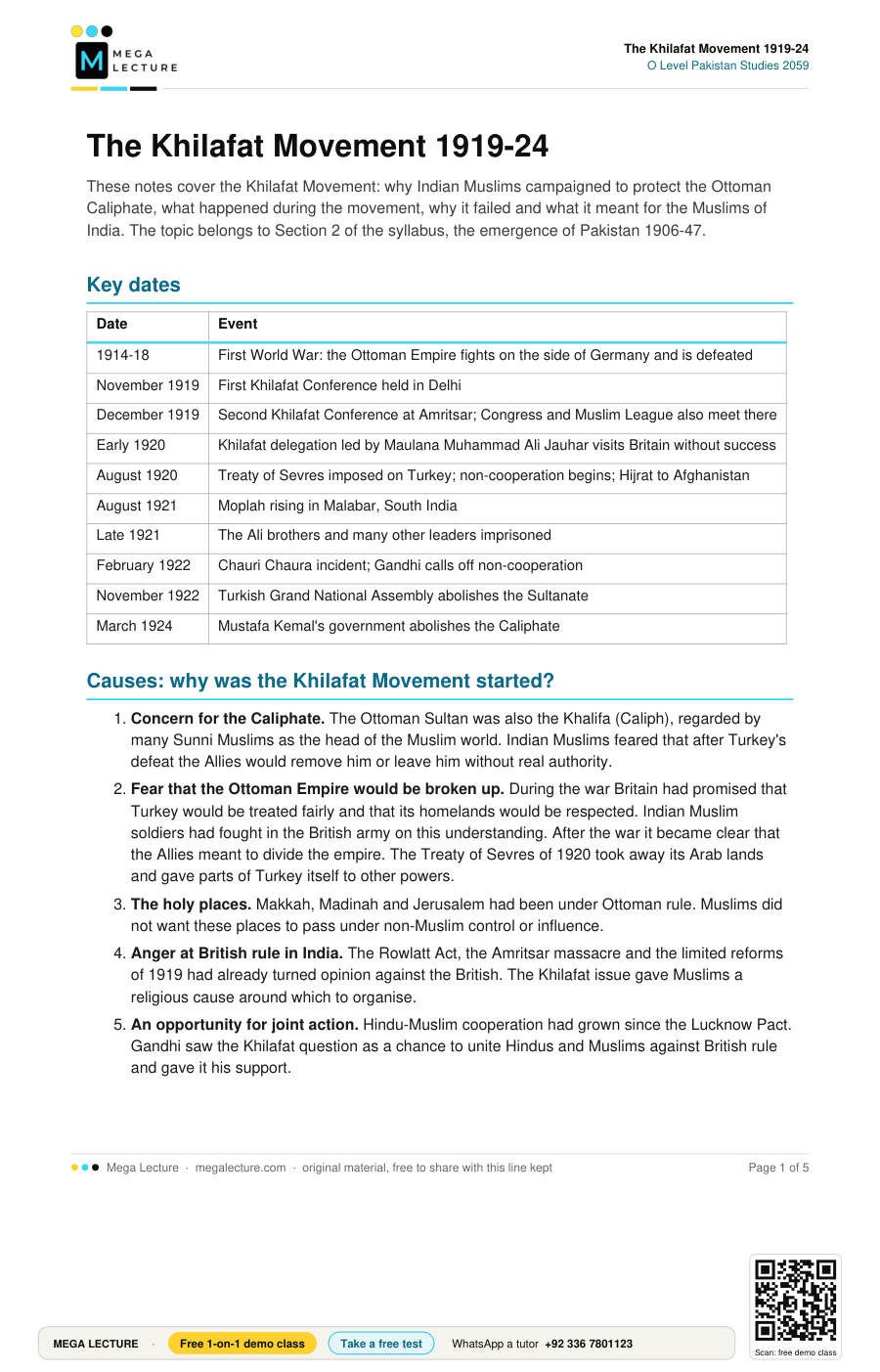
These notes cover the Khilafat Movement: why Indian Muslims campaigned to protect the Ottoman Caliphate, what happened during the movement, why it failed and what it meant for the Muslims of India. The topic belongs to Section 2 of the syllabus, the emergence of Pakistan 1906-47.
Key dates
| Date | Event |
|---|---|
| 1914-18 | First World War: the Ottoman Empire fights on the side of Germany and is defeated |
| November 1919 | First Khilafat Conference held in Delhi |
| December 1919 | Second Khilafat Conference at Amritsar; Congress and Muslim League also meet there |
| Early 1920 | Khilafat delegation led by Maulana Muhammad Ali Jauhar visits Britain without success |
| August 1920 | Treaty of Sevres imposed on Turkey; non-cooperation begins; Hijrat to Afghanistan |
| August 1921 | Moplah rising in Malabar, South India |
| Late 1921 | The Ali brothers and many other leaders imprisoned |
| February 1922 | Chauri Chaura incident; Gandhi calls off non-cooperation |
| November 1922 | Turkish Grand National Assembly abolishes the Sultanate |
| March 1924 | Mustafa Kemal's government abolishes the Caliphate |
Causes: why was the Khilafat Movement started?
- Concern for the Caliphate. The Ottoman Sultan was also the Khalifa (Caliph), regarded by many Sunni Muslims as the head of the Muslim world. Indian Muslims feared that after Turkey's defeat the Allies would remove him or leave him without real authority.
- Fear that the Ottoman Empire would be broken up. During the war Britain had promised that Turkey would be treated fairly and that its homelands would be respected. Indian Muslim soldiers had fought in the British army on this understanding. After the war it became clear that the Allies meant to divide the empire. The Treaty of Sevres of 1920 took away its Arab lands and gave parts of Turkey itself to other powers.
- The holy places. Makkah, Madinah and Jerusalem had been under Ottoman rule. Muslims did not want these places to pass under non-Muslim control or influence.
- Anger at British rule in India. The Rowlatt Act, the Amritsar massacre and the limited reforms of 1919 had already turned opinion against the British. The Khilafat issue gave Muslims a religious cause around which to organise.
- An opportunity for joint action. Hindu-Muslim cooperation had grown since the Lucknow Pact. Gandhi saw the Khilafat question as a chance to unite Hindus and Muslims against British rule and gave it his support.
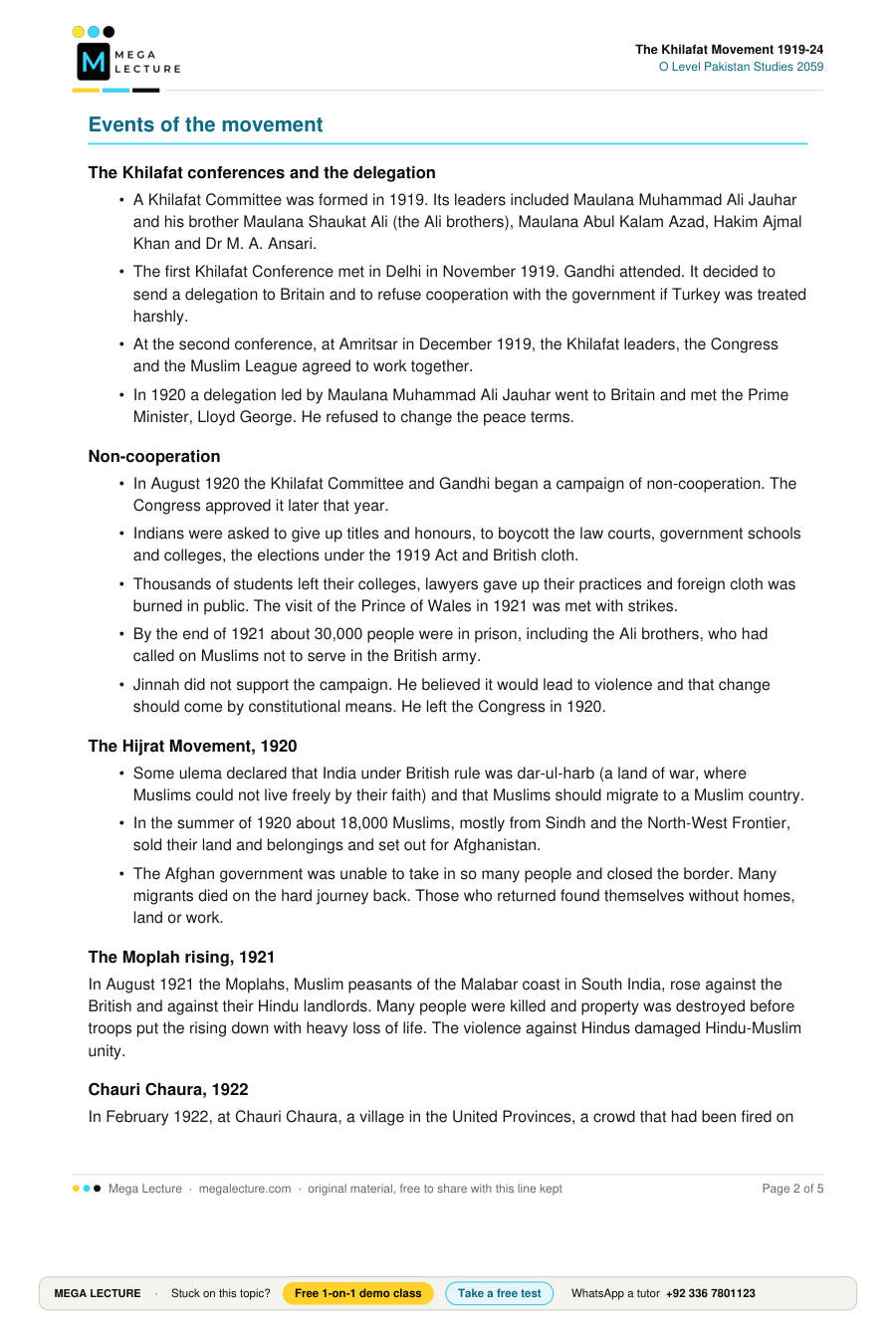
Events of the movement
The Khilafat conferences and the delegation
- A Khilafat Committee was formed in 1919. Its leaders included Maulana Muhammad Ali Jauhar and his brother Maulana Shaukat Ali (the Ali brothers), Maulana Abul Kalam Azad, Hakim Ajmal Khan and Dr M. A. Ansari.
- The first Khilafat Conference met in Delhi in November 1919. Gandhi attended. It decided to send a delegation to Britain and to refuse cooperation with the government if Turkey was treated harshly.
- At the second conference, at Amritsar in December 1919, the Khilafat leaders, the Congress and the Muslim League agreed to work together.
- In 1920 a delegation led by Maulana Muhammad Ali Jauhar went to Britain and met the Prime Minister, Lloyd George. He refused to change the peace terms.
Non-cooperation
- In August 1920 the Khilafat Committee and Gandhi began a campaign of non-cooperation. The Congress approved it later that year.
- Indians were asked to give up titles and honours, to boycott the law courts, government schools and colleges, the elections under the 1919 Act and British cloth.
- Thousands of students left their colleges, lawyers gave up their practices and foreign cloth was burned in public. The visit of the Prince of Wales in 1921 was met with strikes.
- By the end of 1921 about 30,000 people were in prison, including the Ali brothers, who had called on Muslims not to serve in the British army.
- Jinnah did not support the campaign. He believed it would lead to violence and that change should come by constitutional means. He left the Congress in 1920.
The Hijrat Movement, 1920
- Some ulema declared that India under British rule was dar-ul-harb (a land of war, where Muslims could not live freely by their faith) and that Muslims should migrate to a Muslim country.
- In the summer of 1920 about 18,000 Muslims, mostly from Sindh and the North-West Frontier, sold their land and belongings and set out for Afghanistan.
- The Afghan government was unable to take in so many people and closed the border. Many migrants died on the hard journey back. Those who returned found themselves without homes, land or work.
The Moplah rising, 1921
In August 1921 the Moplahs, Muslim peasants of the Malabar coast in South India, rose against the British and against their Hindu landlords. Many people were killed and property was destroyed before troops put the rising down with heavy loss of life. The violence against Hindus damaged Hindu-Muslim unity.
Chauri Chaura, 1922
In February 1922, at Chauri Chaura, a village in the United Provinces, a crowd that had been fired on by police set the police station alight. More than twenty policemen died. Gandhi, who insisted on non-violence, called off the non-cooperation campaign without consulting the Khilafat leaders. He was arrested soon afterwards.
The end of the Caliphate
In Turkey, Mustafa Kemal (later called Ataturk) led a nationalist movement that drove out foreign forces and set up a new government. In November 1922 the Sultanate was abolished, and in March 1924 the Caliphate itself was abolished. The cause for which Indian Muslims had campaigned no longer existed.
Why did the Khilafat Movement fail?
- Gandhi's decision to call off non-cooperation. After Chauri Chaura the mass campaign stopped suddenly. Muslims felt let down, since they had not been consulted. The movement lost its main form of pressure on the British at a time when most of its leaders were in prison.
- The actions of the Turks themselves. The Turks abolished the Caliphate in 1924. Indian Muslims could not defend an institution that Turkey no longer wanted.
- The failure of the Hijrat. The migration brought great suffering and loss to thousands of families and weakened support for the movement.
- The loss of Hindu-Muslim unity. The two communities had different aims: Muslims wanted to protect the Caliphate, while the Congress wanted self-rule. The Moplah rising and later riots broke the alliance.
- British firmness. The British refused to change their policy on Turkey and imprisoned the leaders, leaving the movement without direction.
- Weak planning. The boycott of schools, courts and jobs harmed Muslims more than it harmed the government, and no alternatives were provided for those who gave up their studies or work.
How important was the Khilafat Movement for Muslims?
Ways in which it was important
- It was the first mass political movement of Indian Muslims. Ordinary people, not only the educated classes, took part, and Muslims learned how to organise meetings, funds and protests across India.
- It showed that Muslims could unite for a common cause and produced leaders with wide popular support.
- Muslims learned that they could not depend on the British, who ignored their feelings, or on the Congress, since Gandhi ended the campaign on his own decision. Many concluded that Muslims must rely on their own organisation to protect their interests.
- The ulema entered politics and political awareness spread to towns and villages.
Ways in which it harmed Muslims
- It failed in its aim. The Caliphate was abolished.
- Many Muslims lost their education, jobs and property through the boycotts and the Hijrat.
- Hindu-Muslim relations became worse. Communal riots were frequent in the 1920s and Hindu movements such as Shuddhi and Sangathan added to the tension.
- The Muslim League was pushed into the background for some years and Muslim politics was left divided.
Judgement. The movement failed in its stated aim and brought real hardship. Its importance lies in what Muslims learned from it. They gained experience of mass politics, and the end of the alliance with the Congress strengthened the belief that Muslims were a separate community that had to organise for itself. This belief later became the basis of the Pakistan Movement.
Key terms and people
- Khalifa (Caliph): regarded by many Sunni Muslims as the head of the Muslim world; the title was held by the Ottoman Sultan.
- Maulana Muhammad Ali Jauhar and Maulana Shaukat Ali: the Ali brothers, the best-known Khilafat leaders.
- Maulana Abul Kalam Azad: scholar and Khilafat leader, later a Congress leader.
- Non-cooperation: refusing to work with the government by boycotting its courts, schools, councils and goods.
- Hijrat: migration for the sake of religion; in 1920, the migration to Afghanistan.
- Treaty of Sevres: the 1920 peace treaty that broke up the Ottoman Empire.
- Mustafa Kemal Ataturk: founder of modern Turkey, whose government abolished the Caliphate.
Exam practice
- Describe the Hijrat Movement. [4]
- Why was the Khilafat Movement started? [7]
- "The Khilafat Movement failed mainly because Gandhi withdrew his support." How far do you agree? Explain your answer. [14]
Question 1: in 1920 some ulema declared India dar-ul-harb and urged Muslims to migrate; about 18,000 people, mainly from Sindh and the North-West Frontier, sold their property and left for Afghanistan; the Afghan government closed the border and sent them back; many died on the journey and the rest returned to find their homes and work gone.
Question 2: (1) Muslims wanted to protect the Caliph, the Ottoman Sultan, whose position was in danger after Turkey's defeat. (2) They feared the Ottoman Empire would be divided, against wartime British promises, and that the holy places would fall under non-Muslim control; the Treaty of Sevres confirmed this. (3) Anger at the Rowlatt Act and Amritsar, and Gandhi's support, made it a chance for Hindus and Muslims to act together against British rule.
Question 3: Agree: after Chauri Chaura Gandhi ended non-cooperation without consulting Muslim leaders, removing mass pressure while the leaders were in prison. Other reasons: the Turks abolished the Caliphate in 1924; the Hijrat failed; the Moplah rising and riots ended Hindu-Muslim unity; the British stood firm; the boycotts were poorly planned. Judgement: Gandhi's decision ended the campaign in India, but the movement could not have succeeded once Turkey itself abolished the Caliphate, so that was the deeper reason for failure.
