
O Level · Pakistan Studies 2059 · Topic Notes (chronological)
Sir Syed Ahmad Khan and the Aligarh Movement
Opens inside this page. Prefer your own PDF app? Open the PDF.
Check yourself
5 quick questions on Cultural and historical background to the Pakistan Movement: 1857, Sir Syed Ahmad Khan and languages
Tap an answer to see if you are right, and why. Free, no sign-up.
Start the free test👍 70 students found these notes useful
Was this note useful?
Full text of Sir Syed Ahmad Khan and the Aligarh Movement
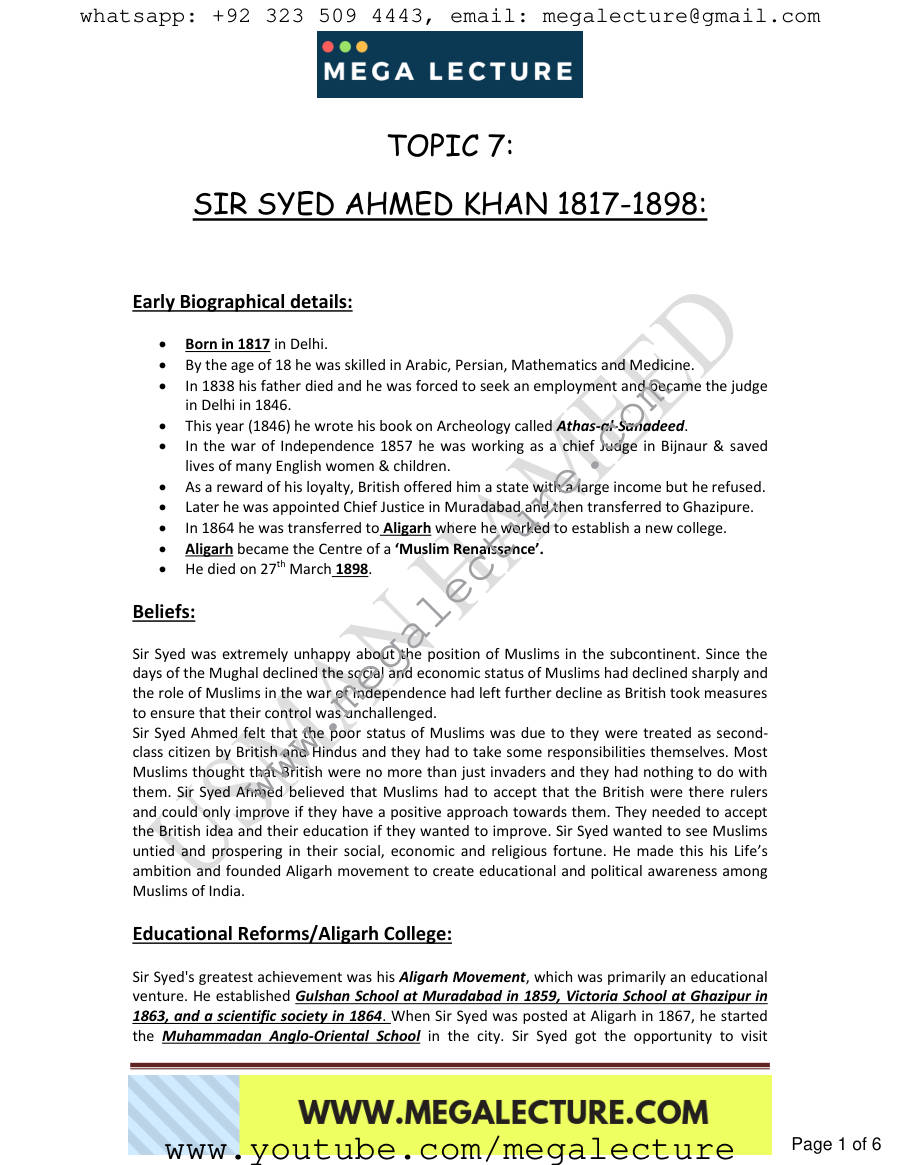
This handout covers the work of Sir Syed Ahmad Khan: his attempts to improve relations between Muslims and the British, his educational work at Aligarh and his political ideas. It belongs to Section 1 of the syllabus: the cultural and historical background to the Pakistan Movement.
Key dates
| Date | Event |
|---|---|
| 1817 | Sir Syed Ahmad Khan is born in Delhi |
| 1857 | During the War of Independence he stays loyal to the British and protects British lives at Bijnor |
| 1859 | Opens a school at Moradabad; writes "The Causes of the Indian Revolt" |
| 1860 | Writes "The Loyal Mohammedans of India" |
| 1863 | Founds the Scientific Society at Ghazipur (moved to Aligarh in 1864) |
| 1867 | The Hindi-Urdu controversy begins at Benares |
| 1869-70 | Visits England and studies the universities of Oxford and Cambridge |
| 1875 | Opens the Mohammedan Anglo-Oriental (MAO) School at Aligarh |
| 1877 | The school becomes the MAO College |
| 1885 | The Indian National Congress is founded; Sir Syed advises Muslims not to join |
| 1886 | Sets up the Mohammedan Educational Conference |
| 1898 | Sir Syed dies at Aligarh |
Background: the position of Muslims after 1857
After the War of Independence the British blamed the Muslims more than any other community. Muslims lost land, jobs and influence. Many Muslims in turn distrusted the British and refused to learn English or attend British-style schools, because they believed that Western education would harm their faith. Meanwhile the Hindu community accepted the new education and moved ahead.
Sir Syed Ahmad Khan had worked for the East India Company (EIC) in its law courts since 1838. He believed that Muslims would stay poor and powerless unless two things changed: the British had to stop seeing Muslims as enemies, and Muslims had to accept modern education. His work to bring about these changes is known as the Aligarh Movement.
Improving relations with the British
Sir Syed worked in two directions. He tried to change the British view of Muslims, and he tried to change the Muslim view of the British.
Convincing the British
- "The Causes of the Indian Revolt" (1859). In this pamphlet he argued that the main causes of 1857 were British mistakes. The government had no Indians in its councils and did not understand the people. It had allowed missionary activity that frightened people and had managed the army badly. It showed that Muslims alone were not to blame.
- "The Loyal Mohammedans of India" (1860). Here he gave examples of Muslims who had stayed loyal and had helped the British during the fighting. He wanted to correct the idea that all Muslims were rebels.
- Explaining the word "Nasara". Some British people were offended that Muslims called Christians "Nasara". Sir Syed explained that the word comes from an Arabic word meaning helper and was not an insult.
Convincing the Muslims
- Showing what the two faiths share. He wrote a commentary on the Bible, the "Tabyin-ul-Kalam", in which he pointed out the similarities between Islam and Christianity.
- Defending Islam with reasoned argument. When Sir William Muir wrote a critical life of the Holy Prophet (peace be upon him), Sir Syed answered with his own "Essays on the Life of Muhammad".
- Urging cooperation. He argued that British rule was a fact that would last, so Muslims would gain more by working with the British than by opposing them.
Educational work
Sir Syed believed that education was the key to the recovery of the Muslims. He wanted Muslims to learn English and modern science while keeping their religion.
- Early schools. He opened a school at Moradabad in 1859 and another at Ghazipur in the early 1860s.
- The Scientific Society (1863). Founded at Ghazipur and soon moved to Aligarh, it translated books on science and other modern subjects from English into Urdu, so that Muslims could read them in their own language.
- The journal "Tahzib-ul-Akhlaq". Started in 1870 after his return from England, it carried articles that encouraged Muslims to take a modern and reasoned approach to social and religious questions.
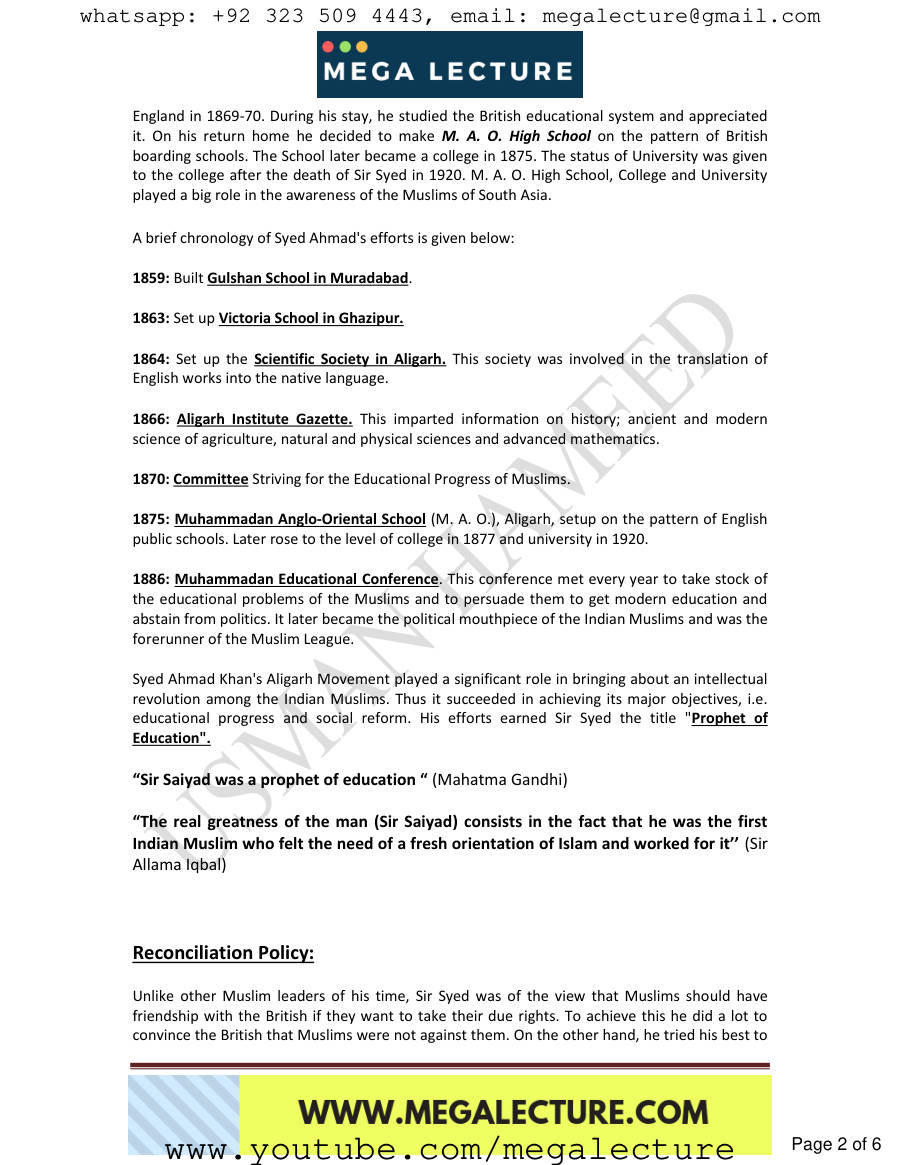
- The MAO School and College. After seeing Oxford and Cambridge, he wanted a similar institution for Muslims. The MAO School opened at Aligarh in 1875 and became a college in 1877. It taught Western subjects in English together with Islamic studies, and it was run on the lines of an English residential college. It became Aligarh Muslim University in 1920, after his death.
- The Mohammedan Educational Conference (1886). It met each year in a different city to spread the message of modern education and to discuss the problems of Muslims.
Aligarh produced many of the educated Muslims who later led the Pakistan Movement. The All-India Muslim League itself was founded in 1906 at a meeting of the Mohammedan Educational Conference.
Political views
The Hindi-Urdu controversy (1867)
In 1867 some Hindu leaders in Benares demanded that Urdu, written in the Persian script, should be replaced in government offices and courts by Hindi, written in the Devanagari script. Muslims saw Urdu as part of their culture. Sir Syed was shocked by the demand. Until then he had spoken of Hindus and Muslims as one nation. He now came to believe that the two communities had different interests and would find it hard to move forward together.
Opposition to the Indian National Congress
The Indian National Congress was formed in 1885 and claimed to speak for all Indians. Sir Syed advised Muslims to stay out of it, for these reasons:
- Elections on the British model. Congress wanted elected councils. Since Hindus were a large majority, Sir Syed said that Muslims would be outvoted in every election and would have no real voice.
- Competitive examinations. Congress wanted government jobs to be filled by open examinations. Muslims were behind in modern education, so they would win few places.
- The language issue. Many in Congress supported Hindi, which strengthened his fear that Congress would serve Hindu interests.
- Risk to relations with the British. He feared that joining a body which criticised the government would undo his work to win British trust.
To give Muslims and other loyal groups a voice outside Congress, he helped to form the United Indian Patriotic Association in 1888.
The Two Nation idea
Sir Syed did not ask for a separate country. However, he was the first major Muslim leader of the period to say clearly that Hindus and Muslims were two separate communities, with different religions, cultures and interests, who could not be treated as one nation in a system of majority rule. This idea is known as the Two Nation Theory. It was later developed by Allama Iqbal and by Quaid-e-Azam Muhammad Ali Jinnah, and it became the basis of the demand for Pakistan.
How important was Sir Syed Ahmad Khan?
His achievements.
- He helped to change the British view of Muslims, so that over time Muslims were again trusted with jobs and consulted by the government.
- He persuaded many Muslims that modern education was not against Islam. Aligarh gave the community a new educated class of lawyers, officials and politicians.
- He defended Urdu and gave Muslims a sense of being a separate political community. This prepared the way for the Simla Deputation, separate electorates and the Muslim League.
The limits of his work.
- Many ulama opposed him. They disliked his close links with the British and his modern approach to religion, and they kept their students away from Aligarh.
- His educational work reached mainly the upper and middle classes of northern India. Poor Muslims and those in distant regions gained little at first.
- His loyalty to the British was criticised by those who wanted Indians to oppose foreign rule.
Judgement. Sir Syed's work did not reach every Muslim. Even so, most historians see him as the most important Muslim leader of the later nineteenth century. His educational work was probably his greatest contribution, because it produced the leaders and the confidence on which the later political movement depended. His political ideas mattered because they gave that movement its direction.
Key terms and people
- Aligarh Movement: the campaign led by Sir Syed for modern education and better relations with the British.
- MAO College: the Mohammedan Anglo-Oriental College at Aligarh, opened as a school in 1875.
- Scientific Society: body that translated modern works into Urdu.
- Tahzib-ul-Akhlaq: Sir Syed's journal of social and religious reform.
- Hindi-Urdu controversy: the dispute from 1867 over which language and script should be used officially.
- Two Nation Theory: the idea that Hindus and Muslims are two separate nations.
Exam practice
- Describe the Hindi-Urdu controversy of 1867. [4]
- Why did Sir Syed Ahmad Khan try to improve relations between the Muslims and the British? [7]
- "Sir Syed Ahmad Khan's educational work was his most important contribution to the Muslims of the subcontinent." How far do you agree? Explain your answer. [14]
Outline answers
1. In 1867 Hindu leaders in Benares demanded that Hindi in the Devanagari script should replace Urdu in offices and courts. Muslims saw Urdu as part of their culture. Sir Syed opposed the demand and worked to defend Urdu. The dispute convinced him that Hindus and Muslims had separate interests.
2. Three explained reasons: (a) the British blamed Muslims for 1857 and kept them out of jobs, so trust had to be rebuilt; (b) Muslims were falling behind Hindus, and only cooperation would open the way to education and employment; (c) he believed British rule would last, so opposing it would bring further loss, while friendship would protect Muslim interests.
3. Agree: explain the schools, the Scientific Society, the MAO College and the Educational Conference, and how they created an educated Muslim leadership. Disagree: explain his work to change British attitudes (the two pamphlets, the Bible commentary) and his political ideas (defence of Urdu, advice to stay out of Congress, the Two Nation idea). Judgement: education was the base, since without it Muslims could not have used the better relations or led a political movement, but the three parts of his work supported each other.
