
IB Diploma · Maths: Analysis and Approaches · Analysis and Approaches (AA)
Topic 1: Number and Algebra
Opens inside this page. Prefer your own PDF app? Open the PDF.
Full text of Topic 1: Number and Algebra
IB DP MATHEMATICS Analysis and Approaches (AA) Topic 1 Number and Algebra
Revision Notes · Standard and Higher Level Fahad H. Ahmad
+92 323 509 4443 | Megalecture.com
Original notes prepared for the IB Diploma Programme Mathematics: Analysis and Approaches course (first assessment 2021)
What Topic 1 requires
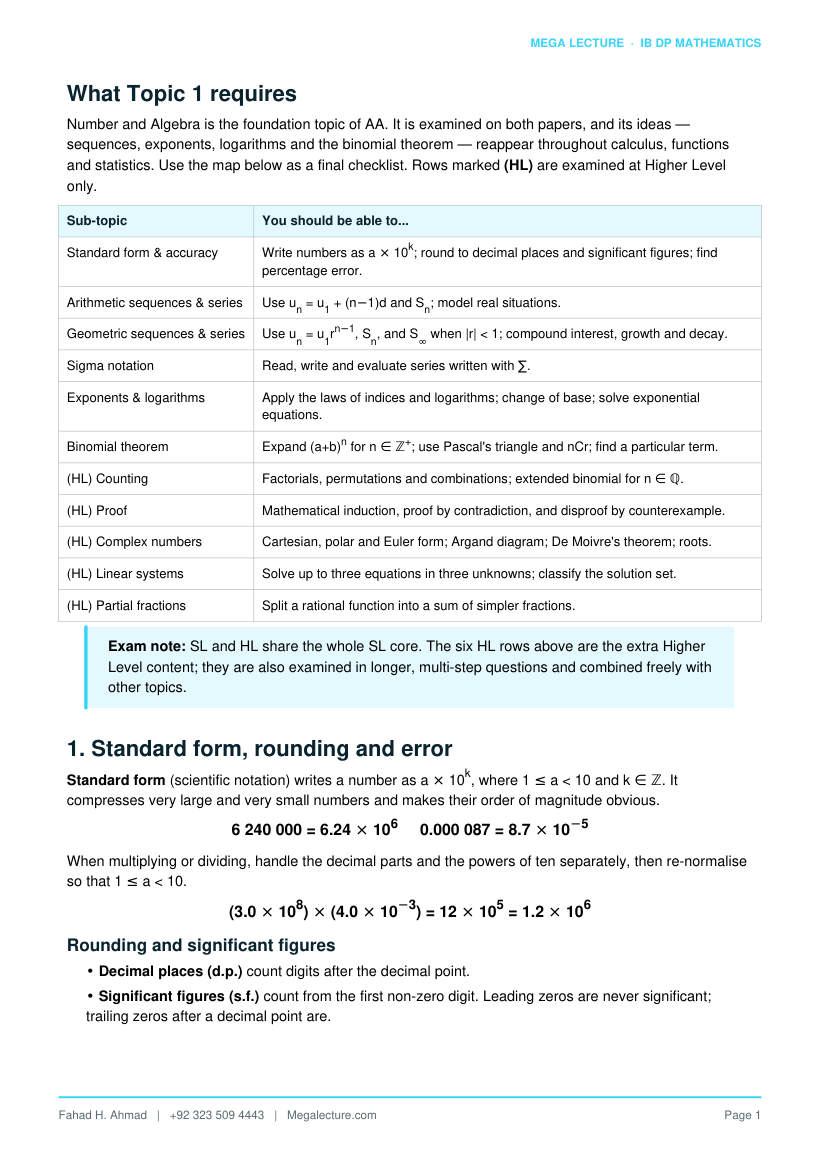
Number and Algebra is the foundation topic of AA. It is examined on both papers, and its ideas — sequences, exponents, logarithms and the binomial theorem — reappear throughout calculus, functions and statistics. Use the map below as a final checklist. Rows marked (HL) are examined at Higher Level only.
Sub-topic You should be able to...
Standard form & accuracy Write numbers as a × 10k; round to decimal places and significant figures; find percentage error.
Arithmetic sequences & series Use un = u1 + (n−1)d and Sn; model real situations.
Geometric sequences & series Use un = u1rn−1, Sn, and S∞ when |r| < 1; compound interest, growth and decay.
Sigma notation Read, write and evaluate series written with ∑.
Exponents & logarithms Apply the laws of indices and logarithms; change of base; solve exponential equations.
Binomial theorem Expand (a+b)n for n ∈ ℤ+; use Pascal's triangle and nCr; find a particular term.
(HL) Counting Factorials, permutations and combinations; extended binomial for n ∈ ℚ.
(HL) Proof Mathematical induction, proof by contradiction, and disproof by counterexample.
(HL) Complex numbers Cartesian, polar and Euler form; Argand diagram; De Moivre's theorem; roots.
(HL) Linear systems Solve up to three equations in three unknowns; classify the solution set.
(HL) Partial fractions Split a rational function into a sum of simpler fractions.
Exam note: SL and HL share the whole SL core. The six HL rows above are the extra Higher Level content; they are also examined in longer, multi-step questions and combined freely with other topics.
1. Standard form, rounding and error
Standard form (scientific notation) writes a number as a × 10k, where 1 ≤ a < 10 and k ∈ ℤ. It compresses very large and very small numbers and makes their order of magnitude obvious.
6 240 000 = 6.24 × 10⁶ 0.000 087 = 8.7 × 10⁻⁵
When multiplying or dividing, handle the decimal parts and the powers of ten separately, then re-normalise so that 1 ≤ a < 10.
(3.0 × 108) × (4.0 × 10−3) = 12 × 105 = 1.2 × 10⁶
Rounding and significant figures
- Decimal places (d.p.) count digits after the decimal point.
- Significant figures (s.f.) count from the first non-zero digit. Leading zeros are never significant; trailing zeros after a decimal point are.
- Round the final answer only; keep full precision in intermediate steps to avoid rounding error building
- IB answers are normally given to three significant figures unless told otherwise.
Percentage error
If vA is an approximate (measured or rounded) value and vE is the exact value, the percentage error is
ε = | (vA − vE) / vE | × 100%
The vertical bars make the error non-negative regardless of whether the estimate is high or low.
Worked example 1 — percentage error
A student measures a rod as 24.8 cm; its true length is 25.0 cm. Find the percentage error.
ε = | (24.8 − 25.0) / 25.0 | × 100% = (0.2 / 25.0) × 100% = 0.8%.
Common pitfall: Always divide by the exact value vE, not by the approximation. Dividing by the wrong quantity is a frequent lost mark.
2. Arithmetic sequences and series
An arithmetic sequence has a constant common difference d between consecutive terms: d = un+1 − un. Each term is the previous term plus d.
un = u1 + (n − 1)d
A series is the sum of the terms of a sequence. For the first n terms of an arithmetic sequence:
Sn = n/2 (2u1 + (n − 1)d) = n/2 (u1 + un)
The second form is quickest when the first and last terms are both known: the sum equals the number of terms times the average of the first and last term.
Worked example 2 — arithmetic sequence and series
The 7th term of an arithmetic sequence is 32 and the 12th term is 52. Find u1, d, and the sum of the first 20 terms.
u7 = u1 + 6d = 32 and u12 = u1 + 11d = 52.
Subtracting: 5d = 20, so d = 4, and u1 = 32 − 6(4) = 8.
S20 = 20/2 (2×8 + 19×4) = 10(16 + 76) = 10 × 92 = 920.
Exam technique: Two facts about an arithmetic sequence give two equations in u1 and d. Subtract them to eliminate u1 and find d first.
3. Geometric sequences and series
A geometric sequence has a constant common ratio r between consecutive terms: r = un+1 / un. Each term is the previous term multiplied by r.
First eight terms: the arithmetic sequence (u1=2, d=3) rises in a straight line, while the geometric sequence (u1=2, r=1.5) curves upward — linear versus exponential growth.
un = u1 rn−1 Sn = u1(rn − 1)/(r − 1) = u1(1 − rn)/(1 − r), r ≠ 1
Use whichever form of Sn keeps the arithmetic positive: the left form when r > 1, the right form when r < 1.
Sum to infinity
If the common ratio satisfies |r| < 1, the terms shrink towards zero and the partial sums approach a finite limit, the sum to infinity:
S∞ = u1 / (1 − r), valid only for |r| < 1
Partial sums Sn of 8 + 4 + 2 + … (a=8, r=1/2) climb toward the limit S∞ = a/(1−r) = 16 (dashed line).
If |r| ≥ 1 the series diverges and no sum to infinity exists — a condition examiners love to test.
Applications: growth and decay
Geometric sequences model anything that changes by a fixed percentage each step. For compound interest at rate i per period on principal P, the value after n periods is P(1 + i)n; a decaying quantity (depreciation, radioactive material, cooling) uses a ratio r < 1.
Worked example 3 — sum to infinity and compound interest
- A geometric series has first term 24 and common ratio 1/2. Find its sum to infinity.
Since |r| = 1/2 < 1, S∞ = 24 / (1 − 1/2) = 24 / (1/2) = 48.
- $2000 is invested at 4.5% per year, compounded annually. Find its value after 6 years.
Value = 2000(1.045)6 = 2000 × 1.30226 = $2604.52 (2 d.p.).
Worked example 4 — depreciation (geometric decay)
A car bought for $18 000 loses 15% of its value each year. Find its value after 4 years and the total value lost.
Each year the value is multiplied by r = 1 − 0.15 = 0.85 (a geometric ratio < 1).
Value after 4 years = 18000(0.85)4 = 18000 × 0.52200625 ≈ $9396.11.
Value lost = 18000 − 9396.11 = $8603.89.
Exponential models: compound interest 2000(1.045)n grows (left) while a car's value 18000(0.85)n decays (right). The marked points reproduce Worked examples 3(b) and 4.
Common pitfall: Never apply S∞ = u1/(1−r) without first checking |r| < 1. If |r| ≥ 1 the correct answer is that the sum does not exist.
4. Sigma notation
Sigma notation is a compact way of writing a sum. The Greek capital sigma Σ means 'add up'; the letter below is the index and its starting value, the number on top is where it stops.
∑r=1 n ur = u1 + u2 + u3 + … + un
For example ∑r=1
4 (2r + 1) = 3 + 5 + 7 + 9 = 24. The index letter is a dummy: ∑r=1 n and ∑k=1 n mean the same thing. Sigma notation is simply a way to write a series — the arithmetic and geometric sum formulae still do the actual work.
Worked example 5 — evaluating a series in sigma notation
Evaluate ∑r=1
8 3(2)r−1.
The general term 3(2)r−1 is geometric with u1 = 3, r = 2, and there are n = 8 terms.
S8 = 3(28 − 1)/(2 − 1) = 3(256 − 1) = 3 × 255 = 765.
Exam technique: If the general term ur is linear in r the series is arithmetic; if it contains a constant raised to the power r (such as 2r) it is geometric. Identify which, read off u1, d or r, and the number of terms, then apply Sn.
5. Exponents and logarithms
The laws of exponents (indices) hold for any non-zero base a and rational powers:
Law Statement
Product am × an = am+n
Quotient am ÷ an = am−n
Power of a power (am)n = amn
Zero and negative a0 = 1; a−n = 1 / an
Fractional (roots) a1/n = √na; am/n = (√na)m
A logarithm answers 'to what power must the base be raised?' It is the inverse of exponentiation:
ax = b ⇒ x = loga b (a > 0, a ≠ 1, b > 0)
The laws of logarithms mirror the index laws:
Law Statement
Product loga(xy) = loga x + loga y
Quotient loga(x/y) = loga x − loga y
Power loga(xm) = m loga x
Special values loga 1 = 0; loga a = 1
Change of base loga x = (logb x) / (logb a)
Natural logarithms use base e ≈ 2.71828 and are written ln x = loge x. The change-of-base rule lets any logarithm be evaluated on a calculator as (ln x)/(ln a) or (log x)/(log a).
To solve an equation with the unknown in the exponent, take logs of both sides and use the power law to bring the exponent down.
Worked example 6 — solving with logarithms
- Solve 5x = 20, giving x to 3 s.f.
Take logs: x log 5 = log 20, so x = log 20 / log 5 = 1.30103 / 0.69897 = 1.86.
- Solve log2 x + log2(x − 2) = 3.
Product law: log2[x(x − 2)] = 3, so x(x − 2) = 23 = 8.
x2 − 2x − 8 = 0 ⇒ (x − 4)(x + 2) = 0, so x = 4 or x = −2.
Reject x = −2 (a logarithm needs a positive argument). ∴ x = 4.
Common pitfall: log(x + y) is not log x + log y. The product law applies to log(xy), not to the log of a sum. Always check the domain of a log equation and reject solutions that make any argument zero or negative.
6. The binomial theorem
The binomial theorem expands a power of a two-term bracket without multiplying it out term by term. For a positive integer n:
(a + b)n = ∑r=0 n nCr an−r br where the binomial coefficient is nCr = ( n over r ) = n! / (r!(n − r)!)
The coefficients are the rows of Pascal's triangle: each entry is the sum of the two above it. Row n (starting at n = 0) gives the coefficients of (a + b)n.
n Row of Pascal's triangle gives coefficients of
(a+b)0
1 1 (a+b)1
1 2 1 (a+b)2
1 3 3 1 (a+b)3
(a+b)4
Worked example 7 — a full expansion
Expand (2x − 3)4 completely.
Use Pascal's row for n = 4: 1, 4, 6, 4, 1, with a = 2x and b = −3.
(2x)4 + 4(2x)3(−3) + 6(2x)2(−3)2 + 4(2x)(−3)3 + (−3)4
= 16x4 − 96x3 + 216x2 − 216x + 81.
Finding a particular term
The general term (the term containing br) is nCr an−r br. To pick out one specific term, find the value of r that gives the required power, then evaluate just that term — there is no need to expand the whole bracket.
Worked example 8 — a particular term
Find the coefficient of x3 in the expansion of (2 + 3x)7.
General term: 7Cr (2)7−r (3x)r. The power of x is r, so for x3 take r = 3.
Term = 7C3 (2)4 (3)3 x3 = 35 × 16 × 27 x3 = 15120 x3.
The coefficient is 15120.
Exam technique: For a constant term, set the total power of the variable to zero and solve for
- Watch signs carefully when the bracket contains a minus, e.g. (x − k)n gives (−k)r in the general term.
7. (HL) Counting: permutations and combinations
(HL) The factorial n! = n(n−1)(n−2)…3 · 2 · 1 counts the number of ways of arranging n distinct objects in a row, with 0! = 1 by definition.
A permutation counts ordered selections; a combination counts unordered selections of r objects from n distinct objects:
nPr = n! / (n − r)! nCr = n! / (r!(n − r)!)
Because order does not matter for a combination, we divide the permutation count by r! (the number of orderings of the chosen r). Combinations are exactly the binomial coefficients of Topic 1.6.
Worked example 9 — combinations with a restriction
A committee of 4 is chosen from 7 women and 5 men. (a) How many committees are possible? (b) How many contain exactly 2 women and 2 men?
- Order does not matter, so choose 4 from 12: 12C4 = 12!/(4! 8!) = 495.
- Choose 2 of 7 women and 2 of 5 men, then multiply: 7C2 × 5C2 = 21 × 10 = 210.
(HL) Extended binomial theorem
For a fractional or negative exponent n ∈ ℚ, the binomial series is an infinite series, valid only for |x| < 1:
(1 + x)n = 1 + nx + n(n−1)/2! x2 + n(n−1)(n−2)/3! x3 + …
Unlike the positive-integer case it does not terminate, and the |x| < 1 condition is essential for the series to converge. To expand (a + x)n, first factor out an to reach the standard (1 + something) form.
Common pitfall: The extended expansion of (1 + x)n is only valid for |x| < 1. State the range of validity — it is often worth a mark of its own.
8. (HL) Proof
(HL) A proof establishes a result for all cases by watertight reasoning; a single numerical check is never a proof. Three methods are examined.
Proof by mathematical induction
Used to prove a statement P(n) for all integers n ≥ some starting value. There are three steps:
- Base case: show P(1) (or the first relevant value) is true.
- Inductive step: assume P(k) is true (the inductive hypothesis) and use it to prove P(k+1).
- Conclusion: since P(1) holds and P(k) ⇒ P(k+1), by induction P(n) is true for all n ≥ 1.
Worked example 10 — proof by induction
Prove that ∑r=1 n r2 = n(n+1)(2n+1)/6 for all n ∈ ℤ+.
Base case (n = 1): LHS = 12 = 1; RHS = 1×2×3/6 = 1. True.
Inductive step: assume ∑r=1 k r2 = k(k+1)(2k+1)/6. Then adding the next term (k+1)2:
∑r=1 k+1 r2 = k(k+1)(2k+1)/6 + (k+1)2 = (k+1)[k(2k+1) + 6(k+1)] / 6.
The bracket is 2k2 + 7k + 6 = (k+2)(2k+3), so the sum = (k+1)(k+2)(2k+3)/6, which is the formula with n = k+1.
Conclusion: true for n = 1 and P(k) ⇒ P(k+1), so by induction the result holds for all n ∈ ℤ+.
Proof by contradiction
Assume the negation of what you want to prove, then derive a logical impossibility. The classic example is that √2 is irrational: assume √2 = p/q in lowest terms, square to get p2 = 2q2, deduce that p and q are both even, contradicting 'lowest terms'.
Disproof by counterexample
To show a universal statement is false, one explicit counterexample is enough. For instance, 'n2 + n + 41 is prime for all n ∈ ℕ' fails at n = 41, where the value is 412, which is not prime.
Exam technique: In an induction answer you must (i) write the inductive hypothesis explicitly,
- show clearly where you use it, and (iii) finish with a full concluding sentence. Marks are awarded for this structure, not only for the algebra.
9. (HL) Complex numbers
(HL) The imaginary unit is defined by i2 = −1. A complex number in Cartesian form is z = a + bi, with real part Re(z) = a and imaginary part Im(z) = b. The set of all complex numbers is ℂ.
Arithmetic works like ordinary algebra with the single rule i2 = −1. The complex conjugate of z = a + bi is z* = a − bi; multiplying a number by its conjugate gives the real number zz* = a2 + b2, which is used to divide (realise the denominator).
(a + bi)(c + di) = (ac − bd) + (ad + bc)i z z* = a2 + b2
Worked example 11 — dividing complex numbers
Express (3 + 2i)/(1 − i) in the form a + bi.
Multiply top and bottom by the conjugate of the denominator, 1 + i:
(3 + 2i)(1 + i) / ((1 − i)(1 + i)) = (3 + 3i + 2i + 2i2) / (1 + 1).
Using i2 = −1: numerator = 3 + 5i − 2 = 1 + 5i, so the result is (1 + 5i)/2 = 0.5 + 2.5i.
Modulus, argument and the Argand diagram
On an Argand diagram z = a + bi is the point (a, b). Its modulus is the distance from the origin and its argument is the angle from the positive real axis:
|z| = √(a2 + b2) arg(z) = θ, where tan θ = b/a
Argand diagram of z = 3 + 2i and its conjugate z* = 3 − 2i. The modulus |z| = √13 ≈ 3.61 and the argument θ ≈ 33.7° are shown; conjugation reflects z in the real axis.
The argument is usually given in the range −π < θ ≤ π (principal argument); always use a sketch to place z in the correct quadrant.
Polar and Euler form; De Moivre's theorem
Writing r = |z| and θ = arg(z), the same number is z = r(cos θ + i sin θ) = r cis θ = r eiθ
Multiplication multiplies the moduli and adds the arguments; this leads to De Moivre's theorem, the engine for powers and roots:
[r(cos θ + i sin θ)]n = rn(cos nθ + i sin nθ)
Worked example 12 — De Moivre's theorem
Let z = 1 + i√3. Find |z| and arg(z), and hence evaluate z6.
|z| = √(12 + (√3)2) = √(1 + 3) = 2.
tan θ = √3 / 1 and z is in the first quadrant, so θ = π/3.
z = 2 cis(π/3), so by De Moivre z6 = 26 cis(6 × π/3) = 64 cis(2π).
cis(2π) = cos 2π + i sin 2π = 1, so z6 = 64.
Roots of a complex number
A non-zero complex number has exactly n distinct n-th roots, found by writing arguments as θ + 2πk and applying De Moivre:
z1/n = r1/n cis((θ + 2πk)/n), k = 0, 1, …, n−1
The n roots are equally spaced by 2π/n around a circle of radius r1/n centred at the origin — they form a regular n-gon on the Argand diagram.
Worked example 13 — the cube roots of a number
Find the three cube roots of 8.
Write 8 in polar form: 8 = 8 cis 0, so r1/3 = 2 and the arguments are (0 + 2πk)/3 for k = 0, 1, 2.
k = 0: 2 cis 0 = 2. k = 1: 2 cis(2π/3) = −1 + i√3. k = 2: 2 cis(4π/3) = −1 − i√3.
The three roots 2, −1 + i√3, −1 − i√3 sit at the vertices of an equilateral triangle on a circle of radius 2.
The three cube roots of 8 lie on a circle of radius 2 at arguments 0°, 120°, 240° (spaced 2π/3 apart), forming the vertices of an equilateral triangle.
Common pitfall: i2 = −1, not +1. When finding roots, add 2πk to the argument before dividing by n, or you will find only one of the n roots. Check your quadrant with a sketch before quoting an argument.
10. (HL) Systems of linear equations
(HL) A linear system in up to three unknowns is solved by elimination (Gaussian reduction): use one equation to eliminate a variable from the others, repeat, then back-substitute. The solution set is one of three types:
Type Geometric meaning (3 planes) Algebra you will see
Unique solution Planes meet at a single point Each variable is pinned to one value
No solution (inconsistent) No common point of intersection A false row such as 0 = 5
Type Geometric meaning (3 planes) Algebra you will see
Infinitely many Planes meet in a common line A row reduces to 0 = 0; answer has a parameter
Worked example 14 — three equations, three unknowns
Solve x + y + z = 6, 2x − y + z = 3, x + 2y − 3z = −4.
Eliminate x. (Eq2 − 2×Eq1): −3y − z = −9. (Eq3 − Eq1): y − 4z = −10.
From the first of these, z = 9 − 3y. Substitute: y − 4(9 − 3y) = −10 ⇒ 13y − 36 = −10 ⇒ y = 2.
Then z = 9 − 6 = 3, and x = 6 − y − z = 6 − 2 − 3 = 1.
Unique solution: x = 1, y = 2, z = 3 (check: all three equations are satisfied).
Exam technique: Always substitute your answer back into the original equations. If a variable cancels to give 0 = 0 the system has infinitely many solutions; if it gives a false statement, there is no solution.
11. (HL) Partial fractions
(HL) A single rational expression with a factorable denominator can be split into a sum of simpler fractions — the reverse of adding fractions. This is essential for integration later in the course. For distinct linear factors:
(px + q)/((x − a)(x − b)) = A/(x − a) + B/(x − b)
Multiply through by the denominator, then find A and B either by substituting the values x = a and x = b (which make one bracket zero) or by comparing coefficients.
Worked example 15 — partial fractions
Express (3x + 5)/((x − 1)(x + 2)) in partial fractions.
Write (3x + 5)/((x − 1)(x + 2)) = A/(x − 1) + B/(x + 2), so 3x + 5 = A(x + 2) + B(x − 1).
Let x = 1: 8 = 3A ⇒ A = 8/3. Let x = −2: −1 = −3B ⇒ B = 1/3.
Therefore (3x + 5)/((x − 1)(x + 2)) = 8/(3(x − 1)) + 1/(3(x + 2)).
Exam technique: The 'cover-up' substitution (choosing x to kill one factor) is the fastest route for distinct linear factors. Check the degree of the numerator is less than that of the denominator first; if not, divide out the polynomial part.
12. Common exam pitfalls
- Using S∞ = u1/(1−r) when |r| ≥ 1 — the sum to infinity only exists for |r| < 1.
- Writing log(x + y) = log x + log y. The laws apply to products and quotients, never to a sum inside the logarithm.
- Confusing nPr (order matters) with nCr (order does not). A team is a combination; a ranked podium is a permutation.
- Forgetting i2 = −1 and treating i as an ordinary variable when multiplying complex numbers.
- Losing a sign in a binomial expansion of (a − b)n: the general term contains (−b)r.
- Treating one numerical check as a proof, or omitting the concluding statement in an induction argument.
- Rounding intermediate values too early and carrying the error into the final answer.
13. Quick-reference formulae
Result Formula
Arithmetic n-th term un = u1 + (n − 1)d
Arithmetic sum Sn = n/2 (2u1 + (n−1)d) = n/2 (u1 + un)
Geometric n-th term un = u1 rn−1
Geometric sum Sn = u1(rn − 1)/(r − 1), r ≠ 1
Sum to infinity S∞ = u1/(1 − r), |r| < 1
Binomial (n ∈ ℤ+) (a+b)n = ∑r=0 n nCr an−r br
Binomial coefficient nCr = n! / (r!(n − r)!)
Change of base loga x = (logb x)/(logb a)
(HL) Permutations nPr = n!/(n − r)!
(HL) Modulus / argument |z| = √(a2+b2); z = r cis θ = r eiθ
(HL) De Moivre (r cis θ)n = rn cis nθ
14. Test yourself
Attempt all ten without notes, then check against the full solutions that follow. Questions 7–10 are Higher Level.
- Evaluate (6.0 × 104) × (5.0 × 10−7), giving the answer in standard form.
- An arithmetic sequence has u1 = 5 and d = 3. Find u10 and S10.
- A geometric sequence has u1 = 40 and r = 0.8. Find its sum to infinity.
- Evaluate ∑r=1 5 (3r − 1).
- Solve 4 × 3x = 100, giving x to 3 s.f.
- Find the coefficient of x2 in the expansion of (1 + 2x)6.
- (HL) In how many ways can a president, a secretary and a treasurer be chosen from a club of 10 members (all posts different)?
- (HL) Prove by induction that ∑r=1 n r = n(n+1)/2.
- (HL) Write z = −1 + i in modulus–argument form.
- (HL) Express (5x − 1)/((x + 1)(x − 2)) in partial fractions.
Full solutions
- Multiply the numbers and add the powers: 6.0 × 5.0 = 30 and 104 × 10−7 = 10−3, giving 30 × 10−3 = 3.0 × 10⁻².
- u10 = 5 + 9(3) = 32. S10 = 10/2 (5 + 32) = 5 × 37 = 185.
- |r| = 0.8 < 1, so S∞ = 40/(1 − 0.8) = 40/0.2 = 200.
- Terms are 2, 5, 8, 11, 14 (arithmetic, u1 = 2, d = 3, n = 5). Sum = 5/2 (2 + 14) = 40.
- 3x = 25, so x = log 25 / log 3 = 1.39794/0.47712 = 2.93 (3 s.f.).
- General term 6Cr (2x)r; for x2 take r = 2: 6C2 (2)2 = 15 × 4 = 60.
- (HL) Order matters, so 10P3 = 10!/7! = 10 × 9 × 8 = 720 ways.
- (HL) Base n = 1: LHS = 1, RHS = 1(2)/2 = 1. Assume ∑r=1 k r = k(k+1)/2. Then ∑r=1 k+1 r = k(k+1)/2 + (k+1) = (k+1)(k+2)/2, the formula with n = k+1. By induction it holds for all n ∈ ℤ+.
- (HL) |z| = √((−1)2 + 12) = √2. z is in the second quadrant, so arg(z) = 3π/4. Thus z = √2 cis(3π/4).
- (HL) Set = A/(x + 1) + B/(x − 2), so 5x − 1 = A(x − 2) + B(x + 1). x = −1: −6 = −3A ⇒ A = 2. x = 2: 9 = 3B ⇒ B = 3. Answer: 2/(x + 1) + 3/(x − 2).
