
IB Diploma · Maths: Analysis and Approaches · Analysis and Approaches (AA)
Topic 2 Worksheet
Opens inside this page. Prefer your own PDF app? Open the PDF.
Check yourself
5 quick questions on Functions
Tap an answer to see if you are right, and why. Free, no sign-up.
Start the free testWas this note useful?
Full text of Topic 2 Worksheet
IB DP MATHEMATICS AA Topic 2 · Functions TOPICAL WORKSHEET
2.1 Function Basics · 2.2 Quadratic Functions
2.3 Transformations of Graphs · 2.4 Rational Functions
Standard and Higher Level · Syllabus 2025
Fahad H. Ahmad
Original exam-style questions written for the IB Diploma Programme Mathematics course (first assessment 2025)
Free notes, practice tests and live classes Back to megalecture.com
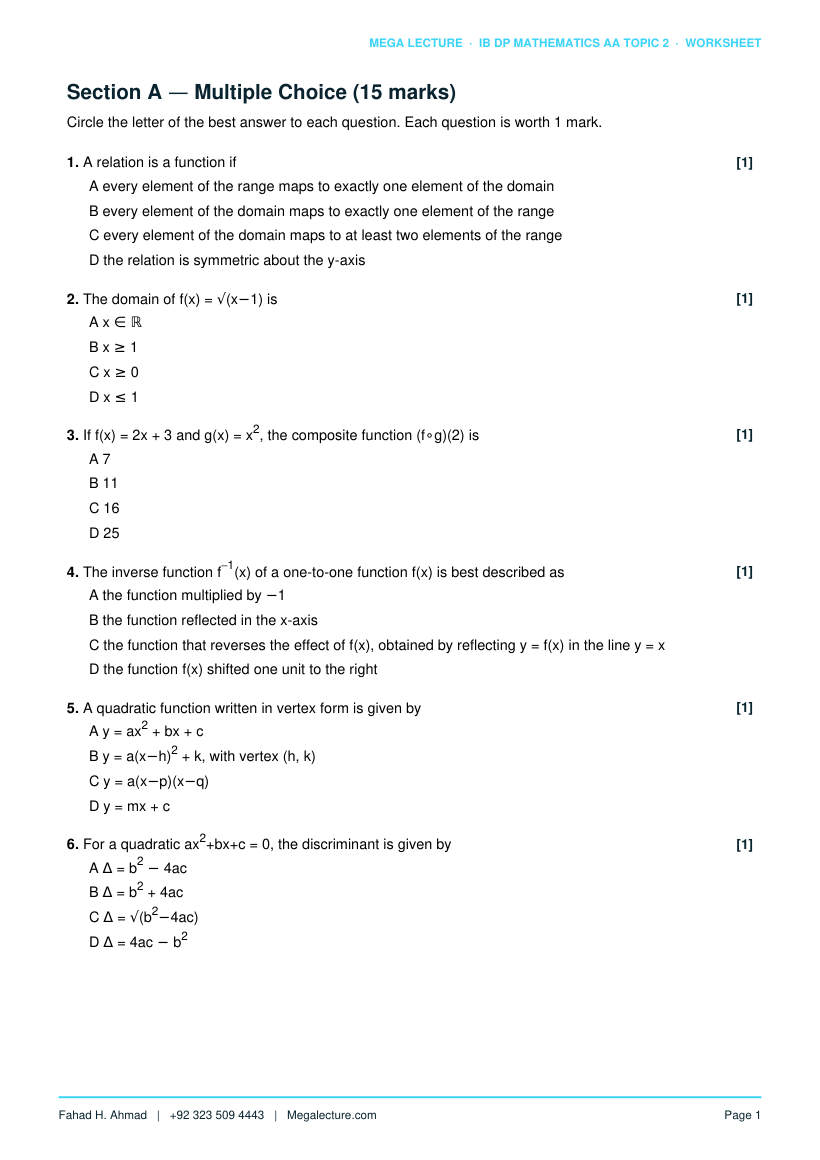
Section A — Multiple Choice (15 marks)
Circle the letter of the best answer to each question. Each question is worth 1 mark.
- A relation is a function if [1]
A every element of the range maps to exactly one element of the domain
B every element of the domain maps to exactly one element of the range
C every element of the domain maps to at least two elements of the range
D the relation is symmetric about the y-axis
- The domain of f(x) = √(x−1) is [1]
A x ∈ ℝ
B x ≥ 1
C x ≥ 0
D x ≤ 1
- If f(x) = 2x + 3 and g(x) = x2, the composite function (f∘g)(2) is [1]
A 7
B 11
C 16
D 25
- The inverse function f−1(x) of a one-to-one function f(x) is best described as [1]
A the function multiplied by −1
B the function reflected in the x-axis
C the function that reverses the effect of f(x), obtained by reflecting y = f(x) in the line y = x
D the function f(x) shifted one unit to the right
- A quadratic function written in vertex form is given by [1]
A y = ax2 + bx + c
B y = a(x−h)2 + k, with vertex (h, k)
C y = a(x−p)(x−q)
D y = mx + c
- For a quadratic ax2+bx+c = 0, the discriminant is given by [1]
A Δ = b2 − 4ac
B Δ = b2 + 4ac
C Δ = √(b2−4ac)
D Δ = 4ac − b2
- If the discriminant of a quadratic equation is positive (Δ > 0), the equation has [1]
A no real roots
B exactly one repeated real root
C two distinct real roots
D infinitely many real roots
- The roots of x2 − 5x + 6 = 0 are [1]
A x = 1, 6
B x = −2, −3
C x = 2, 3
D x = −1, −6
- The graph of y = f(x) + k, for a positive constant k, is the graph of y = f(x) [1]
A translated k units to the right
B translated k units upward
C stretched vertically by a factor of k
D reflected in the x-axis
- The graph of y = f(x−k), for a positive constant k, is the graph of y = f(x) [1]
A translated k units to the left
B translated k units to the right
C translated k units upward
D reflected in the y-axis
- The graph of y = −f(x) is obtained from y = f(x) by [1]
A a reflection in the y-axis
B a reflection in the x-axis
C a horizontal stretch
D a translation upward
- The graph of y = af(x), for a constant a > 1, is the graph of y = f(x) [1]
A stretched vertically by a scale factor of a
B stretched horizontally by a scale factor of a
C translated a units upward
D compressed vertically by a scale factor of a
- The vertical asymptote of y = 1÷(x−3) is [1]
A x = 0
B x = −3
C x = 3
D y = 3
- The horizontal asymptote of y = 1÷(x−3) + 2 is [1]
A y = 0
B y = 2
C y = 3
D x = 2
- The domain of y = 1÷(x+5) is [1]
A all real x
B x ≠ 5
C x ≠ −5
D x ≥ −5
Section B — Structured Questions (65 marks)
Answer all questions in the space provided. Working must be shown for full marks.
2.1 Function Basics
Question 1 [7 marks]
The graph shows the function f(x) = √(x−1) (computed).
The function f(x) = √(x−1) (computed).
- Using the graph, state the domain and range of f(x). [2]
- Calculate f(5), and confirm it agrees with the graph. [2]
- Find the value of x for which f(x) = 3. [3]
Question 2 [6 marks]
Composite and inverse functions combine or reverse the effect of individual functions.
- Given f(x) = 2x + 3, state the value of f(0) and explain what this represents on the graph of y = f(x).
[2]
- Given f(x) = 2x + 3 and g(x) = x2, find (f∘g)(2). [2]
- Find the inverse function, f−1(x), of f(x) = 2x + 3. [2]
2.2 Quadratic Functions
Question 3 [7 marks]
The graph shows the quadratic function y = x2 − 4x + 3 (computed).
y = x2 − 4x + 3 (computed), with roots, y-intercept, and vertex marked.
- Using the graph, state the roots (x-intercepts) and the y-intercept of the function. [2]
- By completing the square, write x2 − 4x + 3 in vertex form, and state the coordinates of the vertex.
[2]
- State the equation of the axis of symmetry of this quadratic. [3]
Question 4 [6 marks]
The quadratic formula and the discriminant allow the roots of any quadratic equation to be found or classified.
- State the quadratic formula for solving ax2+bx+c = 0. [2]
- State the discriminant formula, and state what a negative discriminant tells us about the roots of the equation.
[2]
- Calculate the discriminant of 2x2+3x−5 = 0, and state how many real roots this equation has. [2]
Question 5 [7 marks]
The graph shows three quadratic functions, each with a different discriminant (computed).
Three quadratics with discriminants Δ = 0, 16, and −16 respectively (computed).
- Using the graph, identify which curve touches the x-axis at exactly one point, which crosses it at two points, and which does not meet the x-axis at all. Relate each case to the sign of the discriminant.
[2]
- Verify by calculation that the discriminant of y = x2−2x+1 is zero. [2]
- Calculate the discriminant of y = x2−2x+5, and confirm this is consistent with the graph. [3]
2.3 Transformations of Graphs
Question 6 [6 marks]
Transformations allow the graph of a known function y = f(x) to be used to sketch related functions.
- Describe the transformation applied to y = f(x) to obtain y = f(x) + k and y = f(x−k), for a positive constant k.
[2]
- Describe the transformation applied to y = f(x) to obtain y = −f(x), and to obtain y = f(−x). [2]
- Describe the transformation applied to y = f(x) to obtain y = af(x), for a constant 0 < a < 1. [2]
Question 7 [7 marks]
The graph shows f(x) = x2 and g(x) = (x−2)2+3 (computed).
- Using the graph, describe the single transformation that maps y = f(x) onto y = g(x). [2]
- State the translation vector describing this transformation. [2]
- Using function notation, express g(x) in terms of f(x), and hence confirm this matches the given formula g(x) = (x−2)2+3.
[3]
Question 8 [6 marks]
Let f(x) = x2 − 4x.
- Find expressions for −f(x) and f(−x), and state the transformation each represents. [2]
- Calculate f(1). [2]
- Let g(x) = 2f(x). Calculate g(1). [2]
2.4 Rational Functions
Question 9 [7 marks]
The graph shows the rational function y = 1÷(x−2) + 1 (computed).
y = 1÷(x−2) + 1 (computed), showing its two asymptotes.
- Using the graph, state the equations of the vertical and horizontal asymptotes. [2]
- Using the function, explain algebraically why x = 2 is a vertical asymptote. [2]
- Find the exact y-intercept and x-intercept of the function algebraically. [3]
Question 10 [6 marks]
Rational functions of the form y = 1÷(x−a) + b have asymptotes determined directly by the constants a and b.
- State the general rule for finding the vertical and horizontal asymptotes of y = 1÷(x−a) + b. [2]
- State the equations of the asymptotes of y = 1÷(x+3) − 2. [2]
- State the domain of y = 1÷(x+3) − 2. [2]
