
IB Diploma · Chemistry · SL / HL · Reactivity 3: What Are the Mechanisms of Chemical Change?
Reactivity 3.4 Electron-Pair Sharing Reactions
Need more than one subject? All-notes pass: unlimited downloads of every note for a year: unlimited downloads of every note on the site, PKR 999 a year. All packs and courses.
Opens inside this page. Prefer your own PDF app? Open the PDF.
Chemistry batch classes: coming soon. Small live classes at a lower fee than one-to-one. Join the waiting list
Check yourself
5 quick questions on Reactivity 3: What are the mechanisms of chemical change?
Tap an answer to see if you are right, and why. Free, no sign-up.
Start the free testWas this note useful?
Full text of Reactivity 3.4 Electron-Pair Sharing Reactions
IB DP CHEMISTRY Reactivity 3: What Are the Mechanisms of Chemical Change? Reactivity 3.4 Electron-Pair Sharing Reactions
Revision Notes · Standard and Higher Level Fahad H. Ahmad
Original notes prepared for the IB Diploma Programme Chemistry course (first assessment 2025)
Free notes, practice tests and live classes Back to megalecture.com
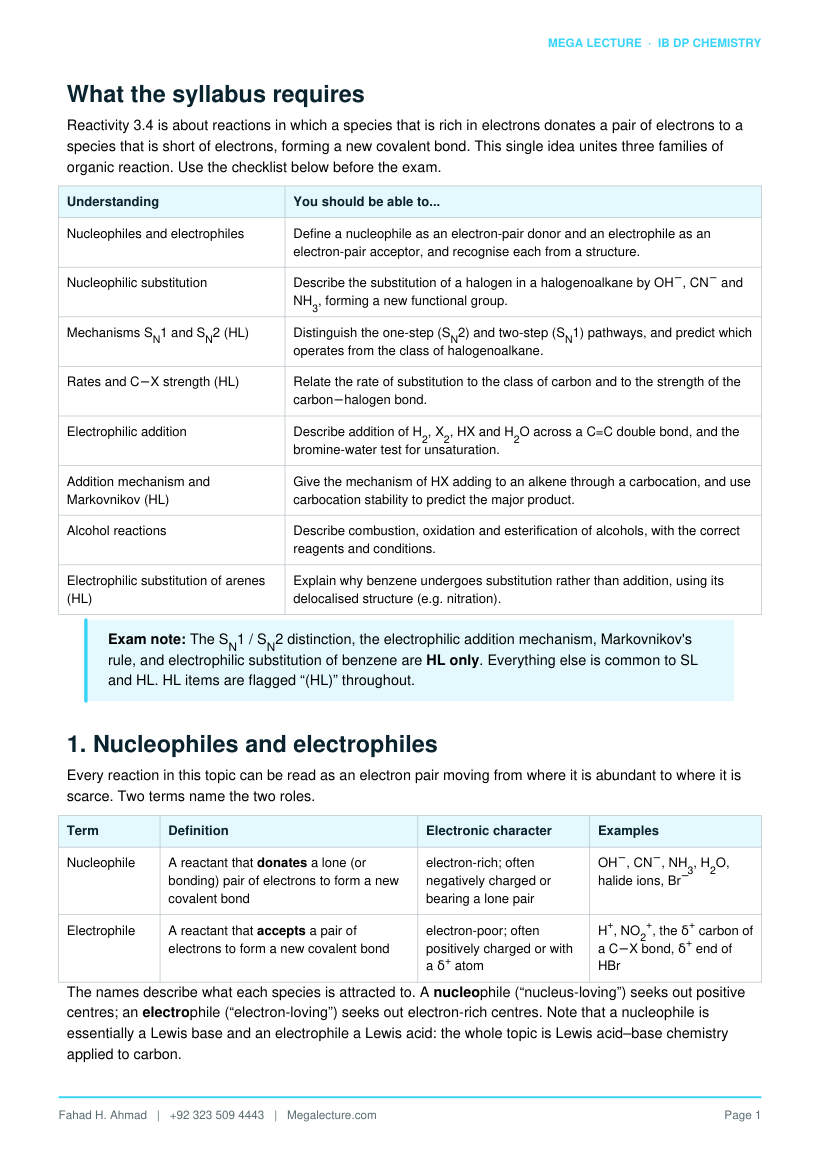
What the syllabus requires
Reactivity 3.4 is about reactions in which a species that is rich in electrons donates a pair of electrons to a species that is short of electrons, forming a new covalent bond. This single idea unites three families of organic reaction. Use the checklist below before the exam.
Understanding You should be able to...
Nucleophiles and electrophiles Define a nucleophile as an electron-pair donor and an electrophile as an electron-pair acceptor, and recognise each from a structure.
Nucleophilic substitution Describe the substitution of a halogen in a halogenoalkane by OH−, CN− and NH3, forming a new functional group.
Mechanisms SN1 and SN2 (HL) Distinguish the one-step (SN2) and two-step (SN1) pathways, and predict which operates from the class of halogenoalkane.
Rates and C−X strength (HL) Relate the rate of substitution to the class of carbon and to the strength of the carbon−halogen bond.
Electrophilic addition Describe addition of H2, X2, HX and H2O across a C=C double bond, and the bromine-water test for unsaturation.
Addition mechanism and Markovnikov (HL)
Give the mechanism of HX adding to an alkene through a carbocation, and use carbocation stability to predict the major product.
Alcohol reactions Describe combustion, oxidation and esterification of alcohols, with the correct reagents and conditions.
Electrophilic substitution of arenes (HL)
Explain why benzene undergoes substitution rather than addition, using its delocalised structure (e.g. nitration).
Exam note: The SN1 / SN2 distinction, the electrophilic addition mechanism, Markovnikov's rule, and electrophilic substitution of benzene are HL only. Everything else is common to SL and HL. HL items are flagged “(HL)” throughout.
1. Nucleophiles and electrophiles
Every reaction in this topic can be read as an electron pair moving from where it is abundant to where it is scarce. Two terms name the two roles.
Term Definition Electronic character Examples
Nucleophile A reactant that donates a lone (or bonding) pair of electrons to form a new covalent bond electron-rich; often negatively charged or bearing a lone pair
OH−, CN−, NH3, H2O, halide ions, Br−
Electrophile A reactant that accepts a pair of electrons to form a new covalent bond electron-poor; often positively charged or with a δ+ atom
H+, NO2
+, the δ+ carbon of a C−X bond, δ+ end of HBr
The names describe what each species is attracted to. A nucleophile (“nucleus-loving”) seeks out positive centres; an electrophile (“electron-loving”) seeks out electron-rich centres. Note that a nucleophile is essentially a Lewis base and an electrophile a Lewis acid: the whole topic is Lewis acid–base chemistry applied to carbon.
How to recognise them
- A nucleophile must have a lone pair or a negative charge to donate. Look for :OH−, :NH3, :CN−, or the oxygen of water.
- An electrophile must have an electron-deficient atom that can accept a pair. Look for a full positive charge, or a δ+ atom created by a polar bond.
- A double bond (C=C) is electron-rich, so an alkene behaves as a nucleophile and is attacked by electrophiles.
Bond polarity drives the attack
Where the reactant is a neutral molecule, it is the polarity of a bond that creates the target for attack. In a halogenoalkane the halogen is more electronegative than carbon, so the bond is polarised Cδ+−Xδ−. The carbon carries a partial positive charge and becomes the site an incoming nucleophile aims at. In an alkene, by contrast, the exposed π-electrons of the C=C bond are the electron-rich site, and a polar or polarisable molecule such as HBr is drawn in as the electrophile. Reading the partial charges first is the single most reliable way to predict what attacks what.
Key phrasing: In answers, always state the direction of electron flow: “the nucleophile donates its lone pair to the δ+ carbon”, or “the π-bond acts as a nucleophile toward the δ+ hydrogen of HBr”. Examiners reward the language of electron-pair donation and acceptance.
2. Halogenoalkanes: nucleophilic substitution
A halogenoalkane (haloalkane) contains a carbon–halogen bond, C−X, where X is Cl, Br or I. Because carbon is δ+, the carbon is open to attack by a nucleophile. The nucleophile takes the place of the halogen, which leaves as a halide ion. This swapping of one group for another is called substitution; because it is started by a nucleophile it is nucleophilic substitution.
General scheme
Nu− + R−X → R−Nu + X−
The C−X bond breaks (X leaves with both bonding electrons as X−, the leaving group), and a new C−Nu bond forms from the nucleophile's lone pair. The three reactions you must know differ only in the nucleophile.
Nucleophile Reagent / conditions Product (new functional group)
Overall equation (using bromoethane)
Hydroxide, OH− warm aqueous NaOH (or KOH); reflux an alcohol (−OH) CH3CH2Br + OH− → CH3CH2OH + Br−
Water, H2O water (slow); a milder route to the alcohol an alcohol (−OH) CH3CH2Br + H2O → CH3CH2OH + HBr
Cyanide, CN− KCN in ethanol; reflux (context) a nitrile (−CN); adds one carbon
CH3CH2Br + CN− → CH3CH2CN + Br−
Ammonia, NH3 excess NH3 in ethanol; sealed tube (context) a primary amine (−NH2) CH3CH2Br + 2NH3 → CH3CH2NH2 + NH4Br
The reaction with OH− (or with water) is the one to know in full: it converts a halogenoalkane into an alcohol and is the standard exam example. The reactions with cyanide and ammonia are given for context, but note their synthetic value: cyanide lengthens the carbon chain by one carbon, and ammonia introduces nitrogen to make an amine.
Watch the reagent: Warm aqueous NaOH gives substitution to an alcohol. Hot NaOH dissolved in ethanol instead favours elimination to an alkene (Reactivity 3.4 elsewhere). Same base, different solvent, different reaction — read the conditions carefully.
Two mechanisms: SN2 and SN1 (HL)
At HL you must describe how the substitution happens. There are two limiting mechanisms, and which one operates depends mainly on the class of halogenoalkane (primary, secondary or tertiary).
SN2 — one step, concerted
In the SN2 mechanism (“Substitution, Nucleophilic, bimolecular”) the nucleophile attacks the δ+ carbon from the side opposite the leaving group. Bond making and bond breaking happen together in a single step. At the half-way point the carbon is bonded partially to both the incoming nucleophile and the departing halide: this is the transition state, a high-energy arrangement (not an isolable species) in which the carbon is roughly trigonal with the three other groups in a plane. As the reaction completes, these three groups “flip through” like an umbrella in the wind (inversion of configuration).
HO− + CH3Br → [ HOδ−···CH3···Brδ− ]‡ → HOCH3 + Br−
Because both the halogenoalkane and the nucleophile are involved in the single, rate-determining step, the rate depends on the concentration of both: the reaction is second order overall.
rate = k [halogenoalkane][nucleophile] (SN2, second order)
Figure 1. The SN2 mechanism. The nucleophile HO− donates its lone pair to the δ+ carbon from the side opposite Br, while the C−Br bonding pair leaves with the bromide ion - all in one concerted step through a single transition state.
SN1 — two steps, via a carbocation
In the SN1 mechanism (“Substitution, Nucleophilic, unimolecular”) the C−X bond breaks first and on its own. Step 1 is the slow, rate-determining heterolysis of the C−X bond to give a positively charged carbocation intermediate and a halide ion. In step 2, which is fast, the nucleophile attacks the flat, electron-deficient carbocation.
Step 1 (slow): (CH3)3C−Br → (CH3)3C+ + Br−
Step 2 (fast): (CH3)3C+ + OH− → (CH3)3C−OH
Only the halogenoalkane takes part in the slow step, so the rate depends on the concentration of the halogenoalkane alone: the reaction is first order overall. The nucleophile, absent from the rate-determining step, does not appear in the rate equation.
rate = k [halogenoalkane] (SN1, first order) Which mechanism, and why
The deciding factor is how well the substrate stabilises a carbocation, and how crowded the carbon is.
Factor Favours SN2 Favours SN1
Class of halogenoalkane primary (RCH2X): little steric crowding, carbocation unstable tertiary (R3CX): carbocation well stabilised, back-side attack blocked
Secondary halogenoalkanes may proceed by either pathway (borderline) may proceed by either pathway (borderline)
Number of steps one concerted step, one transition state two steps, a carbocation intermediate
Nucleophile strong / concentrated nucleophile speeds it up rate independent of nucleophile
Solvent polar aprotic solvents help polar protic solvents (e.g. water) stabilise the ions and help
Rate law / order rate = k[RX][Nu], second order rate = k[RX], first order
The reason tertiary substrates favour SN1 is carbocation stability: the three alkyl groups around the positive carbon release electron density toward it (a positive inductive, or electron-donating, effect), spreading the charge and lowering the energy of the intermediate. A tertiary carbocation is therefore much more stable than a primary one, which is why it forms readily. The same three bulky groups also block a nucleophile from reaching the carbon from behind, so the SN2 route is shut down. Primary substrates show the opposite: no stable carbocation, but an open carbon that a nucleophile can reach, so SN2 dominates.
Relative reactivity primary < secondary < tertiary
Because tertiary halogenoalkanes form stable carbocations easily, they undergo substitution fastest by the SN1 route. Primary halogenoalkanes, forced down the slower SN2 route, react more slowly. In broad terms the order of reactivity for a given halogen and nucleophile is tertiary > secondary > primary.
Carbocation stability order: tertiary > secondary > primary > methyl. Commit this to memory — it explains both the SN1 preference of tertiary halogenoalkanes here and Markovnikov's rule for alkenes in Section 4.
Figure 2. Energy profiles for the two mechanisms. SN2 passes through a single transition state in one step; SN1 has two transition states with a carbocation intermediate between them, and the first step (loss of the leaving group) is the slow, rate-determining step.
3. Relative rates and C−X bond strength (HL)
For halogenoalkanes with the same carbon skeleton, the rate of substitution is controlled not by bond polarity but by bond strength. The step that breaks the C−X bond is easier when that bond is weaker, so the reaction is faster.
Carbon–halogen bond Bond enthalpy / kJ mol−1 Relative rate of substitution
C−F ~ 492 (strongest) slowest (essentially unreactive)
C−Cl ~ 324 slow
C−Br ~ 285 faster
C−I ~ 228 (weakest) fastest
The trend is the reverse of what a first glance at electronegativity might suggest. Fluorine is the most electronegative halogen and gives the most polar C−X bond, so you might expect the δ+ carbon to be most open to attack. But the C−F bond is also by far the strongest, and it is the ease of breaking this bond — not the size of the partial charge — that governs the rate. Going down the group the bond gets longer and weaker (the larger halogen's orbital overlaps the carbon less well), so C−I breaks most readily and iodoalkanes react fastest, while fluoroalkanes are practically inert.
One-line rule: Reactivity increases down Group 17: C−I > C−Br > C−Cl > C−F, because the bond enthalpy decreases and the weakest bond breaks fastest.
Figure 3. Carbon−halogen bond enthalpy sets the rate of substitution. C−F is the strongest bond (492 kJ mol−1) and reacts slowest; C−I is the weakest (228) and reacts fastest, so reactivity increases as the bond weakens down the group.
4. Alkenes: electrophilic addition
An alkene has a carbon–carbon double bond, C=C, made of a strong σ-bond and a weaker, exposed π-bond. The π-electrons stick out above and below the plane of the molecule, making the double bond a region of high electron density that attracts electrophiles. In an addition reaction the π-bond breaks and two new σ-bonds form: one molecule adds across the double bond and nothing is lost. The four additions below are the essential SL reactions.
Reagent Name / conditions Product Example (with ethene)
H2 hydrogenation; Ni catalyst, ~150 °C (or Pt/Pd) alkane CH2=CH2 + H2 → CH3CH3
X2 (Cl2, Br2) halogenation; room temperature, no catalyst dihalogenoalkane CH2=CH2 + Br2 → CH2BrCH2Br
HX (HCl, HBr, HI) hydrohalogenation; room temperature halogenoalkane CH2=CH2 + HBr → CH3CH2Br
H2O (steam) hydration; conc. H3PO4 or H2SO4 catalyst, steam alcohol CH2=CH2 + H2O → CH3CH2OH
Two of these deserve extra comment. Hydrogenation is the industrial route that hardens unsaturated vegetable oils into margarine. Hydration is the industrial manufacture of ethanol from ethene, catalysed by acid; it is the reverse of the dehydration of an alcohol.
The bromine-water test for unsaturation
The reaction of an alkene with bromine is the basis of a simple, memorable test that distinguishes an alkene (unsaturated) from an alkane (saturated). Bromine water is orange-brown. When it is shaken with an alkene, the bromine adds across the double bond to give a colourless product, so the orange-brown colour rapidly disappears (decolourises). An alkane has no double bond and cannot add bromine, so the
Test summary: Add bromine water (orange/brown). Alkene → decolourised (goes colourless). Alkane → no change (stays orange/brown). This is the standard test for a C=C double bond.
Mechanism of electrophilic addition: HBr + alkene (HL)
At HL you must describe the mechanism by which HBr adds to an alkene. Think of it in terms of where electron pairs move (“curly-arrow logic” described in words).
- Step 1 — electrophilic attack. The H−Br bond is polar, Hδ+−Brδ−. The electron-rich π-bond of the alkene acts as a nucleophile and donates its pair of electrons to the δ+ hydrogen of HBr. A new C−H bond forms; at the same time the H−Br bond breaks heterolytically, both electrons going to bromine to give a bromide ion, Br−. The other carbon of the old double bond is left one electron short and becomes a positively charged carbocation intermediate.
- Step 2 — nucleophilic capture. The bromide ion, now a nucleophile, uses one of its lone pairs to attack the positive carbon of the carbocation, forming a new C−Br bond. The product is a halogenoalkane.
CH2=CH2 + HBr → [CH3CH2]+ + Br− → CH3CH2Br
The reaction is called electrophilic addition because the first, decisive step is attack by an electrophile (the δ+ hydrogen) on the double bond. The same two-step logic — form a carbocation, then trap it — applies to the addition of the other hydrogen halides and, with a proton as the electrophile, to acid-catalysed hydration.
Markovnikov's rule and the major product (HL)
When the alkene is not symmetrical — for example propene, CH3CH=CH2 — the H and the Br could add either way round, giving two possible products. Markovnikov's rule predicts which one dominates: when HX adds to an unsymmetrical alkene, the hydrogen atom becomes attached to the carbon of the double bond that already carries the greater number of hydrogen atoms. A useful shorthand is “the rich get richer”: the H goes to the carbon with more H's already.
The reason lies in carbocation stability. In step 1 the proton can add to either carbon, giving either a secondary or a primary carbocation. Adding H to the CH2 end of propene makes a secondary carbocation, (CH3)CH+CH3; adding H to the CH end makes a less stable primary carbocation, +CH2CH2CH3. The more stable secondary carbocation forms in preference (recall: tertiary > secondary > primary), so bromide attacks the middle carbon and the major product is 2-bromopropane, CH3CHBrCH3, rather than 1-bromopropane.
CH3CH=CH2 + HBr → CH3CHBrCH3 (major, Markovnikov)
How to use the rule: To find the major product, (1) add H+ to each double-bond carbon in turn, (2) decide which carbocation is more stable (more alkyl groups = more stable), (3) attach the nucleophile (Br, or OH from water) to that more-substituted carbon.
5. Link: addition polymerisation
The same reactive C=C double bond lets many alkene molecules add to one another to build a long chain. In addition polymerisation the π-bonds open up and the monomer units join end-to-end with no atoms lost — the empirical formula of the polymer matches that of the monomer. Ethene (the monomer) polymerises to poly(ethene); the repeating unit is −(CH2−CH2)−.
n CH2=CH2 → −[CH2−CH2]n−
Connection: Addition polymerisation (covered fully in Structure 2.4) is simply electron-pair sharing at the C=C bond repeated many times — the same “open the π-bond and add” idea that underlies every reaction in Section 4.
6. Alcohols: key reactions
Alcohols (R−OH) are the products of several reactions above, and they undergo three reactions you must know: combustion, oxidation and esterification.
Combustion
Like other organic fuels, alcohols burn in a plentiful supply of oxygen to give carbon dioxide and water, releasing energy. Ethanol is used as a renewable fuel and fuel additive.
CH3CH2OH + 3O2 → 2CO2 + 3H2O
Oxidation
The oxidation of an alcohol depends on its class (primary, secondary or tertiary) and, for primary alcohols, on the conditions. The usual oxidising agent is acidified potassium dichromate(VI), K2Cr2O7/H2SO4, which changes colour from orange to green as Cr(VI) is reduced to Cr(III). In equations the oxidising agent is written simply as [O].
Alcohol class Product(s) and conditions Note
Primary, e.g. CH3CH2OH gentle heating + distillation → aldehyde (CH3CHO); heating under reflux with excess oxidant → carboxylic acid (CH3COOH) distil to stop at the aldehyde; reflux to go all the way to the acid
Secondary, e.g. (CH3)2CHOH heat with oxidant → ketone (CH3COCH3); no further oxidation ketone is the end point
Tertiary, e.g. (CH3)3COH not oxidised by acidified dichromate; dichromate stays orange no C−H bond on the C−OH carbon to remove
The reason a tertiary alcohol resists oxidation is structural: oxidation removes a hydrogen from the carbon bearing the −OH group, but in a tertiary alcohol that carbon has no hydrogen attached (it is bonded to three carbon groups). With no C−H bond to break there, there is nothing for the oxidant to remove, so the orange dichromate stays orange — a simple test that distinguishes tertiary from primary/secondary alcohols.
CH3CH2OH + [O] → CH3CHO + H2O (distil: aldehyde)
CH3CH2OH + 2[O] → CH3COOH + H2O (reflux: carboxylic acid)
Conditions are marked: “Distil” gives the aldehyde (it is removed as it forms, before it can be oxidised further). “Reflux” keeps everything in the flask so the aldehyde is oxidised on to the carboxylic acid. Stating the wrong condition loses the mark even if the product is right.
Esterification
An alcohol reacts with a carboxylic acid, warmed with a concentrated sulfuric acid catalyst, to form an ester and water. Because a small molecule (water) is eliminated as the two molecules join, this is a condensation reaction; it is reversible.
CH3COOH + CH3CH2OH → CH3COOCH2CH3 + H2O
The product here is ethyl ethanoate. Esters have characteristically sweet, fruity smells and are used as flavourings and solvents. Naming: the alcohol supplies the first part (“ethyl”, from ethanol) and the acid supplies the second (“ethanoate”, from ethanoic acid).
7. Arenes: electrophilic substitution of benzene (HL)
Benzene, C6H6, is the parent arene. Its six π-electrons are not fixed in three separate double bonds but delocalised in a ring above and below the plane of the six carbons. This delocalisation makes benzene unusually stable (lower in energy than the hypothetical molecule with three isolated C=C bonds).
Why substitution, not addition
An ordinary alkene undergoes addition, because opening the π-bond is energetically worthwhile. Benzene behaves differently: it reacts by substitution, in which an electrophile replaces a hydrogen atom on the ring. The reason is the stability of the delocalised ring. Addition across the ring would destroy the delocalised π-system and lose that extra stability, which is energetically unfavourable. Substitution, by contrast, keeps the aromatic ring intact: after the electrophile has replaced a hydrogen, the delocalised system is restored. Benzene is therefore electron-rich but far less reactive than an alkene, and it reacts with electrophiles by substitution.
Example: nitration (qualitative)
Warming benzene with a mixture of concentrated nitric acid and concentrated sulfuric acid (about 50 °C) replaces one ring hydrogen with a nitro group, −NO2, giving nitrobenzene. The sulfuric acid is a catalyst: it generates the nitronium ion, NO2
+, which is the electrophile that attacks the electron-rich ring. The ring's π-electrons attack the nitronium ion, and a hydrogen ion is then lost to regenerate the aromatic system — electrophilic substitution.
C6H6 + HNO3 → C6H5NO2 + H2O (conc. H2SO4 catalyst)
Contrast to remember: Alkene = localised π-bond → electrophilic addition. Benzene = delocalised π-ring → electrophilic substitution (keeps the stable aromatic system).
8. Worked examples
Worked example 1 — predict a substitution product
1-bromopropane is heated under reflux with aqueous potassium hydroxide. Give the organic product and the equation.
OH− is a nucleophile; it replaces Br in a nucleophilic substitution, giving an alcohol.
CH3CH2CH2Br + OH− → CH3CH2CH2OH (propan-1-ol) + Br−
Worked example 2 — classify SN1 or SN2 (HL)
2-bromo-2-methylpropane, (CH3)3CBr, reacts with water. State the mechanism, its order, and justify your choice.
The substrate is tertiary. A tertiary carbocation is stabilised by three electron-donating alkyl groups, and the crowded carbon blocks back-side attack, so the reaction goes by SN1.
Rate-determining step is the loss of Br− from the halogenoalkane alone, so the reaction is first order: rate = k[(CH3)3CBr].
Worked example 3 — the other extreme (HL)
Bromomethane, CH3Br, reacts with concentrated hydroxide. State and justify the mechanism.
The carbon is essentially primary (methyl) with no alkyl groups to stabilise a carbocation, but it is open to attack. The strong nucleophile attacks in one concerted step: SN2, second order, rate = k[CH3Br][OH−].
Worked example 4 — major product by Markovnikov (HL)
Predict the major product when HBr adds to but-1-ene, CH3CH2CH=CH2.
Add H+ to each double-bond carbon. Adding H to the terminal CH2 gives a secondary carbocation, CH3CH2CH+CH3; adding H to the other carbon gives a less stable primary carbocation. The secondary carbocation forms preferentially, so Br attaches to carbon-2.
Major product: 2-bromobutane, CH3CH2CHBrCH3.
Worked example 5 — oxidation product of an alcohol
Propan-2-ol, (CH3)2CHOH, is warmed with acidified potassium dichromate(VI). Give the product, the colour change, and name the type of compound.
Propan-2-ol is a secondary alcohol, so it is oxidised to a ketone, propanone (CH3COCH3), and no further. The dichromate changes from orange to green.
(CH3)2CHOH + [O] → CH3COCH3 + H2O
Worked example 6 — bromine-water test outcome
Two unlabelled bottles contain hexane and hex-1-ene. Describe a chemical test to tell them apart and give the result for each.
Add a few drops of bromine water (orange-brown) to a sample of each and shake. Hex-1-ene has a C=C double bond and adds bromine, so it decolourises the bromine water (orange → colourless). Hexane is saturated and gives no change (stays orange-brown). The bottle that decolourises the bromine water is hex-1-ene.
Worked example 7 — distinguish distillation from reflux
Ethanol is oxidised with acidified dichromate. What must be done to obtain (a) ethanal, (b) ethanoic acid?
- To stop at the aldehyde ethanal, distil the product off gently as it forms, removing it before it can be oxidised further.
- To reach the carboxylic acid ethanoic acid, heat under reflux with excess oxidant so the aldehyde is oxidised on to the acid.
Worked example 8 — name the ester
Propan-1-ol is warmed with ethanoic acid and a little concentrated sulfuric acid. Give the equation and name the ester.
Esterification (a condensation): the acid supplies the ethanoate part, the alcohol supplies the propyl part.
CH3COOH + CH3CH2CH2OH → CH3COOCH2CH2CH3 (propyl ethanoate) + H2O.
Worked example 9 — identify nucleophile and electrophile
In the addition of HBr to ethene, identify the electrophile and the nucleophile in each step, and name the intermediate.
Step 1: the electron-rich π-bond (nucleophile) donates to the δ+ hydrogen of HBr (the electrophile), forming a carbocation intermediate and Br−.
Step 2: Br− (now the nucleophile) donates a lone pair to the positive carbon of the carbocation (the electrophile), giving bromoethane.
9. Common pitfalls
- Substitution vs addition. Halogenoalkanes and benzene undergo substitution (a group is swapped, a small molecule may leave); alkenes undergo addition (a molecule adds across C=C, nothing leaves). Match the mechanism to the functional group.
- Markovnikov the wrong way. The H adds to the carbon that already has more H's, so the halogen (or OH) ends up on the more substituted carbon. Justify with carbocation stability, not by guessing.
- Oxidation conditions. Distillation gives the aldehyde; reflux gives the carboxylic acid. Quoting the product without the matching condition costs marks.
- Tertiary alcohols are not oxidised. Do not “invent” a product — acidified dichromate stays orange because there is no C−H on the C−OH carbon.
- Reagent/solvent mix-ups. NaOH(aq) gives substitution to an alcohol; NaOH in ethanol gives elimination to an alkene. KCN adds a carbon; NH3 adds nitrogen.
- Order of reaction (HL). SN2 is second order (rate depends on both reactants); SN1 is first order (rate depends on the halogenoalkane only).
- C−X reactivity (HL). Iodoalkanes react fastest and fluoroalkanes slowest — governed by bond strength, not by bond polarity.
- Nucleophile needs a lone pair. Species with no lone pair or negative charge (e.g. a bare cation, or CH4) cannot act as nucleophiles.
Reaction map: functional-group changes
Use this map to see how the reactions of Reactivity 3.4 interconvert the functional groups. Read each row as starting material + reagent → product.
Starting material Reagent / conditions Product alkene (C=C) H2, Ni catalyst alkane alkene (C=C) Br2 (or bromine water) dihalogenoalkane (test for unsaturation) alkene (C=C) HX halogenoalkane (Markovnikov, HL) alkene (C=C) steam, H+ catalyst alcohol halogenoalkane warm NaOH(aq) alcohol halogenoalkane KCN in ethanol nitrile (+1 carbon) halogenoalkane excess NH3 primary amine primary alcohol acidified dichromate, distil / reflux aldehyde / carboxylic acid secondary alcohol acidified dichromate, heat ketone alcohol + carboxylic acid conc. H2SO4 ester + water benzene (HL) conc. HNO3 / conc. H2SO4 nitrobenzene (substitution)
10. Quick reference
Idea Statement
Nucleophile / electrophile electron-pair donor (Lewis base) / electron-pair acceptor (Lewis acid)
Halogenoalkane + OH− nucleophilic substitution → alcohol + X− (warm NaOH(aq))
Other nucleophiles CN− → nitrile (+1 carbon); NH3 → primary amine
Idea Statement
SN2 (HL) one step, transition state, back-side attack; primary; rate = k[RX][Nu], 2nd order
SN1 (HL) two steps via carbocation; tertiary; rate = k[RX], 1st order
Reactivity of RX (HL) tertiary > secondary > primary; C−I > C−Br > C−Cl > C−F
Alkene additions H2/Ni → alkane; X2 → dihalide; HX → halogenoalkane; H2O/H+ → alcohol
Test for C=C bromine water decolourised (orange → colourless)
Markovnikov (HL) H adds to the C with more H's; major product via the more stable carbocation
Alcohol oxidation 1°: distil → aldehyde, reflux → acid; 2° → ketone; 3° not oxidised
Esterification acid + alcohol → ester + water (conc. H2SO4, condensation)
Benzene (HL) delocalised ring → electrophilic substitution (e.g. nitration by NO2
+)
11. Test yourself
Attempt all ten without notes, then check against the full worked answers below.
- Define the terms nucleophile and electrophile, and state which one attacks a halogenoalkane and why.
- Write the equation for the reaction of chloroethane with warm aqueous sodium hydroxide, and name the organic product.
- Give the organic products of the reactions of 1-bromopropane with (a) KCN in ethanol, (b) excess ammonia.
- (HL) 2-chloro-2-methylpropane and 1-chlorobutane are each hydrolysed. Predict the mechanism (SN1 or SN2) for each and give the rate equation.
- (HL) Place the bonds C−Cl, C−Br and C−I in order of increasing rate of nucleophilic substitution, and explain the trend.
- State the reagents and conditions, and give the organic product, for the addition of (a) hydrogen, (b) steam, to ethene.
- Describe a test to distinguish but-2-ene from butane, including the observation for each.
- (HL) Predict, with reasoning, the major product of the reaction between propene and HCl.
- Give the product and conditions when butan-1-ol is oxidised to (a) an aldehyde, (b) a carboxylic acid. State why 2-methylpropan-2-ol cannot be oxidised this way.
- (HL) Explain why benzene undergoes substitution rather than addition when it reacts with an electrophile.
Worked answers
- A nucleophile is an electron-pair donor (electron-rich, has a lone pair or negative charge); an electrophile is an electron-pair acceptor (electron-deficient). A halogenoalkane is attacked by a nucleophile because the C−X bond is polarised Cδ+−Xδ−, leaving the carbon δ+ and open to donation of an electron pair.
- CH3CH2Cl + OH− → CH3CH2OH + Cl−. Organic product: ethanol (nucleophilic substitution).
- (a) With CN−: butanenitrile, CH3CH2CH2CN (the chain gains one carbon). (b) With excess NH3: propan-1-amine, CH3CH2CH2NH2.
- 2-chloro-2-methylpropane is tertiary → SN1, rate = k[(CH3)3CCl] (first order; forms a stable tertiary carbocation). 1-chlorobutane is primary → SN2, rate = k[RCl][OH−] (second order; concerted attack on an unhindered carbon).
- Increasing rate: C−Cl < C−Br < C−I. The bond enthalpy decreases from C−Cl to C−I (the bond gets longer and weaker down the group), so the C−X bond breaks more easily and substitution is faster. C−I is weakest, so it reacts fastest.
- (a) Hydrogen: H2 with a nickel catalyst, ~150 °C (hydrogenation) → ethane, CH3CH3. (b) Steam: H2O(g) with a concentrated H3PO4 (acid) catalyst (hydration) → ethanol, CH3CH2OH.
- Add bromine water to each and shake. But-2-ene (has C=C) decolourises it (orange-brown → colourless) by addition; butane is saturated and gives no change (stays orange-brown).
- By Markovnikov's rule the H adds to the CH2 end (the carbon with more H's), giving the more stable secondary carbocation CH3CH+CH3; Cl− then attaches to the middle carbon. Major product: 2-chloropropane, CH3CHClCH3.
- (a) Aldehyde butanal, CH3CH2CH2CHO, by gentle oxidation with distillation to remove it as it forms. (b) Carboxylic acid butanoic acid, CH3CH2CH2COOH, by heating under reflux with excess acidified dichromate. 2-methylpropan-2-ol is tertiary: the C−OH carbon has no hydrogen to remove, so it is not oxidised (dichromate stays orange).
- Benzene's six π-electrons are delocalised over the ring, giving extra stability. Addition would break up this delocalised system and lose that stability, which is unfavourable. Substitution replaces a hydrogen while keeping the aromatic ring intact, so benzene reacts with electrophiles by substitution rather than addition.
