
IB Diploma · Chemistry · SL / HL · Reactivity 3: What Are the Mechanisms of Chemical Change?
Reactivity 3.2 Electron Transfer Reactions
Need more than one subject? All-notes pass: unlimited downloads of every note for a year: unlimited downloads of every note on the site, PKR 999 a year. All packs and courses.
Opens inside this page. Prefer your own PDF app? Open the PDF.
Chemistry batch classes: coming soon. Small live classes at a lower fee than one-to-one. Join the waiting list
Check yourself
5 quick questions on Reactivity 3: What are the mechanisms of chemical change?
Tap an answer to see if you are right, and why. Free, no sign-up.
Start the free testWas this note useful?
Full text of Reactivity 3.2 Electron Transfer Reactions
IB DP CHEMISTRY Reactivity 3: What Are the Mechanisms of Chemical Change? Reactivity 3.2 Electron Transfer Reactions
Revision Notes · Standard and Higher Level Fahad H. Ahmad
Original notes prepared for the IB Diploma Programme Chemistry course (2025 syllabus)
Free notes, practice tests and live classes Back to megalecture.com
What the syllabus requires
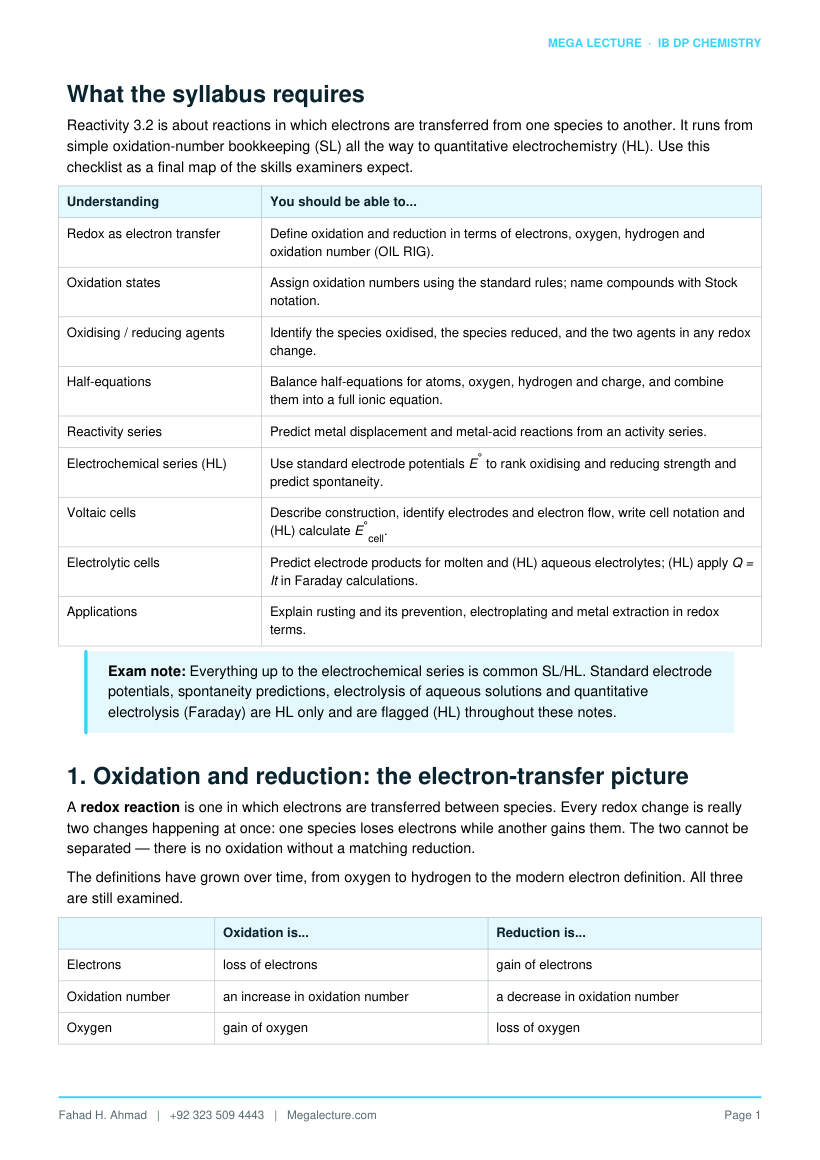
Reactivity 3.2 is about reactions in which electrons are transferred from one species to another. It runs from simple oxidation-number bookkeeping (SL) all the way to quantitative electrochemistry (HL). Use this checklist as a final map of the skills examiners expect.
Understanding You should be able to...
Redox as electron transfer Define oxidation and reduction in terms of electrons, oxygen, hydrogen and oxidation number (OIL RIG).
Oxidation states Assign oxidation numbers using the standard rules; name compounds with Stock notation.
Oxidising / reducing agents Identify the species oxidised, the species reduced, and the two agents in any redox change.
Half-equations Balance half-equations for atoms, oxygen, hydrogen and charge, and combine them into a full ionic equation.
Reactivity series Predict metal displacement and metal-acid reactions from an activity series.
Electrochemical series (HL) Use standard electrode potentials E° to rank oxidising and reducing strength and predict spontaneity.
Voltaic cells Describe construction, identify electrodes and electron flow, write cell notation and (HL) calculate E° cell.
Electrolytic cells Predict electrode products for molten and (HL) aqueous electrolytes; (HL) apply Q = It in Faraday calculations.
Applications Explain rusting and its prevention, electroplating and metal extraction in redox terms.
Exam note: Everything up to the electrochemical series is common SL/HL. Standard electrode potentials, spontaneity predictions, electrolysis of aqueous solutions and quantitative electrolysis (Faraday) are HL only and are flagged (HL) throughout these notes.
1. Oxidation and reduction: the electron-transfer picture
A redox reaction is one in which electrons are transferred between species. Every redox change is really two changes happening at once: one species loses electrons while another gains them. The two cannot be separated — there is no oxidation without a matching reduction.
The definitions have grown over time, from oxygen to hydrogen to the modern electron definition. All three are still examined.
Oxidation is... Reduction is...
Electrons loss of electrons gain of electrons
Oxidation number an increase in oxidation number a decrease in oxidation number
Oxygen gain of oxygen loss of oxygen
Oxidation is... Reduction is...
Hydrogen loss of hydrogen gain of hydrogen
- OIL RIG is the memory hook: Oxidation Is Loss, Reduction Is Gain — of electrons.
For example, when magnesium burns in oxygen:
2Mg(s) + O2(g) → 2MgO(s) each magnesium atom loses two electrons (Mg → Mg2+ + 2e−) and is oxidised, while each oxygen atom gains two electrons (O + 2e− → O2−) and is reduced. The oxygen definition and the electron definition agree: magnesium gains oxygen and loses electrons.
Oxidising agents and reducing agents
The two reactants play opposite roles, and the naming trips up many students because each agent does the opposite of what its own name suggests.
Species What it does What happens to it Contains / becomes
Oxidising agent oxidises the other species (takes its electrons) is itself reduced gains electrons; ox. number falls
Reducing agent reduces the other species (gives it electrons) is itself oxidised loses electrons; ox. number rises
In 2Mg + O2 → 2MgO, magnesium is the reducing agent (it is oxidised) and oxygen is the oxidising agent (it is reduced). Common laboratory oxidising agents include acidified MnO4
−, Cr2O7
2−, Cl2 and concentrated HNO3; common reducing agents include reactive metals, H2, C, and ions such as Fe2+ and I−.
Exam trap: The oxidising agent is the species that is reduced; the reducing agent is the species that is oxidised. Write the two half-changes first, then read off which is which — do not guess from the name.
2. Oxidation states (oxidation numbers)
The oxidation state of an atom is the charge it would carry if every bond were treated as fully ionic — that is, if the shared electrons were given entirely to the more electronegative atom. It is a piece of bookkeeping, not a real charge, but it lets us track electron transfer even in covalent species.
Rules for assigning oxidation numbers
Apply the rules in order; the higher a rule sits in the list, the higher its priority when two rules conflict.
Rule Oxidation number
Free element (uncombined), e.g. Na, O2, P4
Monatomic ion, e.g. Na+, S2− equal to the ionic charge (+1, −2)
Group 1 metals / Group 2 metals in compounds +1 / +2
Fluorine in compounds −1 (always)
Hydrogen in compounds +1 (but −1 in metal hydrides, e.g. NaH)
Rule Oxidation number
Oxygen in compounds −2 (but −1 in peroxides, +2 in OF2)
Sum over a neutral compound
Sum over a polyatomic ion equal to the charge on the ion
Stock notation
When an element can take more than one oxidation state, the state is shown as a Roman numeral in brackets after the element name — this is Stock notation. It removes ambiguity: iron(II) chloride is FeCl2, iron(III) chloride is FeCl3; copper(I) oxide is Cu2O, copper(II) oxide is CuO. In oxoanions the numeral refers to the central atom, so sulfate(VI) is SO4
2− and sulfate(IV) (sulfite) is SO3 2−.
Worked example 1 — assigning oxidation numbers
Find the oxidation number of the underlined atom in each species.
- S in H2SO4: 2(+1) + S + 4(−2) = 0, so S = +6.
- Cr in Cr2O7
2−: 2Cr + 7(−2) = −2, so 2Cr = +12 and Cr = +6.
- N in NH4
+: N + 4(+1) = +1, so N = −3.
- O in H2O2 (a peroxide): the O−O bond makes each O = −1, overriding the usual −2.
- Fe in Fe3O4: 3Fe + 4(−2) = 0, so Fe = +8/3 — a fractional average, because the solid is really FeO·Fe2O3 (a mix of +2 and +3 iron).
Using oxidation-number changes to identify redox
Assign oxidation numbers to every atom on both sides of an equation. If any atom changes its oxidation number, the reaction is redox. The atom whose number rises is oxidised; the atom whose number falls is reduced. If no number changes (as in most acid-base or precipitation reactions), the reaction is not redox.
Worked example 2 — is it redox, and what is oxidised?
Classify each reaction; if redox, name the species oxidised and reduced.
- Zn(s) + Cu2+(aq) → Zn2+(aq) + Cu(s)
Zn: 0 → +2 (oxidised); Cu: +2 → 0 (reduced). Redox. Zn is the reducing agent, Cu2+ the oxidising agent.
- AgNO3(aq) + NaCl(aq) → AgCl(s) + NaNO3(aq)
Every atom keeps its oxidation number (Ag +1, Cl −1, Na +1, N +5, O −2). Not redox — it is a precipitation reaction.
- Cl2(aq) + 2NaOH(aq) → NaCl(aq) + NaClO(aq) + H2O(l)
Chlorine goes 0 → −1 (in NaCl) and 0 → +1 (in NaClO). One element is both oxidised and reduced: this is disproportionation.
Figure 2.1. Tracking oxidation numbers. In Zn + Cu2+, Zn rises 0 → +2 (oxidised, loses 2e−) while Cu falls +2 → 0 (reduced, gains 2e−). For MnO4
− + Fe2+, Mn falls +7 → +2 (gains 5e−) and five Fe2+ each rise +2 → +3, balancing the 5 electrons.
3. Balancing redox equations by half-equations
A half-equation shows one half of a redox process, with the electrons written explicitly. Reduction half-equations have electrons on the left (gained); oxidation half-equations have electrons on the right (lost).
The five-step method (acidic solution)
- Write the species that change, and balance all atoms except O and H. 2. Balance O by adding H2O. 3. Balance H by adding H+. 4. Balance charge by adding electrons (e−) to the more positive side. 5. Check: atoms balance and the total charge is equal on both sides.
Worked example 3 — a half-equation in acid
Balance the reduction of the manganate(VII) ion, MnO4
−, to Mn2+ in acidic solution.
Step 1 (Mn balanced): MnO4
− → Mn2+
Step 2 (O with H2O): MnO4
− → Mn2+ + 4H2O
Step 3 (H with H+): 8H+ + MnO4
− → Mn2+ + 4H2O
Step 4 (charge): left = 8(+1) + (−1) = +7; right = +2. Add 5e− to the left:
8H+ + MnO4
− + 5e− → Mn2+ + 4H2O (charge +2 both sides).
Combining half-equations
To build a full ionic equation, multiply each half-equation so that the electrons lost equal the electrons gained, then add the two and cancel the electrons (and any species appearing identically on both sides).
Worked example 4 — combining half-equations
Manganate(VII) oxidises iron(II) in acid. Combine the two half-equations.
Reduction: 8H+ + MnO4
− + 5e− → Mn2+ + 4H2O (gains 5e−)
Oxidation: Fe2+ → Fe3+ + e− (loses 1e−)
Multiply the iron half-equation by 5 so both involve 5e−, then add and cancel electrons:
MnO4
− + 8H+ + 5Fe2+ → Mn2+ + 5Fe3+ + 4H2O
Check charge: left = (−1) + 8 + 5(+2) = +17; right = (+2) + 5(+3) = +17. Balanced.
Balancing in basic solution (HL)
In alkaline conditions H+ cannot appear in the final equation. Balance first as if acidic, then neutralise every H+ by adding the same number of OH− to both sides. The H+ and OH− on one side combine to water; cancel any water that then appears on both sides.
Worked example 5 (HL) — a half-equation in base
Balance the reduction of MnO4
− to MnO2(s) in basic solution.
Acidic form first: 4H+ + MnO4
− + 3e− → MnO2 + 2H2O
Add 4OH− to both sides; the 4H+ + 4OH− on the left become 4H2O:
4H2O + MnO4 − + 3e− → MnO2 + 2H2O + 4OH−
Cancel 2H2O from each side:
2H2O + MnO4
− + 3e− → MnO2 + 4OH− (charge −4 both sides).
Checkpoint: A correctly balanced half- or full equation must balance for both atoms and charge. Always finish by adding up the charge on each side — it is the fastest way to catch a slip with electrons or H+.
4. The reactivity series and displacement reactions
Metals differ in how readily they give up electrons to form positive ions. Ranking them by this tendency gives the reactivity (activity) series. A more reactive metal is a stronger reducing agent and will displace a less reactive metal from a solution of its ions.
Metal (most → least reactive) Reaction with water / acid Tendency to lose e−
K, Na, Ca react with cold water; violent with acids greatest (strongest reducing agents)
Mg, Al, Zn, Fe slow / no reaction with water; react with dilute acid → H2 high
Pb, (H), Cu Pb slowly, Cu not at all, with dilute acid low
Ag, Au, Pt unreactive; found native least (very weak reducing agents)
Metal displacement
If a strip of zinc is placed in blue copper(II) sulfate solution, the blue colour fades and a red-brown deposit of copper forms on the zinc:
Zn(s) + Cu2+(aq) → Zn2+(aq) + Cu(s)
Zinc is above copper in the series, so zinc atoms hand electrons to copper ions: zinc is oxidised, copper(II) is reduced. The reverse experiment — copper in zinc sulfate — does not occur, because copper is the weaker reducing agent. This is how the series lets you predict whether a reaction will happen.
Metal-acid reactions
Any metal above hydrogen in the series reduces H+ from a dilute acid, releasing hydrogen gas:
Mg(s) + 2H+(aq) → Mg2+(aq) + H2(g)
The rate of effervescence mirrors the ranking: magnesium fizzes vigorously, zinc steadily, iron slowly; copper (below hydrogen) does not react with dilute HCl or H2SO4 at all. Metals below hydrogen dissolve only in oxidising acids that attack them by a different route.
Worked example 6 — predicting a displacement
Will a reaction occur when (a) iron is added to silver nitrate solution, (b) silver is added to iron(II) sulfate solution?
- Iron is above silver, so iron displaces silver. Reaction occurs:
Fe(s) + 2Ag+(aq) → Fe2+(aq) + 2Ag(s).
- Silver is below iron and is a weaker reducing agent, so it cannot displace iron. No reaction.
5. The electrochemical series and standard electrode potentials (HL)
The reactivity series is qualitative. Electrochemistry makes the same ordering quantitative through standard electrode potentials, E°, measured in volts. Each E° is the potential of a half-cell, written as a reduction, relative to a common reference.
The standard hydrogen electrode (SHE)
Absolute electrode potentials cannot be measured, so all values are quoted against the standard hydrogen electrode, defined as exactly 0.00 V. The SHE consists of H2 gas at 100 kPa bubbled over a platinum electrode dipping in 1 mol dm−3 H+(aq) at 298 K:
2H+(aq) + 2e− ⇌ H2(g) E° = 0.00 V
Standard conditions are 298 K, 100 kPa for gases, and 1 mol dm−3 for solutions. Under these conditions the measured cell voltage against the SHE gives the E° of the other half-cell.
Reading the electrochemical series
Half-equations are listed as reductions in order of E°. A more positive E° means the species on the left is more easily reduced — a stronger oxidising agent. A more negative E° means the species on the right is more easily oxidised — a stronger reducing agent.
Reduction half-equation E° / V Note
F2 + 2e− ⇌ 2F− +2.87 strongest oxidising agent (top)
Cl2 + 2e− ⇌ 2Cl− +1.36 strong oxidising agent
Ag+ + e− ⇌ Ag +0.80
Cu2+ + 2e− ⇌ Cu +0.34
2H+ + 2e− ⇌ H2 0.00 reference (SHE)
Fe2+ + 2e− ⇌ Fe −0.44
Zn2+ + 2e− ⇌ Zn −0.76
Na+ + e− ⇌ Na −2.71 strong reducing agent (Na)
Li+ + e− ⇌ Li −3.04 strongest reducing agent (bottom)
Figure 5.1. Standard electrode potentials E° measured against the SHE (0.00 V); a more positive E° marks a stronger oxidising agent. Pairing Cu (+0.34 V, cathode) with Zn (−0.76 V, anode) gives E° cell = E° cathode − E° anode = (+0.34) − (−0.76) = +1.10 V.
Predicting spontaneity from E°
Combine two half-cells into a full cell. The half-cell with the more positive E° runs as the reduction (cathode); the other reverses and runs as the oxidation (anode). The standard cell potential is
E° cell = E° cathode − E° anode
If E° cell is positive, the reaction as written is spontaneous under standard conditions (and °G° is negative). If E° cell is negative, the reaction is not spontaneous — the reverse reaction is. A larger positive E° cell means a stronger thermodynamic driving force.
Key rule: A spontaneous redox reaction pairs the stronger oxidising agent (higher E°, reduced) with the stronger reducing agent (lower E°, oxidised). Positive E° cell → it goes.
Worked example 7 (HL) — spontaneity from E°
Use E°(Cu2+/Cu) = +0.34 V and E°(Zn2+/Zn) = −0.76 V to decide whether Zn(s) reacts with Cu2+(aq).
Cu2+/Cu is more positive, so it is the cathode (reduction); Zn2+/Zn is the anode (oxidation), i.e. Zn is oxidised.
E° cell = E° cathode − E° anode = (+0.34) − (−0.76) = +1.10 V.
Positive, so the reaction Zn(s) + Cu2+(aq) → Zn2+(aq) + Cu(s) is spontaneous — confirming the displacement of Section 4.
6. Voltaic (galvanic) cells
A voltaic cell converts the free energy of a spontaneous redox reaction into electrical energy. It works by physically separating the two half-reactions so that the electrons have to travel through an external wire, where they can do useful work.
Construction
- Two half-cells, each a metal electrode dipping in a solution of its own ions (e.g. Zn in ZnSO4, Cu in CuSO4).
- An external wire (often through a voltmeter) connecting the electrodes, carrying the electrons.
- A salt bridge (e.g. KNO3 in agar) that completes the circuit by letting ions migrate, keeping each solution electrically neutral.
Figure 6.1. The Zn−Cu (Daniell) voltaic cell. Zinc is the anode (−, oxidation) and copper the cathode (+, reduction); electrons flow through the external wire from anode to cathode while ions migrate through the salt bridge. Standard cell potential E° cell = +1.10 V.
Electrode roles and electron flow
Oxidation always happens at the anode and reduction at the cathode (mnemonic: AN OX and RED CAT). In a voltaic cell the anode is the negative terminal (electrons are released there) and the cathode is the positive terminal. Electrons flow through the external wire from anode (−) to cathode (+); in the salt bridge, anions move toward the anode and cations toward the cathode.
Anode Cathode
Process oxidation (loss of e−) reduction (gain of e−)
Sign (voltaic) negative (−) positive (+)
Zn/Cu example Zn → Zn2+ + 2e− Cu2+ + 2e− → Cu
Electrode mass decreases (dissolves) increases (metal deposits)
Cell diagram (notation)
The cell is summarised by a cell diagram: anode on the left, cathode on the right, a single vertical line for a phase boundary and a double line for the salt bridge:
Zn(s) | Zn2+(aq) || Cu2+(aq) | Cu(s)
The measured potential difference across the terminals is the cell potential (EMF). For the Daniell (Zn/Cu) cell it is +1.10 V under standard conditions.
Worked example 8 (HL) — cell notation and EMF
A voltaic cell is built from Mg2+/Mg (E° = −2.37 V) and Ag+/Ag (E° = +0.80 V). Give the cell diagram and E° cell.
Ag+/Ag is more positive → cathode (reduction); Mg2+/Mg → anode (oxidation).
E° cell = (+0.80) − (−2.37) = +3.17 V.
Cell diagram: Mg(s) | Mg2+(aq) || Ag+(aq) | Ag(s). The overall reaction is Mg + 2Ag+ → Mg2+ + 2Ag.
Note: although two Ag+ are reduced, E° is an intensive property and is not multiplied by the coefficient.
7. Electrolytic cells
An electrolytic cell does the opposite of a voltaic cell: it uses an external power supply to drive a non-spontaneous redox reaction. Electrical energy is converted into chemical energy — for example, decomposing a stable compound into its elements.
The battery pushes electrons onto the cathode, making it the negative electrode, where cations are reduced; it draws electrons from the anode, making it the positive electrode, where anions are oxidised. Oxidation is still at the anode and reduction still at the cathode — only the signs are swapped relative to a voltaic cell.
Electrolysis of molten salts
A molten binary ionic compound gives its two elements: the metal at the cathode and the non-metal at the anode. For molten lead(II) bromide:
Cathode (−): Pb2+ + 2e− → Pb(l) Anode (+): 2Br− → Br2(g) + 2e−
Electrolysis of aqueous solutions (HL)
In water there is competition, because water itself can be oxidised or reduced. Which ion is discharged (selective discharge) depends on the electrode potentials, the concentration of the solution, and the nature of the electrode.
Electrode Species competing General outcome
Cathode (−) metal cation vs H2O/H+ less reactive metals (below H, e.g. Cu, Ag) deposit; very reactive metals (K, Na, Ca, Al) stay in solution and H2 is released
Electrode Species competing General outcome
Anode (+) anion vs H2O/OH− with inert electrodes: concentrated halides give the halogen; dilute or oxoanion solutions (SO4
2−, NO3 −) give O2 So dilute sulfuric acid (or Na2SO4) gives H2 at the cathode and O2 at the anode — the net electrolysis of water. Concentrated NaCl (brine) gives H2 at the cathode and Cl2 at the anode, leaving NaOH in solution.
Inert vs active electrodes
Inert electrodes (graphite, platinum) only carry current. Active electrodes take part: in copper refining with copper electrodes, the anode dissolves (Cu → Cu2+ + 2e−) and pure copper plates onto the cathode. Choosing an active electrode can change the anode product entirely.
Voltaic vs electrolytic — a comparison
Feature Voltaic (galvanic) cell Electrolytic cell
Energy change chemical → electrical electrical → chemical
Reaction spontaneous (E° cell > 0) non-spontaneous (driven by supply)
Anode sign negative (−) positive (+)
Cathode sign positive (+) negative (−)
Anode process oxidation oxidation
Cathode process reduction reduction
Electrolyte two half-cells + salt bridge single molten/aqueous electrolyte
Exam trap: In both cells the anode is where oxidation happens and the cathode is where reduction happens — that never changes. What flips is the sign: the anode is − in a voltaic cell but + in an electrolytic cell.
Quantitative electrolysis — Faraday's laws (HL)
The amount of product is proportional to the charge passed. Charge is
Q = It (charge / C = current / A × time / s)
One mole of electrons carries the Faraday constant, F ≈ 96500 C mol−1. So the moles of electrons passed = Q / F. Combine this with the electrode half-equation, which gives the mole ratio of electrons to product.
moles of e− = It / F
Worked example 9 (HL) — a Faraday calculation
A current of 1.50 A flows for 45.0 minutes through molten CuCl2. What mass of copper is deposited at the cathode? (F = 96500 C mol−1; Ar Cu = 63.5)
Charge: Q = It = 1.50 × (45.0 × 60) = 1.50 × 2700 = 4050 C.
Moles of electrons = Q/F = 4050 / 96500 = 0.0420 mol.
Cathode half-equation: Cu2+ + 2e− → Cu, so moles of Cu = 0.0420 / 2 = 0.0210 mol.
Mass = 0.0210 × 63.5 = 1.33 g of copper.
Worked example 10 (HL) — gas volume at an electrode
In the same cell, what volume of chlorine (at STP, molar volume 22.7 dm3 mol−1) is produced at the anode over the 45.0 minutes?
Anode: 2Cl− → Cl2 + 2e−. Moles of e− = 0.0420 mol (same charge), so moles of Cl2 = 0.0210 mol.
Volume = 0.0210 × 22.7 = 0.477 dm3 (about 477 cm3).
8. Applications of electron transfer
Rusting of iron
Rusting is the electrochemical corrosion of iron: it needs both oxygen and water. Part of the iron surface acts as an anode where iron is oxidised, and another part acts as a cathode where oxygen is reduced:
Anode: Fe(s) → Fe2+(aq) + 2e− Cathode: O2(g) + 2H2O(l) + 4e− → 4OH−(aq)
The Fe2+ is further oxidised by oxygen to hydrated iron(III) oxide, Fe2O3·xH2O — the flaky brown solid we call rust. Salt speeds corrosion by raising the conductivity of the solution.
Preventing rust: sacrificial protection
- Barrier methods (paint, oil, plastic, galvanising with zinc) keep out oxygen and water.
- Sacrificial protection: attach a more reactive metal such as zinc or magnesium. Being the stronger reducing agent, it is oxidised in preference to the iron, so the iron is protected even if the coating is scratched. Blocks of zinc bolted to ship hulls and underground pipelines work this way.
- Galvanising combines both ideas: the zinc layer is a barrier and a sacrificial anode.
Electroplating
Electroplating uses electrolysis to coat an object with a thin layer of metal for protection or appearance. The object to be plated is the cathode; the plating metal is the anode; the electrolyte contains ions of that metal. To silver-plate a spoon, the spoon is the cathode in silver nitrate solution with a silver anode:
Cathode: Ag+(aq) + e− → Ag(s) Anode: Ag(s) → Ag+(aq) + e−
Metal extraction
The position of a metal in the reactivity series decides how it is extracted. Very reactive metals (K, Na, Ca, Mg, Al) hold their ions too strongly to be reduced by carbon, so they are obtained by electrolysis of a molten compound — aluminium from molten Al2O3, sodium from molten NaCl. Less reactive metals such as iron and zinc are reduced from their ores by carbon (a cheaper chemical reducing agent) in a furnace, while the least reactive metals (Au, Ag, Pt) occur native or need only gentle treatment.
9. Common pitfalls
- Forgetting the exceptions to the oxygen and hydrogen rules: O is −1 in peroxides and +2 in OF2; H is −1 in metal hydrides.
- Mixing up the agents: the oxidising agent is the species reduced, and the reducing agent is the species oxidised.
- Balancing charge before atoms, or forgetting to check total charge at the end of a half-equation.
- Assuming the anode is always negative. It is − in a voltaic cell but + in an electrolytic cell; only “oxidation at the anode” is constant.
- Multiplying E° by the stoichiometric coefficient when combining half-cells. E° is intensive and is never scaled.
- Using minutes instead of seconds in Q = It, or forgetting to divide by the number of electrons in the electrode half-equation.
- Predicting aqueous electrolysis products without checking concentration — concentrated NaCl gives Cl2, but very dilute NaCl gives O2.
10. Quick reference
Idea Statement
OIL RIG Oxidation Is Loss, Reduction Is Gain (of electrons).
Oxidising agent is reduced (gains e−); reducing agent is oxidised (loses e−).
Half-equation balancing atoms; O with H2O; H with H+; charge with e− (then OH− for base, HL).
Displacement a more reactive metal displaces a less reactive metal from solution.
Spontaneity (HL) E° cell = E° cathode − E° anode; positive → spontaneous.
Electrode processes AN OX (oxidation at anode); RED CAT (reduction at cathode) — in both cell types.
Cell signs voltaic: anode −, cathode +. electrolytic: anode +, cathode −.
Cell notation anode | anode ion || cathode ion | cathode.
Faraday (HL) Q = It; moles e− = Q/F; F ≈ 96500 C mol−1.
11. Test yourself
Attempt all ten without notes, then check against the full answers that follow.
- Find the oxidation number of chlorine in (a) Cl2, (b) NaCl, (c) ClO3 −, (d) ClO4
−.
- In the reaction 2Al + 3Cu2+ → 2Al3+ + 3Cu, identify the species oxidised, the species reduced, the oxidising agent and the reducing agent.
- Balance in acid: Cr2O7 2− → Cr3+ (a reduction half-equation).
- Combine the half-equations MnO4 − + 8H+ + 5e− → Mn2+ + 4H2O and C2O4
2− → 2CO2 + 2e− into a full ionic equation.
- Using the series in Section 5, will Cu(s) react with dilute HCl? Explain with E° values.
- (HL) A cell is made from Ni2+/Ni (E° = −0.26 V) and Ag+/Ag (E° = +0.80 V). Give the cell diagram, state the electron flow direction, and calculate E° cell.
- Predict the products of electrolysing molten KBr, giving both electrode half-equations.
- (HL) Predict the products of electrolysing dilute aqueous Na2SO4 with inert electrodes, and name the overall change.
- (HL) A current of 2.00 A is passed through molten Al2O3 for 1.00 hour. Find the mass of aluminium deposited. (Ar Al = 27.0; F = 96500 C mol−1)
- Explain, with half-equations, why bolting blocks of magnesium to a steel ship's hull protects it from rusting.
Answers
- (a) 0 (free element); (b) −1; (c) in ClO3 −: Cl + 3(−2) = −1, so Cl = +5; (d) in ClO4
−: Cl + 4(−2) = −1, so Cl = +7.
- Al: 0 → +3, oxidised (the reducing agent). Cu: +2 → 0, reduced. Cu2+ is the oxidising agent; Al is the reducing agent.
- Balance Cr (2), O with 7H2O, H with 14H+, charge with 6e−: 14H+ + Cr2O7 2− + 6e− → 2Cr3+ + 7H2O (charge +6 both sides).
- Balance electrons: ×2 the MnO4 − half (10e−) and ×5 the C2O4
2− half (10e−), add and cancel: 2MnO4 −
+ 16H+ + 5C2O4
2− → 2Mn2+ + 10CO2 + 8H2O.
- No. Copper (E° = +0.34 V) lies below hydrogen (0.00 V), so H+ cannot oxidise Cu; E° cell for Cu + 2H+ would be 0.00 − 0.34 = −0.34 V (negative, non-spontaneous).
- Ag+/Ag is more positive → cathode; Ni is the anode (oxidised). Electrons flow through the wire from Ni to Ag. E° cell = (+0.80) − (−0.26) = +1.06 V. Diagram: Ni(s) | Ni2+(aq) || Ag+(aq) | Ag(s).
- Cathode: K+ + e− → K(l); Anode: 2Br− → Br2(g) + 2e−. Products: potassium metal and bromine.
- Cathode: 2H2O + 2e− → H2 + 2OH− (Na+ too reactive to discharge); Anode: 2H2O → O2 + 4H+ + 4e−
(SO4
2− not discharged). Overall this is the electrolysis of water — H2 and O2 in a 2:1 ratio.
- Q = It = 2.00 × 3600 = 7200 C; moles e− = 7200/96500 = 0.0746 mol. Al3+ + 3e− → Al, so moles Al = 0.0746/3 = 0.0249 mol; mass = 0.0249 × 27.0 = 0.671 g.
- Magnesium is above iron in the series (stronger reducing agent), so it is oxidised in preference: Mg → Mg2+ + 2e−. The electrons it releases flow into the steel, keeping the iron reduced, so Fe → Fe2+ is suppressed. The magnesium is the sacrificial anode and corrodes instead of the hull.
