
IB Diploma · Chemistry · SL / HL · Reactivity 3: What Are the Mechanisms of Chemical Change?
Reactivity 3.3 Electron Sharing Reactions
Need more than one subject? All-notes pass: unlimited downloads of every note for a year: unlimited downloads of every note on the site, PKR 999 a year. All packs and courses.
Opens inside this page. Prefer your own PDF app? Open the PDF.
Chemistry batch classes: coming soon. Small live classes at a lower fee than one-to-one. Join the waiting list
Check yourself
5 quick questions on Reactivity 3: What are the mechanisms of chemical change?
Tap an answer to see if you are right, and why. Free, no sign-up.
Start the free testWas this note useful?
Full text of Reactivity 3.3 Electron Sharing Reactions
IB DP CHEMISTRY Reactivity 3: What Are the Mechanisms of Chemical Change? Reactivity 3.3 Electron Sharing Reactions
Revision Notes · Standard and Higher Level Fahad H. Ahmad
Original notes prepared for the IB Diploma Programme Chemistry course (2025 syllabus)
Free notes, practice tests and live classes Back to megalecture.com
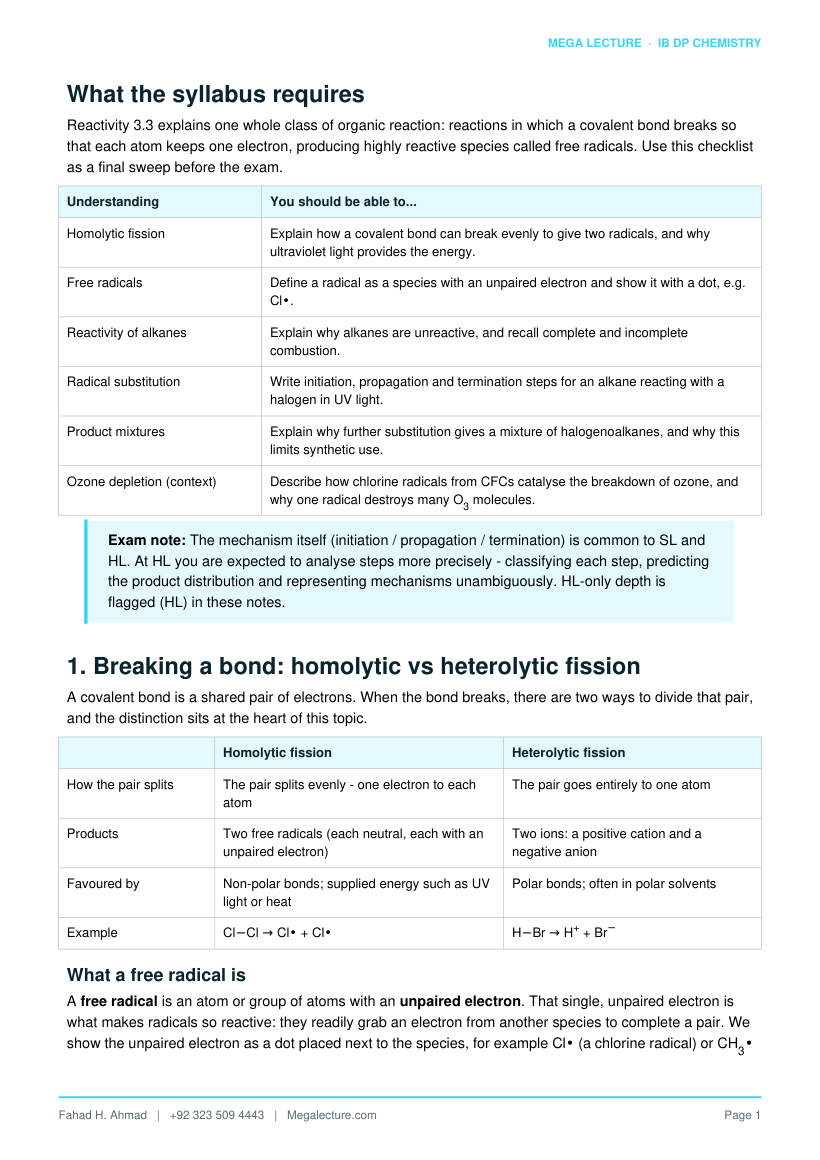
What the syllabus requires
Reactivity 3.3 explains one whole class of organic reaction: reactions in which a covalent bond breaks so that each atom keeps one electron, producing highly reactive species called free radicals. Use this checklist as a final sweep before the exam.
Understanding You should be able to...
Homolytic fission Explain how a covalent bond can break evenly to give two radicals, and why ultraviolet light provides the energy.
Free radicals Define a radical as a species with an unpaired electron and show it with a dot, e.g. Cl•.
Reactivity of alkanes Explain why alkanes are unreactive, and recall complete and incomplete combustion.
Radical substitution Write initiation, propagation and termination steps for an alkane reacting with a halogen in UV light.
Product mixtures Explain why further substitution gives a mixture of halogenoalkanes, and why this limits synthetic use.
Ozone depletion (context) Describe how chlorine radicals from CFCs catalyse the breakdown of ozone, and why one radical destroys many O3 molecules.
Exam note: The mechanism itself (initiation / propagation / termination) is common to SL and HL. At HL you are expected to analyse steps more precisely - classifying each step, predicting the product distribution and representing mechanisms unambiguously. HL-only depth is flagged (HL) in these notes.
1. Breaking a bond: homolytic vs heterolytic fission
A covalent bond is a shared pair of electrons. When the bond breaks, there are two ways to divide that pair, and the distinction sits at the heart of this topic.
Homolytic fission Heterolytic fission
How the pair splits The pair splits evenly - one electron to each atom
The pair goes entirely to one atom
Products Two free radicals (each neutral, each with an unpaired electron)
Two ions: a positive cation and a negative anion
Favoured by Non-polar bonds; supplied energy such as UV light or heat
Polar bonds; often in polar solvents
Example Cl−Cl → Cl• + Cl• H−Br → H+ + Br−
What a free radical is
A free radical is an atom or group of atoms with an unpaired electron. That single, unpaired electron is what makes radicals so reactive: they readily grab an electron from another species to complete a pair. We show the unpaired electron as a dot placed next to the species, for example Cl• (a chlorine radical) or CH3•
(a methyl radical). The dot is not a charge - a radical is electrically neutral.
Why UV light causes homolysis
Homolytic fission needs energy to be supplied to pull the shared pair apart. Ultraviolet (UV) photons carry enough energy to match the bond enthalpy of a bond such as Cl−Cl (242 kJ mol−1). When a Cl2 molecule absorbs a UV photon, the energy promotes the bonding electrons and the bond snaps evenly into two chlorine radicals. Because the split is symmetrical and each chlorine atom is identical, there is no reason for both electrons to go to one side - so the fission is homolytic. This is why the halogenation of alkanes is described as a photochemical reaction: no reaction occurs in the dark.
Key phrase: "UV light provides the energy for homolytic fission of the halogen molecule." Examiners want both ideas - the energy source (UV) and the type of fission (homolytic) - in the same sentence.
Figure 1. Photon energy per mole falls as wavelength rises. A photon carries as much energy as the Cl−Cl bond enthalpy
(242 kJ mol−1) at a threshold wavelength of ≈ 494 nm; shorter-wavelength (violet / UV) light has enough energy for homolysis.
2. Alkanes: bonding and low reactivity
Alkanes are saturated hydrocarbons (general formula CnH2n+2) containing only single C−C and C−H bonds. Understanding why they are so unreactive explains why forcing conditions (UV light) are needed for them to react at all.
- Strong bonds. Both C−C (≈ 346 kJ mol−1) and C−H (≈ 414 kJ mol−1) bonds are strong and require a great deal of energy to break.
- Non-polar. Carbon and hydrogen have very similar electronegativities, so the bonds are essentially non-polar. There is no electron-rich or electron-poor region for an attacking ion to target, so alkanes are not attacked by common nucleophiles or electrophiles.
- No lone pairs, no multiple bonds. Unlike alkenes, alkanes have no reactive site of high electron density.
The consequence is that alkanes react readily in only two situations you meet at this level: combustion (burning) and radical substitution with a halogen under UV light.
Combustion recap
Combustion is highly exothermic, which is why alkanes are used as fuels.
- Complete combustion (plenty of oxygen) gives carbon dioxide and water:
CH4(g) + 2O2(g) → CO2(g) + 2H2O(l)
- Incomplete combustion (limited oxygen) gives carbon monoxide and/or carbon (soot) plus water; less energy is released per mole:
2CH4(g) + 3O2(g) → 2CO(g) + 4H2O(l)
Why CO is dangerous: Carbon monoxide is toxic because it binds to haemoglobin more strongly than oxygen does, reducing the blood's capacity to carry oxygen. It is colourless and odourless, so it cannot be detected without an alarm.
3. Radical substitution of alkanes with halogens
In a substitution reaction, one atom is replaced by another. When methane is mixed with chlorine gas and exposed to UV light, a hydrogen atom is progressively replaced by a chlorine atom. The overall reaction for the first substitution is:
CH4 + Cl2 (UV light) → CH3Cl + HCl
This overall equation hides a chain mechanism with three distinct stages. You must be able to write every step and name each stage.
Stage 1 - Initiation
UV light causes homolytic fission of the chlorine molecule, generating two chlorine radicals. This is the only step that creates radicals from neutral molecules.
Cl2 (UV) → 2Cl•
Stage 2 - Propagation
A radical reacts with a molecule to form a product and a new radical. Because a radical is consumed but another is created, the chain keeps going. Two propagation steps repeat as a cycle:
Cl• + CH4 → CH3• + HCl
CH3• + Cl2 → CH3Cl + Cl•
The chlorine radical regenerated in the second step attacks another methane molecule, so a single initiation event can lead to thousands of product molecules - this is a chain reaction.
Stage 3 - Termination
When two radicals meet, they pair their unpaired electrons to form a new covalent bond. This removes radicals from the system and ends that chain. Any two radicals can combine, so several termination products are possible:
Cl• + Cl• → Cl2 CH3• + Cl• → CH3Cl
CH3• + CH3• → C2H6 (ethane)
Spot the difference: In propagation the number of radicals stays the same (one in, one out). In termination the number of radicals falls (two in, none out). In initiation the number of radicals rises (none in, two out). Counting radicals is the fastest way to classify a step.
Figure 2. The free-radical chain mechanism for CH4 + Cl2 in UV light. Initiation makes radicals by homolysis (0 → 2); each propagation step conserves the radical count (1 → 1) so the chain continues; termination pairs radicals and ends the chain (2
→ 0).
Figure 3. Enthalpy profile for CH4 + Cl2 → CH3Cl + HCl. Bond enthalpies give a reaction enthalpy of −113 kJ mol−1 (bonds broken 656 − bonds formed 769), so the reaction is exothermic; the activation energy Ea is the barrier at the transition state.
4. Further substitution and product mixtures
The reaction rarely stops at chloromethane. As long as chlorine radicals and chlorine molecules are present, the chlorine atoms already on the carbon can themselves be substituted. Each product still has C−H bonds, so each can be attacked again:
CH4 → CH3Cl → CH2Cl2 → CHCl3 → CCl4
Product Name Formed by substituting
CH3Cl chloromethane 1 H atom
CH2Cl2 dichloromethane 2 H atoms
CHCl3 trichloromethane (chloroform) 3 H atoms
CCl4 tetrachloromethane all 4 H atoms
Why a mixture forms
Once chloromethane exists, a chlorine radical is just as able to remove a hydrogen atom from CH3Cl as from CH4. Molecules at every stage of substitution are present at the same time, so the product is a mixture of CH3Cl, CH2Cl2, CHCl3 and CCl4, together with unreacted methane and HCl. Using a large excess of methane favours monosubstitution; using excess chlorine drives the reaction toward CCl4.
Why this limits synthetic use
- The reaction gives a mixture, so the yield of any one desired product is low.
- Separating the products (by fractional distillation) is costly and wasteful.
- With a longer alkane, substitution can occur at different carbon positions, giving structural isomers as well - even more products. For example, chlorination of propane gives both 1-chloropropane and 2-chloropropane.
For these reasons radical substitution is a poor route for making a specific halogenoalkane in the laboratory, even though it is industrially important for bulk chlorination.
5. Reactivity and selectivity of the halogens
All four halogens can in principle undergo radical substitution with alkanes, but their reactivity varies enormously, and this affects whether the reaction is useful at all.
Halogen Behaviour with alkanes Reason
F2 Reacts explosively, often uncontrollably The reaction is extremely exothermic; the weak F−F bond breaks very easily and C−F bonds are very strong.
Cl2 Reacts steadily in UV light - the standard example
Bond enthalpies give a controllable, moderately exothermic reaction.
Br2 Reacts more slowly, needs UV light Weaker C−Br bond formed; less exothermic than chlorination.
I2 Barely reacts; effectively unreactive The reaction is endothermic overall; the C−I bond formed is weak and the step is unfavourable.
Reactivity therefore falls down the group: F2 > Cl2 > Br2 > I2. Fluorine is too violent to be synthetically useful and iodine is too unreactive, so chlorine and bromine are the halogens actually used to illustrate the mechanism.
Selectivity within a molecule
When an alkane has hydrogen atoms in more than one environment, radicals do not attack them all equally. Hydrogen atoms on more substituted carbons are removed slightly more easily because the radical formed is more stable. This means the product distribution is not simply the ratio of the numbers of each type of hydrogen - another reason the reaction gives an awkward mixture.
Exam note: You are not asked to predict exact product ratios at SL. It is enough to state that reactivity decreases down the group, that F2 is too violent and I2 too unreactive, and that mixtures result.
6. Environmental relevance: CFCs and ozone depletion
Radical chemistry is not just a laboratory curiosity - the same type of chain reaction destroys ozone in the stratosphere. This is a favourite context for linking the mechanism to a real-world issue.
What CFCs are
Chlorofluorocarbons (CFCs) are alkanes in which all the hydrogen atoms have been replaced by chlorine and fluorine, for example CCl3F and CCl2F2. They were once widely used as refrigerants, aerosol propellants and foam-blowing agents because they are unreactive, non-toxic and non-flammable. That same inertness lets them survive long enough to drift up into the stratosphere.
The radical chain that destroys ozone
Initiation. High-energy UV light in the stratosphere breaks a C−Cl bond in a CFC by homolytic fission, releasing a chlorine radical (the weaker C−Cl bond breaks in preference to the stronger C−F bond):
CCl2F2 (UV) → •CClF2 + Cl•
Propagation (the catalytic cycle). The chlorine radical then destroys ozone in two steps that regenerate the radical:
Cl• + O3 → ClO• + O2
ClO• + O → Cl• + O2
Adding the two steps, the overall change is O3 + O → 2O2, and the chlorine radical is unchanged at the end.
Why one radical destroys many ozone molecules
Notice that Cl• is used up in the first propagation step but regenerated in the second. It therefore acts as a catalyst: it is not consumed overall, so a single chlorine radical can cycle round again and again, destroying tens of thousands of ozone molecules before it is finally removed by a termination reaction. This is why even trace amounts of CFCs cause serious ozone depletion.
Replacements
CFCs have been phased out under the Montreal Protocol. Early replacements were HCFCs (hydrochlorofluorocarbons), which still contain some chlorine but break down lower in the atmosphere. The
Fahad H. Ahmad | +92 323 509 4443 | Megalecture.com longer-term replacements are HFCs (hydrofluorocarbons), such as CH2FCF3, which contain no chlorine at all. With no C−Cl bond, UV light cannot release chlorine radicals, so HFCs do not deplete the ozone layer. (They are, however, greenhouse gases, which is a separate concern.)
Link to the mechanism: The stratospheric cycle is exactly the same radical chemistry as alkane halogenation - initiation by UV, propagation that regenerates a radical - only here the regenerated radical makes Cl• behave as a catalyst rather than merely continuing a chain.
7. (HL) Analysing the mechanism more closely
At Higher Level the same mechanism is examined with greater precision. The reactions and equations are identical, but you are expected to reason about them more carefully.
(HL) Classifying every step
Be ready to label any given step as initiation, propagation or termination and to justify it by the change in radical count, not by where it appears in the scheme:
Step type Radicals in → out Signature
Initiation 0 → 2 A bond broken by UV; radicals created from neutral molecules.
Propagation 1 → 1 A radical reacts with a molecule to give a product plus a new radical; the chain continues.
Termination 2 → 0 Two radicals combine into one molecule; the chain ends.
(HL) Rate and product distribution
The overall rate depends on the intensity of UV light (which sets how many radicals are formed by initiation) and on the concentrations of the alkane and the halogen. Because propagation is fast and self-sustaining, only a small amount of initiation is needed to keep the reaction going. The distribution of products depends on:
- the ratio of halogen to alkane - excess alkane favours single substitution; excess halogen favours multiple substitution;
- how long the reaction is allowed to run - longer times shift products toward the more heavily substituted compounds;
- the relative ease of removing hydrogen atoms from different carbon environments, which biases where substitution occurs.
(HL) Representing mechanisms clearly
- Always show the dot on a radical, and place it on the atom that carries the unpaired electron (for example the carbon in CH3•).
- Balance each step: radicals and atoms must balance on both sides.
- State the condition (UV light) on the initiation step, and label each step with its stage name.
- Do not write ions (no + or − charges): radical substitution proceeds through neutral radicals, not ions.
(HL) Common trap: If a step shows a radical being consumed and a radical being produced, it is propagation - even if it looks like the "last" step. Only a step that destroys radicals without making new ones is termination.
8. Worked examples
Worked example 1 - full mechanism for ethane + chlorine
Write the mechanism for the monochlorination of ethane, C2H6, in UV light, naming each stage.
Initiation: Cl2 → 2Cl• (UV light)
Propagation: Cl• + C2H6 → C2H5• + HCl
Propagation: C2H5• + Cl2 → C2H5Cl + Cl•
Termination (any one): Cl• + Cl• → Cl2; C2H5• + Cl• → C2H5Cl; 2C2H5• → C4H10.
Worked example 2 - classify the step
For methane chlorination, state whether each step is initiation, propagation or termination, and justify your answer.
- CH3• + Cl2 → CH3Cl + Cl•
- CH3• + Cl• → CH3Cl
- Propagation: one radical in (CH3•), one radical out (Cl•) - the radical count is unchanged, so the chain continues.
- Termination: two radicals in, none out - two radicals have combined into one molecule, ending the chain.
Worked example 3 - explaining multiple products
Chlorination of methane is carried out with an excess of chlorine. Explain why the product is a mixture and name two organic products other than chloromethane.
Chloromethane still has three C−H bonds, so a chlorine radical can remove another hydrogen and substitute a second chlorine, and so on. Successive substitution gives CH2Cl2, CHCl3 and CCl4. Because molecules at every stage are present together, and excess chlorine drives further substitution, a mixture forms.
Two further products: dichloromethane, CH2Cl2, and tetrachloromethane, CCl4.
Worked example 4 - positional isomers
When propane, CH3CH2CH3, is monochlorinated in UV light, two isomeric products form. Draw out why, giving their names.
Propane has hydrogen atoms in two environments: six on the two end (CH3) carbons and two on the middle (CH2) carbon. Substituting an end hydrogen gives 1-chloropropane, CH3CH2CH2Cl; substituting a middle hydrogen gives 2-chloropropane, CH3CHClCH3.
This is a further reason radical substitution is poor for synthesis: even monosubstitution can give a mixture of structural isomers.
Worked example 5 - the ozone radical cycle
A chlorine radical enters the stratosphere. Write the two propagation steps by which it destroys ozone, give the overall equation, and explain why one radical can destroy many ozone molecules.
Propagation 1: Cl• + O3 → ClO• + O2
Propagation 2: ClO• + O → Cl• + O2
Overall: O3 + O → 2O2.
The chlorine radical is regenerated in step 2, so it is not used up overall - it behaves as a catalyst and can repeat the cycle thousands of times, destroying one O3 molecule per cycle.
Worked example 6 - (HL) reasoning about conditions
(HL) A student mixes methane and chlorine in a flask and keeps it in the dark; no reaction occurs. Explain why, and state the minimum change needed to start the reaction.
Radical substitution begins with initiation, which requires homolytic fission of Cl2. In the dark there is no source of the energy needed to break the Cl−Cl bond, so no radicals form and the chain cannot start. Exposing the mixture to UV light supplies photons of the right energy to break the bond homolytically, generating chlorine radicals and initiating the reaction.
Common pitfalls
- Confusing initiation with propagation. Initiation makes radicals from a neutral molecule using UV; propagation keeps a constant number of radicals. Only the halogen molecule splits in initiation.
- Forgetting the dot. A radical must show its unpaired electron: write Cl• and CH3•, not Cl or CH3. Missing dots lose marks.
- Treating the dot as a charge. A radical is neutral. Do not write Cl+ or Cl− for a chlorine radical.
- Leaving out the condition. Always state UV light on the initiation step; without it there is no reaction.
- Unbalanced steps. Check each equation balances for atoms and for radicals on both sides.
- Stopping at one product. Remember further substitution and, for larger alkanes, positional isomers - the reaction gives a mixture.
Quick reference
Idea Summary
Homolytic fission Bond breaks evenly: X−X → 2X• (two radicals).
Free radical Species with an unpaired electron; neutral; shown with a dot, e.g. Cl•.
Why UV Supplies the energy to break the halogen bond by homolytic fission; no reaction in the dark.
Initiation Cl2 → 2Cl• (UV) - radicals created (0 → 2).
Propagation Cl• + CH4 → CH3• + HCl; CH3• + Cl2 → CH3Cl + Cl• (1 → 1).
Termination Two radicals combine, e.g. CH3• + Cl• → CH3Cl (2 → 0).
Mixture Further substitution: CH4 → CH3Cl → CH2Cl2 → CHCl3 → CCl4.
Halogen reactivity F2 > Cl2 > Br2 > I2; F2 too violent, I2 too unreactive.
Ozone cycle Cl• + O3 → ClO• + O2; ClO• + O → Cl• + O2 (Cl• is a catalyst).
Test yourself
Attempt all eight without notes; full worked answers follow.
- Define a free radical and explain why radicals are so reactive.
- Distinguish between homolytic and heterolytic bond fission, giving one example of each.
- Write the full mechanism (all stages named) for the monobromination of methane, CH4, with Br2 in UV light.
- Explain why alkanes are generally unreactive but do react with chlorine in UV light.
- Explain why the reaction of excess chlorine with methane gives a mixture of products, and name all four organic chlorine-containing products.
- State and explain the trend in reactivity of the halogens towards alkanes.
- Write the two propagation steps for ozone destruction by chlorine radicals and explain why the chlorine radical is described as a catalyst.
- (HL) A step in a mechanism is CH3• + CH3• → C2H6. Name this type of step and justify your answer using radical counting.
Answers
- A free radical is a species with an unpaired electron. It is highly reactive because the unpaired electron readily pairs up by taking an electron from (or bonding to) another species, so radicals attack other molecules easily.
- In homolytic fission the shared pair splits evenly, one electron to each atom, giving two neutral radicals: Cl2 → 2Cl•. In heterolytic fission both electrons go to one atom, giving two ions: H−Br → H+ + Br−.
- Initiation: Br2 → 2Br• (UV). Propagation: Br• + CH4 → CH3• + HBr; CH3• + Br2 → CH3Br + Br•. Termination (any one): Br• + Br• → Br2; CH3• + Br• → CH3Br; 2CH3• → C2H6.
- Alkanes have strong, non-polar C−C and C−H bonds and no region of high or low electron density, so they are not attacked by nucleophiles or electrophiles. With chlorine, UV light supplies enough energy to break the Cl−Cl bond homolytically, generating radicals that then attack the alkane by a chain mechanism.
- Each product still contains C−H bonds, so a chlorine radical can substitute a further hydrogen; with molecules at every stage present together, successive substitution occurs. The four organic products are chloromethane (CH3Cl), dichloromethane (CH2Cl2), trichloromethane (CHCl3) and tetrachloromethane (CCl4).
- Reactivity falls down the group: F2 > Cl2 > Br2 > I2. Fluorination is extremely exothermic and explosive (weak F−F bond, very strong C−F bonds formed), while iodination is endothermic and essentially does not occur (weak C−I bond formed). Chlorine and bromine react at a controllable rate in UV light.
- Cl• + O3 → ClO• + O2; then ClO• + O → Cl• + O2. The chlorine radical is consumed in the first step but regenerated in the second, so it is not used up overall - it is a catalyst and can repeat the cycle, destroying many ozone molecules.
- This is termination. Two radicals enter and no radicals leave (2 → 0): the two methyl radicals pair their unpaired electrons to form a C−C bond in ethane, removing radicals and ending the chain.
