
A Level · Chemistry 9701 · AS Organic Chemistry Notes by Fahad Hameed
AS Organic Chemistry Notes by Fahad Hameed
Typed from the teacher’s handwritten class notes. The original pages are one tap away.
Opens inside this page. Prefer your own PDF app? Open the PDF.
Chemistry batch classes: coming soon. Small live classes at a lower fee than one-to-one. Join the waiting list
Check yourself
5 quick questions on A Level Chemistry
Tap an answer to see if you are right, and why. Free, no sign-up.
Start the free test7 of 7 students found these notes useful
Was this note useful?
Full text of AS Organic Chemistry Notes by Fahad Hameed
Typed version of Fahad Hameed's handwritten AS Organic Chemistry notes for Cambridge International AS Level Chemistry (9701). Every page of the original is typed in the same order, with drawn structures named and written as formulae, and drawn mechanisms written as numbered steps, so the notes can be searched and copied. The handwritten original is on the same page of megalecture.com.
Organic Chemistry
Carbon compounds → living organisms (plants / animals).
Arrows lead from here to:
- food
- fossil fuels
- pharmaceutical
- agriculture
Formulas
1. Molecular formula
Total number of atoms of elements in a compound.
C4H8O2, C6H12O6. No information about structure.
2. Structural formula
Provides information about the structure.
(a) Full displayed formula
Every single atom / bond is shown.
- C: 4 bonds
- N: 3 bonds
- O: 2 bonds
- H: 1 bond
- halogens: 1 bond
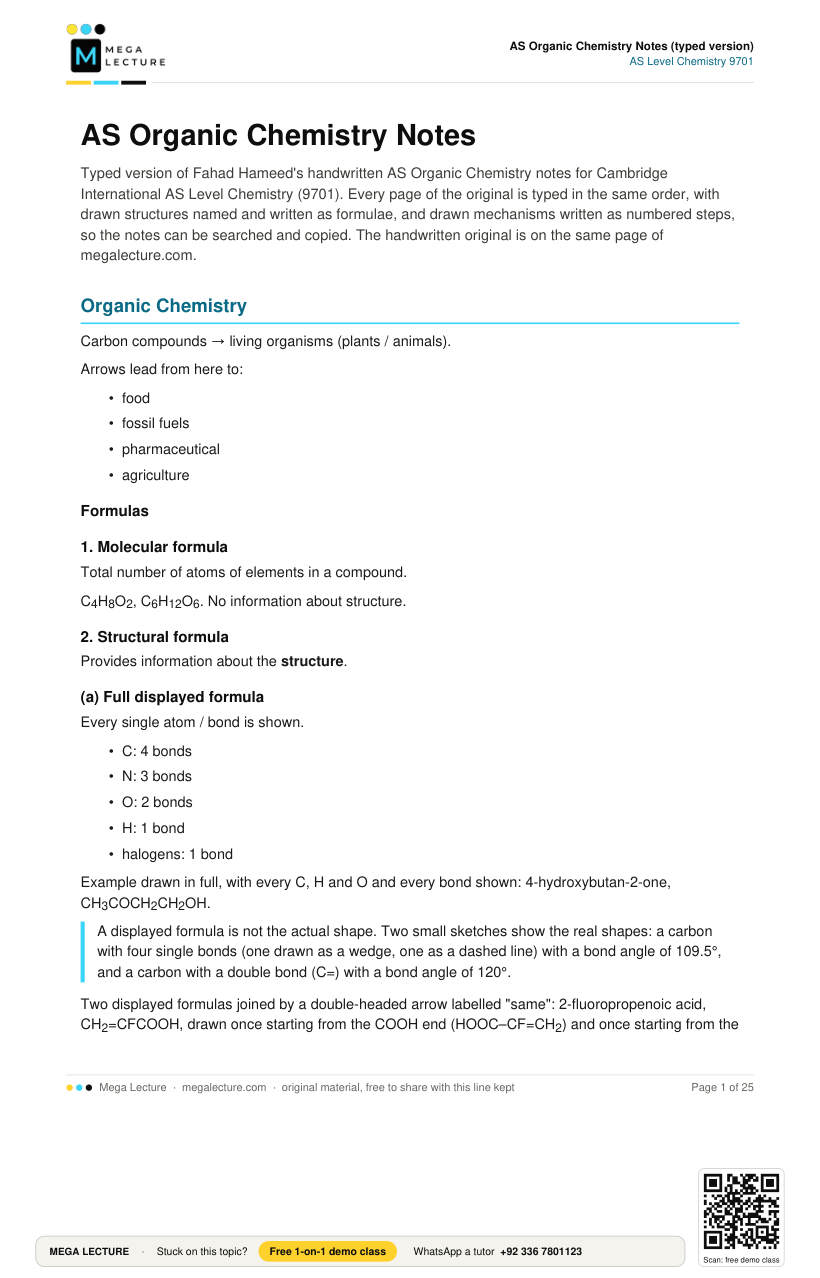
Example drawn in full, with every C, H and O and every bond shown: 4-hydroxybutan-2-one, CH3COCH2CH2OH.
A displayed formula is not the actual shape. Two small sketches show the real shapes: a carbon with four single bonds (one drawn as a wedge, one as a dashed line) with a bond angle of 109.5°, and a carbon with a double bond (C=) with a bond angle of 120°.
Two displayed formulas joined by a double-headed arrow labelled "same": 2-fluoropropenoic acid, CH2=CFCOOH, drawn once starting from the COOH end (HOOC–CF=CH2) and once starting from the CH2 end with the chain bent downwards (CH2=CF–COOH). Both drawings are the same molecule.
A ring drawn as a full displayed formula: a six-membered carbon ring containing two C=C double bonds (four CH groups), one CH2 group and one carbon that is double bonded to N–H outside the ring. This is cyclohexa-2,4-dien-1-imine, C6H7N.
(b) Condensed structural formula
Running out of space.
First example, drawn three ways:
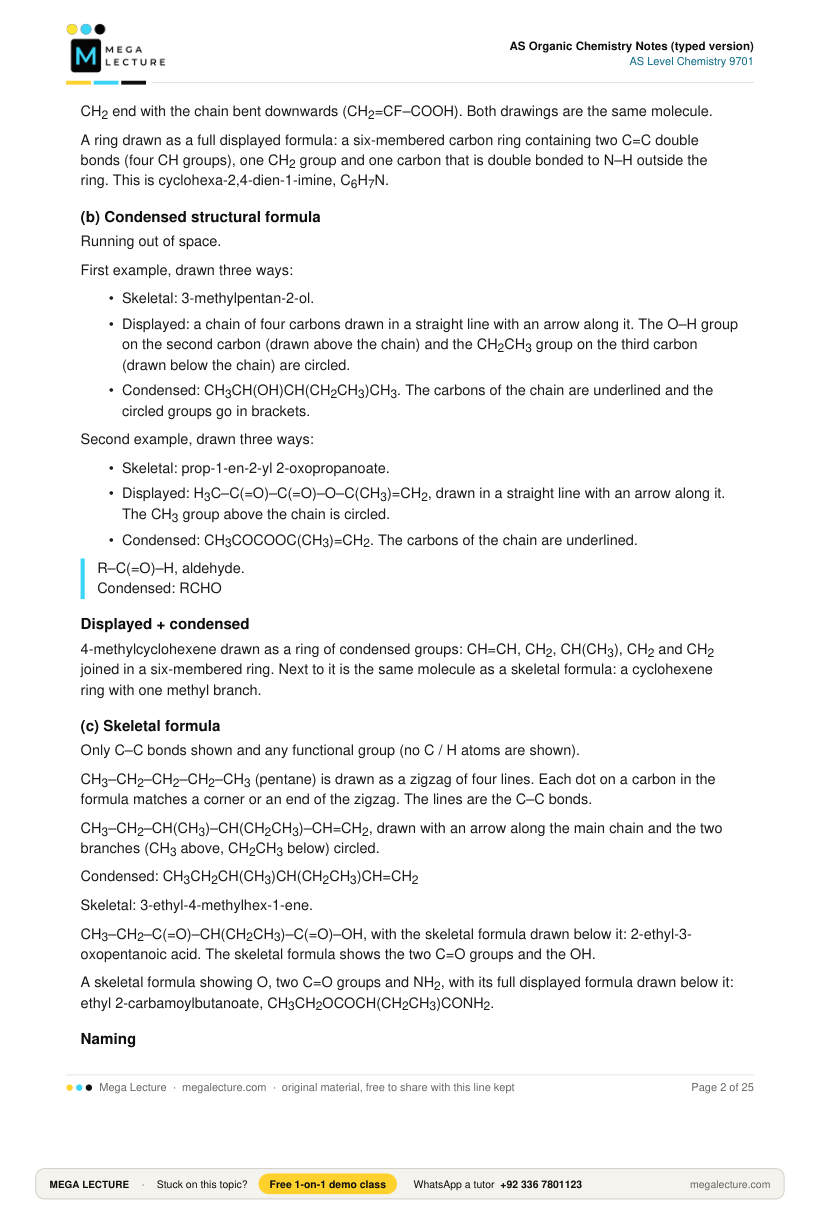
- Skeletal: 3-methylpentan-2-ol.
- Displayed: a chain of four carbons drawn in a straight line with an arrow along it. The O–H group on the second carbon (drawn above the chain) and the CH2CH3 group on the third carbon (drawn below the chain) are circled.
- Condensed: CH3CH(OH)CH(CH2CH3)CH3. The carbons of the chain are underlined and the circled groups go in brackets.
Second example, drawn three ways:
- Skeletal: prop-1-en-2-yl 2-oxopropanoate.
- Displayed: H3C–C(=O)–C(=O)–O–C(CH3)=CH2, drawn in a straight line with an arrow along it. The CH3 group above the chain is circled.
- Condensed: CH3COCOOC(CH3)=CH2. The carbons of the chain are underlined.
R–C(=O)–H, aldehyde.
Condensed: RCHO
Displayed + condensed
4-methylcyclohexene drawn as a ring of condensed groups: CH=CH, CH2, CH(CH3), CH2 and CH2 joined in a six-membered ring. Next to it is the same molecule as a skeletal formula: a cyclohexene ring with one methyl branch.
(c) Skeletal formula
Only C–C bonds shown and any functional group (no C / H atoms are shown).
CH3–CH2–CH2–CH2–CH3 (pentane) is drawn as a zigzag of four lines. Each dot on a carbon in the formula matches a corner or an end of the zigzag. The lines are the C–C bonds.
CH3–CH2–CH(CH3)–CH(CH2CH3)–CH=CH2, drawn with an arrow along the main chain and the two branches (CH3 above, CH2CH3 below) circled.
Condensed: CH3CH2CH(CH3)CH(CH2CH3)CH=CH2
Skeletal: 3-ethyl-4-methylhex-1-ene.
CH3–CH2–C(=O)–CH(CH2CH3)–C(=O)–OH, with the skeletal formula drawn below it: 2-ethyl-3-oxopentanoic acid. The skeletal formula shows the two C=O groups and the OH.
A skeletal formula showing O, two C=O groups and NH2, with its full displayed formula drawn below it: ethyl 2-carbamoylbutanoate, CH3CH2OCOCH(CH2CH3)CONH2.
Naming
Homologous series
Family of organic molecules having:
- Similar chemical properties.
- Show trends in physical properties. As molecule size increases:
- melting point / boiling point higher
- more viscosity
- less flammability
Sketch: two CH3–CH3 molecules (18 electrons each) side by side. The electrons shift in one molecule so that one end is δ+ and the other δ-, and this induces a matching δ+ and δ- in the molecule next to it, with a dotted line of attraction between them. A second pair shows the same thing with the dipoles the other way round. Label: instantaneous - induced dipole. - Same functional group: group of atoms / structure that determines chemical properties.
CH2=CH–CH2–CH3, with an arrow to the C=C: all reactions. - Same general formula: only applicable for simple molecules.
CnH2n
CH3–CH=CH2 is C3H6: general formula works.
CH2=CH–CH2–CH=CH–CH3 is C6H10: general formula does not work. - Successive members differ by CH2.
CH4 → C2H6 → C3H8 → C4H10, each step adding CH2.
Prefix = number of carbon atoms
| Prefix | meth | eth | prop | but | pent | hex | hept | oct | non | dec |
|---|---|---|---|---|---|---|---|---|---|---|
| Carbons | 1C | 2C | 3C | 4C | 5C | 6C | 7C | 8C | 9C | 10C |
Suffix
The suffix gives the homologous series.
| No. | Homologous series | Suffix | Notes |
|---|---|---|---|
| 1 | Alkane | -ane | saturated hydrocarbon |
| 2 | Alkene | -ene | unsaturated hydrocarbon, C=C |
| 3 | Alcohol | -ol | –OH, hydroxy group (hydroxyl) |
| 4 | Carboxylic acid | -oic acid | –C(=O)–OH |
| 5 | Carbonyl compounds | ||
| 5 (a) | Aldehyde | -al | –C(=O)–H, at the end of the carbon chain |
| 5 (b) | Ketone | -one | –C(=O)–, in the middle of the carbon chain |
| 6 | Nitriles | -nitrile | –C≡N, at the end of a carbon chain |
| 7 | Amines | -amine | –NH2 |
A name has three parts:
| Prefix | an / en | Suffix |
|---|---|---|
| number of C | saturated or unsaturated | homologous series |
Alkanes
CH3CH2CH3 (drawn as a displayed formula): propane
Alkenes
CH3CH=CH2 (displayed formula): propene
CH3CH2CH=CHCH3 (displayed formula, carbons numbered 5 to 1 from left to right so the C=C is between carbons 2 and 3): pent-2-ene
CH2=CH–CH=CH–CH3 (displayed formula, carbons numbered 1 to 5 from left to right): pent-1,3-diene. The numbers 1,3 give the position of C=C.
Number (smaller number should be given to higher precedence group):
- carboxylic acid
- nitrile
- aldehyde
- ketones
- alcohols (hydroxy)
- amines (amino)
Alcohols
CH3CH2CH(OH)CH(OH)CH2OH (displayed formula, the three OH groups circled, numbering starts from the right-hand end): pentan-1,2,3-triol. The "an" shows a saturated carbon chain.
CH2=CH–CH=CH–CH(OH)–CH2OH (displayed formula, the two OH groups circled, carbons numbered 6 to 1 from left to right): hex-3,5-dien-1,2-diol
Aldehyde
Suffix -al, group –C(=O)–H
CH3CH2CHO (displayed formula): propan-1-al, the same as propanal. It is unnecessary to write the 1.
CH2=CH–CH2–CHO (carbons numbered 4 to 1 from left to right, starting from the CHO carbon): but-3-en(-1-)al
Ketones
–C(=O)– in the middle of the chain. Suffix -one.
CH2=CH–CH2–CO–CH3 (carbons numbered 5 to 1 from left to right): pent-4-en-2-one
CH3–CO–CH2–CO–CH3 (numbered from the right): pentan-2,4-dione
Nitriles
Group –C≡N
CH3–CH2–CH2–CH2–C≡N: pentanenitrile
CH2=CH–CH2–C≡N (carbons numbered 4 to 1 from left to right, the C of C≡N is carbon 1): but-3-enenitrile
Amines
CH3–CH2–CH2–NH2: propanamine
Branched molecules and multiple functional groups
- number, number → comma
- number - letter → dash
Structure drawn with the main chain highlighted and numbered 1 to 6: CH3CH(NH2)C(OH)(CH3)CH=C(CH3)CHO. Carbon 1 is the CHO carbon. The branches are circled and labelled: methyl on carbon 2, hydroxy and methyl on carbon 4, amino on carbon 5.
Name: 5-amino-4-hydroxy-2,4-dimethylhex-2-enal
Position - branches, alphabetically.
Main chain: longest possible / continuous carbon atom chain, containing:
- suffix functional group
- maximum C=C, C≡C
- maximum groups attached to it
Number (smaller number should be given to higher precedence group). The name used when the group is a branch is in brackets:
- carboxylic acid
- nitrile (cyano)
- aldehyde (formyl)
- ketones (oxo)
- alcohols (hydroxy)
- amines (amino)
Structure drawn with the chain highlighted: OHC–CH(OH)–CH(CH2CH3)–COOH. The COOH carbon is carbon 1 (carboxylic acid). The circled groups are labelled formyl (the H–C=O at the left-hand end), hydroxy (the OH on carbon 3) and ethyl (the CH2CH3 on carbon 2).
Name: 2-ethyl-3-formyl-3-hydroxypropanoic acid
- Halogen branches: chloro, bromo, iodo
- Carbon branches: alkyl, methyl etc.
CH3–CO–CHCl–CHO (displayed formula, carbons numbered 4 to 1 from left to right, the Cl circled, an arrow pointing at the CHO carbon as carbon 1): 2-chlorobutan-3-one-1-al
Isomers
C2H4O2. Six different displayed formulas are drawn for this one molecular formula:
- ethanoic acid, CH3COOH
- hydroxyethanal, HOCH2CHO
- ethene-1,2-diol, HOCH=CHOH
- methyl methanoate, HCOOCH3
- ethene-1,1-diol, CH2=C(OH)2
- oxiran-2-ol, a three-membered ring of two carbons and one oxygen, with an OH group on one of the carbons
Structural isomers
Molecules having same molecular formula and different structural formulas.
Methyl methanoate drawn twice, once in a straight line as CH3–O–CHO and once bent round as OHC–O–CH3, joined by a double-headed arrow labelled "same". These are not isomers, they are the same molecule.
Types of structural isomers
(a) Chain isomer
Four displayed formulas of carboxylic acids with five carbons, with the carbon chain highlighted in each:
- pentanoic acid, CH3CH2CH2CH2COOH (straight chain of five carbons)
- 2-methylbutanoic acid, CH3CH2CH(CH3)COOH (chain of four with one branch)
- 3-methylbutanoic acid, (CH3)2CHCH2COOH (chain of four with one branch)
- 2,2-dimethylpropanoic acid, (CH3)3CCOOH (chain of three with two branches, drawn as a cross)
(b) Positional isomers
Three displayed formulas of a five-carbon chain with the OH group circled in a different position each time:
- pentan-1-ol, CH3CH2CH2CH2CH2OH
- pentan-3-ol, CH3CH2CH(OH)CH2CH3
- pentan-2-ol, CH3CH2CH2CH(OH)CH3
An arrow leads from pentan-2-ol to a three-dimensional drawing of it: a central carbon marked with a star (C*) bonded to H (up), CH3 (dashed bond), OH (wedge bond) and CH3CH2CH2. A vertical line is drawn beside it.
3. Functional group isomer
Change the functional group.
| Functional group | Example drawn | Isomer with a different functional group | Example drawn |
|---|---|---|---|
| alkenes | propene, CH2=CHCH3 | cycloalkanes | cyclopropane, a ring of three CH2 groups |
| aldehydes | propanal, CH3CH2CHO | ketones | propanone, CH3COCH3 |
| carboxylic acid | ethanoic acid, CH3COOH | ester | methyl methanoate, HCOOCH3 |
Stereoisomer
Molecules having same molecular formula, same structural formula but different 3-dimensional geometry (shape is different).
Picture: a left hand and a right hand on either side of a mirror. They are mirror images and cannot be superimposed.
1. Geometric isomer
- C=C must be present, each C in C=C must be bonded to two different groups.
Each C of the C=C is sp2 hybridised: 120°, trigonal planar. Sketch: a carbon atom with three sp2 orbitals pointing outwards in one plane, each holding one electron, and one p orbital drawn above and below the plane.
Sketch: C=C with H and Cl on each carbon and the π bond drawn as two shaded regions, one above and one below the line joining the carbons. Independent rotation is restricted.
Sketch for comparison: two carbons joined by a single bond, one carrying Cl, Cl and H and the other carrying H, Cl and H. Rotation possible around a σ bond.
The two arrangements of CHCl=CHCl (1,2-dichloroethene), each drawn first with its π bond and again as a plain structure with the Cl atoms circled:
| Isomer | Arrangement |
|---|---|
| cis (same side) | both H on the top, both Cl on the bottom |
| trans (opposite sides) | one Cl on the bottom left and the other Cl on the top right, H on the top left and bottom right |
Examples
(a) CH3–CH=CH2, propene. Redrawn around the C=C: the left carbon has H and CH3 (different groups), the right carbon has H and H (same groups). No geometric isomers.
(b) but-2-ene, CH3–CH=CH–CH3
- cis but-2-ene: both CH3 groups on the same side (both drawn at the bottom), both H at the top
- trans but-2-ene: CH3 groups on opposite sides (one bottom left, one top right)
Unsymmetric molecules
Multiple cis / trans.
Cl–CH=CH–CH=CH–CH3. Each of the two C=C can be cis / trans.
| First C=C | Second C=C |
|---|---|
| cis | cis |
| cis | trans |
| trans | cis |
| trans | trans |
The cis, trans and trans, cis rows are the same if the molecule is symmetric.
The isomers are drawn out as structures with each C=C labelled. On this page: cis, cis and cis, trans.
Continued at the top of the next page: trans, trans and trans, cis.
Cl–CH=CH–CH=CH–CH=CH–CH3. With three C=C there are 8 combinations:
| First C=C | Second C=C | Third C=C |
|---|---|---|
| cis | cis | cis |
| cis | cis | trans |
| cis | trans | cis |
| cis | trans | trans |
| trans | cis | cis |
| trans | cis | trans |
| trans | trans | cis |
| trans | trans | trans |
Arrows pair up rows that are the same if the molecule is symmetric: cis, cis, trans with trans, cis, cis, and cis, trans, trans with trans, trans, cis (each pair is the same order read from the other end).
Number of geometric isomers
2n
n is the number of C=C that make cis / trans isomers in unsymmetric molecules (also add chiral centres).
Can't form geometric isomers in cyclic structures
Cyclohexene drawn as a ring, –CH=CH–CH2–CH2–CH2–CH2–, with the two H atoms on the C=C marked. Can't make the trans version as the cyclic structure needs to be broken.
2. Optical isomers
Enantiomers. Mixture of enantiomers → racemic mixture.
Chiral centre needed: C atom that is making 4 single bonds with 4 different groups.
- tetrahedral, 109.5° bond angles, sp3 hybridised
Sketch: a carbon with four H atoms in a tetrahedral arrangement, one bond up, one to the side, one dashed and one wedge.
Two three-dimensional drawings of 2-chlorobutan-2-ol, CH3CH2C(OH)(Cl)CH3, on either side of a vertical mirror line. The chiral carbon is marked C* and carries Cl (up), OH, CH2CH3 (dashed bond) and CH3 (wedge bond). The left drawing is labelled (+) and the right drawing, its reflection, is labelled (-). These are non-superimposable mirror images.
A third drawing below shows the molecule turned upside down (CH3 on a wedge at the top, Cl at the bottom, HO on the left, CH2CH3 on a dashed bond). A curved arrow labelled "same" joins it to one of the two drawings above: turning the molecule over does not make a new isomer.
Enantiomers have almost identical physical / chemical properties.
- Shape specific functionality varies a lot, e.g. biology / enzyme.
Differentiate between enantiomers
Both enantiomers rotate plane polarised monochromatic light in opposite directions, clockwise (+) and anticlockwise (-).
Homolytic bond fission
Bond breaks equally.
Cl–Cl → Cl• + Cl• (free radicals formed)
Two half arrows start from the Cl–Cl bond, one going to each chlorine atom.
Heterolytic bond fission
Bond breaks unequally.
H–Cl → H+ + :Cl-
One full arrow starts from the H–Cl bond and goes to the chlorine atom.
Curly arrows
Represent movements of electrons.
- Half arrow: movement of 1 electron.
- Full arrow: movement of 2 electrons.
Free radical
A species (atom or molecule) with an unpaired electron. Very reactive.
•Cl, •OH, •CH3 (single dot: unpaired electron)
Dot-and-cross diagrams are drawn for the hydroxyl radical, •OH, and the methyl radical, •CH3. In each one the central atom has one unpaired electron.
Nucleophile (attracted to +ve charge)
Species which can donate a pair of electrons and is attracted to +ve charge.
Diagram: curly arrows go to X+ from the lone pair of each of these nucleophiles, and from the double bond of ethene:
- NC:-
- :OH-
- :NH3
- H2O:
- ethene, CH2=CH2
Electrophile
Species which can accept a pair of electrons and is attracted to -ve charge.
Types of reactions
| Type of reaction | Example |
|---|---|
| (a) Addition | CH2=CH2 + Br2 → CH2BrCH2Br |
| (b) Substitution | CH3CH3 + Cl2 → CH3CH2Cl + HCl |
| (c) Elimination | CH3CH2Cl → CH2=CH2 + HCl |
Source of organic compounds
Source of organic compounds → fossil fuel.
Printed diagram: fractionating column. Crude oil passes through a heater and enters the bottom of the column.
| Fraction | Temperature | Use |
|---|---|---|
| Refinery gas | 20 °C | Bottled gas |
| Petrol | 70 °C | Petrol for vehicles |
| Naphtha | 120 °C | Chemicals |
| Kerosene | 170 °C | Jet fuel, paraffin for lighting and heating |
| Diesel | 270 °C | Diesel fuels |
| Lubricating oil | Lubricating oils, waxes, polishes | |
| Fuel oil | Fuel for ships, factories and central heating | |
| Bitumen | 340 °C | Roads and roofing |
| Small molecules (top of the column) | Large molecules (bottom of the column) |
|---|---|
| Low boiling point | High boiling point |
| Light in colour | Dark in colour |
| Easy to light | Hard to light |
| Runny | Thick |
Alkanes
Saturated hydrocarbons. CnH2n+2
Structures drawn: 2-methylpropane, (CH3)3CH; cyclopropane, C3H6 (a ring of three CH2 groups); methane, CH4.
Physical properties
- Non-polar, van der Waals (weak).
- Not soluble in water.
When size of molecule increases:
- more van der Waals
- higher MP, BP
- more viscous
- less flammable
Free radical substitution
Halogenation / chlorination / bromination (for I2 reaction is very slow, F2 reaction is very uncontrolled).
CH3CH3 + Cl2 → CH3CH2Cl + HCl (UV light)
Also drawn below the product: 1,1,2-trichloroethane, CH2ClCHCl2. Many random substitution products.
Reaction can happen with any alkyl chain:
propanoic acid, CH3CH2COOH + Cl2 → 2,3,3-trichloropropanoic acid, CHCl2CHClCOOH + HCl (UV light)
The alkyl chain of the propanoic acid (the CH3CH2 part) is underlined.
Mechanism
- Step 1, Initiation: free radicals formed, homolytic bond fission because of UV light.
Cl–Cl → Cl• + Cl• (free radicals formed)
UV light falls on the Cl–Cl bond. Two half arrows start from the Cl–Cl bond, one going to each chlorine atom. - Step 2, Propagation: total number of free radicals remains constant.
CH3CH3 + •Cl → CH3CH2• + HCl (ethyl radical formed)
One half arrow goes from the C–H bond to the carbon atom. A second half arrow from the C–H bond and a half arrow from the unpaired electron of •Cl meet between H and Cl to form the H–Cl bond.
CH3CH2• + Cl–Cl → CH3CH2Cl + •Cl
A half arrow from the unpaired electron of the ethyl radical and a half arrow from the Cl–Cl bond meet to form the C–Cl bond. The other half arrow from the Cl–Cl bond goes to the second chlorine atom, which leaves as •Cl. - Propagation (continued, further substitution):
CH3CH2Cl + •Cl → •CH2CH2Cl + HCl (chloroethyl radical)
The •Cl takes a hydrogen atom from the carbon that does not carry the chlorine. Half arrows go from the C–H bond and from the unpaired electron of •Cl.
•CH2CH2Cl + Cl–Cl → CH2ClCH2Cl + •Cl
A half arrow from the unpaired electron on carbon and a half arrow from the Cl–Cl bond form the new C–Cl bond, giving 1,2-dichloroethane, and •Cl is regenerated. - Step 3, Termination: two free radicals join, no more free radicals → reaction stops.
•CH2CH2Cl + Cl• → CH2ClCH2Cl
CH3CH2• + •Cl → CH3CH2Cl
CH3CH2• + •CH2CH2Cl → CH3CH2CH2CH2Cl
In each case a half arrow from the unpaired electron of each radical meets to form the new bond. In the last product the new C–C bond in the middle of the chain is marked.
Bigger molecules are produced than the original molecule, because two radicals join.
(H2 gas molecules are never produced as there are no H• radicals.)
Speed up free radical: higher concentration of free radicals.
Pb(CH3)4, tetramethyl lead(IV) → •CH3
Free radical substitution of propane
CH3CH2CH3 + Cl2 → products (UV light)
Products drawn:
- 1,2,2-trichloropropane, CH2ClCCl2CH3 (ticked)
- 1,1,1,2,2-pentachloropropane, CH3CCl2CCl3 (ticked)
- 2-chlorohexane, CH3CH2CH2CH2CHClCH3
How the bigger molecules form (two radicals join):
| From | To |
|---|---|
| propyl radical, CH3CH2CH2• + 2-chloropropyl radical, •CH2CHClCH3 | 2-chlorohexane, CH3CH2CH2CH2CHClCH3 |
| 3-chloropropyl radical, CH2ClCH2CH2• + secondary radical CHCl2–•CH–CH2Cl | CH2ClCH2CH2CH(CHCl2)CH2Cl |
Not formed (arrow crossed out): CH3CHClCH(CH3)CCl2CCl3 (as drawn). Can't split it into two propyl radicals.
All hydrocarbons (or most organic compounds): combustion
C2H6(g) + 7/2 O2(g) → 2CO2(g) + 3H2O(l)
O2 in "excess": complete combustion.
In incomplete combustion C (soot) and CO are produced.
CO: deadly poisonous gas, causes choking, combines irreversibly with haemoglobin.
Cracking of long chain hydrocarbons
| From | Reagents and conditions | To |
|---|---|---|
| Fossil fuel → large molecules (not useful) high MP/BP, more van der Waals solid, semi-solid, wax very viscous less flammable | Catalytic cracking T > 450 °C catalyst: Al2O3 / SiO2 pumice / zeolite | Small molecules (alkanes / alkenes) + hydrogen gas low MP/BP, less van der Waals less viscous very flammable |
Drawn example: octane, CH3(CH2)6CH3, with the chain broken between the sixth and seventh carbon atoms → hex-1-ene, CH3CH2CH2CH2CH=CH2 + H2(g) + ethene, CH2=CH2
C8H18 can crack in different ways:
- C8H18 → C2H6 (ethane) + C6H12 (hexene)
- C8H18 → CH4 (alkane) + C3H6 (alkene) + C4H8 (alkene)
- C8H18 → C3H6 + C5H10 + H2
Alkenes
CnH2n
Ethene, CH2=CH2. Each carbon atom of the double bond is sp2.
Diagram of ethene with the π electron cloud above and below the C–C bond: high charge density π electron cloud.
An arrow points to the cloud from: electrophiles (+ve ions, δ+ charge, electron deficient).
Electrophilic addition reactions
CH3CH=CH2 + X–Y (electrophile) → CH3CHXCH2Y
A curly arrow goes from the C=C double bond to X–Y.
1. Bromination reaction
CH3CH=CH2 + Br–Br (electrophile) → CH3CHBrCH2Br (r.t.p., solvent: aqueous or inert (CCl4))
A curly arrow goes from the C=C double bond to Br–Br.
If aqueous: the product is CH3CH(OH)CH2Br.
Test for identification of unsaturated compounds: +ve test → red / orange / brown Br2 decolourises.
Electrophilic addition mechanism
Drawn first with the π cloud of ethene, then with displayed formulae (boxed):
- Step 1: a curly arrow goes from the C=C double bond (the π electron cloud) of ethene, CH2=CH2, to the Brδ+ of Brδ+–Brδ-. A second curly arrow goes from the Br–Br bond to the Brδ-. This forms the carbocation intermediate, +CH2CH2Br, and :Br-.
- Step 2: a curly arrow goes from the lone pair of :Br- to the C+ of the carbocation. The product is 1,2-dibromoethane, CH2BrCH2Br.
2. Hydration of alkenes (electrophilic addition)
CH3CH=CH2 (unsymmetric) + H2O → products (300 °C, 60 atm, H3PO4 catalyst)
- CH3CH2CH2OH, propan-1-ol, minor product
- or CH3CH(OH)CH3, propan-2-ol, major product
Markovnikov's Rule
H likes to be bonded to C in C=C which is already bonded to more H-atoms.
(CH3)2C=CH2 + H2O → (CH3)2C(OH)CH3 (major product)
In (CH3)2C=CH2 the left carbon of the double bond has 0 × H and the right carbon has 2 × H.
Mechanism for the major product:
- A curly arrow goes from the C=C double bond of (CH3)2C=CH2 to the Hδ+ of Hδ+–OHδ-. A second curly arrow goes from the H–O bond to the Oδ-. The H joins the CH2 carbon, forming the 3° carbocation (CH3)2C+CH3 and :OH-.
- A curly arrow goes from the lone pair of :OH- to the C+. The product is (CH3)2C(OH)CH3, the major product.
Mechanism for the minor product:
- A curly arrow goes from the C=C double bond of (CH3)2C=CH2 to the Hδ+ of Hδ+–OHδ-. A second curly arrow goes from the H–O bond to the Oδ-. This time the H joins the carbon carrying the two CH3 groups, forming the 1° carbocation (CH3)2CHCH2+ and :OH-.
- A curly arrow goes from the lone pair of :OH- to the C+. The product is (CH3)2CHCH2OH, the minor product.
Carbocations with more alkyl chains, which are electron donating, are more stable, as they have lower charge density.
| 1° carbocation | 2° carbocation | 3° carbocation |
|---|---|---|
| CH3CH2+ | (CH3)2CH+ | (CH3)3C+ |
| CH3 (9 electrons) and two H (1 electron each) around C+ high charge density | three CH3 (9 electrons each) around C+ low charge density | |
| unstable | → | stable |
3. Hydrogenation
CH3CH=CH2 (unsaturated) + H2 → CH3CH2CH3 (saturated) (Ni / Pt catalyst, 150 °C)
Molecule size slightly increases, van der Waals increase, higher MP/BP.
Printed diagram: unsaturated vegetable oil (a triglyceride with linoleic, linoleic and oleic chains) → margarine (a triglyceride with stearic, oleic and oleic chains) (H2, Ni).
Heterogeneous catalyst → drawn as ethene, CH2=CH2, and H–H above a nickel surface, in three stages:
- Ethene and H–H approach the Ni surface.
- Adsorption: catalyst and reactants form very weak bonds.
- Desorption: weak bonds between catalyst / reactants break, now new bonds can form. The H atoms join the carbon atoms and the product leaves the Ni surface.
4. Hydrogen halides (electrophilic addition)
CH3CH=CH2 → CH3CHClCH3 (major) or CH3CH2CH2Cl (minor) (HCl; also HBr, HI)
Mechanism (boxed):
- A curly arrow goes from the C=C double bond of CH3CH=CH2 to the Hδ+ of Hδ+–Clδ-. A second curly arrow goes from the H–Cl bond to the Clδ-. This forms the carbocation CH3C+HCH3 and :Cl-.
- A curly arrow goes from the lone pair of :Cl- to the C+. The product is CH3CHClCH3.
Oxidation of alkenes
1. Mild oxidation
Cold / dilute KMnO4
CH3CH=CH2 + [O] + H2O → CH3CH(OH)CH2OH
Diols formed. Propane-1,2-diol.
Skeletal example: 4-(prop-1-enyl)cyclohexene (a cyclohexene ring with a –CH=CHCH3 side chain) → 4-(1,2-dihydroxypropyl)cyclohexane-1,2-diol. An OH group is added to each of the four carbon atoms that were in the two double bonds.
2. Strong oxidation
Hot, concentrated, acidified KMnO4 (potassium manganate(VII)).
* Double bond breaks completely.
| From (each end of C=C) | To |
|---|---|
| 1. =CH2 | CO2 + H2O |
| 2. =CHR | RCHO (aldehyde) → RCOOH (carboxylic acid) |
| 3. =CR2 | R2C=O (ketone) |
Example: 2-methylpent-1-ene, CH3CH2CH2C(CH3)=CH2. The double bond is broken:
- =CH2 → CO2 + H2O
- CH3CH2CH2C(CH3)= → CH3CH2CH2C(CH3)=O (ketone)
Skeletal example: 2-methylbut-2-ene, (CH3)2C=CHCH3, with the double bond broken → ethanoic acid, CH3COOH (from the =CHCH3 end) + propanone, (CH3)2C=O (from the =C(CH3)2 end).
Assignment
Draw products for both mild and strong oxidation.
- 2,3-dimethylpent-2-ene
- 2-methylbut-1-ene
- Skeletal structure: 4-methylcyclohexene
- Skeletal structure: 1-methylcyclohexa-1,4-diene (as read from the sketch)
- Skeletal structure: 2,3,5-trimethylhexa-2,4-diene, (CH3)2C=C(CH3)CH=C(CH3)2 (as read from the sketch)
- penta-1,3-diene
Alkenes, addition polymers
Polymer: a very large macromolecule formed when hundreds of monomers join together.
Monomer: ethene, CH2=CH2 (six ethene molecules drawn side by side)
→ polyethene: –CH2–CH2–CH2–CH2–CH2–CH2–CH2–CH2–CH2–CH2–CH2–CH2– with continuation bonds at each end.
Polyethene: plastic bags etc.
Repeat unit: –(CH2–CH2)–n
2-methylpropene
2-methylpropene, (CH3)2C=CH2. The C=C is highlighted. The CH3 group and the H drawn in line with the double bond are circled, with arrows showing them being moved to above and below the carbon atoms, so the monomer is redrawn with the C=C horizontal and the four groups above and below it.
Five 2-methylpropene monomers drawn side by side → polymer chain –C(CH3)2–CH2–C(CH3)2–CH2–C(CH3)2–CH2–C(CH3)2–CH2–C(CH3)2–CH2– with continuation bonds at each end.
Repeat unit: –(C(CH3)2–CH2)–n
Two unlabelled sketches at the side: many long polymer chains tangled across each other, and two long chains joined by short links between them.
PVC
Polyvinyl chloride: pipes, tiles, doors, windows.
Monomer: chloroethene, CH2=CHCl (five drawn side by side) → polymer chain –CH2–CHCl–CH2–CHCl–CH2–CHCl–CH2–CHCl–CH2–CHCl– with continuation bonds at each end. The Cl atoms are marked δ- and an H atom is marked δ+.
Dipoles, stronger attraction between polymer chains.
PTFE
Teflon.
Monomer: tetrafluoroethene, CF2=CF2. Repeat unit: –(CF2–CF2)–n
- No dipoles, less intermolecular, non-stick in cooking.
- C–F strong, heat resistant.
* Addition polymers: non-biodegradable. C–C bonds are strong and unreactive / non-polar.
Halogenoalkanes
Structure drawn: 2-bromo-1-chlorobutane, CH3CH2CHBrCH2Cl, with the Br and the Cl circled.
- Higher (slightly) melting and boiling points. Polar molecules: chloromethane, CH3Cl, drawn with Cδ+–Clδ-. Strength of dipoles decreases down the group, electronegativity of halogen decreases (bigger molecules have more van der Waals).
- Very slightly soluble in water.
Formation of halogenoalkanes
1. Free radical substitution (see alkanes)
CH3CH3 + 2Cl2 → CH2ClCH2Cl + 2HCl (UV light)
2. Electrophilic addition of alkenes (see alkenes)
CH2=CH2 → CH2BrCH2Br (Br2 / HCl / HBr)
3. Alcohols (nucleophilic substitution)
| From | Reagents and conditions | To |
|---|---|---|
| CH3CH2OH | 1. PCl3 + heat 2. PCl5, vigorous at r.t.p. 3. SOCl2 + heat (thionyl chloride) 4. HCl + heat (NaCl + conc. H2SO4) | CH3CH2Cl |
| CH3CH2OH | 1. HBr + heat 2. PBr3 + heat (P + Br2) | CH3CH2Br |
| CH3CH2OH | 1. HI + heat 2. PI3 + heat (P + I2) | CH3CH2I |
Printed diagram: Heating under Reflux. Labels, from the top: stopper, condenser (water outlet at the top, water inlet at the bottom), round bottom flask, Bunsen burner.
| Primary halogenoalkane | RCH2Cl |
| Secondary halogenoalkane | R2CHCl |
| Tertiary halogenoalkane | R3CCl |
Skeletal example with each halogen labelled: CH2Cl–CHBr–CCl(CH3)–CH2Cl (as read from the sketch). The Cl at each end is primary, the Br is secondary and the Cl on the carbon with the methyl branch is tertiary.
Nucleophilic substitution, SN
| From | Reagents and conditions | Nucleophile | To |
|---|---|---|---|
| CH3CH2Cl | NaOH(aq) + reflux | :OH- | CH3CH2OH |
| CH3CH2Cl | NaCN (ethanolic), reflux | :CN- | CH3CH2CN |
| CH3CH2Cl | NH3 (ethanolic) + reflux or NH3(g) in a sealed container + heat | ":NH3" | CH3CH2NH2 |
Nucleophile: species which is attracted to +ve charge, donates a pair of electrons.
SN2 Reaction Mechanism: Primary Halogenoalkanes
1-chloropropane, CH3CH2CH2Cl, reacting with the hydroxide ion, HO-. The carbon bonded to chlorine is δ+ and the chlorine is δ-.
Other nucleophiles (boxed): NC- and H3N, each with a lone pair.
- A curly arrow starts from the lone pair on the oxygen of HO- and goes to the δ+ carbon. At the same time a curly arrow starts from the C–Cl bond and goes to the chlorine.
- Transition state: [HO···C(H)(H)(CH2CH3)···Cl]-, with partial bonds from carbon to both HO and Cl. C is partially bonded to 5 groups.
- The C–Cl bond breaks completely, giving propan-1-ol, CH3CH2CH2OH, and a chloride ion, Cl-.
CH3CH2CH2Cl + OH- → CH3CH2CH2OH + Cl-
Rate depends on both reactants. Rate ∝ [R–Cl][OH-]
SN2: One Step Mechanism.
SN1 Reaction Mechanism: Tertiary Halogenoalkanes
2-chloro-2-methylbutane, CH3C(CH3)(Cl)CH2CH3. The carbon bonded to chlorine is δ+ and the chlorine is δ-.
- Slow step: a curly arrow starts from the C–Cl bond and goes to the chlorine. The bond breaks to give an intermediate carbocation, CH3C+(CH3)CH2CH3, and a chloride ion, Cl-. Intermediate carbocation formed.
- Fast step: a curly arrow starts from the lone pair on OH- (or CN-, NH3) and goes to the positive carbon, giving 2-methylbutan-2-ol, CH3C(CH3)(OH)CH2CH3.
Rate ∝ [R–Cl] ([OH-] is crossed out). Rate depends on only one reactant.
2 step reaction.
Why do primary halogenoalkanes undergo SN2 and tertiary halogenoalkanes undergo SN1?
| Primary | Tertiary |
|---|---|
| Chloroethane, CH3CH2Cl. If the C–Cl bond broke (curly arrow from the C–Cl bond to Cl) it would give CH3CH2+ and Cl-. The positive charge on the carbon is large. | 2-chloro-2-methylpropane, (CH3)3CCl. The C–Cl bond breaks (curly arrow from the C–Cl bond to Cl) to give (CH3)3C+ and Cl-. Each of the three CH3 groups donates electrons to the positive carbon, so the positive charge is small. |
| Primary carbocations have less electron donating alkyl chains, which increases charge density on the carbocation, making it very unstable, hence SN2 mechanism. | Tertiary carbocations have more electron donating alkyl chains, which decreases charge density on the carbocation, making it very stable, hence SN1 mechanism. |
Secondary: both SN1 / SN2, depends on conditions.
Reactivity of Halogenoalkanes
R–I > R–Br > R–Cl
R–I: very reactive.
R–Cl: least reactive.
- smaller atoms, make stronger bonds
- shorter bond length
- more orbital overlap
- less shielded nuclei
Elimination Reactions
2-chlorobutane, CH3CH2CHClCH3. The Cl is underlined, and a hydrogen on each of the two carbons next to the C–Cl carbon is underlined with a question mark (either one can be lost with the Cl).
| From | Reagents and conditions | To |
|---|---|---|
| 2-chlorobutane, CH3CH2CHClCH3 | NaOH (ethanolic), reflux | but-1-ene, CH3CH2CH=CH2 + HCl |
| 2-chlorobutane, CH3CH2CHClCH3 | NaOH (ethanolic), reflux | but-2-ene, CH3CH=CHCH3 + HCl |
Identification of halogen in halogenoalkane
R–X ⇌ R+ + X-
X = Cl, Br, I
| Ion | Add aqueous AgNO3 | Dissolve in NH3 |
|---|---|---|
| Cl- | AgCl(s), white ppt | dissolves in aqueous NH3 |
| Br- | AgBr(s), cream ppt | dissolves in conc. NH3 |
| I- | AgI(s), yellow ppt | does not dissolve |
Uses of Halogenoalkanes
- CFCs, chlorofluorocarbons. Example drawn: 1,1,2-trichloro-1,2,2-trifluoroethane, CF2ClCFCl2. Inert solvents, volatile.
- solvents, coolants, freons, anaesthetics, aerosols
- Fire retardants: bromine related compounds.
- Polymers → PVC: pipes, tiles. Teflon, PTFE: non stick in cooking utensils.
Harmful effect of CFC
Destroy ozone. Free radicals in upper atmosphere / strong UV rays.
Trichlorofluoromethane, CFCl3: the C–Cl bond breaks, with one electron of the bond going to each atom.
CFCl3 → •CFCl2 + •Cl
Cl• radicals attack O3, ozone.
Cl• + O3 → ClO• + O2
ClO• + O3 → Cl• + O2 + O2
Ozone reflects harmful UV rays.
Alcohols
Ethanol, CH3–CH2–OH. The –OH group is the hydroxy group.
- high melting / boiling points
- soluble in water
→ form hydrogen bonds.
Diagram: methanol, CH3–O–H, with two lone pairs on the oxygen (δ-) and δ+ on the hydrogen. A dotted line (hydrogen bond) runs from the δ+ hydrogen of the alcohol to a lone pair on the δ- oxygen of a water molecule, H–O–H, whose hydrogens are δ+.
| Primary alcohol | Secondary alcohol | Tertiary alcohol |
|---|---|---|
| propan-1-ol, CH3CH2CH2OH | pentan-3-ol, CH3CH2CH(OH)CH2CH3 | 3-ethylpentan-3-ol, (CH3CH2)3COH |
Formation of Alcohols
1. Hydration of alkenes (see Alkenes)
CH2=CH2 + H2O → CH3CH2OH (300 °C, 60 atm, H3PO4 catalyst)
Dehydration of alcohols
Butan-2-ol, CH3CH2CH(OH)CH3. The OH is crossed out, and a hydrogen on each of the two carbons next to the C–OH carbon is underlined (either one can be lost with the OH).
| From | Reagents and conditions | To |
|---|---|---|
| butan-2-ol, CH3CH2CH(OH)CH3 | concentrated H2SO4 (dehydrating agent), or heat with Al2O3 / SiO2 (pumice, zeolite) | but-2-ene, CH3CH=CHCH3 |
| butan-2-ol, CH3CH2CH(OH)CH3 | concentrated H2SO4 (dehydrating agent), or heat with Al2O3 / SiO2 (pumice, zeolite) | but-1-ene, CH3CH2CH=CH2 |
2. SN nucleophilic substitution of halogenoalkanes (see Halogenoalkanes)
CH3CH2Cl → CH3CH2OH (NaOH(aq), reflux)
Alcohols are extremely weak acids (not acids, no acid-base reactions)
Ionization is even weaker compared to H2O.
CH3–CH2–O–H ⇌ CH3–CH2–O- + H+
An arrow from the CH3–CH2 group points towards the O-, and the charge on the oxygen is labelled large. Almost no ionization.
Alcohols do react with Group 1 reactive metals, very slow.
CH3CH2–O–H + Na → CH3CH2–O- Na+ + H2
The H of the O–H gains an electron. Na loses an electron. Slight effervescence.
cyclohexane-1,3-diol, C6H10(OH)2 + 2Na → disodium salt of cyclohexane-1,3-diol, C6H10(O-Na+)2 + H2
Oxidation of Alcohols
Primary alcohols → aldehydes → carboxylic acids
| From | Reagents and conditions | To |
|---|---|---|
| primary alcohol, R–CH2–OH | 1. K2Cr2O7 / H+, heat with reflux (orange to green) 2. KMnO4 / H+, heat with reflux (purple to colourless) | aldehyde, R–CHO |
| aldehyde, R–CHO | 1. K2Cr2O7 / H+, heat with reflux (orange to green) 2. KMnO4 / H+, heat with reflux (purple to colourless) 3. Tollens reagent, [Ag(NH3)2]+ (mix NH3(aq) + AgNO3(aq)). Silver mirror formed, black ppt. Ag+ + 1e- → Ag 4. Fehling solution + heat. Cu2+ gets reduced to a brick red ppt of Cu2O | carboxylic acid, R–COOH |
Stopping the reaction at the aldehyde: use distillation + heat instead of heat with reflux.
Aldehydes have a lower boiling point compared to alcohols, carboxylic acid, so they will immediately evaporate once they are formed.Secondary alcohols → ketone (no further oxidation)
| From | Reagents and conditions | To |
|---|---|---|
| secondary alcohol, R–CH(OH)–R | 1. K2Cr2O7 / H+, heat with reflux (orange to green) 2. KMnO4 / H+, heat with reflux (purple to colourless) | ketone, R–CO–R |
* Tertiary alcohols are not oxidized.
Examples: Oxidation of alcohols
Skeletal structure of the starting compound: a cyclohexane ring carrying four alcohol groups.
- One ring carbon carries a methyl group and an –OH group, labelled tertiary.
- The next ring carbon carries a –CH2OH group, labelled primary.
- The ring carbon opposite the tertiary one carries a methyl group and a side chain –CH(OH)–CH(OH)–CH3. Both –OH groups on the side chain are labelled secondary.
Reagents and conditions: K2Cr2O7 / H+, reflux.
Product: the tertiary –OH is unchanged, the primary –CH2OH becomes –COOH, and the two secondary –CH(OH)– groups become C=O, giving the side chain –CO–CO–CH3.
Reduction
Gain of H / loss of O.
| From | Reagents and conditions | To |
|---|---|---|
| carboxylic acid: ethanoic acid, CH3COOH | LiAlH4 | aldehyde: ethanal, CH3CHO |
| aldehyde: ethanal, CH3CHO | LiAlH4 or NaBH4 | primary alcohol: ethanol, CH3CH2OH |
| ketone: propanone, CH3COCH3 | LiAlH4 or NaBH4 | secondary alcohol: propan-2-ol, CH3CH(OH)CH3 |
LiAlH4, reducing agent. Lithium aluminium hydride. AlH4- is drawn as AlH3 with a fourth H- (carrying a lone pair) bonded to the Al. It is a source of H- ions.
In R–CO–R the carbonyl carbon is δ+. The lone pair on H- attacks the δ+ carbon and the C=O bond pair moves to the oxygen. H- ions are nucleophiles.
Example: the product of the oxidation example above (cyclohexane ring with a tertiary –OH and methyl on one carbon, –COOH on the next carbon, and a methyl and –CO–CO–CH3 side chain on the opposite carbon) + LiAlH4 → the –COOH becomes –CH2OH and the two C=O groups become –CH(OH)–, giving the side chain –CH(OH)–CH(OH)–CH3. The tertiary –OH is unchanged.
Uses of Alcohols- Alcoholic drinks.
- Industrial methylated spirits.
- Use of ethanol as a fuel.
- Ethanol as a solvent.
- Methanol as a fuel.
- Methanol as an industrial feedstock.
Aldehyde and Ketones
Aldehyde: R–CHO (R–C(=O)–H). Ketone: R–CO–R (R–C(=O)–R).
Carbonyl compound: C=O, with O δ- and C δ+. Polar molecule. Permanent dipole - permanent dipole attraction.
Example
- CH3CH2CHO, propanal
- CH3COCH2CH3, butan-2-one
Identification of Carbonyl Compounds
Add 2,4-DNPH (2,4-dinitrophenylhydrazine), H2NNHC6H3(NO2)2 → orange precipitate.
R–CO–R + H2N–NH–C6H3(NO2)2 → H2O + R–C(R)=N–NH–C6H3(NO2)2 (condensation)
The O of the C=O and the two H atoms of the –NH2 group are circled together. They leave as H2O. The product, with a C=N bond, is the orange precipitate.
How to differentiate between aldehyde / ketone
Aldehydes get oxidized, ketones don't.
aldehydes → carboxylic acids, R–COOH ("oxidation")
- K2Cr2O7 / H+, heat with reflux (orange to green)
- KMnO4 / H+, heat with reflux (purple to colourless)
- Tollens reagent, [Ag(NH3)2]+ (mix NH3(aq) + AgNO3(aq)). Silver mirror formed, black ppt. Ag+ + 1e- → Ag
- Fehling solution + heat. Cu2+ gets reduced to a brick red ppt of Cu2O
Carbonyl Compounds, nucleophilic addition (mechanism, 2 step reaction)
R–CO–R, with the carbonyl carbon δ+ and the oxygen δ-.
- A curly arrow starts from the lone pair on CN- (from catalyst) and goes to the δ+ carbon. A second curly arrow starts from the C=O double bond and goes to the oxygen. Intermediate formed: R–C(O-)(CN)–R, with a lone pair and a negative charge on the oxygen.
- A curly arrow starts from the lone pair on the O- of the intermediate and goes to H+. Product: cyanohydrin, R–C(OH)(CN)–R.
R–CO–R → R–C(OH)(CN)–R (HCN, NaCN catalyst)
Iodoform Test (NaOH(aq) + I2)
Identifies a specific structure.
- H/R–CO–CH3 (a C=O with a CH3 group attached)
- H/R–CH(OH)–CH3 (a CH(OH) with a CH3 group attached)
Not carboxylic acid or esters. R represents an alkyl chain.
The bond between the carbon and the CH3 group is marked as the bond that breaks. Two products:
- CHI3, triiodomethane, yellow ppt
- H/R–COO- Na+
Alkaline condition: RCOOH → RCOO-Na+
Further acidification can form RCOOH.
Carboxylic Acids
R–COOH (R–C(=O)–OH)
- hydrogen bonds
- high melting / boiling points
- very soluble in water
Weak acids
pH = 3 - 7
Partially dissociate and produce fewer H+ ions.
R–COOH ⇌ R–COO- + H+
Acid + Metal → Salt + H2
RCOOH + Na → RCOO-Na+ + ½H2
Redox reaction. Na loses an electron, H+ gains an electron.
Acid + Metal oxide / hydroxide → Salt + H2O
RCOOH + NaOH → RCOO-Na+ + H2O
Acid + Metal carbonate → Salt + H2O + CO2
2RCOOH + Na2CO3 → 2RCOO-Na+ + H2O + CO2
Acid + NH3 → Ammonium salt
RCOOH + NH3 → RCOO-NH4+
Esterification
Formation of esters
R–CO–OH + H–O–R → R–CO–O–R + H2O (condensation, conc. H2SO4 catalyst, heat with reflux)
The OH of the acid and the H of the alcohol's O–H are crossed out. They leave as H2O. The carbonyl carbon of the acid is δ+ and the alcohol oxygen has lone pairs.
Hydrolysis of esters
R–CO–O–R + H2O → R–CO–OH + H–O–R (hydrolysis, dil. NaOH(aq) or dil. H2SO4(aq), reflux)
An arrow from H2O points to the C–O single bond of the ester, the bond that breaks.
In alkaline hydrolysis the acid reacts with the alkali: RCOO-Na+
Naming of esters
CH3–CH2–CH2–CO–O–CH3, split by a line between the C=O carbon and the –O–.
- CH3–CH2–CH2–CO: 4C, butanoate
- O–CH3: 1C, methyl
Hydrolysis of Nitriles
R–C≡N + H2O → R–COOH + NH4+ (dilute H2SO4, reflux, or dilute NaOH, reflux)
In alkaline conditions: RCOO-Na+
RCOO-Na+ → RCOOH (add acid, H+)
Infrared Spectroscopy
Diagram: propanone, CH3COCH3, drawn in three dimensions. Infrared radiation (labelled infrared spectrum) is shown arriving at the C=O bond. Double-headed arrows on the C=O bond and on a C–H bond are labelled vibrate.
Each bond will vibrate / stretch at a very specific frequency.
Table 4.2 (1/λ ∝ frequency)
| bond | functional group containing the bond | characteristic infrared absorption range (in wavenumbers) / cm-1 |
|---|---|---|
| C–O | hydroxy, ester | 1040–1300 |
| C=C | aromatic compound, alkene | 1500–1680 |
| C=O (circled) | amide carbonyl, carboxyl ester | 1640–1690 1670–1740 1710–1750 (all three circled) |
| C≡N | nitrile | 2200–2250 |
| C–H | alkane | 2850–3100 |
| N–H | amine, amide | 3300–3500 |
| O–H (circled) | carboxyl hydroxy (alcohol) | 2500–3000 3200–3650 |
40 Which diagram shows the infrared spectrum of a compound that contains both a C=O and an O–H group?
Four infrared spectra, A to D, each plotted as transmittance / % (0 to 100) against wavenumber / cm-1 (from above 3000 down to below 1000). The teacher's markings:
| Spectrum | What the spectrum shows | Teacher's marking |
|---|---|---|
| A | A sharp absorption just below 3000 and a strong sharp absorption near 1700. | The absorption near 3000 is marked with a cross. The absorption near 1700 is marked C=O. The region below about 1500 is marked hard to identify. |
| B | A broad absorption around 3000 to 3500 and a strong sharp absorption near 1700. | The broad absorption is marked alcohol. The absorption near 1700 is marked C=O. B is circled as the answer. |
| C | A strong sharp absorption just below 3000 and a sharp absorption near 1400. | The absorption near 1400 is marked probably not C=O. |
| D | A broad, strong absorption around 3300 and absorptions below about 1500. | The broad absorption is marked alcohol. Marked no C=O. |
