
A Level · Chemistry 9701 · Transition elements: A Level Chemistry notes
Transition elements: A Level Chemistry notes
Opens inside this page. Prefer your own PDF app? Open the PDF.
Chemistry batch classes: coming soon. Small live classes at a lower fee than one-to-one. Join the waiting list
Check yourself
5 quick questions on A Level Chemistry
Tap an answer to see if you are right, and why. Free, no sign-up.
Start the free test7 of 7 students found these notes useful
Was this note useful?
Full text of Transition elements: A Level Chemistry notes
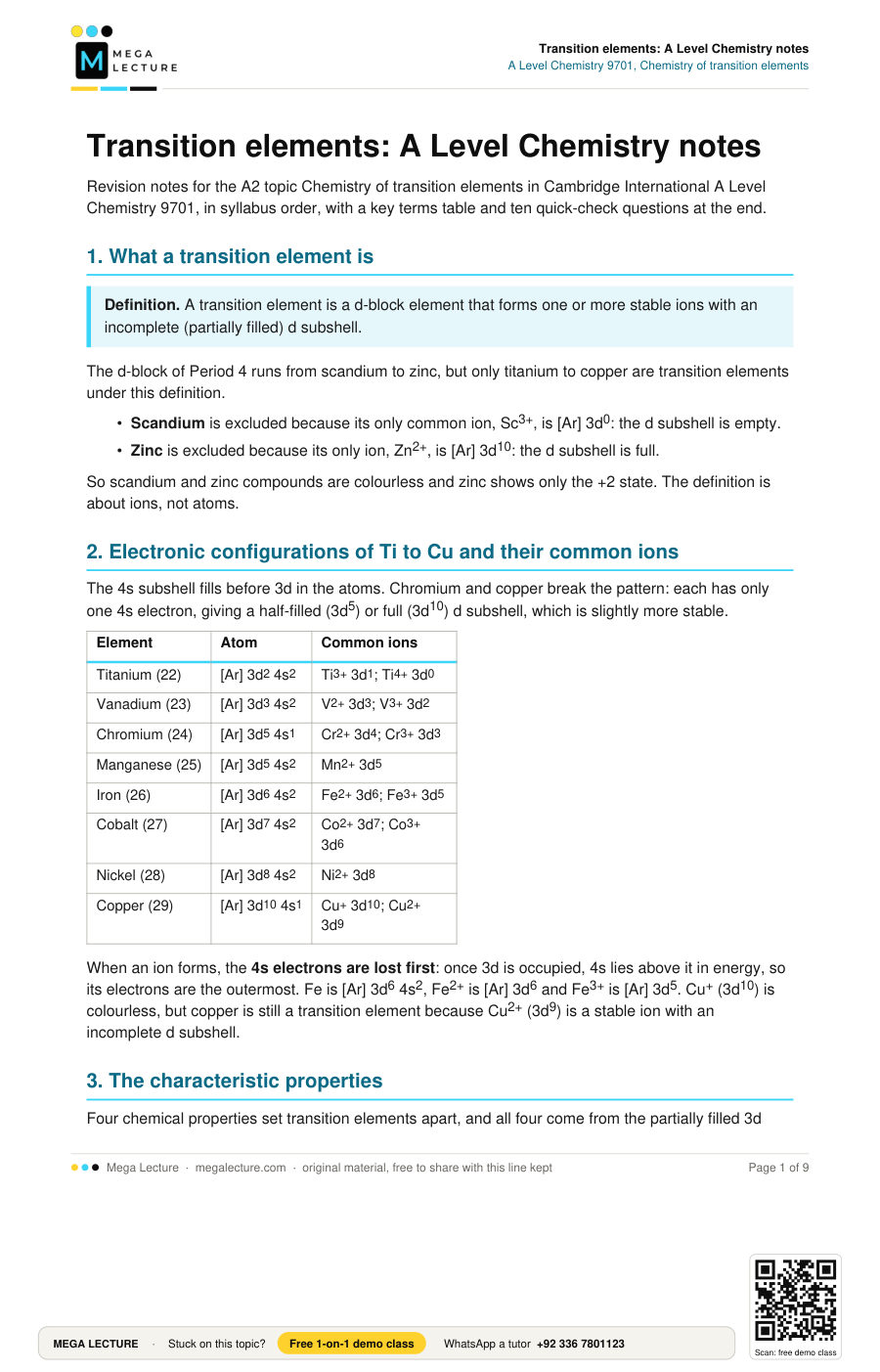
Revision notes for the A2 topic Chemistry of transition elements in Cambridge International A Level Chemistry 9701, in syllabus order, with a key terms table and ten quick-check questions at the end.
1. What a transition element is
Definition. A transition element is a d-block element that forms one or more stable ions with an incomplete (partially filled) d subshell.
The d-block of Period 4 runs from scandium to zinc, but only titanium to copper are transition elements under this definition.
- Scandium is excluded because its only common ion, Sc3+, is [Ar] 3d0: the d subshell is empty.
- Zinc is excluded because its only ion, Zn2+, is [Ar] 3d10: the d subshell is full.
So scandium and zinc compounds are colourless and zinc shows only the +2 state. The definition is about ions, not atoms.
2. Electronic configurations of Ti to Cu and their common ions
The 4s subshell fills before 3d in the atoms. Chromium and copper break the pattern: each has only one 4s electron, giving a half-filled (3d5) or full (3d10) d subshell, which is slightly more stable.
| Element | Atom | Common ions |
|---|---|---|
| Titanium (22) | [Ar] 3d2 4s2 | Ti3+ 3d1; Ti4+ 3d0 |
| Vanadium (23) | [Ar] 3d3 4s2 | V2+ 3d3; V3+ 3d2 |
| Chromium (24) | [Ar] 3d5 4s1 | Cr2+ 3d4; Cr3+ 3d3 |
| Manganese (25) | [Ar] 3d5 4s2 | Mn2+ 3d5 |
| Iron (26) | [Ar] 3d6 4s2 | Fe2+ 3d6; Fe3+ 3d5 |
| Cobalt (27) | [Ar] 3d7 4s2 | Co2+ 3d7; Co3+ 3d6 |
| Nickel (28) | [Ar] 3d8 4s2 | Ni2+ 3d8 |
| Copper (29) | [Ar] 3d10 4s1 | Cu+ 3d10; Cu2+ 3d9 |
When an ion forms, the 4s electrons are lost first: once 3d is occupied, 4s lies above it in energy, so its electrons are the outermost. Fe is [Ar] 3d6 4s2, Fe2+ is [Ar] 3d6 and Fe3+ is [Ar] 3d5. Cu+ (3d10) is colourless, but copper is still a transition element because Cu2+ (3d9) is a stable ion with an incomplete d subshell.
3. The characteristic properties
Four chemical properties set transition elements apart, and all four come from the partially filled 3d subshell.
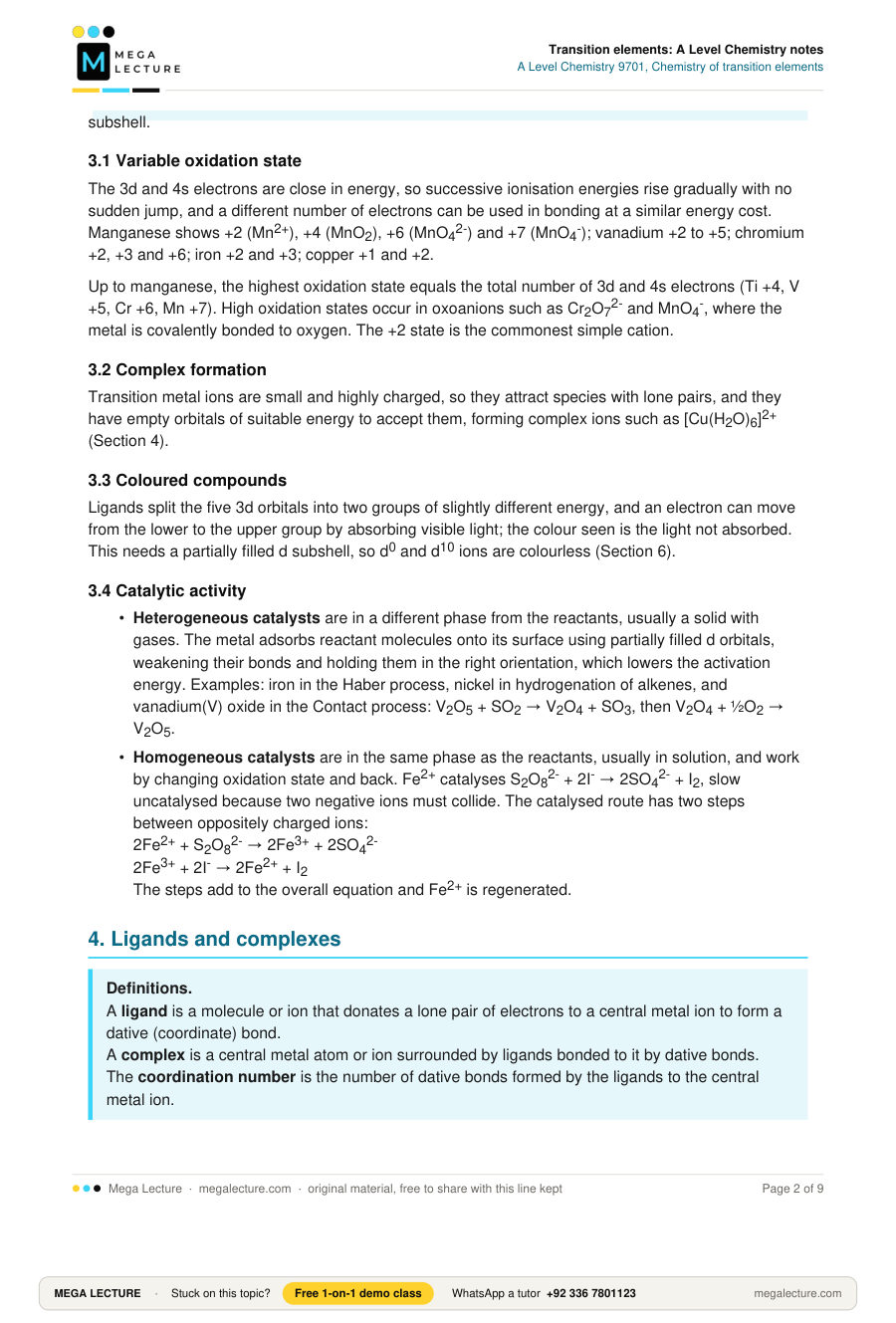
3.1 Variable oxidation state
The 3d and 4s electrons are close in energy, so successive ionisation energies rise gradually with no sudden jump, and a different number of electrons can be used in bonding at a similar energy cost. Manganese shows +2 (Mn2+), +4 (MnO2), +6 (MnO42-) and +7 (MnO4-); vanadium +2 to +5; chromium +2, +3 and +6; iron +2 and +3; copper +1 and +2.
Up to manganese, the highest oxidation state equals the total number of 3d and 4s electrons (Ti +4, V +5, Cr +6, Mn +7). High oxidation states occur in oxoanions such as Cr2O72- and MnO4-, where the metal is covalently bonded to oxygen. The +2 state is the commonest simple cation.
3.2 Complex formation
Transition metal ions are small and highly charged, so they attract species with lone pairs, and they have empty orbitals of suitable energy to accept them, forming complex ions such as [Cu(H2O)6]2+ (Section 4).
3.3 Coloured compounds
Ligands split the five 3d orbitals into two groups of slightly different energy, and an electron can move from the lower to the upper group by absorbing visible light; the colour seen is the light not absorbed. This needs a partially filled d subshell, so d0 and d10 ions are colourless (Section 6).
3.4 Catalytic activity
- Heterogeneous catalysts are in a different phase from the reactants, usually a solid with gases. The metal adsorbs reactant molecules onto its surface using partially filled d orbitals, weakening their bonds and holding them in the right orientation, which lowers the activation energy. Examples: iron in the Haber process, nickel in hydrogenation of alkenes, and vanadium(V) oxide in the Contact process: V2O5 + SO2 → V2O4 + SO3, then V2O4 + ½O2 → V2O5.
- Homogeneous catalysts are in the same phase as the reactants, usually in solution, and work by changing oxidation state and back. Fe2+ catalyses S2O82- + 2I- → 2SO42- + I2, slow uncatalysed because two negative ions must collide. The catalysed route has two steps between oppositely charged ions:
2Fe2+ + S2O82- → 2Fe3+ + 2SO42-
2Fe3+ + 2I- → 2Fe2+ + I2
The steps add to the overall equation and Fe2+ is regenerated.
4. Ligands and complexes
Definitions.
A ligand is a molecule or ion that donates a lone pair of electrons to a central metal ion to form a dative (coordinate) bond.
A complex is a central metal atom or ion surrounded by ligands bonded to it by dative bonds.
The coordination number is the number of dative bonds formed by the ligands to the central metal ion.
The coordination number counts bonds, not ligands: [Ni(en)3]2+ has three ligands but each forms two bonds, so the coordination number is 6.
4.1 Types of ligand
- Monodentate: one dative bond each. H2O, NH3, Cl-, OH-, CN-.
- Bidentate: two dative bonds to the same metal ion. 1,2-diaminoethane, H2NCH2CH2NH2 (en), bonds through both nitrogen atoms; the ethanedioate ion, C2O42-, through one oxygen of each carboxylate group.
- Polydentate: several dative bonds. EDTA4- is hexadentate (two nitrogen and four oxygen atoms), so one ion fills all six positions around an octahedral metal ion.
4.2 Shapes of complexes
| Coordination number | Shape | Bond angle | Examples |
|---|---|---|---|
| 6 | Octahedral | 90° | [Cu(H2O)6]2+, [Fe(H2O)6]3+, [Cr(OH)6]3-, [Ni(en)3]2+ |
| 4 | Tetrahedral | 109.5° | [CuCl4]2-, [CoCl4]2- |
| 4 | Square planar | 90° | [Ni(CN)4]2-, [Pt(NH3)2Cl2] (cisplatin) |
| 2 | Linear | 180° | [Ag(NH3)2]+ (Tollens' reagent) |
Four-coordinate complexes are tetrahedral when the ligands are large, as with chloride, because only four fit around the small metal ion. The oxidation state of the metal follows from the charges: in [Fe(CN)6]3- six CN- contribute 6-, so iron is +3.
5. Isomerism in complexes
5.1 Cis-trans (geometrical) isomerism
- Square planar: in [Pt(NH3)2Cl2] the two chloride ligands are either adjacent, at 90° (cis), or opposite, at 180° (trans). The cis isomer, cisplatin, is an anti-cancer drug: the platinum binds to two adjacent guanine bases of DNA, distorting the helix and stopping replication; the trans isomer cannot do this.
- Octahedral: in [Co(NH3)4Cl2]+ the two chloride ligands are cis (90°) or trans (180°), and the isomers have different colours.
5.2 Optical isomerism
An octahedral complex with three bidentate ligands, such as [Ni(en)3]2+ or [Cr(C2O4)3]3-, has no plane of symmetry, so it exists as two non-superimposable mirror images (enantiomers) which rotate plane-polarised light in opposite directions. With two bidentate and two monodentate ligands, as in [Co(en)2Cl2]+, only the cis form is chiral. Draw one octahedron with the bidentate ligands as curved links across adjacent corners, then its mirror image across a dashed line.
6. Colour and the splitting of d orbitals
In an isolated ion the five 3d orbitals are degenerate (equal in energy). In an octahedral complex the six ligands approach along the x, y and z axes, and their lone pairs repel the two d orbitals that point along the axes more than the three that point between them, so the orbitals split into an upper set of two and a lower set of three separated by a small energy gap, ΔE. This matches the energy of visible light: an electron in a lower orbital absorbs a photon of energy ΔE = hν and is promoted, that frequency is removed from white light, and the light transmitted is the complementary colour. [Cu(H2O)6]2+ absorbs in the orange-red region and so appears blue.
- d0 and d10 ions are colourless: there is no electron to promote, or no empty orbital to receive it.
- ΔE, and so the colour, depends on the ligand, the oxidation state and the coordination number. A colour change is therefore the usual sign of ligand exchange: [Cu(H2O)6]2+ pale blue, [Cu(NH3)4(H2O)2]2+ deep blue, [CuCl4]2- yellow; Fe2+(aq) pale green, Fe3+(aq) yellow-brown.
- The colours of MnO4- and Cr2O72- are not d to d transitions, since Mn(VII) and Cr(VI) are d0.
7. Ligand exchange and stability constants
In a ligand exchange reaction one or more ligands in a complex are replaced by different ones. The reactions are reversible equilibria.
| Reaction | Equation | Colour change |
|---|---|---|
| Cu2+ with excess ammonia | [Cu(H2O)6]2+ + 4NH3 ⇌ [Cu(NH3)4(H2O)2]2+ + 4H2O | Pale blue to deep blue |
| Cu2+ with concentrated HCl | [Cu(H2O)6]2+ + 4Cl- ⇌ [CuCl4]2- + 6H2O | Pale blue to yellow (green while both are present) |
| Co2+ with concentrated HCl | [Co(H2O)6]2+ + 4Cl- ⇌ [CoCl4]2- + 6H2O | Pink to blue |
Only four of the six water molecules are replaced by ammonia. In the chloride reactions the coordination number falls from 6 to 4 and the shape changes from octahedral to tetrahedral, because chloride ions are larger than water molecules; diluting with water shifts the equilibrium back and the original colour returns.
Definition. The stability constant, Kstab, of a complex is the equilibrium constant for the formation of the complex ion from the aqueous metal ion and its ligands in solution.
Water is left out of the expression because it is the solvent and its concentration is effectively constant. For the copper ammine complex:
Kstab = [[Cu(NH3)4(H2O)2]2+] / ([[Cu(H2O)6]2+] [NH3]4), units mol-4 dm12.
A large Kstab means the equilibrium lies far to the right. The rule to use: a ligand whose complex has the larger Kstab displaces a ligand whose complex has a smaller Kstab. Kstab for [Cu(NH3)4(H2O)2]2+ is about 1013 and for [CuCl4]2- about 105, so ammonia turns a solution of [CuCl4]2- deep blue.
Worked example: using a stability constant.
Kstab for the formation of [Cu(NH3)4(H2O)2]2+ from [Cu(H2O)6]2+ is 1.2 × 10¹³ mol-4 dm12 at 298 K. The equilibrium concentration of free ammonia in a solution is 0.10 mol dm-3. Calculate the ratio of the concentration of the ammine complex to that of the hexaaqua ion.
Step 1. Kstab = [complex] / ([Cu(H2O)62+] [NH3]4), water omitted.
Step 2. Rearrange: [complex] / [Cu(H2O)62+] = Kstab × [NH3]4.
Step 3. Substitute: (0.10)4 = 1.0 × 10⁻⁴, so the ratio = 1.2 × 1013 × 1.0 × 10-4 = 1.2 × 10⁹ (the units cancel).
Comment. About a thousand million complex ions for every hexaaqua ion: a small excess of ammonia is enough to turn the solution deep blue.
8. Redox chemistry of Mn, Cr, Fe and Cu
The E° values below are those usually tabulated in the Cambridge data booklet; always use the booklet supplied in your exam. A reaction is feasible under standard conditions when E°cell = E°(reduction) - E°(oxidation) is positive.
| Half-equation (as a reduction) | E°/V | Colour change, oxidised form to reduced form |
|---|---|---|
| MnO4- + 8H+ + 5e- ⇌ Mn2+ + 4H2O | +1.52 | Purple to colourless (very pale pink) |
| Cr2O72- + 14H+ + 6e- ⇌ 2Cr3+ + 7H2O | +1.33 | Orange to green |
| Fe3+ + e- ⇌ Fe2+ | +0.77 | Yellow-brown to pale green |
| I2 + 2e- ⇌ 2I- | +0.54 | Brown to colourless |
| Cu2+ + e- ⇌ Cu+ | +0.15 | Blue to colourless |
| Cr3+ + e- ⇌ Cr2+ | -0.41 | Green to blue |
| Zn2+ + 2e- ⇌ Zn | -0.76 | Both colourless |
8.1 Manganese
Acidified potassium manganate(VII) is a strong oxidising agent and its own indicator: the first permanent pink tint marks the end point. It is acidified with sulfuric acid, never hydrochloric acid, because MnO4- (+1.52 V) would oxidise chloride ions to chlorine (+1.36 V).
With iron(II), E°cell = +1.52 - 0.77 = +0.75 V:
MnO4- + 8H+ + 5Fe2+ → Mn2+ + 4H2O + 5Fe3+ (1 : 5 ratio).
With ethanedioate, oxidised to carbon dioxide:
2MnO4- + 16H+ + 5C2O42- → 2Mn2+ + 8H2O + 10CO2
This titration is done at about 60 °C because the reaction is slow when cold; it is autocatalysed by the Mn2+ produced.
8.2 Chromium
- Dichromate(VI) and chromate(VI) interconvert with pH; chromium stays at +6, so this is acid-base, not redox:
Cr2O72- + 2OH- ⇌ 2CrO42- + H2O (orange to yellow with alkali; acid reverses it). - Dichromate(VI) as an oxidising agent: with Fe2+, E°cell = +1.33 - 0.77 = +0.56 V:
Cr2O72- + 14H+ + 6Fe2+ → 2Cr3+ + 7H2O + 6Fe3+ (orange to green, 1 : 6 ratio). It does not oxidise chloride (+1.33 V is below +1.36 V), so hydrochloric acid may be used, but it needs an indicator. - Reduction by zinc: zinc in acid reduces dichromate(VI) to Cr3+ (orange to green) and then, since -0.76 V is more negative than -0.41 V, to Cr2+ (green to blue): 2Cr3+ + Zn → 2Cr2+ + Zn2+, E°cell = +0.35 V. Cr2+ is rapidly re-oxidised by air.
- Oxidation of Cr(III) to Cr(VI): in alkali, hydrogen peroxide oxidises the green [Cr(OH)6]3- ion to yellow chromate(VI):
2[Cr(OH)6]3- + 3H2O2 → 2CrO42- + 2OH- + 8H2O
8.3 Iron
Fe2+ is a mild reducing agent, oxidised to Fe3+ by MnO4-, Cr2O72- and slowly by air. Fe3+ is a mild oxidising agent: it oxidises iodide to iodine, E°cell = +0.77 - 0.54 = +0.23 V:
2Fe3+ + 2I- → 2Fe2+ + I2
Because E°(Fe3+/Fe2+) lies between E° for S2O82- (+2.01 V) and I2 (+0.54 V), iron can catalyse their reaction (Section 3.4).
8.4 Copper
Copper(II) oxidises iodide ions even though E° predicts it should not (+0.15 V is below +0.54 V), because copper(I) iodide is insoluble and precipitates, removing Cu+ from solution:
2Cu2+ + 4I- → 2CuI + I2
A white precipitate of CuI forms in a brown solution of iodine. The iodine is titrated with thiosulfate: one mole of Cu2+ gives half a mole of I2, which reacts with one mole of S2O32-, so Cu2+ and thiosulfate are in a 1 : 1 ratio.
Copper(I) ions disproportionate in water. From E°(Cu+/Cu) = +0.52 V and E°(Cu2+/Cu+) = +0.15 V, E°cell = +0.37 V:
2Cu+(aq) → Cu(s) + Cu2+(aq)
Copper(I) survives only as insoluble compounds (CuI, CuCl, Cu2O) or in complexes.
Exam tip. Given two E° values: write both half-equations as reductions, reverse the one with the more negative E°, scale and add so the electrons cancel, and calculate E°cell = E°(more positive) - E°(less positive). If prediction and observation disagree, the usual reasons are non-standard concentrations, a precipitate or complex removing a product, or a high activation energy.
9. Reactions with hydroxide and ammonia
Sodium hydroxide and aqueous ammonia both precipitate the metal hydroxide first (ammonia is a weak base supplying a low concentration of OH-), for example Cu2+ + 2OH- → Cu(OH)2. What happens in excess reagent is what distinguishes the ions.
| Ion (colour in solution) | NaOH(aq), a few drops then excess | NH3(aq), a few drops then excess |
|---|---|---|
| Cr3+ (green) | Grey-green precipitate of Cr(OH)3; dissolves in excess to a dark green solution of [Cr(OH)6]3- | Grey-green precipitate; dissolves slowly in a large excess to a purple solution of [Cr(NH3)6]3+ |
| Mn2+ (very pale pink) | Off-white precipitate of Mn(OH)2, rapidly turning brown in air; insoluble in excess | As with NaOH; insoluble in excess |
| Fe2+ (pale green) | Green precipitate of Fe(OH)2, turning brown at the surface in air; insoluble in excess | As with NaOH; insoluble in excess |
| Fe3+ (yellow-brown) | Red-brown precipitate of Fe(OH)3; insoluble in excess | As with NaOH; insoluble in excess |
| Cu2+ (blue) | Pale blue precipitate of Cu(OH)2; insoluble in excess | Pale blue precipitate; dissolves in excess to a deep blue solution of [Cu(NH3)4(H2O)2]2+ |
- Cr(OH)3 is amphoteric, so it dissolves in excess hydroxide: Cr(OH)3 + 3OH- → [Cr(OH)6]3-. The hydroxides of Cu(II), Fe(II), Fe(III) and Mn(II) are basic only and remain as precipitates.
- Cu(OH)2 dissolves in excess ammonia because ammonia is a ligand forming a more stable complex: Cu(OH)2 + 4NH3 + 2H2O → [Cu(NH3)4(H2O)2]2+ + 2OH-. The deep blue solution is the test for Cu2+.
Key terms
| Term | Meaning |
|---|---|
| Transition element | A d-block element that forms one or more stable ions with an incomplete d subshell. |
| Degenerate orbitals | Orbitals of exactly the same energy. |
| Ligand | A molecule or ion with a lone pair that forms a dative bond to a central metal ion. |
| Dative (coordinate) bond | A covalent bond in which both shared electrons come from one atom. |
| Complex ion | A central metal ion bonded to ligands by dative bonds. |
| Coordination number | The number of dative bonds from ligands to the central metal ion. |
| Monodentate / bidentate / polydentate | A ligand forming one / two / several dative bonds to the same metal ion. |
| Cis-trans isomerism | Stereoisomerism in which two identical ligands are adjacent (cis, 90°) or opposite (trans, 180°). |
| Optical isomerism | Stereoisomerism in which a complex and its mirror image cannot be superimposed, as in octahedral complexes with three bidentate ligands. |
| Ligand exchange | A reaction in which one or more ligands in a complex are replaced by others. |
| Stability constant, Kstab | The equilibrium constant for the formation of a complex ion from the aqueous metal ion and its ligands. |
| Heterogeneous / homogeneous catalyst | A catalyst in a different phase from / the same phase as the reactants. |
| Disproportionation | A reaction in which the same species is both oxidised and reduced, as when Cu+ forms Cu and Cu2+. |
| Amphoteric hydroxide | A hydroxide that reacts with both acids and bases, such as Cr(OH)3. |
| Autocatalysis | A reaction catalysed by one of its own products, such as Mn2+ in the manganate(VII) and ethanedioate reaction. |
Quick check
- State the definition of a transition element and explain why zinc is a d-block element but not a transition element.
- Write the electronic configurations of a chromium atom, a Cr3+ ion and a Cu+ ion. State, with a reason, which of the two ions forms colourless compounds.
- Explain why transition elements show variable oxidation states, and state the highest oxidation state of manganese with the formula of an ion in which it occurs.
- Define the terms ligand and coordination number. Give the coordination number and shape of [CoCl4]2- and of [Ni(en)3]2+, where en is 1,2-diaminoethane.
- Explain, in terms of d orbitals, why a solution of [Cu(H2O)6]2+ is blue and a solution of Zn2+(aq) is colourless.
- Describe what is seen when concentrated hydrochloric acid is added drop by drop to a solution of cobalt(II) chloride, and then when the mixture is diluted with a large volume of water. Write an equation and name the type of reaction.
- Kstab for [CuCl4]2- is 4.2 × 10⁵ mol-4 dm12. Write the expression for Kstab and calculate the ratio [CuCl42-] : [Cu(H2O)62+] when the equilibrium chloride concentration is 2.0 mol dm-3. Explain why adding ammonia to this solution gives a deep blue colour.
- A 0.250 g sample of an iron(II) salt was dissolved in dilute sulfuric acid and titrated with 0.0200 mol dm-3 potassium manganate(VII); 18.40 cm3 were needed. Write the ionic equation, calculate the percentage by mass of iron in the sample (Ar: Fe, 55.8), and explain why hydrochloric acid must not be used.
- Use E°(Cu2+/Cu+) = +0.15 V, E°(Cu+/Cu) = +0.52 V and E°(I2/I-) = +0.54 V to predict whether (a) Cu+(aq) is stable in solution and (b) Cu2+ should oxidise iodide ions. Explain why the observation in (b) differs from the prediction, and state what is seen.
- Three unlabelled solutions contain Cr3+, Fe3+ and Cu2+. Describe how aqueous sodium hydroxide alone identifies all three, with observations and an equation for any reaction in excess, and explain why Cr(OH)3 behaves differently from Fe(OH)3.
1. A transition element is a d-block element that forms one or more stable ions with an incomplete d subshell. Zinc is in the d-block because its highest-energy electrons fill the 3d subshell ([Ar] 3d10 4s2), but its only ion, Zn2+, is [Ar] 3d10, a full d subshell, so it does not meet the definition.
2. Cr: [Ar] 3d5 4s1. Cr3+: [Ar] 3d3. Cu+: [Ar] 3d10. Cu+ forms colourless compounds: its d subshell is full, so no electron can be promoted into an empty d orbital and no visible light is absorbed. Cr3+ (3d3) has both occupied and empty d orbitals and is coloured.
3. The 3d and 4s electrons are close in energy, so successive ionisation energies rise gradually with no large jump, and different numbers of electrons can be used in bonding at a comparable energy cost. Manganese reaches +7, equal to its five 3d and two 4s electrons, in the manganate(VII) ion MnO4-.
4. A ligand is a molecule or ion that donates a lone pair of electrons to a central metal ion to form a dative bond. The coordination number is the number of dative bonds from ligands to the central metal ion. [CoCl4]2-: coordination number 4, tetrahedral, 109.5°. [Ni(en)3]2+: three bidentate ligands each forming two bonds, so coordination number 6 (not 3), octahedral, 90°.
5. In the free Cu2+ ion the five 3d orbitals are degenerate. In [Cu(H2O)6]2+ the ligands repel the two d orbitals pointing along the axes more than the three pointing between them, so the orbitals split into a lower set of three and an upper set of two with a small gap ΔE. Cu2+ is 3d9, so there is a vacancy in the upper set; an electron absorbs visible light of energy ΔE = hν and is promoted. The light absorbed is orange-red, so the transmitted (complementary) colour is blue. Zn2+ is 3d10: all five d orbitals are full, no promotion is possible and no visible light is absorbed.
6. The pink solution of [Co(H2O)6]2+ turns blue as the acid is added (purple while both complexes are present); on dilution it returns to pink. [Co(H2O)6]2+ + 4Cl- ⇌ [CoCl4]2- + 6H2O. It is a ligand exchange, the coordination number changing from 6 (octahedral) to 4 (tetrahedral) because chloride ions are larger than water molecules. High chloride concentration pushes the equilibrium right; adding water pushes it back.
7. Kstab = [[CuCl4]2-] / ([[Cu(H2O)6]2+] [Cl-]4), water omitted. Ratio = Kstab × [Cl-]4 = 4.2 × 105 × (2.0)4 = 4.2 × 105 × 16 = 6.7 × 10⁶, so the copper is almost all present as the yellow chloro complex. Ammonia forms [Cu(NH3)4(H2O)2]2+, whose Kstab (about 1.2 × 10¹³ mol-4 dm12) is far larger, so ammonia displaces chloride: [CuCl4]2- + 4NH3 + 2H2O → [Cu(NH3)4(H2O)2]2+ + 4Cl-, deep blue.
8. MnO4- + 8H+ + 5Fe2+ → Mn2+ + 4H2O + 5Fe3+.
Moles of MnO4- = 0.0200 × 18.40/1000 = 3.68 × 10⁻⁴ mol.
Moles of Fe2+ = 5 × 3.68 × 10-4 = 1.84 × 10⁻³ mol.
Mass of iron = 1.84 × 10-3 × 55.8 = 0.1027 g, so percentage = 0.1027/0.250 × 100 = 41.1 %.
Hydrochloric acid must not be used because MnO4- (+1.52 V) oxidises Cl- to Cl2 (+1.36 V): some manganate(VII) would be consumed by chloride, the titre would be too large and the iron content too high.
9. (a) For 2Cu+ → Cu + Cu2+: reduction Cu+ + e- → Cu, E° = +0.52 V; oxidation Cu+ → Cu2+ + e-, the reverse of +0.15 V. E°cell = +0.52 - 0.15 = +0.37 V, positive, so disproportionation is feasible and Cu+(aq) is not stable.
(b) E°cell = +0.15 - 0.54 = -0.39 V, negative, so Cu2+ is predicted not to oxidise I-. It does, 2Cu2+ + 4I- → 2CuI + I2, because the product is insoluble copper(I) iodide rather than Cu+(aq); removing Cu+ as a precipitate makes the effective electrode potential much more positive than +0.15 V (non-standard conditions). A white precipitate of CuI forms in a brown solution of iodine.
10. Add sodium hydroxide dropwise to each solution, then in excess. Cu2+: pale blue precipitate of Cu(OH)2, insoluble in excess. Fe3+: red-brown precipitate of Fe(OH)3, insoluble in excess. Cr3+: grey-green precipitate of Cr(OH)3, which dissolves in excess to a dark green solution: Cr(OH)3 + 3OH- → [Cr(OH)6]3-. Cr(OH)3 is amphoteric, reacting with hydroxide ions to form a hydroxo complex; Fe(OH)3 is basic only and stays as a precipitate.
