
AS Level · Physics 9702 · Physical quantities, units and measurement: AS Physics notes with questions
Physical quantities, units and measurement: AS Physics notes with questions
Opens inside this page. Prefer your own PDF app? Open the PDF.
Check yourself
5 quick questions on AS Level Physics
Tap an answer to see if you are right, and why. Free, no sign-up.
Start the free test👍 13 students found these notes useful
Was this note useful?
Full text of Physical quantities, units and measurement: AS Physics notes with questions
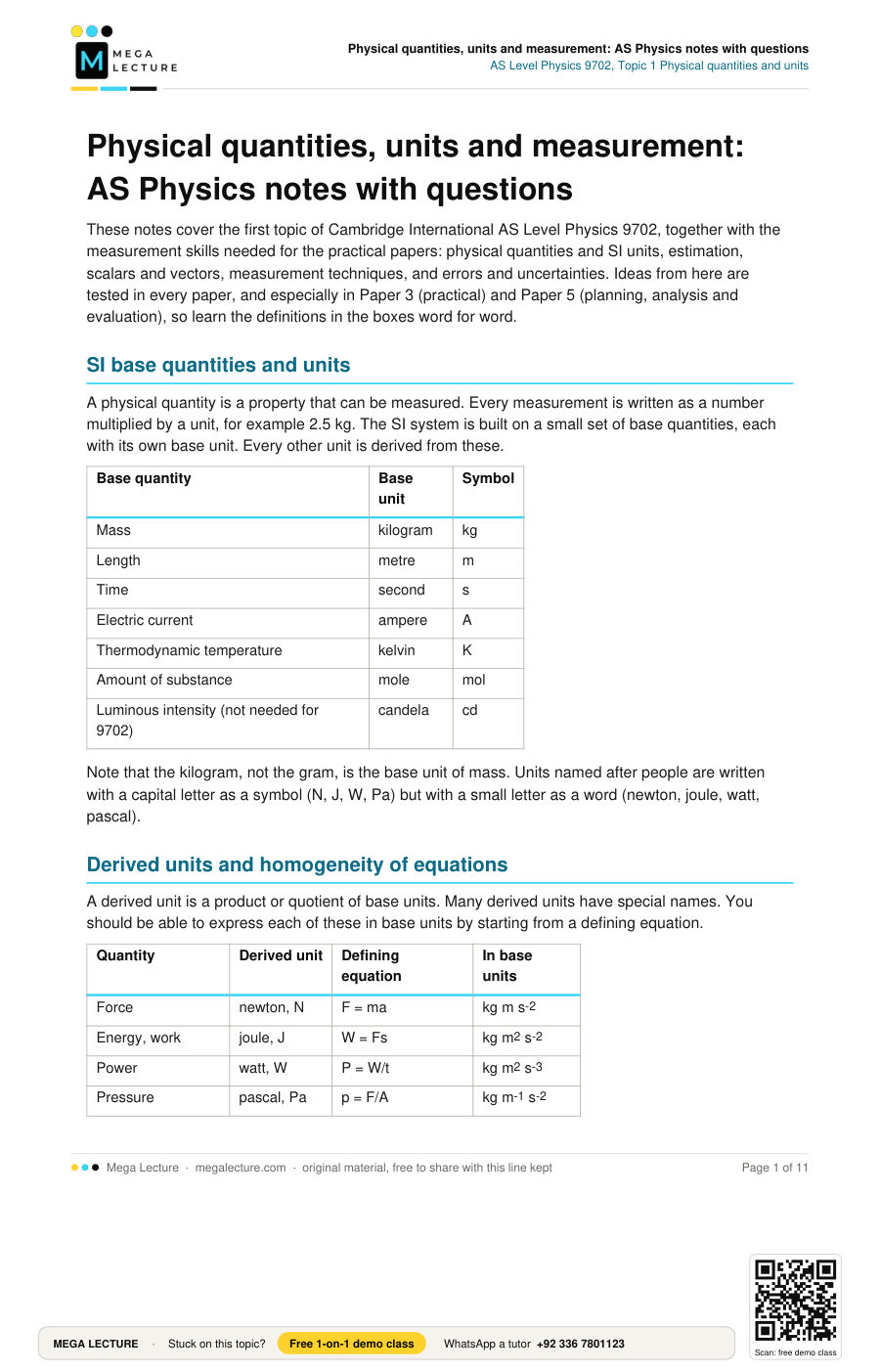
These notes cover the first topic of Cambridge International AS Level Physics 9702, together with the measurement skills needed for the practical papers: physical quantities and SI units, estimation, scalars and vectors, measurement techniques, and errors and uncertainties. Ideas from here are tested in every paper, and especially in Paper 3 (practical) and Paper 5 (planning, analysis and evaluation), so learn the definitions in the boxes word for word.
SI base quantities and units
A physical quantity is a property that can be measured. Every measurement is written as a number multiplied by a unit, for example 2.5 kg. The SI system is built on a small set of base quantities, each with its own base unit. Every other unit is derived from these.
| Base quantity | Base unit | Symbol |
|---|---|---|
| Mass | kilogram | kg |
| Length | metre | m |
| Time | second | s |
| Electric current | ampere | A |
| Thermodynamic temperature | kelvin | K |
| Amount of substance | mole | mol |
| Luminous intensity (not needed for 9702) | candela | cd |
Note that the kilogram, not the gram, is the base unit of mass. Units named after people are written with a capital letter as a symbol (N, J, W, Pa) but with a small letter as a word (newton, joule, watt, pascal).
Derived units and homogeneity of equations
A derived unit is a product or quotient of base units. Many derived units have special names. You should be able to express each of these in base units by starting from a defining equation.
| Quantity | Derived unit | Defining equation | In base units |
|---|---|---|---|
| Force | newton, N | F = ma | kg m s-2 |
| Energy, work | joule, J | W = Fs | kg m2 s-2 |
| Power | watt, W | P = W/t | kg m2 s-3 |
| Pressure | pascal, Pa | p = F/A | kg m-1 s-2 |
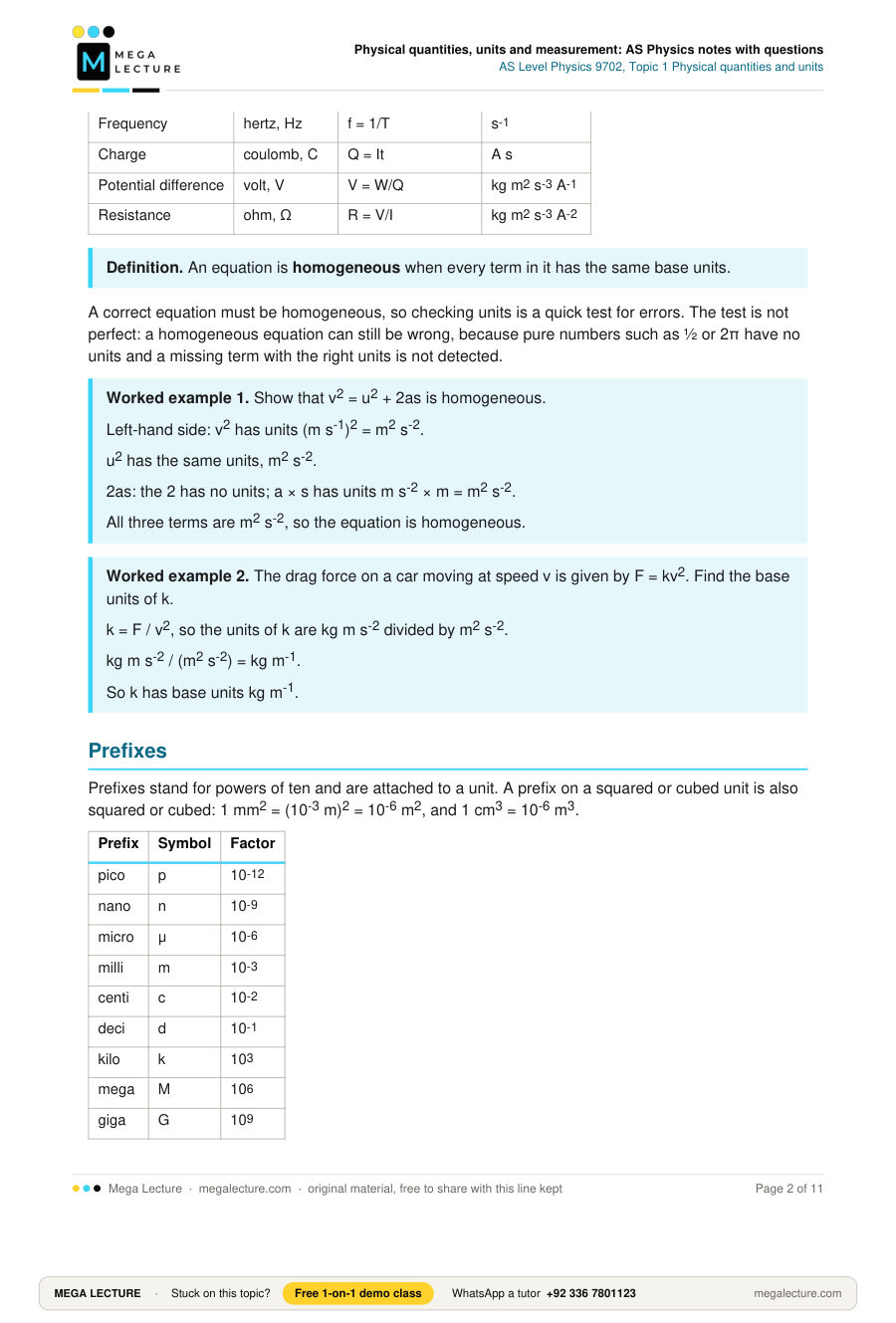
| Frequency | hertz, Hz | f = 1/T | s-1 |
| Charge | coulomb, C | Q = It | A s |
| Potential difference | volt, V | V = W/Q | kg m2 s-3 A-1 |
| Resistance | ohm, Ω | R = V/I | kg m2 s-3 A-2 |
Definition. An equation is homogeneous when every term in it has the same base units.
A correct equation must be homogeneous, so checking units is a quick test for errors. The test is not perfect: a homogeneous equation can still be wrong, because pure numbers such as ½ or 2π have no units and a missing term with the right units is not detected.
Worked example 1. Show that v2 = u2 + 2as is homogeneous.
Left-hand side: v2 has units (m s-1)2 = m2 s-2.
u2 has the same units, m2 s-2.
2as: the 2 has no units; a × s has units m s-2 × m = m2 s-2.
All three terms are m2 s-2, so the equation is homogeneous.
Worked example 2. The drag force on a car moving at speed v is given by F = kv2. Find the base units of k.
k = F / v2, so the units of k are kg m s-2 divided by m2 s-2.
kg m s-2 / (m2 s-2) = kg m-1.
So k has base units kg m-1.
Prefixes
Prefixes stand for powers of ten and are attached to a unit. A prefix on a squared or cubed unit is also squared or cubed: 1 mm2 = (10-3 m)2 = 10-6 m2, and 1 cm3 = 10-6 m3.
| Prefix | Symbol | Factor |
|---|---|---|
| pico | p | 10-12 |
| nano | n | 10-9 |
| micro | μ | 10-6 |
| milli | m | 10-3 |
| centi | c | 10-2 |
| deci | d | 10-1 |
| kilo | k | 103 |
| mega | M | 106 |
| giga | G | 109 |
| tera | T | 1012 |
Always convert to base units before substituting into an equation: 250 nm = 250 × 10-9 m = 2.5 × 10⁻⁷ m, and 3.0 GHz = 3.0 × 10⁹ Hz.
Estimating magnitudes
Exam questions ask you to make reasonable estimates of physical quantities. A sensible estimate is within a factor of about 3 of the true value and is given to one significant figure. Learn the values below as anchors and build other estimates from them, stating any assumptions you make.
| Quantity | Typical value |
|---|---|
| Mass of an adult | 70 kg |
| Mass of a car | 1 × 10³ kg |
| Mass of a proton | 1.7 × 10⁻²⁷ kg |
| Diameter of an atom | 1 × 10⁻¹⁰ m |
| Wavelength of visible light | 5 × 10⁻⁷ m |
| Height of a door | 2 m |
| Radius of the Earth | 6.4 × 10⁶ m |
| Walking speed | 1.5 m s-1 |
| Speed of a car on a motorway | 30 m s-1 |
| Speed of sound in air | 340 m s-1 |
| Density of water | 1000 kg m-3 |
| Density of air | 1.2 kg m-3 |
| Atmospheric pressure | 1 × 10⁵ Pa |
| Power of an electric kettle | 2 kW |
| Energy stored in an AA cell | 1 × 10⁴ J |
| Young modulus of steel | 2 × 10¹¹ Pa |
| Frequency of mains electricity | 50 Hz |
| Gravitational field strength at the Earth's surface | 9.81 N kg-1 |
Exam tip. In an estimate question, write the equation, state each value you assume with its unit, then calculate. Marks are given for a reasonable method and a sensible order of magnitude, not for a precise number.
Scalars and vectors
Definitions. A scalar is a quantity that has magnitude only.
A vector is a quantity that has both magnitude and direction.
| Scalars | Vectors |
|---|---|
| distance, speed, mass, time, energy, work, power, temperature, density, pressure, volume, charge | displacement, velocity, acceleration, force, weight, momentum, electric field strength, gravitational field strength |
Adding vectors by drawing
Draw the first vector to scale, then draw the second vector starting from the tip of the first. The resultant runs from the start of the first vector to the tip of the second (the tip-to-tail rule). Measure its length and convert with the scale, and measure its direction with a protractor. For two vectors you can also complete the parallelogram: the resultant is the diagonal from the common starting point.
Adding vectors by calculation
- Vectors at right angles: use Pythagoras for the magnitude and a tangent for the direction.
- Vectors at any other angle: either use the cosine rule and sine rule on the triangle, or resolve each vector into two perpendicular components, add the components, and recombine.
Resolving a vector
A vector of magnitude V at angle θ to a chosen axis has a component V cos θ along the axis and a component V sin θ perpendicular to it. For a weight W on a slope inclined at θ to the horizontal, the component down the slope is W sin θ and the component perpendicular to the slope is W cos θ.
Worked example 3. Two forces of 6.0 N and 8.0 N act on a point at right angles to each other. Find the resultant.
Magnitude: R = √(6.02 + 8.02) = √(36 + 64) = √100 = 10.0 N.
Direction: tan θ = 6.0 / 8.0 = 0.75, so θ = 36.9° measured from the 8.0 N force.
Worked example 4. Forces of 7.0 N and 5.0 N act on an object with an angle of 60° between them. Find the resultant by resolving.
Take the x-axis along the 7.0 N force.
Sum of x-components: 7.0 + 5.0 cos 60° = 7.0 + 2.50 = 9.50 N.
Sum of y-components: 0 + 5.0 sin 60° = 4.33 N.
Magnitude: R = √(9.502 + 4.332) = √(90.25 + 18.75) = √109.0 = 10.4 N.
Direction: tan θ = 4.33 / 9.50 = 0.456, so θ = 24.5° from the 7.0 N force.
Check with the cosine rule: R2 = 7.02 + 5.02 + 2 × 7.0 × 5.0 × cos 60° = 49 + 25 + 35 = 109, so R = 10.4 N. Agreed.
Measurement techniques and instruments
Choose an instrument whose range covers the quantity and whose precision is small compared with the value being measured. The precision of an instrument is usually taken as its smallest scale division (for an analogue scale, half a division is also acceptable).
| Instrument | Measures | Typical range | Precision |
|---|---|---|---|
| Metre rule | length | up to 1 m | 1 mm |
| Tape measure | length | up to several metres | 1 mm |
| Vernier calipers | length, internal and external diameters, depth | up to about 150 mm | 0.1 mm (0.02 mm on some models) |
| Micrometer screw gauge | small lengths, wire diameters, sheet thickness | up to 25 mm | 0.01 mm |
| Digital balance | mass | up to a few kilograms | 0.01 g or 0.1 g |
| Stopwatch | time | hours | 0.01 s on the display, but human reaction time of 0.1 to 0.3 s dominates |
| Measuring cylinder | volume | 10 cm3 to 1000 cm3 | 1 cm3 (varies with size) |
| Liquid-in-glass thermometer | temperature | -10 °C to 110 °C | 0.5 °C or 1 °C |
| Thermocouple | temperature, rapid changes and small objects | very wide | needs a calibration curve |
| Analogue ammeter or voltmeter | current, p.d. | depends on the range selected | typically 0.1 A or 0.1 V per division |
| Digital multimeter | current, p.d., resistance | switchable ranges | last digit of the display |
| Cathode-ray oscilloscope | p.d. against time, period, frequency | set by the Y-gain and time-base | a fraction of a division |
Points to remember
- Check for a zero error before using a micrometer or calipers, and subtract it from every reading. A micrometer that reads 0.03 mm with its jaws closed has a zero error of +0.03 mm, so a reading of 1.27 mm means a true diameter of 1.24 mm.
- Avoid parallax error by viewing a scale at right angles, and by reading the bottom of the meniscus of water in a measuring cylinder at eye level.
- Measure a small quantity many times over: time 20 oscillations rather than one, or measure the thickness of 50 sheets rather than one sheet. The reaction time or scale precision is then divided by 20 or 50.
- Use a fiducial marker (a fixed reference point, usually at the centre of an oscillation where the object moves fastest) when timing oscillations.
- An oscilloscope gives the period from the time-base setting multiplied by the number of horizontal divisions for one cycle; the frequency is 1 over the period. The peak voltage is the Y-gain setting multiplied by the vertical height in divisions.
- Some sensors (thermistor, thermocouple, light-dependent resistor) do not give a straight-line relationship with the quantity measured, so a calibration curve is plotted against a known instrument and used to convert readings.
Errors and uncertainties
Systematic and random errors
Definitions. A systematic error is an error that shifts every reading away from the true value by the same amount or in the same direction. It cannot be reduced by repeating readings and taking an average. Examples: a zero error on an instrument, an instrument that has been wrongly calibrated, heat loss to the surroundings in a heating experiment.
A random error is an error that causes readings to be scattered on either side of the true value. It can be reduced by repeating readings and taking an average. Examples: human reaction time when starting a stopwatch, parallax when reading a scale from slightly different angles, fluctuations in a reading from a changing room temperature.
Precision and accuracy
Definitions. Precision is the degree to which repeated readings of the same quantity agree with one another. A precise set of readings has a small spread, which means small random error.
Accuracy is the degree to which a measured value is close to the true value. An accurate result has small systematic error and small random error.
A set of readings can be precise but not accurate (all close together but all shifted by a zero error), or accurate but not precise (widely scattered but with a mean close to the true value). Think of arrows on a target: a tight cluster away from the centre is precise but not accurate.
Absolute, fractional and percentage uncertainty
Definitions. The absolute uncertainty Δx is the range on either side of a measured value x within which the true value is expected to lie. It has the same unit as x, and a result is written x ± Δx.
The fractional uncertainty is Δx / x. It has no unit.
The percentage uncertainty is (Δx / x) × 100%.
- For a single reading, the absolute uncertainty is usually the precision of the instrument, for example 25.0 ± 0.1 cm with a metre rule (two readings, one at each end, each ± 0.05 cm, combine to ± 0.1 cm).
- For a set of repeated readings, take the mean as the value and half the range (largest minus smallest, divided by 2) as the absolute uncertainty.
- Quote an uncertainty to one significant figure, and round the value to the same decimal place as its uncertainty: 9.8 ± 0.2 m s-2, not 9.802 ± 0.17 m s-2.
Combining uncertainties
| Operation | Rule |
|---|---|
| Adding or subtracting: y = a + b or y = a - b | Add the absolute uncertainties: Δy = Δa + Δb |
| Multiplying or dividing: y = ab or y = a/b | Add the fractional (or percentage) uncertainties: Δy/y = Δa/a + Δb/b |
| Raising to a power: y = an | Multiply the fractional uncertainty by the power: Δy/y = n × Δa/a (n is taken as positive, so a square root gives ½ and 1/a gives 1) |
| Multiplying by a constant: y = ka | The fractional uncertainty is unchanged: Δy/y = Δa/a |
Worked example 5 (multiplying). A rectangular sheet has length 25.0 ± 0.1 cm and width 12.0 ± 0.1 cm. Find its area with its uncertainty.
Area A = 25.0 × 12.0 = 300 cm2.
Percentage uncertainty in length = (0.1 / 25.0) × 100% = 0.40%.
Percentage uncertainty in width = (0.1 / 12.0) × 100% = 0.83%.
Percentage uncertainty in area = 0.40% + 0.83% = 1.23%.
Absolute uncertainty ΔA = 0.0123 × 300 = 3.7 cm2, rounded to 4 cm2.
A = 300 ± 4 cm2.
Worked example 6 (subtracting). Water is heated from 15.0 ± 0.5 °C to 42.0 ± 0.5 °C. Find the temperature rise.
Rise = 42.0 - 15.0 = 27.0 °C. Uncertainty = 0.5 + 0.5 = 1.0 °C.
Temperature rise = 27.0 ± 1.0 °C. Notice that the percentage uncertainty (3.7%) is much larger than the percentage uncertainty in either reading, which is why subtracting two similar values gives a poor result.
Worked example 7 (powers). The diameter of a wire is measured five times with a micrometer: 0.52, 0.54, 0.53, 0.55 and 0.51 mm. Find the cross-sectional area with its uncertainty.
Mean diameter d = (0.52 + 0.54 + 0.53 + 0.55 + 0.51) / 5 = 2.65 / 5 = 0.530 mm.
Absolute uncertainty in d = half the range = (0.55 - 0.51) / 2 = 0.02 mm.
Area A = πd2 / 4 = π × 0.5302 / 4 = π × 0.2809 / 4 = 0.2206 mm2.
Percentage uncertainty in d = (0.02 / 0.530) × 100% = 3.8%.
Percentage uncertainty in A = 2 × 3.8% = 7.6% (the power is 2; π and 4 are exact).
ΔA = 0.076 × 0.2206 = 0.017 mm2, rounded to 0.02 mm2.
A = 0.22 ± 0.02 mm2.
Worked example 8 (a full calculation). A pendulum of length L = 0.800 ± 0.005 m has period T = 1.795 ± 0.010 s. Use g = 4π2L / T2 to find g with its uncertainty.
g = 4π2 × 0.800 / 1.7952 = 31.58 / 3.222 = 9.80 m s-2.
Percentage uncertainty in L = (0.005 / 0.800) × 100% = 0.63%.
Percentage uncertainty in T = (0.010 / 1.795) × 100% = 0.56%, and T is squared, so its contribution is 2 × 0.56% = 1.12%.
Percentage uncertainty in g = 0.63% + 1.12% = 1.75%.
Δg = 0.0175 × 9.80 = 0.17 m s-2, rounded to 0.2 m s-2.
g = 9.8 ± 0.2 m s-2. The accepted value 9.81 m s-2 lies inside this range, so the result is consistent with it.
Exam tip. When a question asks which measurement contributes most to the uncertainty, compare the percentage uncertainties after they have been multiplied by their powers. In Worked example 8 it is the period, because its 0.56% is doubled. Suggest reducing it by timing more oscillations, not by using a stopwatch with more decimal places.
Key terms
| Term | Meaning |
|---|---|
| Physical quantity | A property that can be measured, written as a number and a unit. |
| Base unit | One of the seven SI units from which all others are derived (kg, m, s, A, K, mol, cd). |
| Derived unit | A unit formed by multiplying or dividing base units, for example N = kg m s-2. |
| Homogeneous equation | An equation in which every term has the same base units. |
| Prefix | A multiplier that is a power of ten attached to a unit, for example k = 103. |
| Order of magnitude | The power of ten nearest to the size of a quantity. |
| Scalar | A quantity with magnitude only. |
| Vector | A quantity with magnitude and direction. |
| Resultant | The single vector that has the same effect as two or more vectors added together. |
| Component | One of two perpendicular vectors into which a vector is resolved. |
| Precision (of an instrument) | The smallest change the instrument can show, usually one scale division. |
| Range | The smallest and largest values an instrument can measure. |
| Zero error | A non-zero reading when the true value is zero; a systematic error. |
| Parallax error | An error from viewing a scale and pointer at an angle rather than square on. |
| Calibration curve | A graph of the reading of an instrument against the true value, used to convert readings. |
| Systematic error | An error that shifts all readings in the same direction; not reduced by averaging. |
| Random error | An error that scatters readings around the true value; reduced by averaging. |
| Precision (of readings) | How closely repeated readings agree with each other. |
| Accuracy | How close a measured value is to the true value. |
| Absolute uncertainty | The margin Δx on either side of a value x; same unit as x. |
| Fractional uncertainty | Δx / x, with no unit. |
| Percentage uncertainty | (Δx / x) × 100%. |
Practice
Marks are shown in square brackets. Full answers are given at the end.
- State, in SI base units, the units of (a) force, (b) pressure, (c) energy. [3]
- The pressure p at a depth h in a liquid of density ρ is p = ρgh, where g is the acceleration of free fall. Show that this equation is homogeneous. [3]
- The viscous drag force F on a small sphere of radius r moving at speed v through a liquid is F = 6πηrv, where η is a constant for the liquid. Determine the base units of η. [3]
- Convert each of the following to the SI unit without a prefix, giving your answer in standard form: (a) 3.5 GHz, (b) 0.25 mm2, (c) 1.2 g cm-3. [3]
- Estimate the kinetic energy of a family car travelling on a motorway. State the values you assume. [3]
- (a) State the difference between a scalar quantity and a vector quantity. (b) Sort the following into scalars and vectors: distance, displacement, speed, velocity, acceleration, force, energy, momentum, temperature, power. [4]
- A boat is steered due north at 4.0 m s-1 relative to the water of a river that flows due east at 3.0 m s-1. Calculate the magnitude and direction of the resultant velocity of the boat. [4]
- Two forces of 12 N and 9.0 N act at a point. The angle between them is 50°. Calculate the magnitude of the resultant force and the angle it makes with the 12 N force. [4]
- A box of weight 45 N rests on a slope inclined at 25° to the horizontal. Calculate the components of the weight (a) parallel to the slope, (b) perpendicular to the slope. [3]
- (a) With the jaws closed, a micrometer reads 0.03 mm. With a wire between the jaws it reads 1.27 mm. State the diameter of the wire. (b) Name the most suitable instrument for measuring: (i) the diameter of a wire of about 0.5 mm, (ii) the internal diameter of a pipe of about 2 cm, (iii) the length of a laboratory bench of about 2 m. [4]
- A student times 20 complete oscillations of a pendulum with a stopwatch and records 28.4 s. The student's reaction time is estimated as 0.2 s. (a) Calculate the period of the pendulum. (b) Calculate the absolute uncertainty in the period. (c) Explain why the student timed 20 oscillations rather than one. (d) The stopwatch runs slow, so that every reading is 1% too small. State the type of error this introduces and whether repeating the readings would reduce it. [6]
- In an experiment to find the resistivity of a wire, the potential difference across it is 4.80 ± 0.05 V and the current in it is 0.240 ± 0.005 A. The wire has length 1.500 ± 0.002 m and diameter 0.32 ± 0.01 mm. (a) Calculate the resistance R of the wire with its absolute uncertainty. (b) Calculate the resistivity ρ = RA / L of the wire, where A is the cross-sectional area, with its percentage and absolute uncertainty. (c) State which measurement should be improved first to reduce the uncertainty in ρ, with a reason. [6]
1. (a) Force: F = ma, so kg × m s-2 = kg m s-2. (b) Pressure: p = F/A, so kg m s-2 / m2 = kg m-1 s-2. (c) Energy: W = Fs, so kg m s-2 × m = kg m2 s-2. [3]
2. Left-hand side: pressure has base units kg m-1 s-2. Right-hand side: ρ is kg m-3, g is m s-2, h is m. Multiplying: kg m-3 × m s-2 × m = kg m-3 + 1 + 1 s-2 = kg m-1 s-2. Both sides have the same base units, so the equation is homogeneous. [3]
3. Rearranging, η = F / (6πrv). The 6π has no units. Units of η = kg m s-2 / (m × m s-1) = kg m s-2 / (m2 s-1) = kg m-1 s-1. [3]
4. (a) 3.5 GHz = 3.5 × 10⁹ Hz. (b) 1 mm2 = (10-3 m)2 = 10-6 m2, so 0.25 mm2 = 0.25 × 10⁻⁶ m2 = 2.5 × 10⁻⁷ m2. (c) 1 g = 10-3 kg and 1 cm3 = 10-6 m3, so 1 g cm-3 = 10-3 / 10-6 = 103 kg m-3, and 1.2 g cm-3 = 1.2 × 10³ kg m-3. [3]
5. Assume the mass of the car is 1200 kg and its speed is 30 m s-1 (about 110 km h-1). Kinetic energy = ½mv2 = ½ × 1200 × 302 = ½ × 1200 × 900 = 5.4 × 10⁵ J, so about 5 × 10⁵ J. Any answer between about 2 × 10⁵ J and 1 × 10⁶ J with stated assumptions is acceptable. [3]
6. (a) A scalar has magnitude only; a vector has both magnitude and direction. (b) Scalars: distance, speed, energy, temperature, power. Vectors: displacement, velocity, acceleration, force, momentum. [4]
7. The two velocities are at right angles. Magnitude: v = √(4.02 + 3.02) = √(16 + 9) = √25 = 5.0 m s-1. Direction: tan θ = 3.0 / 4.0 = 0.75, so θ = 36.9°, measured from north towards east. The boat moves at 5.0 m s-1 on a bearing of 037° (36.9° east of north). [4]
8. Resolve along and perpendicular to the 12 N force. Along: 12 + 9.0 cos 50° = 12 + 9.0 × 0.6428 = 12 + 5.79 = 17.79 N. Perpendicular: 9.0 sin 50° = 9.0 × 0.7660 = 6.89 N. Magnitude: R = √(17.792 + 6.892) = √(316.5 + 47.5) = √364.0 = 19.1 N. Angle with the 12 N force: tan θ = 6.89 / 17.79 = 0.387, so θ = 21.2°. Check by the cosine rule: R2 = 122 + 9.02 + 2 × 12 × 9.0 × cos 50° = 144 + 81 + 138.8 = 363.8, R = 19.1 N. [4]
9. (a) Parallel to the slope: 45 sin 25° = 45 × 0.4226 = 19.0 N (acting down the slope). (b) Perpendicular to the slope: 45 cos 25° = 45 × 0.9063 = 40.8 N (acting into the slope). Check: 19.02 + 40.82 = 361 + 1665 = 2026, and √2026 = 45.0 N. [3]
10. (a) The zero error is +0.03 mm, so it must be subtracted: diameter = 1.27 - 0.03 = 1.24 mm. (b) (i) Micrometer screw gauge, precision 0.01 mm, because the diameter is only about 50 times its precision and a vernier (0.1 mm) would give a 20% uncertainty. (ii) Vernier calipers, using the internal jaws. (iii) A tape measure, or a metre rule used twice end to end. [4]
11. (a) Period T = 28.4 / 20 = 1.42 s. (b) The uncertainty in the total time is the reaction time, 0.2 s, so the uncertainty in the period is 0.2 / 20 = 0.01 s, giving T = 1.42 ± 0.01 s. (c) The reaction time of about 0.2 s is the same whether one oscillation or twenty is timed. Timing one oscillation would give 1.42 ± 0.2 s, a percentage uncertainty of 14%; timing twenty divides the absolute uncertainty by 20 and reduces the percentage uncertainty to about 0.7%. (d) A systematic error: every reading is shifted in the same direction by the same fraction. Repeating and averaging would not reduce it, because every repeat is 1% too small as well; it can only be removed by calibrating the stopwatch against a reliable clock and correcting the readings. [6]
12. (a) R = V / I = 4.80 / 0.240 = 20.0 Ω. Percentage uncertainty in V = (0.05 / 4.80) × 100% = 1.04%. Percentage uncertainty in I = (0.005 / 0.240) × 100% = 2.08%. Percentage uncertainty in R = 1.04% + 2.08% = 3.1%. ΔR = 0.031 × 20.0 = 0.62 Ω, rounded to 0.6 Ω. R = 20.0 ± 0.6 Ω.
(b) Convert the diameter: d = 0.32 mm = 3.2 × 10⁻⁴ m. Area A = πd2 / 4 = π × (3.2 × 10⁻⁴)2 / 4 = π × 1.024 × 10⁻⁷ / 4 = 8.04 × 10⁻⁸ m2. Resistivity ρ = RA / L = 20.0 × 8.04 × 10-8 / 1.500 = 1.07 × 10⁻⁶ Ω m.
Percentage uncertainties: R is 3.1% (from part a); d is (0.01 / 0.32) × 100% = 3.1%, and d is squared, so its contribution is 2 × 3.1% = 6.2%; L is (0.002 / 1.500) × 100% = 0.13%. Total percentage uncertainty in ρ = 3.1% + 6.2% + 0.13% = 9.4%, which is about 10%. Absolute uncertainty Δρ = 0.094 × 1.07 × 10-6 = 1.0 × 10⁻⁷ Ω m. So ρ = (1.07 ± 0.10) × 10-6 Ω m, which could be written (1.1 ± 0.1) × 10-6 Ω m.
(c) The diameter. Its 3.1% uncertainty is doubled to 6.2% because the area depends on d2, making it the largest contribution by far. It should be measured at several places along the wire and in two directions at right angles at each place, with a micrometer that has been checked for zero error, and the mean taken. [6]
