
AS Level · Physics 9702 · Physics definitions and equations: AS and A Level
Physics definitions and equations: AS and A Level
Opens inside this page. Prefer your own PDF app? Open the PDF.
New: small group classes for AS Level Physics are opening, at a lower fee than one-to-one. Join the waiting list
Check yourself
5 quick questions on AS Level Physics
Tap an answer to see if you are right, and why. Free, no sign-up.
Start the free test8 of 8 students found these notes useful
Was this note useful?
Full text of Physics definitions and equations: AS and A Level
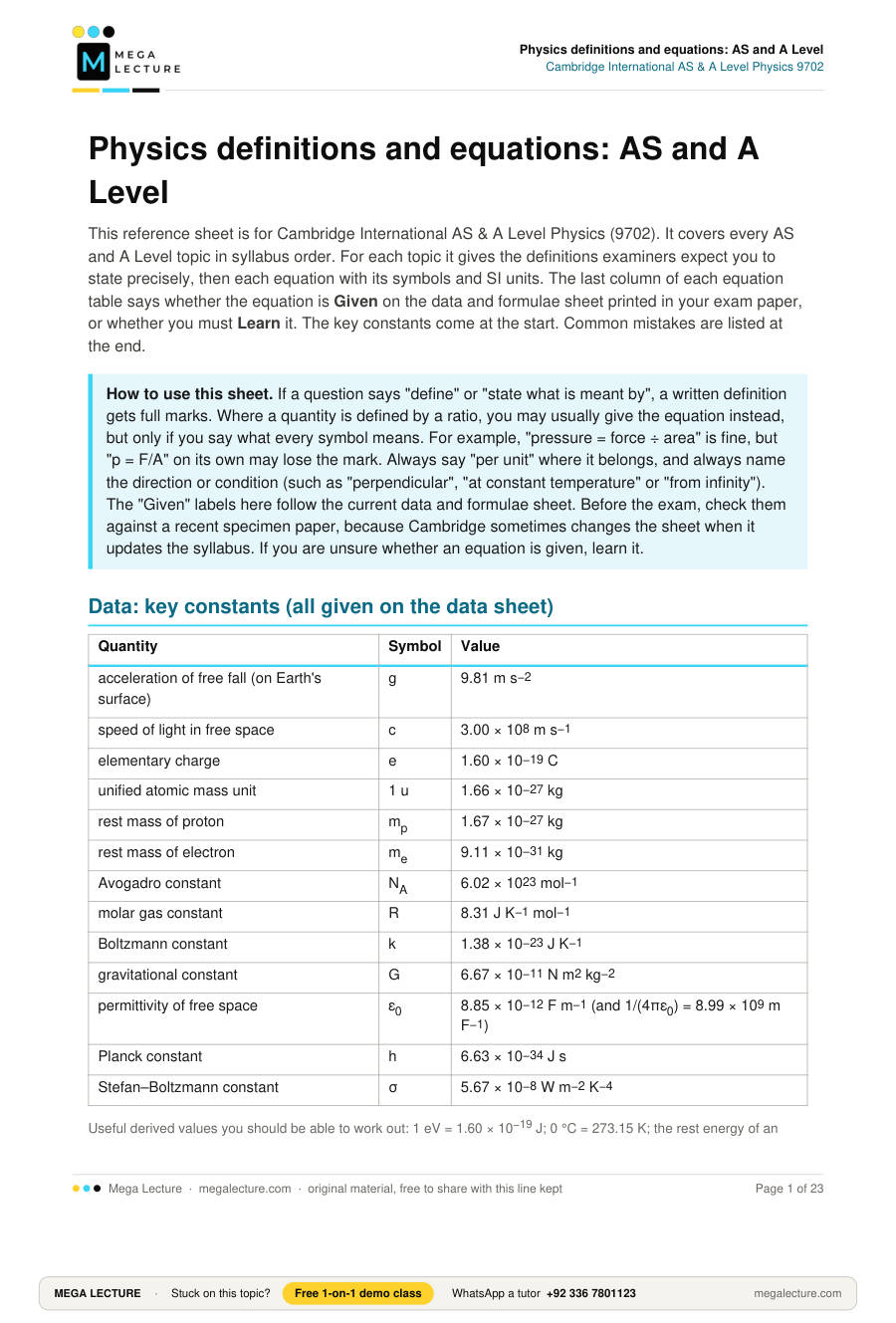
This reference sheet is for Cambridge International AS & A Level Physics (9702). It covers every AS and A Level topic in syllabus order. For each topic it gives the definitions examiners expect you to state precisely, then each equation with its symbols and SI units. The last column of each equation table says whether the equation is Given on the data and formulae sheet printed in your exam paper, or whether you must Learn it. The key constants come at the start. Common mistakes are listed at the end.
How to use this sheet. If a question says "define" or "state what is meant by", a written definition gets full marks. Where a quantity is defined by a ratio, you may usually give the equation instead, but only if you say what every symbol means. For example, "pressure = force ÷ area" is fine, but "p = F/A" on its own may lose the mark. Always say "per unit" where it belongs, and always name the direction or condition (such as "perpendicular", "at constant temperature" or "from infinity"). The "Given" labels here follow the current data and formulae sheet. Before the exam, check them against a recent specimen paper, because Cambridge sometimes changes the sheet when it updates the syllabus. If you are unsure whether an equation is given, learn it.
Data: key constants (all given on the data sheet)
| Quantity | Symbol | Value |
|---|---|---|
| acceleration of free fall (on Earth's surface) | g | 9.81 m s−2 |
| speed of light in free space | c | 3.00 × 10⁸ m s−1 |
| elementary charge | e | 1.60 × 10⁻¹⁹ C |
| unified atomic mass unit | 1 u | 1.66 × 10⁻²⁷ kg |
| rest mass of proton | mp | 1.67 × 10⁻²⁷ kg |
| rest mass of electron | me | 9.11 × 10⁻³¹ kg |
| Avogadro constant | NA | 6.02 × 10²³ mol−1 |
| molar gas constant | R | 8.31 J K−1 mol−1 |
| Boltzmann constant | k | 1.38 × 10⁻²³ J K−1 |
| gravitational constant | G | 6.67 × 10⁻¹¹ N m2 kg−2 |
| permittivity of free space | ε0 | 8.85 × 10⁻¹² F m−1 (and 1/(4πε0) = 8.99 × 10⁹ m F−1) |
| Planck constant | h | 6.63 × 10⁻³⁴ J s |
| Stefan–Boltzmann constant | σ | 5.67 × 10⁻⁸ W m−2 K−4 |
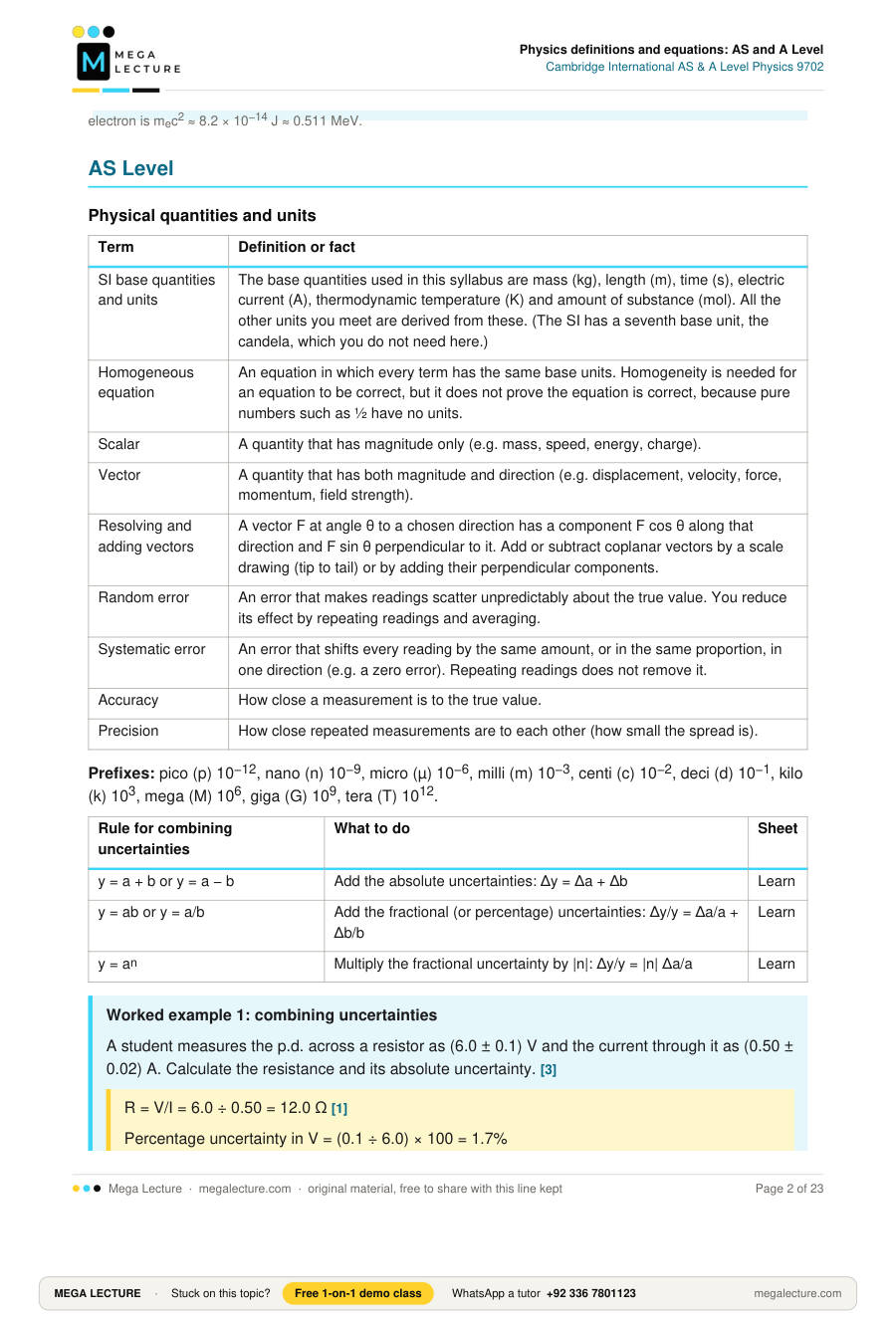
Useful derived values you should be able to work out: 1 eV = 1.60 × 10⁻¹⁹ J; 0 °C = 273.15 K; the rest energy of an electron is mec2 ≈ 8.2 × 10⁻¹⁴ J ≈ 0.511 MeV.
AS Level
Physical quantities and units
| Term | Definition or fact |
|---|---|
| SI base quantities and units | The base quantities used in this syllabus are mass (kg), length (m), time (s), electric current (A), thermodynamic temperature (K) and amount of substance (mol). All the other units you meet are derived from these. (The SI has a seventh base unit, the candela, which you do not need here.) |
| Homogeneous equation | An equation in which every term has the same base units. Homogeneity is needed for an equation to be correct, but it does not prove the equation is correct, because pure numbers such as ½ have no units. |
| Scalar | A quantity that has magnitude only (e.g. mass, speed, energy, charge). |
| Vector | A quantity that has both magnitude and direction (e.g. displacement, velocity, force, momentum, field strength). |
| Resolving and adding vectors | A vector F at angle θ to a chosen direction has a component F cos θ along that direction and F sin θ perpendicular to it. Add or subtract coplanar vectors by a scale drawing (tip to tail) or by adding their perpendicular components. |
| Random error | An error that makes readings scatter unpredictably about the true value. You reduce its effect by repeating readings and averaging. |
| Systematic error | An error that shifts every reading by the same amount, or in the same proportion, in one direction (e.g. a zero error). Repeating readings does not remove it. |
| Accuracy | How close a measurement is to the true value. |
| Precision | How close repeated measurements are to each other (how small the spread is). |
Prefixes: pico (p) 10−12, nano (n) 10−9, micro (µ) 10−6, milli (m) 10−3, centi (c) 10−2, deci (d) 10−1, kilo (k) 103, mega (M) 106, giga (G) 109, tera (T) 1012.
| Rule for combining uncertainties | What to do | Sheet |
|---|---|---|
| y = a + b or y = a − b | Add the absolute uncertainties: Δy = Δa + Δb | Learn |
| y = ab or y = a/b | Add the fractional (or percentage) uncertainties: Δy/y = Δa/a + Δb/b | Learn |
| y = an | Multiply the fractional uncertainty by |n|: Δy/y = |n| Δa/a | Learn |
Worked example 1: combining uncertainties
A student measures the p.d. across a resistor as (6.0 ± 0.1) V and the current through it as (0.50 ± 0.02) A. Calculate the resistance and its absolute uncertainty. [3]
R = V/I = 6.0 ÷ 0.50 = 12.0 Ω [1]
Percentage uncertainty in V = (0.1 ÷ 6.0) × 100 = 1.7%
Percentage uncertainty in I = (0.02 ÷ 0.50) × 100 = 4.0%
Percentage uncertainty in R = 1.7% + 4.0% = 5.7% [1]
Absolute uncertainty in R = 0.057 × 12.0 = 0.68 Ω ≈ 0.7 Ω
R = (12.0 ± 0.7) Ω [1]. The uncertainty is rounded to one significant figure, and the value is quoted to the same decimal place.
The [1] markers in the worked examples show one likely way the marks are split: usually method, substitution, then final answer with unit.
Kinematics
| Term | Definition |
|---|---|
| Distance | The total length of path travelled (a scalar). |
| Displacement | The distance in a straight line from a fixed reference point, in a specified direction (a vector). |
| Speed | The rate of change of distance travelled (distance ÷ time). |
| Velocity | The rate of change of displacement. |
| Acceleration | The rate of change of velocity. |
| Equation | Symbols and units | Sheet |
|---|---|---|
| v = u + at | u initial velocity, v final velocity (m s−1); a acceleration (m s−2); t time (s) | Learn |
| s = ½(u + v)t | s displacement (m) | Learn |
| s = ut + ½at2 | as above | Given |
| v2 = u2 + 2as | as above | Given |
Often forgotten: the four equations apply only when the acceleration is constant in a straight line. On a displacement–time graph, the gradient is velocity. On a velocity–time graph, the gradient is acceleration and the area under the line is displacement. For a projectile with no air resistance, treat the horizontal motion (constant velocity) and the vertical motion (acceleration g downwards) separately.
Dynamics
| Term | Definition |
|---|---|
| Mass | The property of an object that resists a change in its motion. |
| Weight | The gravitational force acting on an object's mass (W = mg). |
| Linear momentum | The product of mass and velocity. |
| Force | Resultant force: the rate of change of momentum. |
| Newton (N) | The force that gives a mass of 1 kg an acceleration of 1 m s−2. |
| Newton's first law | An object stays at rest, or keeps moving at constant velocity, unless a resultant force acts on it. |
| Newton's second law | The resultant force on an object is proportional to its rate of change of momentum, and acts in the same direction as that change. |
| Newton's third law | If body A exerts a force on body B, then B exerts a force on A that is equal in magnitude, opposite in direction and of the same type. |
| Principle of conservation of momentum | The total momentum of a system of interacting objects stays constant, provided no resultant external force acts on the system. |
| Elastic collision | A collision in which total kinetic energy is conserved. Equivalently, the relative speed of approach equals the relative speed of separation. |
| Inelastic collision | A collision in which total momentum is conserved but some kinetic energy is transferred to other forms. |
| Terminal velocity | The constant velocity reached when the drag force (plus any upthrust) equals the weight, so the resultant force and the acceleration are both zero. |
| Equation | Symbols and units | Sheet |
|---|---|---|
| p = mv | p momentum (kg m s−1 or N s); m mass (kg); v velocity (m s−1) | Learn |
| F = ma | F resultant force (N); a acceleration (m s−2); only for constant mass | Learn |
| F = Δp/Δt | Δp change in momentum (N s); Δt time taken (s) | Learn |
| impulse = FΔt = Δp | impulse (N s); equal to the area under a force–time graph | Learn |
| W = mg | W weight (N); g gravitational field strength (N kg−1) | Learn |
Forces, density and pressure
| Term | Definition |
|---|---|
| Moment of a force | The force multiplied by the perpendicular distance from the pivot to the line of action of the force. |
| Couple | A pair of forces that are equal in size, opposite in direction, and act along different (parallel) lines of action. A couple causes rotation only, with no resultant force. |
| Torque of a couple | One of the forces multiplied by the perpendicular distance between their lines of action. |
| Principle of moments | For an object in equilibrium, the sum of the clockwise moments about any point equals the sum of the anticlockwise moments about the same point. |
| Equilibrium | An object is in equilibrium when the resultant force on it is zero and the resultant moment (about any point) is zero. |
| Centre of gravity | The point at which the whole weight of an object can be taken to act. |
| Density | Mass per unit volume. |
| Pressure | Normal (perpendicular) force per unit area. |
| Upthrust | The upward force on an object in a fluid. It arises because the fluid pressure on the lower surface is greater than on the upper surface. By Archimedes' principle, it equals the weight of fluid displaced. |
| Drag / viscous force | A resistive force on an object moving through a fluid. It acts opposite to the velocity and increases as the speed increases. |
| Equation | Symbols and units | Sheet |
|---|---|---|
| moment = Fd | F force (N); d perpendicular distance from pivot to line of action (m); moment in N m | Learn |
| torque = Fd | d perpendicular distance between the two lines of action of the couple (m) | Learn |
| ρ = m/V | ρ density (kg m−3); V volume (m3) | Learn |
| p = F/A | p pressure (Pa = N m−2); A area (m2) | Learn |
| Δp = ρgΔh | Δp change in pressure (Pa); Δh change in depth (m); ρ fluid density | Given |
| F = ρgV | F upthrust (N); ρ density of the fluid; V volume of fluid displaced (m3) | Given |
Work, energy and power
| Term | Definition |
|---|---|
| Work done | The force multiplied by the displacement in the direction of the force. |
| Joule (J) | The work done when a force of 1 N moves its point of application 1 m in the direction of the force. |
| Principle of conservation of energy | Energy cannot be created or destroyed, only transferred from one form to another. The total energy of a closed system is constant. |
| Power | The rate of doing work, or the work done (energy transferred) per unit time. |
| Watt (W) | One joule per second. |
| Efficiency | The ratio of useful energy output (or useful power output) to total energy input (or total power input). |
| Equation | Symbols and units | Sheet |
|---|---|---|
| W = Fs cos θ | W work done (J); s displacement (m); θ angle between force and displacement | Learn |
| EK = ½mv2 | EK kinetic energy (J) | Learn (and be able to derive it from the equations of motion) |
| ΔEP = mgΔh | ΔEP change in gravitational potential energy (J); Δh change in height (m). Only valid in a uniform field, i.e. near the surface. | Learn (and derive) |
| P = W/t | P power (W); t time (s) | Learn |
| P = Fv | v velocity in the direction of F (m s−1) | Learn |
| efficiency = useful output ÷ total input × 100% | no unit | Learn |
Deformation of solids
| Term | Definition |
|---|---|
| Hooke's law | The extension of a spring (or wire) is directly proportional to the applied force, provided the limit of proportionality is not exceeded. |
| Spring constant | The force per unit extension, provided the limit of proportionality is not exceeded (k = F/x). |
| Stress | Force per unit cross-sectional area. |
| Strain | Extension divided by the original length. |
| Young modulus | Stress divided by strain (within the limit of proportionality). |
| Elastic deformation | Deformation in which the material returns to its original shape and size once the load is removed. |
| Plastic deformation | Deformation in which the material does not return to its original shape once the load is removed (permanent deformation). |
| Limit of proportionality | The point beyond which force is no longer proportional to extension. |
| Elastic limit | The point beyond which deformation becomes plastic. |
| Equation | Symbols and units | Sheet |
|---|---|---|
| F = kx | k spring constant (N m−1); x extension (m) | Learn |
| σ = F/A | σ stress (Pa); A cross-sectional area (m2) | Learn |
| ε = x/L | ε strain (no unit); L original length (m) | Learn |
| E = σ/ε | E Young modulus (Pa) | Learn |
| EP = ½Fx = ½kx2 | EP elastic potential (strain) energy (J); only within the limit of proportionality. In general, it equals the area under the force–extension graph. | Learn |
Waves
| Term | Definition |
|---|---|
| Displacement (of a wave) | The distance of a point on the wave from its equilibrium position, in a specified direction. |
| Amplitude | The maximum displacement from the equilibrium position. |
| Wavelength | The distance between two adjacent points on a wave that oscillate in phase (e.g. crest to crest). |
| Period | The time taken for one complete oscillation. |
| Frequency | The number of complete oscillations per unit time. |
| Phase difference | How far one oscillation is ahead of or behind another, as a fraction of a cycle, measured in degrees or radians (one cycle = 360° = 2π rad). |
| Wave speed | The distance travelled by the wave energy (wavefront) per unit time. |
| Progressive wave | A wave that transfers energy from one place to another without transferring matter. |
| Intensity | Power per unit area, where the area is at right angles to the direction the wave is travelling. |
| Transverse wave | A wave whose particles oscillate perpendicular to the direction of energy transfer. |
| Longitudinal wave | A wave whose particles oscillate parallel to the direction of energy transfer (it has compressions and rarefactions). |
| Doppler effect | The observed frequency changes when the source moves relative to the observer. It is higher when they approach and lower when they separate. |
| Polarisation | A polarised wave oscillates in only one direction perpendicular to its direction of travel. Only transverse waves can be polarised. |
| Electromagnetic waves | Transverse waves that all travel at 3.00 × 10⁸ m s−1 in free space. Approximate wavelengths: radio > 10−1 m; microwaves 10−3 to 10−1 m; infrared 7 × 10⁻⁷ to 10−3 m; visible 400 nm to 700 nm; ultraviolet 10−8 to 4 × 10⁻⁷ m; X-rays 10−13 to 10−8 m; gamma rays 10−16 to 10−10 m (the X-ray and gamma-ray ranges overlap). |
| Equation | Symbols and units | Sheet |
|---|---|---|
| v = fλ | v wave speed (m s−1); f frequency (Hz); λ wavelength (m) | Learn (and derive) |
| f = 1/T | T period (s) | Learn |
| I = P/A and I ∝ A2 | I intensity (W m−2); P power (W); A area (m2) in the first equation, but amplitude in the second | Learn |
| fo = fsv/(v ± vs) | fo observed frequency; fs source frequency (Hz); v speed of sound; vs speed of source (m s−1). Use − when the source approaches and + when it recedes. Only for a moving source and a stationary observer. | Given |
| I = I0 cos2θ (Malus's law) | I0 intensity of the plane-polarised light arriving at the analyser; θ angle between the plane of polarisation and the analyser's transmission axis | Learn |
Superposition
| Term | Definition |
|---|---|
| Principle of superposition | When two or more waves meet at a point, the resultant displacement is the sum of the displacements of the individual waves. |
| Diffraction | The spreading of a wave as it passes through a gap or around an edge. It is most noticeable when the gap is about the same size as the wavelength. |
| Coherent sources | Sources that have a constant phase difference, which means they must have the same frequency. |
| Interference | The superposition of coherent waves, which gives a steady pattern of maxima (constructive) and minima (destructive). |
| Conditions for two-source interference | Constructive where the path difference is nλ (sources in phase). Destructive where it is (n + ½)λ. Seeing the pattern needs coherent sources with similar amplitudes, and polarised waves need the same polarisation. |
| Stationary wave | A wave formed when two progressive waves of the same frequency (and speed, and ideally the same amplitude) travel in opposite directions and superpose. It stores energy rather than transferring it. |
| Node / antinode | A node is a point of zero amplitude. An antinode is a point of maximum amplitude. Adjacent nodes are λ/2 apart, and a node is λ/4 from the next antinode. |
| Equation | Symbols and units | Sheet |
|---|---|---|
| λ = ax/D | a slit separation (m); x fringe separation (m); D slit-to-screen distance (m). Needs a ≪ D. | Learn |
| d sin θ = nλ | d grating spacing, i.e. 1 ÷ (lines per metre) (m); θ angle of the nth order maximum from the straight-through direction; n order (integer) | Learn |
Often forgotten: in a stationary wave, all points between two adjacent nodes oscillate in phase, and points on either side of a node are in antiphase (180° apart). The highest observable order from a grating is the largest whole number n that is less than d/λ, because sin θ must be less than 1 (an order at θ = 90° would travel along the grating and could not be seen).
Electricity
| Term | Definition |
|---|---|
| Electric current | The rate of flow of charge. |
| Coulomb (C) | The charge that passes a point when a current of 1 A flows for 1 s. |
| Potential difference | The energy transferred from electrical energy to other forms per unit charge passing between two points. |
| Volt (V) | One joule per coulomb. |
| Electromotive force (e.m.f.) | The energy transferred from other forms to electrical energy per unit charge moved round a complete circuit. |
| Resistance | The potential difference across a component divided by the current through it. |
| Ohm (Ω) | One volt per ampere. |
| Ohm's law | The current in a conductor is directly proportional to the potential difference across it, provided the temperature (and other physical conditions) stay constant. |
| Resistivity | A property of the material, defined by ρ = RA/L, where R is the resistance of a sample of length L and uniform cross-sectional area A. (Equivalently, the resistance of a sample of unit length and unit cross-sectional area.) |
| Quantisation of charge | Every charge is a whole-number multiple of the elementary charge e. |
| Characteristic behaviour | A filament lamp's resistance rises with p.d. because it gets hotter. A semiconductor diode conducts in one direction only, above a threshold p.d. An NTC thermistor's resistance falls as temperature rises. An LDR's resistance falls as light intensity rises. |
| Equation | Symbols and units | Sheet |
|---|---|---|
| Q = It | Q charge (C); I current (A); t time (s) | Learn |
| I = Anvq | A cross-sectional area (m2); n number density of charge carriers (m−3); v drift speed (m s−1); q charge of each carrier (C) | Given |
| V = W/Q | V p.d. (V); W energy transferred (J) | Learn |
| R = V/I | R resistance (Ω) | Learn |
| P = VI = I2R = V2/R | P power (W) | Learn |
| W = VIt | W energy transferred (J) | Learn |
| R = ρL/A | ρ resistivity (Ω m); L length (m); A cross-sectional area (m2) | Learn |
D.C. circuits
| Term | Definition |
|---|---|
| Kirchhoff's first law | The sum of the currents entering a junction equals the sum of the currents leaving it. This follows from conservation of charge. |
| Kirchhoff's second law | Round any closed loop in a circuit, the sum of the e.m.f.s equals the sum of the p.d.s. This follows from conservation of energy. |
| Internal resistance | The resistance inside a source of e.m.f. Energy is transferred to thermal energy in it, so the terminal p.d. is less than the e.m.f. whenever a current flows. |
| Terminal p.d. | The p.d. across the terminals of a source. It equals the e.m.f. only when the current is zero. |
| Potential divider | Two (or more) resistors in series that split the supply p.d. in the ratio of their resistances. |
| Equation | Symbols and units | Sheet |
|---|---|---|
| R = R1 + R2 + … | resistors in series (Ω) | Given |
| 1/R = 1/R1 + 1/R2 + … | resistors in parallel | Given |
| E = I(R + r) = V + Ir | E e.m.f. (V); r internal resistance (Ω); R external resistance; V terminal p.d. | Learn |
| Vout = Vin × R2/(R1 + R2) | Vout p.d. across R2 (no load connected) | Learn |
Often forgotten: a potentiometer is balanced when the galvanometer reads zero. At that point no current is drawn from the cell under test, so the balance gives its e.m.f., not its terminal p.d.
Particle physics
| Term | Definition or fact |
|---|---|
| α-particle scattering result | Most α-particles pass straight through the foil, so most of the atom is empty space. A very small fraction are deflected through large angles, so the positive charge and most of the mass are concentrated in a tiny nucleus. |
| Proton number Z | The number of protons in a nucleus. |
| Nucleon number A | The total number of protons and neutrons in a nucleus. |
| Isotopes | Nuclei of the same element with the same proton number but different numbers of neutrons (different nucleon numbers). |
| Nuclide notation | AZX. Charge and nucleon number are conserved in every nuclear reaction. |
| α decay | A helium nucleus 42He is emitted. A falls by 4 and Z falls by 2. α-particles all have the same (discrete) energy. |
| β− decay | A neutron changes to a proton, and an electron and an electron antineutrino are emitted. Z rises by 1. β-particles have a continuous range of energies because the (anti)neutrino carries away some of the energy. |
| β+ decay | A proton changes to a neutron, and a positron and an electron neutrino are emitted. Z falls by 1. |
| γ emission | A high-energy photon leaves an excited nucleus. A and Z do not change. |
| Antiparticle | A particle with the same mass as its partner but the opposite charge (and other opposite quantum numbers). |
| Quarks | Six flavours. Up (+⅔e), charm (+⅔e) and top (+⅔e); down (−⅓e), strange (−⅓e) and bottom (−⅓e). Antiquarks have the opposite charges. |
| Hadron | A particle made of quarks, which feels the strong force. Baryons contain three quarks (proton uud, neutron udd). Mesons contain a quark and an antiquark. |
| Lepton | A fundamental particle with no quark structure, which does not feel the strong force (e.g. electron, neutrino). |
| Quark changes in β decay | β−: d → u + e− + ν̄e (electron antineutrino). β+: u → d + e+ + νe (electron neutrino). Both happen through the weak interaction. |
| Radiation | What it is | Mass | Charge |
|---|---|---|---|
| α | helium nucleus (2 protons + 2 neutrons) | 4 u | +2e |
| β− | electron | about 1/2000 u | −e |
| β+ | positron | about 1/2000 u | +e |
| γ | photon of electromagnetic radiation | 0 | 0 |
A Level
Motion in a circle
| Term | Definition |
|---|---|
| Radian | The angle subtended at the centre of a circle by an arc equal in length to the radius. |
| Angular displacement | The angle turned through about the centre (in radians). |
| Angular speed | The rate of change of angular displacement. |
| Centripetal force | The resultant force towards the centre that keeps an object moving in a circle. It is not an extra force. It is supplied by tension, gravity, friction and so on. |
| Equation | Symbols and units | Sheet |
|---|---|---|
| θ = s/r | θ angle (rad); s arc length (m); r radius (m) | Learn |
| ω = Δθ/Δt = 2π/T = 2πf | ω angular speed (rad s−1); T period (s) | Learn |
| v = rω | v linear (tangential) speed (m s−1) | Learn |
| a = rω2 = v2/r | a centripetal acceleration (m s−2), directed towards the centre | Learn |
| F = mrω2 = mv2/r | F centripetal force (N) | Learn |
Gravitational fields
| Term | Definition |
|---|---|
| Gravitational field | A region of space in which a mass experiences a force. |
| Gravitational field strength | The gravitational force per unit mass acting on a small test mass placed at that point. |
| Newton's law of gravitation | The gravitational force between two point masses is proportional to the product of their masses and inversely proportional to the square of their separation. |
| Gravitational potential | The work done per unit mass in bringing a small test mass from infinity to that point. |
| Geostationary orbit | An orbit above the equator, moving west to east (the same direction as Earth's rotation), with a period of 24 hours. The satellite stays above the same point on Earth. |
| Equation | Symbols and units | Sheet |
|---|---|---|
| F = GMm/r2 | G gravitational constant; M, m masses (kg); r separation of centres (m) | Learn |
| g = F/m | g field strength (N kg−1) | Learn |
| g = GM/r2 | field of a point (or spherical) mass M | Learn |
| φ = −GM/r | φ gravitational potential (J kg−1) | Given |
| EP = −GMm/r | EP gravitational potential energy (J) | Given |
| g = −Δφ/Δr | field strength = minus the potential gradient | Learn |
| GMm/r2 = mv2/r, which gives T2 = (4π2/GM)r3 | circular orbit: gravity supplies the centripetal force | Learn (derive) |
Often forgotten: potential is zero at infinity and negative everywhere else, because gravity is attractive and work is done by the field as a mass moves in. Near the Earth's surface, g ≈ constant, so ΔEP = mgΔh works. Over large distances you must use −GMm/r.
Worked example 2: geostationary orbit radius
The mass of the Earth is 6.0 × 1024 kg. Calculate the radius of a geostationary orbit. [3]
Gravitational force provides the centripetal force: GMm/r2 = mrω2, so r3 = GM/ω2 = GMT2/(4π2) [1]
T = 24 × 3600 = 86 400 s
r3 = (6.67 × 10−11 × 6.0 × 1024 × 86 4002) ÷ (4π2) [1]
r3 = (4.00 × 1014 × 7.46 × 109) ÷ 39.5 = 7.57 × 10²² m3
r = ∛(7.57 × 10²²) = 4.2 × 10⁷ m, measured from the centre of the Earth. [1]
Temperature
| Term | Definition |
|---|---|
| Thermal equilibrium | Two objects are in thermal equilibrium when there is no net transfer of thermal energy between them, which means they are at the same temperature. |
| Thermodynamic (Kelvin) scale | An absolute temperature scale that does not depend on the property of any particular substance. |
| Absolute zero | The lowest possible temperature (0 K), at which a substance has minimum internal energy. |
| Specific heat capacity | The energy needed per unit mass to raise the temperature of a substance by one kelvin. |
| Specific latent heat of fusion | The energy needed per unit mass to change a substance from solid to liquid without a change in temperature. |
| Specific latent heat of vaporisation | The energy needed per unit mass to change a substance from liquid to gas without a change in temperature. |
| Thermometers | Any thermometer relies on a physical property that changes with temperature (e.g. the resistance of a thermistor, or the e.m.f. of a thermocouple). |
| Equation | Symbols and units | Sheet |
|---|---|---|
| T/K = θ/°C + 273.15 | T thermodynamic temperature; θ Celsius temperature. A temperature change of 1 K is the same as a change of 1 °C. | Learn |
| E = mcΔθ | c specific heat capacity (J kg−1 K−1); Δθ temperature change (K or °C) | Learn |
| E = mL | L specific latent heat (J kg−1) | Learn |
Often forgotten: the latent heat of vaporisation is much larger than that of fusion for the same substance. On boiling, the molecules must be separated completely and work must be done pushing back the atmosphere. On melting, the molecules only need to be separated slightly.
Ideal gases
| Term | Definition |
|---|---|
| Mole | The amount of substance that contains NA (6.02 × 10²³) particles. |
| Avogadro constant | The number of particles in one mole of substance. |
| Ideal gas | A gas that obeys pV ∝ T (pV = nRT) at all pressures, volumes and temperatures. |
| Kinetic theory assumptions | (1) The gas has a very large number of molecules moving randomly. (2) The volume of the molecules is negligible compared with the volume of the container. (3) There are no intermolecular forces except during collisions. (4) Collisions with each other and with the walls are elastic. (5) The time spent in a collision is negligible compared with the time between collisions. |
| Origin of gas pressure | Molecules change momentum as they hit a wall. By Newton's laws the wall exerts a force on them and they exert a force on the wall. Pressure is the total force per unit area. |
| Equation | Symbols and units | Sheet |
|---|---|---|
| pV = nRT | p pressure (Pa); V volume (m3); n amount (mol); T temperature (K) | Learn |
| pV = NkT | N number of molecules; k Boltzmann constant (J K−1) | Learn |
| k = R/NA | links the two constants | Learn |
| p = ⅓(Nm/V)<c2> | m mass of one molecule (kg); <c2> mean square speed (m2 s−2). Printed on the sheet as "pressure of an ideal gas"; it rearranges to pV = ⅓Nm<c2>. | Given |
| p = ⅓ρ<c2> | ρ = Nm/V density of the gas | Learn (follows from the given equation) |
| ½m<c2> = (3/2)kT | mean translational kinetic energy of one molecule (J) | Learn (derive) |
| cr.m.s. = √<c2> | root-mean-square speed (m s−1) | Learn |
Worked example 3: mean kinetic energy of a molecule
Calculate the mean translational kinetic energy of a molecule of an ideal gas at 27 °C. [2]
T = 27 + 273 = 300 K [1]
EK = (3/2)kT = 1.5 × 1.38 × 10−23 × 300
EK = 6.2 × 10⁻²¹ J [1]. This does not depend on which gas it is.
Thermodynamics
| Term | Definition |
|---|---|
| Internal energy | The sum of the random distribution of kinetic and potential energies of the molecules in a system. |
| First law of thermodynamics | The increase in internal energy of a system equals the energy supplied to it by heating plus the work done on it. |
| Internal energy of an ideal gas | Only kinetic, because an ideal gas has no intermolecular forces and therefore no potential energy. So its internal energy is proportional to T. |
| Temperature and internal energy | A rise in temperature raises the mean kinetic energy of the molecules. A change of state at constant temperature changes the potential energy instead. |
| Equation | Symbols and units | Sheet |
|---|---|---|
| ΔU = q + W | ΔU increase in internal energy (J); q energy supplied to the system by heating (J); W work done on the system (J) | Learn |
| W = pΔV | work done when a gas changes volume at constant pressure p. ΔV is the volume change (m3). | Learn |
Sign convention: when a gas is compressed, work is done on it, so W is positive. When a gas expands, it does work on its surroundings, so W is negative. Energy lost by heating makes q negative. For a p–V graph, the work done equals the area under the line.
Oscillations
| Term | Definition |
|---|---|
| Simple harmonic motion | Motion in which the acceleration is directly proportional to the displacement from a fixed point and always directed towards that point. |
| Displacement, amplitude, period, frequency | These mean the same as for waves. Displacement is measured from the equilibrium position. |
| Angular frequency | ω = 2πf. It measures the rate of oscillation in rad s−1. |
| Damping | The loss of energy from an oscillating system, usually because of a resistive force. The amplitude decreases over time. |
| Light damping | The system oscillates, and the amplitude decreases gradually (roughly exponentially). |
| Critical damping | The system returns to equilibrium in the shortest possible time without oscillating. |
| Heavy damping | The system returns to equilibrium slowly, without oscillating. |
| Free oscillation | Oscillation at the system's natural frequency with no external driving force. |
| Forced oscillation | Oscillation caused by a periodic driving force. The system oscillates at the driving frequency. |
| Resonance | The amplitude of a forced oscillation is at its maximum when the driving frequency equals the natural frequency of the system. More damping lowers and broadens the resonance peak, and moves it to a slightly lower frequency. |
| Equation | Symbols and units | Sheet |
|---|---|---|
| a = −ω2x | a acceleration (m s−2); x displacement (m); ω angular frequency (rad s−1) | Given |
| ω = 2πf = 2π/T | f frequency (Hz) | Learn |
| x = x0 sin ωt | x0 amplitude (m). Use x = x0 cos ωt if timing starts at maximum displacement. | Given (printed under alternating current/voltage; the same form applies to s.h.m.) |
| v = v0 cos ωt | v0 = ωx0 maximum speed | Given |
| v = ±ω√(x02 − x2) | speed at displacement x | Given |
| vmax = ωx0; amax = ω2x0 | maximum speed at x = 0; maximum acceleration at x = ±x0 | Learn |
| E = ½mω2x02 | E total energy (J); constant if undamped | Learn |
Often forgotten: in s.h.m., displacement and acceleration are in antiphase. Velocity leads displacement by π/2. The period does not depend on the amplitude. Kinetic and potential energy each vary at twice the oscillation frequency.
Electric fields
| Term | Definition |
|---|---|
| Electric field | A region of space in which a charge experiences a force. |
| Electric field strength | The force per unit positive charge acting on a small stationary test charge. |
| Field lines | These show the direction of the force on a positive charge. Where the lines are closer together, the field is stronger. |
| Coulomb's law | The electric force between two point charges is proportional to the product of the charges and inversely proportional to the square of their separation. |
| Electric potential | The work done per unit positive charge in bringing a small test charge from infinity to that point. |
| Equation | Symbols and units | Sheet |
|---|---|---|
| E = F/q | E field strength (N C−1 = V m−1); F force (N); q charge (C) | Learn |
| E = ΔV/Δd | uniform field between parallel plates. ΔV p.d. (V); Δd plate separation (m) | Learn |
| F = Qq/(4πε0r2) | ε0 permittivity of free space (F m−1); r separation (m) | Learn |
| E = Q/(4πε0r2) | field of a point charge | Learn |
| V = Q/(4πε0r) | V electric potential (V) | Given |
| EP = Qq/(4πε0r) | EP electric potential energy (J) | Given |
| E = −ΔV/Δr | field strength = minus the potential gradient | Learn |
| W = qΔV | work done moving charge q through p.d. ΔV (J) | Learn |
Gravitational vs electric: both obey an inverse-square law and both define potential with the zero at infinity. Gravity only attracts, so gravitational potential is always negative. Electric potential near a positive charge is positive and near a negative charge is negative. A charged particle entering a uniform field at right angles follows a parabola, like a projectile.
Capacitance
| Term | Definition |
|---|---|
| Capacitance | The charge stored per unit potential difference. For a parallel-plate capacitor, the charge is the charge on one plate and the p.d. is between the plates. For an isolated conductor (such as a charged sphere), capacitance = charge ÷ potential of the conductor, with the potential measured relative to zero at infinity. |
| Farad (F) | One coulomb per volt. |
| Time constant | τ = RC. It is the time for the charge, p.d. or current of a discharging capacitor to fall to 1/e (about 37%) of its starting value. |
| Equation | Symbols and units | Sheet |
|---|---|---|
| C = Q/V | C capacitance (F); Q charge (C); V p.d. (V) | Learn |
| C = 4πε0r | capacitance of an isolated sphere of radius r (m) | Learn (derive from V = Q/(4πε0r)) |
| C = C1 + C2 + … | capacitors in parallel | Given |
| 1/C = 1/C1 + 1/C2 + … | capacitors in series | Given |
| W = ½QV = ½CV2 = Q2/(2C) | W energy stored (J). It equals the area under a graph of V against Q. | Learn |
| x = x0 e−t/RC | x stands for Q, V or I during discharge; R resistance (Ω); RC time constant (s) | Given |
Worked example 4: capacitor discharge
A 470 µF capacitor charged to 12 V discharges through a 22 kΩ resistor. Calculate the p.d. across the capacitor 5.0 s after the discharge begins. [3]
τ = RC = 22 × 103 × 470 × 10−6 = 10.3 s [1]
V = V0 e−t/RC = 12 × e−5.0/10.3 [1]
V = 12 × e−0.484 = 12 × 0.617
V = 7.4 V [1]
Magnetic fields
| Term | Definition |
|---|---|
| Magnetic field | A region of space in which a magnetic pole, a current-carrying conductor or a moving charge experiences a force. |
| Field of a long straight wire | Concentric circles centred on the wire, in planes perpendicular to it. The circles are further apart (the field is weaker) further from the wire. Right-hand grip rule: thumb along the conventional current, fingers curl in the direction of the field. |
| Field of a flat circular coil | The lines loop around each side of the wire. Near the centre of the coil they are nearly straight and pass through the coil perpendicular to its plane. |
| Field of a long solenoid | Inside: strong and nearly uniform, with parallel, equally spaced lines along the axis. Outside: like the field of a bar magnet. Right-hand grip rule: fingers curl with the current, and the thumb points to the north-pole end. |
| Ferrous core | Inserting a ferrous (iron) core into a solenoid greatly increases the magnetic flux density. |
| Forces between parallel conductors | Each conductor sits in the magnetic field of the other, so each feels a force F = BIL. Currents in the same direction attract; currents in opposite directions repel. The two forces are equal and opposite (Newton's third law). |
| Magnetic flux density | The force per unit current per unit length on a straight conductor placed at right angles to the magnetic field. |
| Tesla (T) | The flux density that produces a force of 1 N on each metre of a conductor carrying 1 A at right angles to the field (1 T = 1 N A−1 m−1). |
| Magnetic flux | The product of the magnetic flux density and the area normal to the field. |
| Weber (Wb) | 1 Wb = 1 T m2. |
| Magnetic flux linkage | The product of the magnetic flux and the number of turns of the coil. |
| Faraday's law | The magnitude of the induced e.m.f. is proportional to (equal to) the rate of change of magnetic flux linkage. |
| Lenz's law | The direction of the induced e.m.f. (or current) is such that it opposes the change that produces it. This is a consequence of conservation of energy. |
| Hall voltage | The p.d. that appears across a conductor carrying a current at right angles to a magnetic field. It forms because the charge carriers are pushed to one side. |
| Velocity selector | Crossed electric and magnetic fields. Only particles with speed v = E/B pass through undeflected. |
| Equation | Symbols and units | Sheet |
|---|---|---|
| F = BIL sin θ | B flux density (T); I current (A); L length in field (m); θ angle between the conductor and B | Learn |
| F = BQv sin θ | force on a moving charge Q (C) with speed v (m s−1) | Learn |
| VH = BI/(ntq) | VH Hall voltage (V); n number density of carriers (m−3); t thickness of the probe in the direction of B (m); q charge of each carrier (C) | Given |
| r = mv/(BQ) | radius of the circular path of a charge moving at right angles to B | Learn (derive from BQv = mv2/r) |
| v = E/B | velocity selector (from EQ = BQv) | Learn |
| Φ = BA | Φ flux (Wb); A area perpendicular to B (m2) | Learn |
| E = −Δ(NΦ)/Δt | E induced e.m.f. (V); NΦ flux linkage (Wb); the minus sign expresses Lenz's law | Learn |
Often forgotten: use Fleming's left-hand rule for the motor effect, with conventional current (for an electron, point your second finger opposite to its motion). A magnetic force on a moving charge is always perpendicular to the velocity. It therefore does no work and changes the direction of motion but not the speed.
Alternating currents
| Term | Definition |
|---|---|
| Root-mean-square (r.m.s.) current | The value of the steady direct current that would dissipate energy at the same average rate (produce the same mean power) in a resistor as the alternating current. |
| Peak value | The maximum value (amplitude) of the alternating current or voltage. |
| Half-wave rectification | A single diode lets only one half of each cycle through. |
| Full-wave rectification | A bridge of four diodes makes current flow through the load in the same direction during both halves of each cycle. |
| Smoothing | A capacitor connected in parallel with the load discharges through the load between peaks, which reduces the ripple. A larger RC gives smoother output. |
| Equation | Symbols and units | Sheet |
|---|---|---|
| x = x0 sin ωt | x instantaneous current or p.d.; x0 peak value; ω = 2πf (rad s−1) | Given |
| Ir.m.s. = I0/√2; Vr.m.s. = V0/√2 | sinusoidal a.c. only | Learn |
| Pmean = ½I0V0 = Ir.m.s.Vr.m.s. | mean power in a resistive load (W). The peak power is I0V0, twice the mean. | Learn |
Quantum physics
| Term | Definition |
|---|---|
| Photon | A quantum (discrete packet) of electromagnetic energy. |
| Electronvolt (eV) | The energy transferred to an electron when it moves through a potential difference of 1 V (1 eV = 1.60 × 10⁻¹⁹ J). |
| Photoelectric effect | The emission of electrons from a metal surface when electromagnetic radiation of high enough frequency falls on it. |
| Work function | The minimum energy needed to remove an electron from the surface of a metal. |
| Threshold frequency | The minimum frequency of electromagnetic radiation that causes electrons to be emitted from the surface of a metal. |
| Evidence for particle nature | The photoelectric effect. One photon interacts with one electron and transfers all its energy (hf) to it. So emission is instantaneous, needs a minimum frequency whatever the intensity, and the maximum kinetic energy depends on frequency, not intensity. Intensity changes only the rate of emission. |
| Evidence for wave nature of particles | Electron diffraction by thin crystalline graphite gives rings, which shows electrons behave as waves. |
| de Broglie wavelength | The wavelength associated with a moving particle, λ = h/p. |
| Energy levels | Electrons in atoms can only have certain discrete energies. When an electron moves between levels, a photon of energy hf = E1 − E2 is emitted or absorbed. This produces emission and absorption line spectra. |
| Equation | Symbols and units | Sheet |
|---|---|---|
| E = hf = hc/λ | E photon energy (J); h Planck constant (J s); f frequency (Hz); λ wavelength (m) | Learn |
| p = E/c | p photon momentum (kg m s−1) | Learn |
| hf = Φ + ½mvmax2 | Φ work function (J); ½mvmax2 maximum kinetic energy of photoelectrons (J) | Learn |
| λ = h/p = h/(mv) | λ de Broglie wavelength (m) | Learn |
| hf = E1 − E2 | E1, E2 the upper and lower energy levels (J) | Learn |
Worked example 5: photoelectric effect
Light of wavelength 400 nm falls on a metal with work function 2.3 eV. Calculate the maximum kinetic energy of the emitted electrons. [3]
Photon energy E = hc/λ = (6.63 × 10−34 × 3.00 × 108) ÷ (400 × 10−9) = 4.97 × 10⁻¹⁹ J [1]
Work function Φ = 2.3 × 1.60 × 10−19 = 3.68 × 10⁻¹⁹ J [1]
EK,max = hf − Φ = 4.97 × 10⁻¹⁹ − 3.68 × 10−19 = 1.3 × 10⁻¹⁹ J (about 0.81 eV) [1]
Nuclear physics
| Term | Definition |
|---|---|
| Mass defect | The difference between the total mass of the separate nucleons and the mass of the nucleus. |
| Binding energy | The minimum energy needed to separate a nucleus completely into its individual protons and neutrons. |
| Binding energy per nucleon | The binding energy divided by the nucleon number. It measures stability, with a peak near iron-56. Fusion of light nuclei and fission of heavy nuclei both raise the binding energy per nucleon, so both release energy. |
| Fission | A heavy nucleus splits into two smaller nuclei of similar mass, usually after absorbing a neutron, and releases energy and more neutrons. |
| Fusion | Two light nuclei join to form a heavier nucleus and release energy. It needs very high temperatures to overcome electrostatic repulsion. |
| Random decay | It is impossible to predict when a particular nucleus will decay, or which one will decay next. |
| Spontaneous decay | Decay is not affected by external factors such as temperature, pressure or chemical state. |
| Activity | The number of nuclei that decay per unit time. |
| Becquerel (Bq) | One decay per second. |
| Decay constant | The probability per unit time that a nucleus will decay. |
| Half-life | The time taken for half the undecayed nuclei of a particular isotope to decay (or for the activity to halve). |
| Equation | Symbols and units | Sheet |
|---|---|---|
| E = mc2 (ΔE = Δm c2) | E energy (J); m mass (kg); c speed of light (m s−1) | Learn |
| A = λN | A activity (Bq); λ decay constant (s−1); N number of undecayed nuclei | Learn |
| x = x0 e−λt | x stands for N, A or count rate (after correcting for background) | Given |
| λ = ln 2/t½ = 0.693/t½ | t½ half-life (s) | Learn |
Worked example 6: activity from half-life
A sample contains 3.0 × 10¹⁸ undecayed nuclei of an isotope with half-life 8.0 days. Calculate the activity of the sample. [3]
t½ = 8.0 × 24 × 3600 = 6.91 × 10⁵ s [1]
λ = 0.693 ÷ 6.91 × 105 = 1.00 × 10⁻⁶ s−1 [1]
A = λN = 1.00 × 10−6 × 3.0 × 1018 = 3.0 × 10¹² Bq [1]
Convert the half-life to seconds before you use A = λN, so the activity comes out in Bq.
Medical physics
| Term | Definition or fact |
|---|---|
| Piezoelectric transducer | A p.d. across a piezoelectric crystal changes its shape. An alternating p.d. makes it vibrate and emit ultrasound. Returning ultrasound deforms the crystal and produces a p.d., so the same crystal both emits and receives. |
| Specific acoustic impedance | The product of the density of a medium and the speed of sound in it (Z = ρc). |
| Why a coupling gel is used | Air and skin have very different acoustic impedances, so almost all ultrasound would be reflected at the skin. Gel with an impedance close to skin's removes the air and lets most of the ultrasound enter the body. |
| Production of X-rays | Electrons are accelerated through a high p.d. and strike a metal target. As they decelerate they give a continuous (braking radiation) spectrum. The shortest wavelength is set by eV = hc/λmin. Background, not required: incident electrons also knock out inner-shell electrons; electrons from higher shells fall into the vacancies and emit characteristic line photons. |
| Attenuation | The decrease in intensity of a beam as it passes through matter. Absorption and scattering both contribute. |
| Contrast | The difference in brightness or blackening between neighbouring areas of an X-ray image. Contrast is good when neighbouring tissues have very different attenuation coefficients, and can be improved by using a contrast medium (e.g. barium or iodine). |
| CT scanning | Many X-ray images of one section (slice) are taken from different angles. A computer combines them into a 2-D image of the section. Repeating this for many sections along an axis and combining them builds a 3-D image, made of voxels (3-D volume elements). |
| PET scanning | A β+-emitting tracer is injected and collects in active tissue. Each positron annihilates with an electron to give two gamma photons that travel in opposite directions. Detectors record arrival times to locate the source. |
| Annihilation photon energy | Each photon carries the rest energy of one electron: mec2 = 9.11 × 10−31 × (3.00 × 108)2 = 8.2 × 10⁻¹⁴ J (0.511 MeV). Two photons are needed to conserve momentum. |
| Equation | Symbols and units | Sheet |
|---|---|---|
| Z = ρc | Z acoustic impedance (kg m−2 s−1); ρ density (kg m−3); c speed of sound (m s−1) | Learn |
| IR/I0 = (Z1 − Z2)2/(Z1 + Z2)2 | IR/I0 intensity reflection coefficient (no unit) | Given |
| I = I0 e−µx | µ linear attenuation (absorption) coefficient (m−1); x thickness (m). Applies to both ultrasound and X-rays. | Learn |
| λmin = hc/(eV) | V accelerating p.d. of the X-ray tube (V) | Learn |
Astronomy and cosmology
| Term | Definition |
|---|---|
| Luminosity | The total power of electromagnetic radiation emitted by a star. |
| Radiant flux intensity | The radiant power passing through unit area normal to the direction of travel (the power received per unit area at the observer). |
| Standard candle | An astronomical object of known luminosity (e.g. a Cepheid variable star or a type Ia supernova). Measuring its radiant flux intensity gives its distance. |
| Wien's displacement law | The wavelength at which a black body emits maximum power per unit wavelength is inversely proportional to its thermodynamic temperature (λmax ∝ 1/T). |
| Redshift | An increase in the observed wavelength (a decrease in frequency) of radiation from a source moving away from the observer. |
| Hubble's law | The recession speed of a distant galaxy is proportional to its distance from us. |
| Big Bang evidence | Redshift of distant galaxies increases with distance, which shows the Universe is expanding. Traced backwards, this suggests the Universe was once extremely small, hot and dense (the Big Bang theory). |
| Equation | Symbols and units | Sheet |
|---|---|---|
| F = L/(4πd2) | F radiant flux intensity (W m−2); L luminosity (W); d distance (m) | Learn |
| L = 4πσr2T4 | σ Stefan–Boltzmann constant; r radius of the star (m); T surface temperature (K) | Given |
| λmax ∝ 1/T | λmax peak wavelength (m); T thermodynamic temperature (K). Use it as a ratio: λ1T1 = λ2T2. | Learn |
| Δλ/λ ≈ Δf/f ≈ v/c | Δλ change in wavelength; v speed of the source along the line of sight (v ≪ c) | Given |
| v = H0d | H0 Hubble constant (s−1); d distance (m) | Learn |
Often forgotten: 1/H0 gives an estimate of the age of the Universe, so convert H0 to s−1 first. Hubble's law needs the recession speed, so find it from the redshift first.
Common mistakes
- Leaving out "per unit" or the reference condition in a definition. Examples: "force on a charge" instead of "force per unit positive charge", and "work done bringing a mass from infinity" without "per unit mass".
- Defining potential difference as "energy per charge" without the direction of transfer. Keep p.d. (electrical → other forms) and e.m.f. (other forms → electrical) apart.
- Defining the spring constant or Young modulus without "within the limit of proportionality".
- Writing "acceleration proportional to displacement" for s.h.m. and forgetting "and directed towards the fixed point (equilibrium position)".
- Defining the r.m.s. current as "the average current". The mean of a sinusoidal current over a cycle is zero. The r.m.s. value is defined by equal power in a resistor.
- Using Celsius temperatures in pV = nRT, EK = (3/2)kT or the Stefan–Boltzmann law. Always convert to kelvin.
- Getting the sign in ΔU = q + W wrong. W is the work done on the gas, so it is negative when the gas expands.
- Measuring r from the surface instead of the centre in gravitational and electric field equations (for an orbit, r = planet radius + height).
- Stating that weight or centripetal force is "the same as mass" or is an extra force in a free-body diagram. Mass is a property of the object, and centripetal force is the resultant force.
- Forgetting to convert eV to J (× 1.60 × 10⁻¹⁹), MeV to J (× 1.60 × 10⁻¹³), days or years to seconds before using A = λN, and nm, µF or kΩ to base units.
- Squaring the amplitude incorrectly. Intensity ∝ amplitude2, so halving the amplitude quarters the intensity.
- Using d in d sin θ = nλ as "lines per mm". It must be the spacing in metres, 1 ÷ (lines per metre).
- Quoting the photoelectric equation with the typical kinetic energy instead of the maximum kinetic energy.
- Claiming that increasing light intensity increases the kinetic energy of photoelectrons. It increases only the number emitted per second.
- Describing binding energy as "energy stored in the nucleus" or "energy released when the nucleus forms" without the idea of separating it into its individual nucleons.
- Giving the half-life as "time for the mass to halve". The mass of the sample hardly changes. It is the number of undecayed nuclei, or the activity, that halves.
- Quoting final answers to too many significant figures. Match the least precise data in the question, usually 2 or 3 s.f., and always include the unit.
