
IB Diploma · Maths: Applications and Interpretation · Applications and Interpretation (AI)
Topic 3 Worksheet
Opens inside this page. Prefer your own PDF app? Open the PDF.
Check yourself
5 quick questions on Geometry and trigonometry
Tap an answer to see if you are right, and why. Free, no sign-up.
Start the free testWas this note useful?
Full text of Topic 3 Worksheet
IB DP MATHEMATICS AI Topic 3 · Geometry and Trigonometry TOPICAL WORKSHEET
3.1 Volume & Surface Area · 3.2 Trigonometry in Context
3.3 Sine & Cosine Rules · 3.4 Navigation & Construction
Standard and Higher Level · Syllabus 2025
Fahad H. Ahmad
Original exam-style questions written for the IB Diploma Programme Mathematics course (first assessment 2025)
Free notes, practice tests and live classes Back to megalecture.com
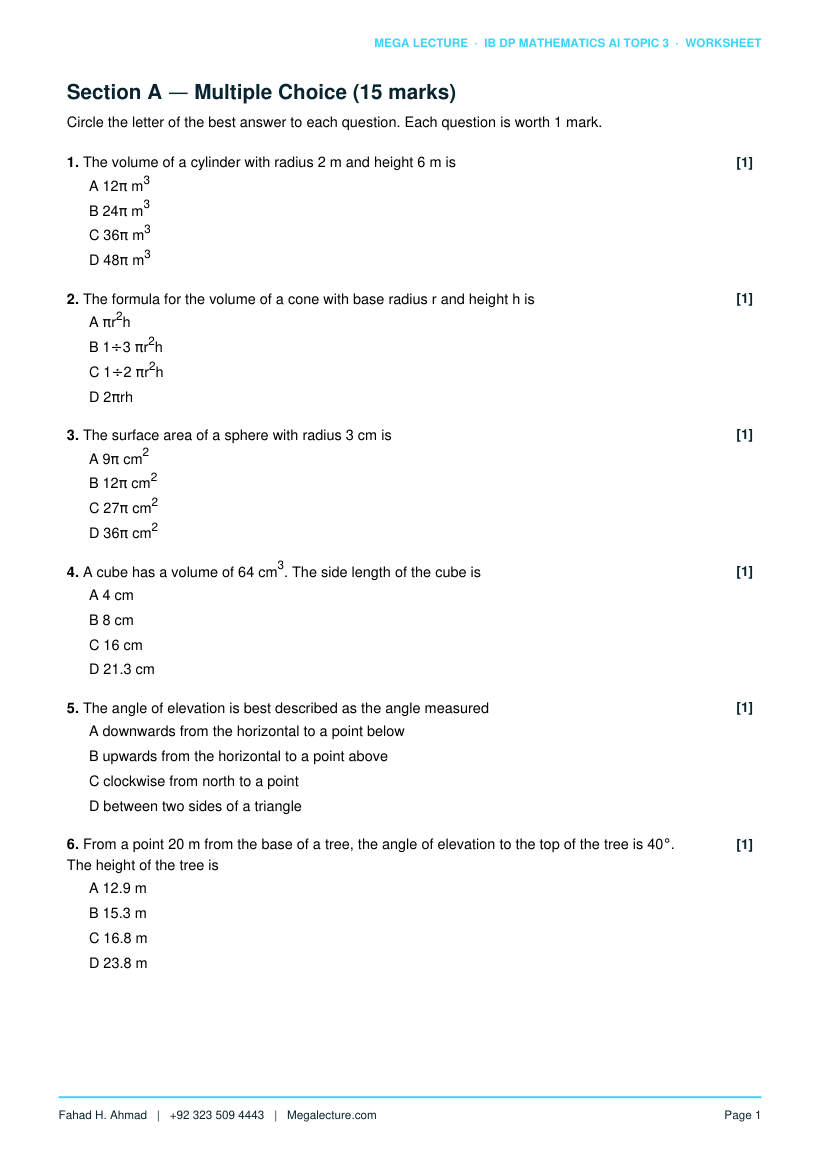
Section A — Multiple Choice (15 marks)
Circle the letter of the best answer to each question. Each question is worth 1 mark.
- The volume of a cylinder with radius 2 m and height 6 m is [1]
A 12π m3
B 24π m3
C 36π m3
D 48π m3
- The formula for the volume of a cone with base radius r and height h is [1]
A πr2h
B 1÷3 πr2h
C 1÷2 πr2h
D 2πrh
- The surface area of a sphere with radius 3 cm is [1]
A 9π cm2
B 12π cm2
C 27π cm2
D 36π cm2
- A cube has a volume of 64 cm3. The side length of the cube is [1]
A 4 cm
B 8 cm
C 16 cm
D 21.3 cm
- The angle of elevation is best described as the angle measured [1]
A downwards from the horizontal to a point below
B upwards from the horizontal to a point above
C clockwise from north to a point
D between two sides of a triangle
- From a point 20 m from the base of a tree, the angle of elevation to the top of the tree is 40°. The height of the tree is
[1]
A 12.9 m
B 15.3 m
C 16.8 m
D 23.8 m
- A bearing is always measured [1]
A anticlockwise from south
B clockwise from north, as an angle from 000° to 360°
C as the shortest angle between two directions
D anticlockwise from east
- If the bearing of point B from point A is 130°, the bearing of point A from point B (the 'back bearing') is
[1]
A 050°
B 230°
C 310°
D 130°
- The sine rule for a triangle with sides a, b, c opposite angles A, B, C states that [1]
A a÷sinA = b÷sinB = c÷sinC
B a×sinA = b×sinB
C a2 = b2+c2
D sinA+sinB+sinC = 180°
- The cosine rule for finding side a, given sides b, c and the included angle A, is [1]
A a2 = b2+c2
B a2 = b2+c2−2bc·cosA
C a2 = b2−c2
D a = b·cosA
- A triangle has angles of 50° and 70°. The third angle is [1]
A 50°
B 60°
C 70°
D 120°
- The area of a triangle with sides a, b and included angle C is given by [1]
A 1÷2 ab·sinC
B 1÷2 ab·cosC
C ab·sinC
D 1÷2 (a+b)sinC
- A ship sails on a bearing of 040°, then changes course and sails on a bearing of 130°. The angle turned through between the two bearings is
[1]
A 40°
B 90°
C 130°
D 170°
- A ship sails 30 km east then 40 km north. The direct distance from its starting point is [1]
A 10 km
B 35 km
C 50 km
D 70 km
- For an observer on a cliff watching a boat at sea, the angle of depression from the observer to the boat is
[1]
A always greater than the angle of elevation from the boat to the observer
B always less than the angle of elevation from the boat to the observer
C always equal to the angle of elevation from the boat to the observer (alternate angles)
D unrelated to the angle of elevation from the boat
Section B — Structured Questions (65 marks)
Answer all questions in the space provided. Working must be shown for full marks.
3.1 Volume & Surface Area of 3D Solids
Question 1 [7 marks]
A cylindrical water tank has radius 3 m and height 5 m (given data).
Cylindrical water tank, r=3 m, h=5 m (given data).
- Using the formula V = πr2h, calculate the volume of the tank, giving your answer to 3 significant figures.
[2]
- Calculate the curved (lateral) surface area of the tank, giving your answer to 3 significant figures.
[2]
- Calculate the total surface area of the tank (including the top and bottom circular ends), giving your answer to 3 significant figures.
[3]
Question 2 [6 marks]
A solid cone has base radius 4 cm and height 9 cm.
- Using V = 1÷3 πr2h, calculate the volume of the cone, giving your answer to 3 significant figures.
[2]
- Using Pythagoras' theorem, calculate the slant height, l, of the cone, giving your answer to 3 significant figures.
[2]
- Using the curved surface area formula, CSA = πrl, calculate the curved surface area of the cone, giving your answer to 3 significant figures.
[2]
3.2 Right-Angled Trigonometry in Context
Question 3 [7 marks]
An observer stands 50 m from the base of a tower. The angle of elevation from the observer to the top of the tower is 35° (given data).
Angle of elevation diagram, base=50 m, angle=35° (given data).
- Calculate the height, h, of the tower, giving your answer to 3 significant figures. [2]
- Calculate the distance from the observer to the top of the tower (the line of sight distance), giving your answer to 3 significant figures.
[2]
- The observer walks 20 m closer to the tower (now 30 m from the base). Calculate the new angle of elevation, giving your answer to 3 significant figures.
[3]
Question 4 [6 marks]
A hiker walks 8 km on a bearing of 065° from point A to point B.
- State the bearing required to walk directly back from B to A. [2]
- Calculate how far east of A point B is, giving your answer to 3 significant figures. [2]
- Calculate how far north of A point B is, giving your answer to 3 significant figures. [2]
3.3 Sine & Cosine Rules in Context
Question 5 [7 marks]
A triangular plot of land has vertices A, B and C, with AB=120 m, angle A=52° and angle B=61° (given data).
Survey triangle diagram, AB=120 m, A=52°, B=61° (given data).
- Calculate the size of angle C. [2]
- Using the sine rule, calculate the length of BC, giving your answer to 3 significant figures. [3]
- Using the sine rule, calculate the length of AC, giving your answer to 3 significant figures. [2]
Question 6 [6 marks]
A triangular garden has two sides of length 15 m and 18 m, with an included angle of 75° between them.
- Using the cosine rule, calculate the length of the third side, c, giving your answer to 3 significant figures.
[3]
- Using the formula Area = 1÷2 ab·sinC, calculate the area of the garden, giving your answer to 3 significant figures.
[3]
3.4 Applications: Navigation & Construction
Question 7 [7 marks]
A ship sails from port P on a bearing of 040° for 60 km to point Q, then changes course to a bearing of 130° and sails 45 km to point R (given data).
Navigation diagram, PQ=60 km (bearing 040°), QR=45 km (bearing 130°) (given data).
- Show that angle PQR = 90°, explaining your reasoning using the given bearings. [2]
- Using Pythagoras' theorem, calculate the distance PR. [2]
- Calculate the bearing of R from P, giving your answer to 3 significant figures. [3]
3.1 Volume & Surface Area of 3D Solids
Question 8 [6 marks]
A spherical water storage tank has radius 2.5 m.
- Using V = 4÷3 πr3, calculate the volume of the tank, giving your answer to 3 significant figures.
[2]
- Using SA = 4πr2, calculate the surface area of the tank, giving your answer to 3 significant figures.
[2]
- The tank is filled with water at a rate of 2 m3 per minute. Calculate the time taken to fill the tank, giving your answer to the nearest minute.
[2]
3.2 Right-Angled Trigonometry in Context
Question 9 [7 marks]
From the top of a cliff 80 m high, the angle of depression to a boat at sea is 22° (given data).
Angle of depression diagram, cliff height=80 m, angle=22° (given data).
- Calculate the horizontal distance from the base of the cliff to the boat, giving your answer to 3 significant figures.
[2]
- Calculate the distance from the top of the cliff to the boat (the line of sight distance), giving your answer to 3 significant figures.
[2]
- The boat sails directly away from the base of the cliff until the angle of depression becomes 15°. Calculate how far the boat has sailed, giving your answer to 3 significant figures.
[3]
3.1 Volume & Surface Area of 3D Solids
Question 10 [6 marks]
A grain silo is made from a cylinder of radius 3 m and height 8 m, topped with a cone of the same radius and height 2 m.
- Calculate the volume of the cylindrical part of the silo, giving your answer to 3 significant figures.
[2]
- Calculate the volume of the conical part of the silo, giving your answer to 3 significant figures. [2]
- Calculate the total volume of the silo, giving your answer to 3 significant figures. [2]
