
IB Diploma · Maths: Analysis and Approaches · Analysis and Approaches (AA)
Topic 5 Worksheet
Opens inside this page. Prefer your own PDF app? Open the PDF.
Check yourself
5 quick questions on Calculus
Tap an answer to see if you are right, and why. Free, no sign-up.
Start the free testWas this note useful?
Full text of Topic 5 Worksheet
IB DP MATHEMATICS AA Topic 5 · Calculus TOPICAL WORKSHEET
5.1 Differentiation Basics · 5.2 Applications of Differentiation
5.3 Integration Basics · 5.4 Applications of Integration
Standard and Higher Level · Syllabus 2025
Fahad H. Ahmad
Original exam-style questions written for the IB Diploma Programme Mathematics course (first assessment 2025)
Free notes, practice tests and live classes Back to megalecture.com
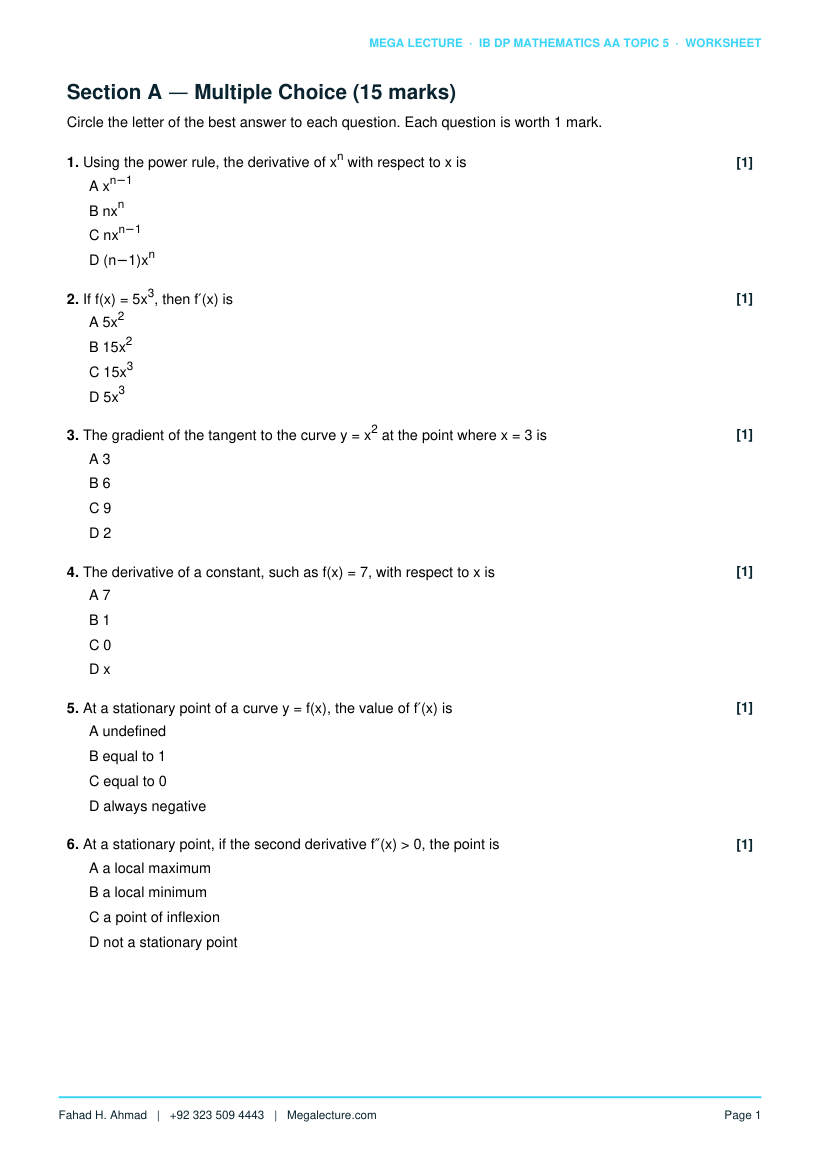
Section A — Multiple Choice (15 marks)
Circle the letter of the best answer to each question. Each question is worth 1 mark.
- Using the power rule, the derivative of xn with respect to x is [1]
A xn−1
B nxn
C nxn−1
D (n−1)xn
- If f(x) = 5x3, then f′(x) is [1]
A 5x2
B 15x2
C 15x3
D 5x3
- The gradient of the tangent to the curve y = x2 at the point where x = 3 is [1]
A 3
B 6
C 9
D 2
- The derivative of a constant, such as f(x) = 7, with respect to x is [1]
A 7
B 1
C 0
D x
- At a stationary point of a curve y = f(x), the value of f′(x) is [1]
A undefined
B equal to 1
C equal to 0
D always negative
- At a stationary point, if the second derivative f″(x) > 0, the point is [1]
A a local maximum
B a local minimum
C a point of inflexion
D not a stationary point
- If two lines are perpendicular, the product of their gradients is [1]
A 0
B 1
C −1
D undefined
- For a function y = f(x), the derivative dy÷dx represents [1]
A the area under the curve
B the y-intercept of the curve
C the instantaneous rate of change of y with respect to x
D the average value of y
- Using the power rule for integration (n ≠ −1), ∫xndx is equal to [1]
A nxn−1 + C
B xn+1÷(n+1) + C
C xn−1 + C
D (n+1)xn + C
- ∫6x dx is equal to [1]
A 6x + C
B 3x2 + C
C 6x2 + C
D x2 + C
- A definite integral ∫a bf(x)dx, where f(x) ≥ 0 on [a,b], represents [1]
A the gradient of f(x) at x = b
B the area enclosed between the curve y=f(x) and the x-axis, from x=a to x=b
C the value of f(x) at the midpoint of [a,b]
D the number of roots of f(x) between a and b
- ∫5 dx is equal to [1]
A 5 + C
B 5x + C
C x + C
D 0
- The area enclosed between two curves y=f(x) and y=g(x), where f(x) ≥ g(x) on [a,b], is given by
[1]
A ∫a b f(x)×g(x) dx
B ∫a b (f(x)−g(x)) dx
C f(b)−g(a)
D ∫a b (f(x)+g(x)) dx
- For a particle moving in a straight line, if s(t) is displacement and v(t) is velocity, then [1]
A v(t) = ds÷dt
B s(t) = dv÷dt
C v(t) = s(t)2
D v(t) and s(t) are unrelated
- Given the velocity function v(t) of a particle, the displacement function s(t) can be found by [1]
A differentiating v(t)
B integrating v(t)
C squaring v(t)
D finding the maximum of v(t)
Section B — Structured Questions (65 marks)
Answer all questions in the space provided. Working must be shown for full marks.
5.1 Differentiation Basics
Question 1 [7 marks]
The graph shows the curve y = f(x) = x2, together with the tangent line at the point where x = 2 (computed).
y = x2 with the tangent line at x = 2 (computed).
- Using the graph, estimate the gradient of the tangent line shown. [2]
- Using the power rule, differentiate f(x) = x2, and hence calculate the exact gradient of the tangent at x = 2.
[2]
- Find the equation of the tangent line to y = x2 at x = 2, and confirm it matches the line shown on the graph.
[3]
Question 2 [6 marks]
Polynomial functions can be differentiated term-by-term using the power rule.
- State the power rule for differentiating xn with respect to x. [2]
- Differentiate f(x) = 3x4−5x2+7 with respect to x. [2]
- Calculate f′(1). [2]
5.2 Applications of Differentiation
Question 3 [7 marks]
The graph shows the curve y = f(x) = x3−3x2+4, with its two stationary points marked (computed).
y = x3−3x2+4 (computed), with stationary points marked.
- Using the graph, write down the x-coordinate of the local maximum and the x-coordinate of the local minimum.
[2]
- Find f′(x), and hence find the x-coordinates of the stationary points algebraically. [2]
- Find f″(x), and use it to classify each stationary point found in part (b). [3]
Question 4 [6 marks]
The tangent and normal to a curve at a point are perpendicular to each other.
- State the relationship between the gradient of the tangent and the gradient of the normal to a curve at a given point.
[2]
- For the curve y = x3 at the point (1, 1), find the gradient of the tangent. [2]
- Hence find the gradient of the normal to the curve at the point (1, 1). [2]
Question 5 [7 marks]
The graph shows the daily profit, P(x) (in dollars), of a company producing x units of a product, where P(x) = −2x2+40x−150 (computed).
P(x) = −2x2+40x−150 (computed), showing the maximum profit.
- Using the graph, estimate the number of units, x, that maximizes the daily profit. [2]
- Find P′(x), and hence find the exact value of x that maximizes the profit. [2]
- Calculate the maximum daily profit. [3]
5.3 Integration Basics
Question 6 [6 marks]
Integration is the reverse process of differentiation, and follows its own power rule.
- State the power rule for integration, ∫xndx (for n ≠ −1). [2]
- Find ∫(3x2−4x+5)dx. [2]
- Evaluate the definite integral ∫0
2(3x2−4x+5)dx. [2]
Question 7 [7 marks]
The graph shows the curve y = x2, with the region between x = 1 and x = 3 shaded (computed).
- State what the shaded area on the graph represents, in terms of a definite integral. [2]
- Find the indefinite integral ∫x2dx. [2]
- Calculate the exact value of the shaded area, giving your answer as an exact fraction. [3]
Question 8 [6 marks]
A curve has gradient function dy÷dx = 6x−4, and passes through the point (1, 3).
- Explain what the constant of integration, C, represents when finding y from dy÷dx by integration.
[2]
- Find the equation of the curve y = f(x), using the given point to find the value of C. [2]
- Find the value of y when x = 2. [2]
5.4 Applications of Integration
Question 9 [7 marks]
The graph shows the region enclosed between the curve y = x2 and the line y = 4 (computed).
Region enclosed between y = x2 and y = 4 (computed).
- Using the graph, write down the x-coordinates of the points where the curve and the line intersect.
[2]
- State the formula used to find the area between two curves y = f(x) (upper) and y = g(x) (lower), for a ≤ x ≤ b.
[2]
- Calculate the exact area of the shaded region, using ∫−2
2(4−x2)dx. [3]
Question 10 [6 marks]
A particle moves in a straight line with velocity v(t) = 6t−t2 (m/s), and starts at displacement s(0) = 0.
- State the relationship between displacement s(t), velocity v(t), and acceleration a(t) in terms of derivatives and integrals.
[2]
- Find the displacement function s(t), using the given initial condition s(0) = 0. [2]
- Calculate the displacement of the particle at t = 3 seconds. [2]
