
IB Diploma · Maths: Analysis and Approaches · Analysis and Approaches (AA)
Topic 1 Worksheet
Opens inside this page. Prefer your own PDF app? Open the PDF.
Check yourself
5 quick questions on Number and algebra
Tap an answer to see if you are right, and why. Free, no sign-up.
Start the free testWas this note useful?
Full text of Topic 1 Worksheet
IB DP MATHEMATICS AA Topic 1 · Number and Algebra TOPICAL WORKSHEET
1.1 Arithmetic Sequences · 1.2 Geometric Sequences
1.3 Exponents, Logs & Binomial Thm · 1.4 Financial Applications
Standard and Higher Level · Syllabus 2025
Fahad H. Ahmad
Original exam-style questions written for the IB Diploma Programme Mathematics course (first assessment 2025)
Free notes, practice tests and live classes Back to megalecture.com
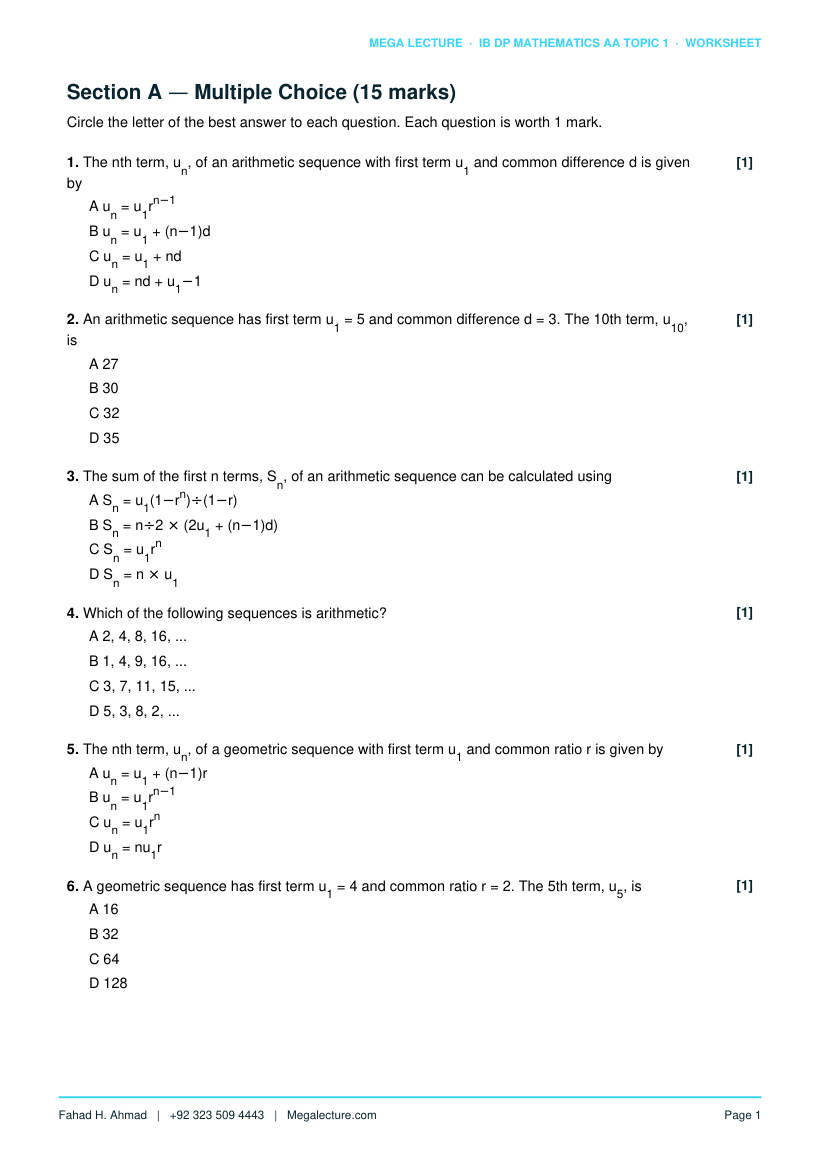
Section A — Multiple Choice (15 marks)
Circle the letter of the best answer to each question. Each question is worth 1 mark.
- The nth term, un, of an arithmetic sequence with first term u1 and common difference d is given by
[1]
A un = u1rn−1
B un = u1 + (n−1)d
C un = u1 + nd
D un = nd + u1−1
- An arithmetic sequence has first term u1 = 5 and common difference d = 3. The 10th term, u10, is
[1]
A 27
B 30
C 32
D 35
- The sum of the first n terms, Sn, of an arithmetic sequence can be calculated using [1]
A Sn = u1(1−rn)÷(1−r)
B Sn = n÷2 × (2u1 + (n−1)d)
C Sn = u1rn
D Sn = n × u1
- Which of the following sequences is arithmetic? [1]
A 2, 4, 8, 16, ...
B 1, 4, 9, 16, ...
C 3, 7, 11, 15, ...
D 5, 3, 8, 2, ...
- The nth term, un, of a geometric sequence with first term u1 and common ratio r is given by [1]
A un = u1 + (n−1)r
B un = u1rn−1
C un = u1rn
D un = nu1r
- A geometric sequence has first term u1 = 4 and common ratio r = 2. The 5th term, u5, is [1]
A 16
B 32
C 64
D 128
- For an infinite geometric series to converge to a finite sum, the common ratio r must satisfy [1]
A r > 1
B r ≥ 1
C |r| < 1
D r = 1
- For an infinite geometric series with |r| < 1, the sum to infinity, S∞, is given by [1]
A S∞ = u1÷(1−r)
B S∞ = u1(1−r)
C S∞ = u1÷r
D S∞ = n÷(1−r)
- Which expression is equivalent to loga(x) + loga(y)? [1]
A loga(x + y)
B loga(xy)
C loga(x÷y)
D loga(x)×loga(y)
- The solution to 2x = 8 is [1]
A x = 2
B x = 3
C x = 4
D x = 8
- In the binomial expansion of (x + y)n, the general term is given by [1]
A nCr xryn−r
B nCr xn−ryr
C n÷r × xnyr
D nCr (x+y)r
- loga(1) is equal to [1]
A a
B 1
C 0
D undefined
- The future value, FV, of an investment of PV earning compound interest at a rate r per period for n periods is given by
[1]
A FV = PV(1 + rn)
B FV = PV(1 + r)n
C FV = PV × rn
D FV = PV + rn
- An investment of $1000 earns compound interest at 5% per annum. Its value after 2 years is [1]
A $1050.00
B $1100.00
C $1102.50
D $1150.00
- For the same principal and interest rate, over a long time period, compound interest compared with simple interest results in
[1]
A exactly the same final value
B a smaller final value
C a greater final value, growing exponentially rather than linearly
D a final value that cannot be determined
Section B — Structured Questions (65 marks)
Answer all questions in the space provided. Working must be shown for full marks.
1.1 Arithmetic Sequences
Question 1 [7 marks]
The graph shows the first 10 terms of an arithmetic sequence (computed).
Terms un of an arithmetic sequence for n = 1 to 10 (computed).
- Using the graph, write down the value of the first term u1 and the common difference d of the sequence.
[2]
- Using un = u1 + (n−1)d, calculate u10, the 10th term, and confirm this matches the graph. [2]
- The sequence is continued beyond the terms shown on the graph. Using the formula for the nth term, predict u15, the 15th term.
[3]
Question 2 [6 marks]
Arithmetic sequences and series can be described using standard formulas relating u1, d, n, and Sn.
- State the formula for the nth term, un, of an arithmetic sequence, defining each symbol used. [2]
- State the formula for the sum of the first n terms, Sn, of an arithmetic sequence. [2]
- An arithmetic sequence has u1 = 8 and u5 = 24. Find the common difference, d. [2]
1.2 Geometric Sequences
Question 3 [7 marks]
The graph shows the first 8 terms of a geometric sequence (computed).
Terms un of a geometric sequence for n = 1 to 8 (computed).
- Using the graph, write down the value of u1, and use two consecutive terms to determine the common ratio, r.
[2]
- Using un = u1rn−1, verify the value of u4 shown on the graph. [2]
- Calculate u9, the 9th term of the sequence (beyond the terms shown on the graph), giving your answer to 3 significant figures.
[3]
Question 4 [6 marks]
Geometric sequences and series can also be described using standard formulas relating u1, r, n, and Sn.
- State the formula for the nth term, un, of a geometric sequence, defining each symbol used. [2]
- State the formula for the sum of the first n terms, Sn, of a geometric sequence (for r ≠ 1). [2]
- A geometric sequence has u1 = 6 and u4 = 48. Find the common ratio, r. [2]
Question 5 [7 marks]
The graph shows the partial sum Sn (the sum of the first n terms) of the same geometric sequence, u1 = 100, r = 0.5, plotted against n (computed).
Partial sums Sn of a geometric series, u1 = 100, r = 0.5 (computed).
- Using the graph, describe what happens to Sn as n increases, and estimate the value that Sn approaches.
[2]
- State the condition on r required for an infinite geometric series to have a finite sum to infinity, and state whether this condition is satisfied here.
[2]
- Using S∞ = u1÷(1−r), calculate the exact value of S∞, and confirm it matches your estimate from the graph.
[3]
1.3 Exponents & Logarithms
Question 6 [6 marks]
The laws of logarithms allow expressions involving logarithms to be simplified or combined.
- State the law of logarithms for loga(x) + loga(y), and for loga(x) − loga(y). [2]
- Simplify loga(x3) in terms of loga(x). [2]
- Solve for x: log2(x) = 5. [2]
Question 7 [7 marks]
The graph shows y = 2x and y = log2x plotted together with the line y = x (computed).
- Using the graph, describe the relationship between the graphs of y = 2x and y = log2x. [2]
- Using the graph, estimate the solution to the equation 2x = 6. [2]
- Calculate log2(6) algebraically, using the change-of-base formula, giving your answer to 3 significant figures. Confirm this is consistent with your estimate in part (b).
[3]
Question 8 [6 marks]
The binomial theorem allows expressions of the form (x+y)n to be expanded without repeated multiplication.
- State the general term in the binomial expansion of (x+y)n, in terms of n, r, x, and y. [2]
- Write out the full binomial expansion of (x+2)3. [2]
- Hence state the coefficient of x2 in this expansion. [2]
1.4 Financial Applications
Question 9 [7 marks]
The graph shows the value of a $1000 investment over 20 years, earning 5% per annum, under compound interest and under simple interest (computed).
Value of a $1000 investment at 5% per annum: compound interest vs simple interest (computed).
- Using the graph, compare how the value of the compound-interest investment changes over time with the value of the simple-interest investment.
[2]
- Using FV = PV(1+r)n, calculate the value of the compound-interest investment after 20 years, confirming it matches the graph.
[2]
- Calculate the value of the simple-interest investment after 20 years, and hence find the difference between the two investments at that time.
[3]
Question 10 [6 marks]
Compound interest is widely used in real-world financial applications, such as savings accounts, loans, and investments.
- Define 'compound interest', distinguishing it from simple interest. [2]
- Calculate the value of a $2000 investment after 3 years at 4% per annum compound interest. [2]
- Explain why compound interest results in a greater final value than simple interest over long time periods, for the same principal and rate.
[2]
