
IB Diploma · Biology · SL / HL · Worksheets
Theme D Worksheet
Need more than one subject? All-notes pass: unlimited downloads of every note for a year: unlimited downloads of every note on the site, PKR 999 a year. All packs and courses.
Opens inside this page. Prefer your own PDF app? Open the PDF.
Check yourself
5 quick questions on D Continuity and change
Tap an answer to see if you are right, and why. Free, no sign-up.
Start the free test👍 16 students found these notes useful
Was this note useful?
Full text of Theme D Worksheet
IB DP BIOLOGY Theme D · Continuity and Change TOPICAL WORKSHEET
D1 DNA & Protein Synthesis · D2 Cell Division
D3 Reproduction & Inheritance · D4 Natural Selection
Standard and Higher Level · Syllabus 2025
Fahad H. Ahmad
Original exam-style questions written for the IB Diploma Programme Biology course (first assessment 2025)
Free notes, practice tests and live classes Back to megalecture.com
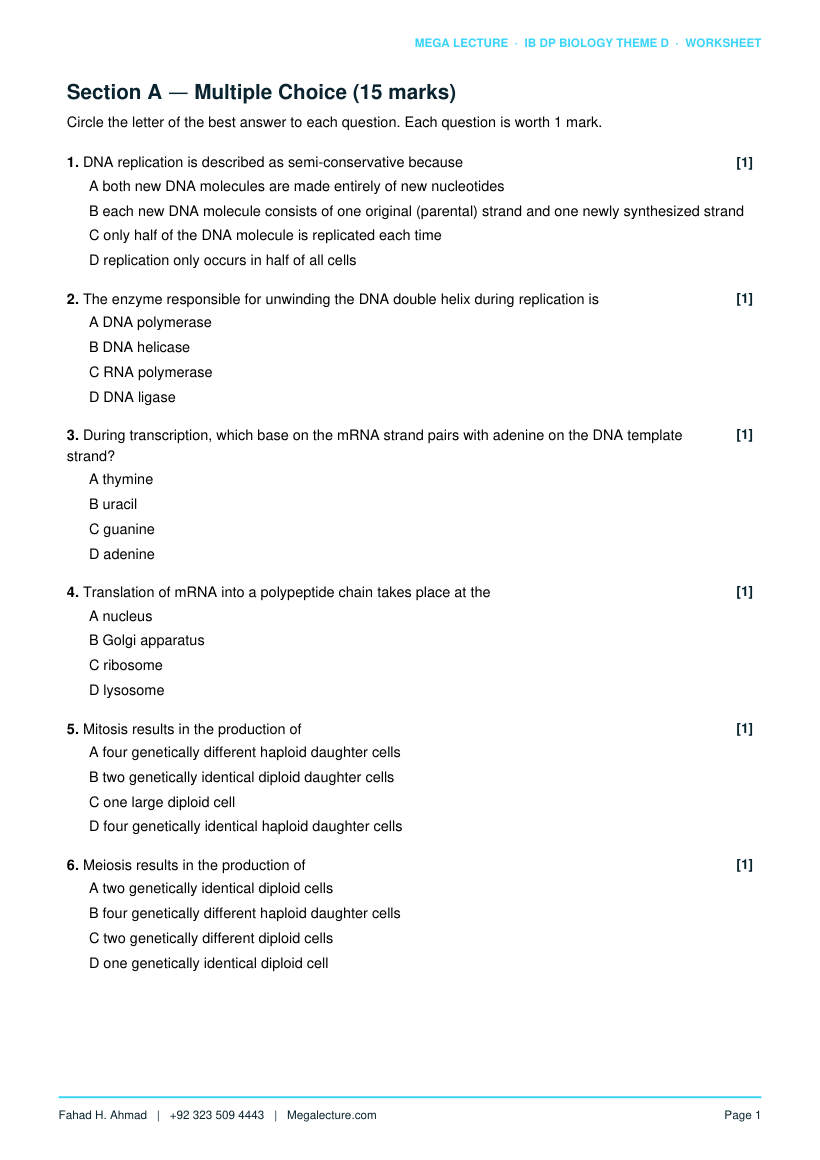
Section A — Multiple Choice (15 marks)
Circle the letter of the best answer to each question. Each question is worth 1 mark.
- DNA replication is described as semi-conservative because [1]
A both new DNA molecules are made entirely of new nucleotides
B each new DNA molecule consists of one original (parental) strand and one newly synthesized strand
C only half of the DNA molecule is replicated each time
D replication only occurs in half of all cells
- The enzyme responsible for unwinding the DNA double helix during replication is [1]
A DNA polymerase
B DNA helicase
C RNA polymerase
D DNA ligase
- During transcription, which base on the mRNA strand pairs with adenine on the DNA template strand?
[1]
A thymine
B uracil
C guanine
D adenine
- Translation of mRNA into a polypeptide chain takes place at the [1]
A nucleus
B Golgi apparatus
C ribosome
D lysosome
- Mitosis results in the production of [1]
A four genetically different haploid daughter cells
B two genetically identical diploid daughter cells
C one large diploid cell
D four genetically identical haploid daughter cells
- Meiosis results in the production of [1]
A two genetically identical diploid cells
B four genetically different haploid daughter cells
C two genetically different diploid cells
D one genetically identical diploid cell
- A gene mutation is best defined as [1]
A a change in the number of chromosomes in a cell
B a change in the nucleotide sequence of DNA
C the process of crossing over during meiosis
D the normal process of DNA replication
- Which stage of the cell cycle is generally the longest in most actively dividing cells? [1]
A mitosis (M phase)
B interphase
C cytokinesis only
D prophase only
- In a monohybrid cross between two heterozygous individuals (Aa × Aa), the expected phenotype ratio among the offspring is
[1]
A 1:1
B 1:2:1
C 3:1
D 9:3:3:1
- Continuous variation, such as human height, typically results from [1]
A a single gene with two alleles only
B the combined effect of many genes (polygenic inheritance) and environmental factors
C mutation alone, with no genetic basis
D meiosis without fertilization
- A phenotype is best described as [1]
A the complete set of alleles an organism carries for a particular gene
B the observable characteristics of an organism, resulting from genotype and environment
C a diagram showing the inheritance of a trait across generations
D the process by which gametes are formed
- Natural selection acts on [1]
A heritable variation within a population
B variation that cannot be passed on to offspring
C identical individuals within a population only
D organisms after they have already reproduced
- The change in the frequency of dark-coloured peppered moths during the industrial revolution is often cited as an example of
[1]
A genetic drift only
B natural selection (industrial melanism)
C artificial selection
D a mutation with no selective advantage
- A change in the allele frequencies of a population over successive generations is a definition of
[1]
A mutation
B evolution
C fertilization
D meiosis
- Random changes in allele frequency due to chance, which tend to have a greater effect in small populations, are best described as
[1]
A natural selection
B genetic drift
C gene flow
D polygenic inheritance
Section B — Structured Questions (65 marks)
Answer all questions in the space provided. Working must be shown for full marks.
D1 DNA & Protein Synthesis
Question 1 [7 marks]
The Meselson-Stahl experiment provided evidence for semi-conservative DNA replication. Bacteria were grown in a medium containing only the heavy isotope 15N, then transferred to a medium containing only the light isotope 14N; DNA density was analysed after each round of replication (given data).
Proportion of heavy, hybrid, and light DNA over two generations of replication (given data).
- Using the graph, describe the composition of the DNA after one generation of replication in 14N medium.
[2]
- Explain how the results after two generations support the semi-conservative model of replication (rather than a conservative model).
[2]
- Predict the percentage of hybrid and light DNA that would be present after a third round of replication (Generation 3).
[3]
Question 2 [6 marks]
Protein synthesis involves the processes of transcription and translation, sometimes referred to as the 'central dogma' of molecular biology.
- State where, in a eukaryotic cell, transcription takes place, and where translation takes place. [2]
- Outline the process of transcription. [2]
- Outline the process of translation. [2]
Question 3 [7 marks]
The graph shows how the melting temperature (Tm) of a DNA sample – the temperature at which the two strands separate – varies with its percentage GC content (computed using a simplified empirical model).
DNA melting temperature vs %GC content (computed, simplified model).
- Using the graph, describe the relationship between %GC content and DNA melting temperature.
[2]
- Explain, in terms of hydrogen bonding, why DNA with a higher GC content has a higher melting temperature.
[2]
- Using the trend shown, predict the melting temperature of a DNA sample with a GC content of 55%.
[3]
D2 Cell Division
Question 4 [6 marks]
Mitosis and meiosis are both forms of nuclear division, but they serve very different biological roles.
- State two differences between mitosis and meiosis. [2]
- State the biological role of mitosis, and the biological role of meiosis. [2]
- Explain how meiosis contributes to genetic variation among offspring. [2]
Question 5 [7 marks]
The bar chart shows the relative duration of each phase of the cell cycle for a typical dividing cell with a 24-hour cell cycle (given data).
Relative duration of cell cycle phases (given data, % of a 24-hour cycle).
- Using the graph, identify which phase of the cell cycle occupies the greatest proportion of time. [2]
- Calculate the actual time, in hours, spent in the M (mitosis) phase of this 24-hour cell cycle. [2]
- Describe what occurs during the S phase of the cell cycle. [3]
Question 6 [6 marks]
Mutations are changes in the nucleotide sequence of DNA, and can have a range of effects.
- Distinguish between a substitution mutation and a deletion mutation. [2]
- Explain why a deletion mutation is often more harmful to the resulting protein than a substitution mutation.
[2]
- Explain why most mutations do not have a significant effect on an organism's phenotype. [2]
D3 Reproduction & Inheritance
Question 7 [7 marks]
The bar chart shows the expected phenotype ratio among the offspring of a monohybrid cross between two heterozygous individuals, Aa × Aa, where A (dominant) codes for the dominant phenotype and a (recessive) codes for the recessive phenotype (computed).
Expected phenotype ratio for a monohybrid cross, Aa × Aa (computed).
- Using the graph, state the expected phenotype ratio (dominant : recessive) for this cross. [2]
- Using a Punnett square (or genotype reasoning), explain why this 3:1 ratio arises from an Aa × Aa cross.
[2]
- In a large sample of 200 offspring from this cross, calculate the expected number showing the dominant phenotype.
[3]
Question 8 [6 marks]
Variation among individuals in a population can be classified in different ways.
- Distinguish between continuous variation and discontinuous (discrete) variation, giving one example of each.
[2]
- Explain why discontinuous variation is usually controlled by a single gene, while continuous variation is usually polygenic.
[2]
- Explain how the environment can contribute to variation, even between individuals with identical genotypes.
[2]
D4 Natural Selection
Question 9 [7 marks]
The graph shows the percentage of dark (melanic) peppered moths in a population near an industrial city, from 1848 to 2000 (given data), a classic example of natural selection.
Percentage of dark (melanic) peppered moths over time (given data).
- Using the graph, describe how the percentage of dark moths changed between 1848 and 1950.
[2]
- Explain, in terms of natural selection, why dark moths became more common during this period of heavy industrial pollution.
[2]
- Using the graph, describe and explain the change in the percentage of dark moths after 1950. [3]
Question 10 [6 marks]
Evolution by natural selection requires several key conditions to operate.
- State three conditions necessary for natural selection to occur in a population. [2]
- Distinguish between natural selection and genetic drift. [2]
- Outline two forms of evidence (other than direct observation of natural selection) that support the theory of evolution.
[2]
