
IB Diploma · Biology · SL / HL · Worksheets
Theme A Worksheet
Need more than one subject? All-notes pass: unlimited downloads of every note for a year: unlimited downloads of every note on the site, PKR 999 a year. All packs and courses.
Opens inside this page. Prefer your own PDF app? Open the PDF.
Check yourself
5 quick questions on A Unity and diversity
Tap an answer to see if you are right, and why. Free, no sign-up.
Start the free test👍 16 students found these notes useful
Was this note useful?
Full text of Theme A Worksheet
IB DP BIOLOGY Theme A · Unity and Diversity TOPICAL WORKSHEET
A1 Water & Nucleic Acids · A2 Cells
A3 Classification & Diversity · A4 Interaction & Ecosystems
Standard and Higher Level · Syllabus 2025
Fahad H. Ahmad
Original exam-style questions written for the IB Diploma Programme Biology course (first assessment 2025)
Free notes, practice tests and live classes Back to megalecture.com
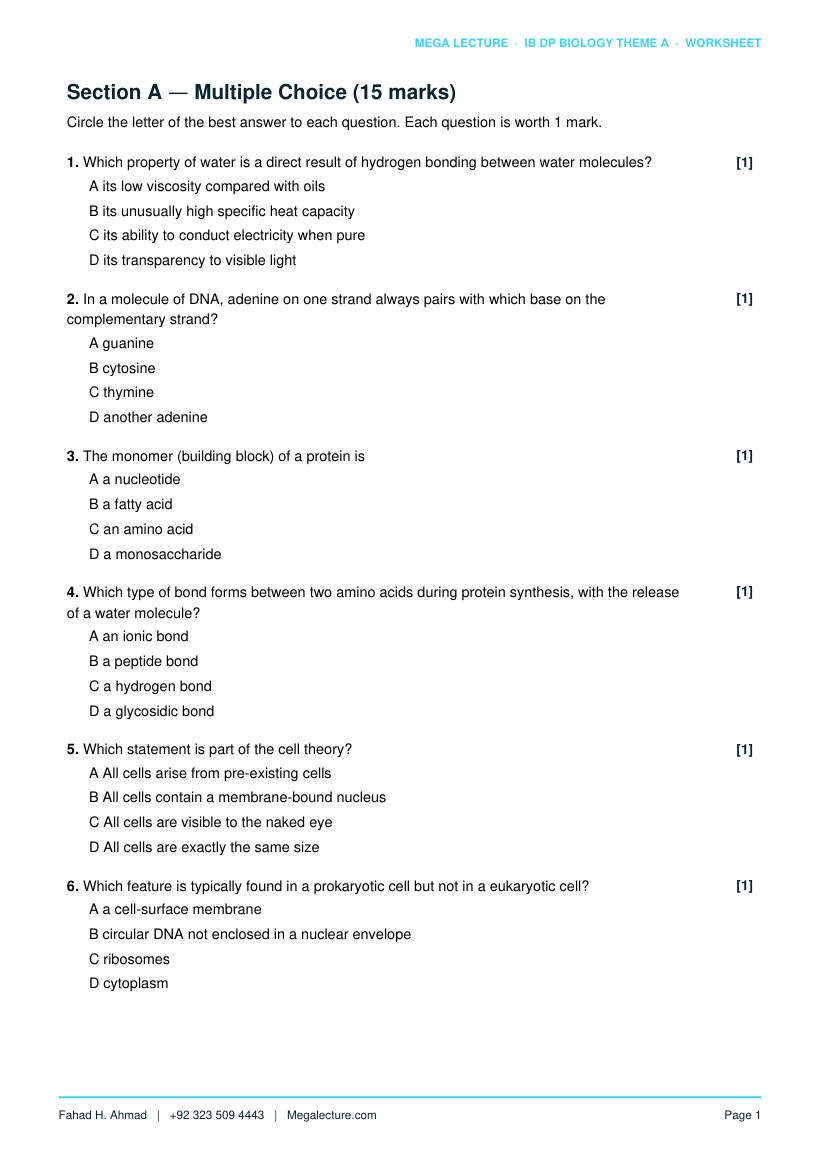
Section A — Multiple Choice (15 marks)
Circle the letter of the best answer to each question. Each question is worth 1 mark.
- Which property of water is a direct result of hydrogen bonding between water molecules? [1]
A its low viscosity compared with oils
B its unusually high specific heat capacity
C its ability to conduct electricity when pure
D its transparency to visible light
- In a molecule of DNA, adenine on one strand always pairs with which base on the complementary strand?
[1]
A guanine
B cytosine
C thymine
D another adenine
- The monomer (building block) of a protein is [1]
A a nucleotide
B a fatty acid
C an amino acid
D a monosaccharide
- Which type of bond forms between two amino acids during protein synthesis, with the release of a water molecule?
[1]
A an ionic bond
B a peptide bond
C a hydrogen bond
D a glycosidic bond
- Which statement is part of the cell theory? [1]
A All cells arise from pre-existing cells
B All cells contain a membrane-bound nucleus
C All cells are visible to the naked eye
D All cells are exactly the same size
- Which feature is typically found in a prokaryotic cell but not in a eukaryotic cell? [1]
A a cell-surface membrane
B circular DNA not enclosed in a nuclear envelope
C ribosomes
D cytoplasm
- As a spherical cell increases in radius, its surface area to volume ratio [1]
A increases
B decreases
C stays constant
D first increases, then decreases
- The fluid mosaic model describes the cell-surface membrane as being composed mainly of [1]
A a rigid layer of cellulose fibres
B a phospholipid bilayer with proteins embedded and able to move within it
C a single layer of protein molecules only
D a solid layer of cholesterol
- The binomial naming system gives each species a two-part scientific name consisting of [1]
A the kingdom and the phylum
B the genus and the species epithet
C the family and the order
D the class and the domain
- Which taxonomic rank includes (contains) the greatest number of different organisms? [1]
A species
B genus
C phylum
D kingdom
- Two organisms are generally considered to belong to the same species if they [1]
A live in the same habitat
B have identical DNA sequences
C can interbreed to produce fertile offspring
D are the same size and colour
- In a food chain, primary consumers are organisms that [1]
A carry out photosynthesis
B feed directly on producers
C feed on other consumers only
D decompose dead organic matter
- Approximately what percentage of energy is typically transferred from one trophic level to the next?
[1]
A 1%
B 10%
C 50%
D 90%
- A close, long-term interaction between two different species that benefits both of them is called
[1]
A competition
B predation
C mutualism
D parasitism
- In a classic predator-prey population cycle, an increase in the prey population is typically followed by
[1]
A an immediate, simultaneous increase in the predator population
B an increase in the predator population, after a time lag
C an immediate decrease in the predator population
D no change in the predator population
Section B — Structured Questions (65 marks)
Answer all questions in the space provided. Working must be shown for full marks.
A1 Water & Nucleic Acids
Question 1 [7 marks]
The bar chart shows the boiling points of the Group 16 hydrides of oxygen, sulfur, selenium, and tellurium (given data).
Boiling points of the Group 16 hydrides (given data).
- Using the graph, identify which hydride does not fit the general trend shown by the other three, and state its identity.
[2]
- Explain, in terms of intermolecular forces, why water has an unexpectedly high boiling point compared to the general trend of the other Group 16 hydrides.
[2]
- The boiling points of H2S, H2Se, and H2Te increase roughly linearly with molar mass (due to increasing van der Waals' forces). Using this trend, estimate the boiling point water would be expected to have if it followed the same trend, and hence calculate the size of the anomaly (the difference between this predicted value and the actual boiling point of water).
[3]
Question 2 [6 marks]
Water has several properties that make it essential to living organisms.
- Define 'cohesion' and 'adhesion' as properties of water, and give one biological example of each.
[2]
- Explain why water's high specific heat capacity is biologically important. [2]
- Explain why water is described as a good solvent for polar and ionic substances. [2]
Question 3 [7 marks]
The bar chart shows the percentage of each of the four nitrogenous bases in a sample of human DNA (given data).
Base composition of human DNA (given data).
- Using the graph, state the relationship (Chargaff's rule) illustrated by this data. [2]
- Explain, in terms of base pairing, why %A ≈ %T and %G ≈ %C. [2]
- This DNA sample contains a total of 3.0×10⁹ base pairs. Calculate the number of guanine bases present in the sample.
[3]
A2 Cells
Question 4 [6 marks]
Cell theory is a foundational idea in biology, though some exceptions and unusual cases exist.
- State two components of the (modern) cell theory. [2]
- Identify two structural features that distinguish prokaryotic cells from eukaryotic cells. [2]
- Suggest why viruses are generally not considered to satisfy the cell theory. [2]
Question 5 [7 marks]
The graph shows how the surface area to volume (SA:V) ratio of a cube-shaped cell changes with the length of its side, L (computed for cubes from L = 1 mm to L = 6 mm).
Surface area : volume ratio vs cube side length (computed: SA:V = 6÷L).
- Using the graph, describe the relationship between cube side length and surface area to volume ratio.
[2]
- Calculate the surface area to volume ratio for a cube-shaped cell of side length 4 mm, showing your working.
[2]
- Explain why a large surface area to volume ratio is advantageous for a cell, and why this places an upper limit on cell size.
[3]
Question 6 [6 marks]
The fluid mosaic model describes the structure of the cell-surface membrane.
- Describe the basic structure of the cell-surface membrane according to the fluid mosaic model.
[2]
- Explain the meaning of the term 'fluid' in the fluid mosaic model. [2]
- State two functions carried out by proteins embedded in the cell-surface membrane. [2]
A3 Classification & Diversity
Question 7 [7 marks]
The bar chart shows the number of different species recorded using quadrat sampling in three different habitats (given data).
Species richness recorded in three habitats (given data).
- Using the graph, identify the habitat with the greatest species richness. [2]
- Define the term 'species richness', and explain how it differs from 'species diversity'. [2]
- Suggest two reasons why the urban park habitat might have lower species richness than the woodland.
[3]
Question 8 [6 marks]
Classification systems organize the diversity of living organisms.
- State the two parts of a binomial name, and describe the convention used when writing one. [2]
- List the following taxonomic ranks in order from broadest to narrowest: species, phylum, kingdom, genus.
[2]
- Define the biological species concept. [2]
A4 Interaction & Ecosystems
Question 9 [7 marks]
The bar chart (on a logarithmic scale) shows the energy available at each trophic level of a food chain over one year (given data).
Energy available at successive trophic levels (given data, log scale).
- Using the graph, calculate the percentage of energy transferred from producers to primary consumers.
[2]
- Explain why energy transfer between trophic levels is never 100% efficient. [2]
- Explain why food chains rarely have more than four or five trophic levels. [3]
Question 10 [6 marks]
Organisms within an ecosystem interact with one another in various ways.
- Define 'interspecific competition', and give an example. [2]
- Define 'mutualism', giving an example. [2]
- Using the terms 'predator' and 'prey', explain why predator population cycles typically lag behind prey population cycles.
[2]
